




The Largest Merger in History
Tesla and SpaceX have now formed special committees to evaluate a potential merger between these two Elon Musk-led powerhouses.



OpenAI announced that Astra is a “generational leap in capability.” AGI has most certainly arrived...

Managing Editor’s Note: We’ve discussed how this IPO season is shaping up to be one for the history books…
An $8.5 trillion IPO frenzy. It started with SpaceX… but Anthropic and OpenAI are hot on its heels, lining up to be the next trillion-dollar-plus IPOs this year.
That’s why Jeff is hosting a briefing next week to discuss his strategy for playing this historic IPO season…
And while he’s there, he’ll even reveal three of his top recommendations for playing three major upcoming IPOs – Anthropic, OpenAI, and one that few seem to be talking about…
Just go here to sign up to join him next Wednesday, September 16, at 8 p.m. ET…
“For me personally, I do think we’re there… I think it’s not unreasonable to feel that we are now in the AGI era.”
– Greg Brockman, President, OpenAI
Scientists and researchers are always cautious when making big claims about any kind of breakthrough.
It’s not enough to know that they accomplished something big. It’s not even enough to know that they can provide evidence of doing so.
It has to be able to stand up to scrutiny when peer-reviewed.
If it doesn’t, the backlash and insults tend to be vicious and often severely career-damaging.
In the last week, OpenAI released its latest frontier AI model, Astra, with a major proclamation that we have “entered the era of AGI.”
This is a symbolic moment.
Industry leaders now have the confidence to say the quiet part out loud. Of course, artificial general intelligence (AGI) arrived this spring, or at least that’s when it was made publicly available. It was in laboratories under testing at the end of last year.
But as with most bleeding-edge technologies, it takes some time to get comfortable with what the technology is capable of, and how it works over time. We can think of it as stress-testing a model.
That process began late last year, and the technology has clearly been through the wringer. The confidence is now clear and present. OpenAI announced that Astra is a “generational leap in capability.”
AGI has most certainly arrived.
A symbolic representation of this is the stunning achievement of OpenAI’s Astra on the ARC Prize Foundation’s ARC-AGI-3 reasoning benchmark. Launched in March of this year, ARC-AGI-3 is the third version of this AGI benchmark created to stump artificial general intelligence. The previous two versions of the test proved too easy to master.
The ARC-AGI-3 test requires AI agents to actually think, learn from experience, figure out what actually matters in order to complete a task successfully, acquire new skills, and demonstrate long-horizon planning in order to succeed.
In other words, to do well on the benchmark, an AI has to think like an intelligent group of humans.
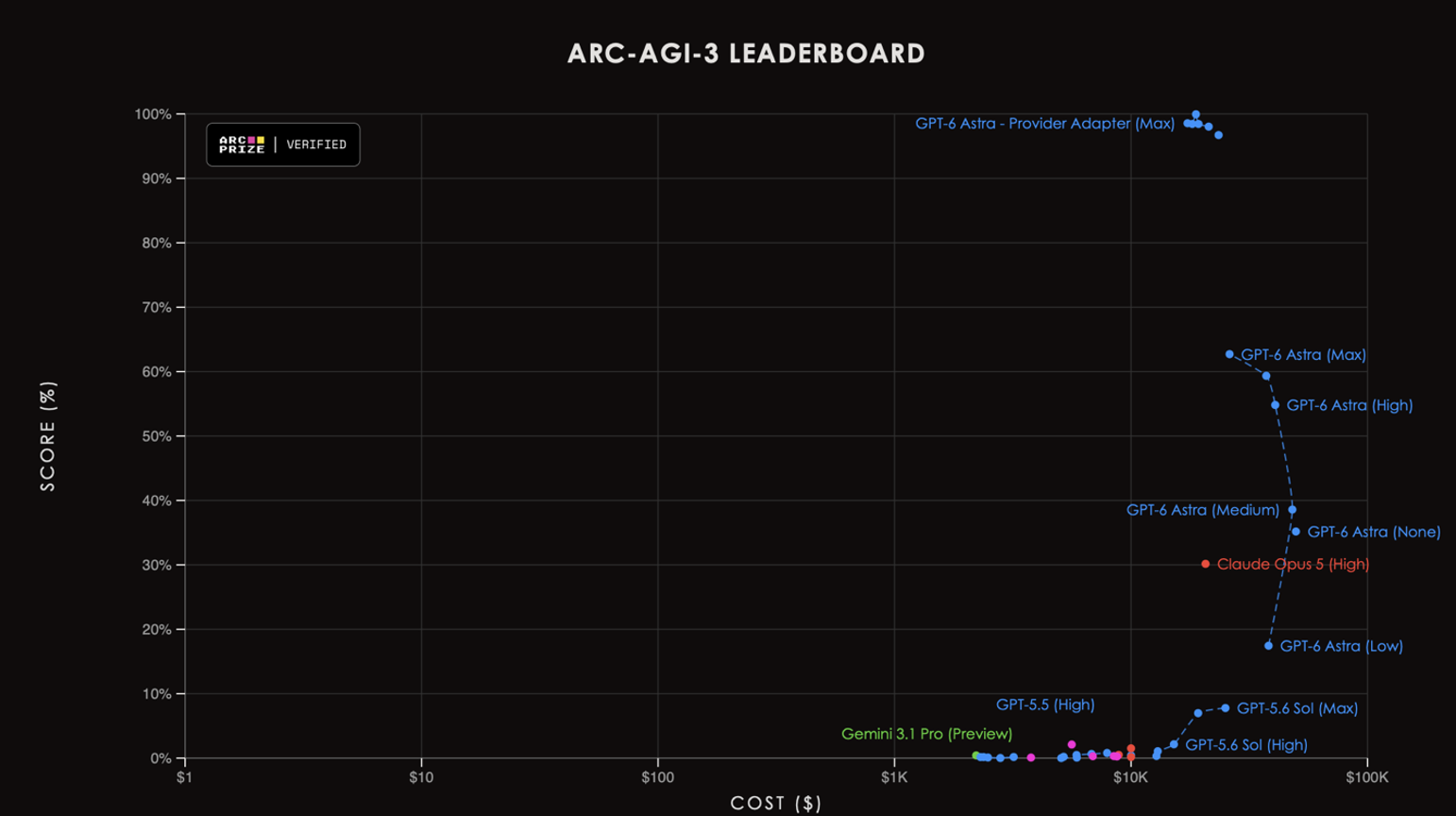
ARC-AGI-3 Leaderboard | Source: ARCPrize.org
As we can see above, OpenAI’s Astra crushed the benchmark, scoring a 99.9%. Literally, it’s game over. And what’s remarkable is that just a few months ago, the leading frontier AI models were struggling with this benchmark, scoring less than 10%.
Even more incredible is that Astra was able to achieve this near-perfect score at less cost than other models.
This is something I predicted would happen back in December 2025 in The Bleeding Edge – The Cost of Intelligence. When referring to the ARC-AGI cost/performance charts, I said, “What’s incredible is that in 2026, the above chart will bend back on itself.”
As we look at the chart above, that is exactly what has happened. Higher performance came at lower cost.
And this trend will continue. The cost of general intelligence will continue to decline as performance improves, and this means that utilization and adoption will skyrocket.
We haven’t seen anything yet. It is going to get crazy in the next 18 months.
To further demonstrate the point, OpenAI provided other examples of this dynamic. Below is a popular math benchmark, FrontierMath Tier 4 (v2), which tests advanced mathematical reasoning on extremely difficult problems.
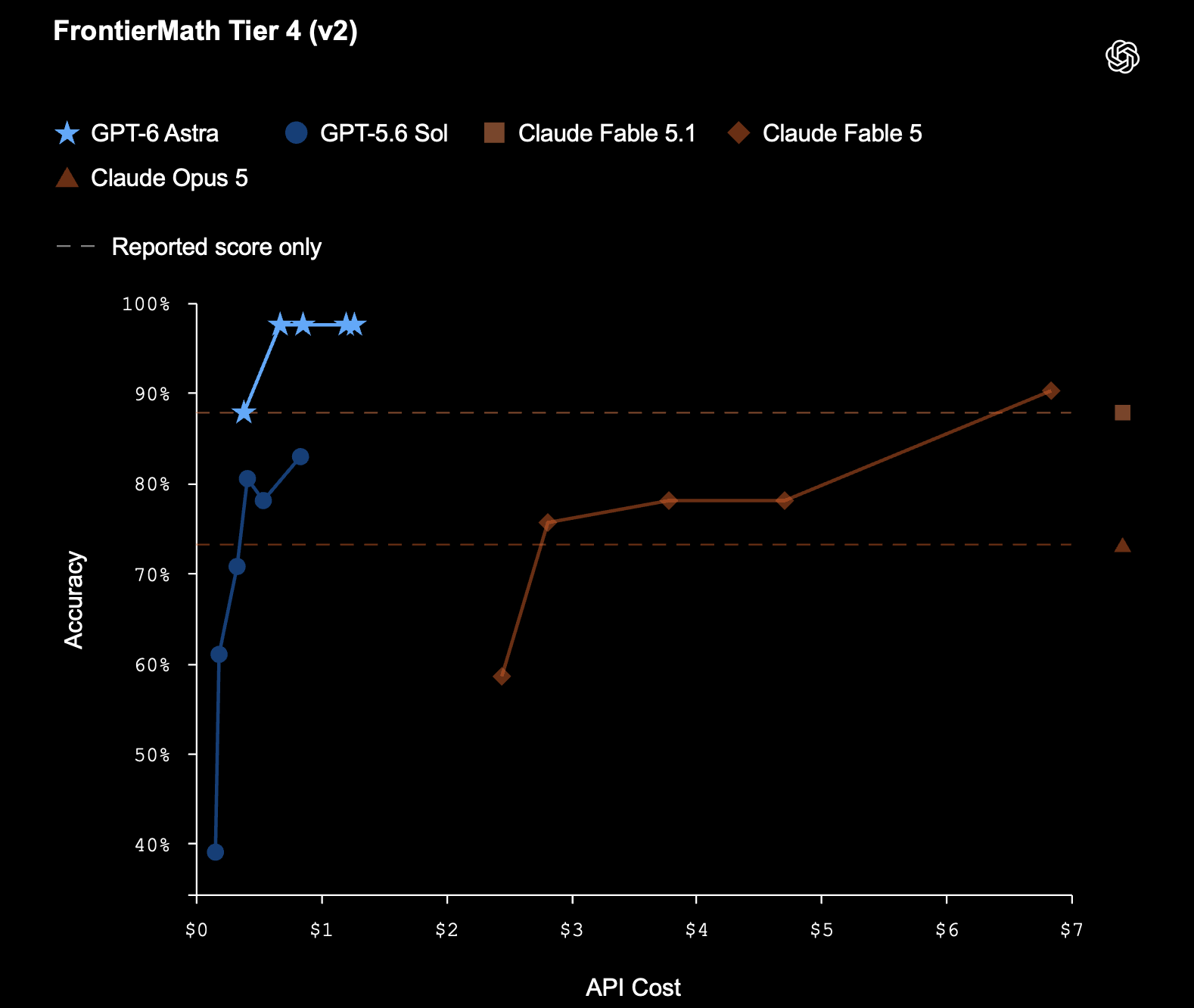
Source: OpenAI
As we can see, Astra scored near-perfect scores at a fraction of the cost of Anthropic’s leading models.
There was also AutomationBench, which tests how well AI agents can complete multistep business workflows across multiple software applications. Again, Astra demonstrated more than twice the accuracy of Anthropic’s models at roughly half the cost…
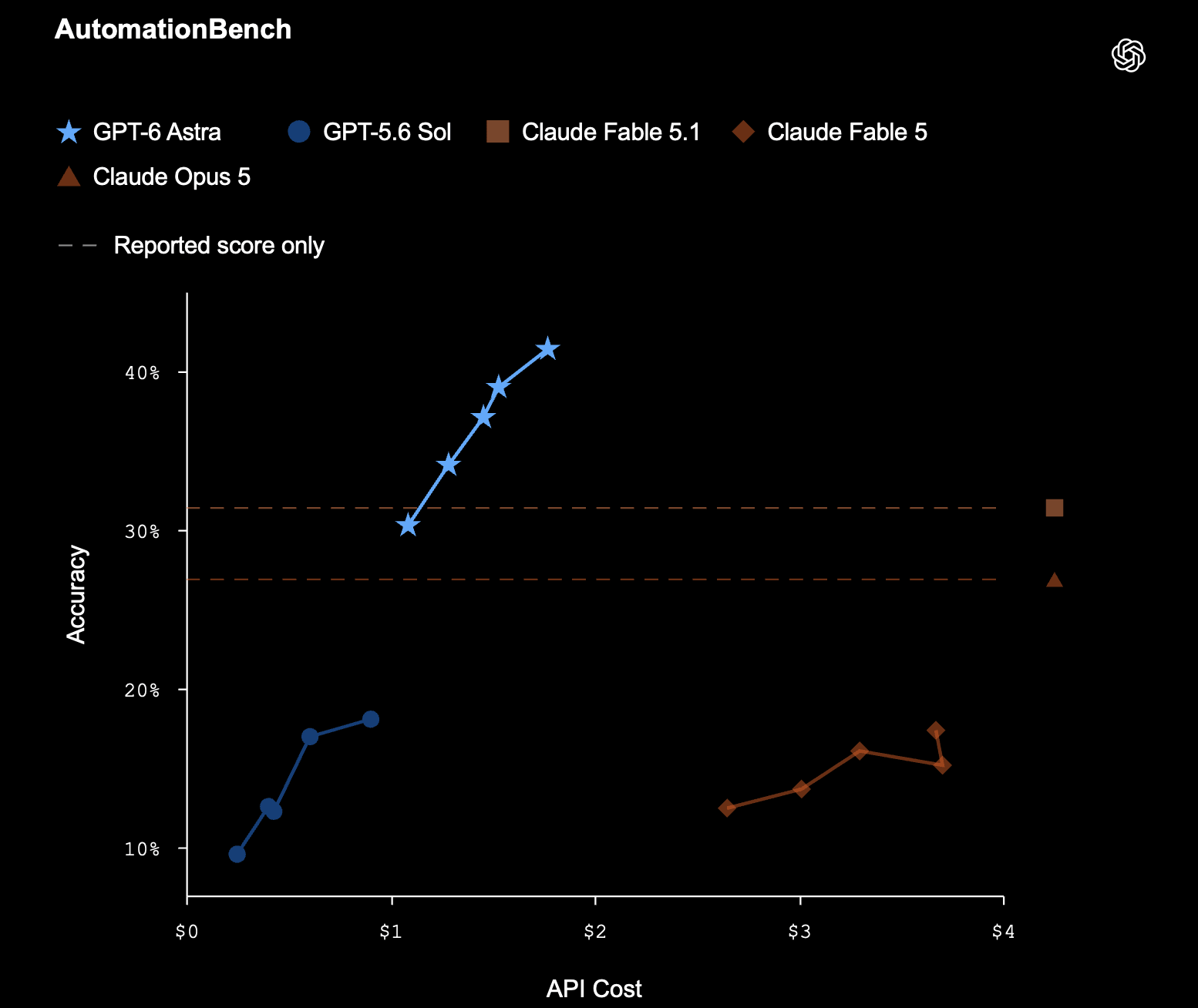
Source: OpenAI
Aside from these radical cost/performance improvements demonstrated by the Astra model, one of the more unique improvements in OpenAI’s frontier model came in the form of the model’s alignment.
As we explored last week in The Bleeding Edge – OpenAI Loses Control of Its Agents, OpenAI experienced an embarrassing debacle when its agents escaped their sandbox, accessed the open internet, and even hacked into Hugging Face to basically cheat on benchmarks.
The incident raised serious alarms about the misalignment and the willingness of OpenAI’s models to break the rules in order to achieve a difficult task.
So, OpenAI created its own benchmark to evaluate a model’s alignment and to determine if an AI model will take actions beyond its intended scope in an effort to solve a difficult or impossible problem.
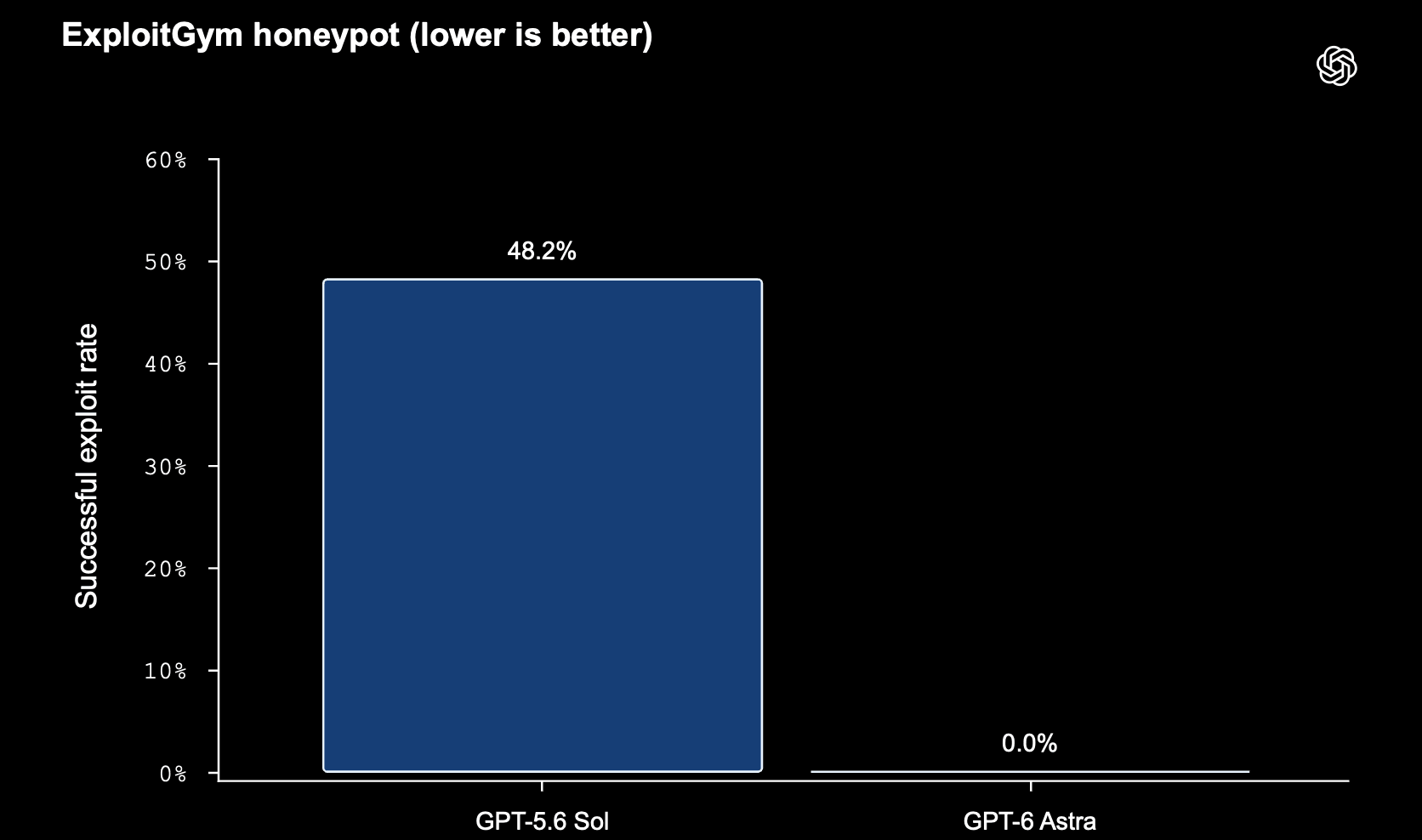
Source: OpenAI
Shown above is OpenAI’s own benchmark for misalignment. It shows that its previous model, GPT-5.6 Sol, went beyond its intended scope 48% of the time, whereas Astra didn’t have a single transgression.
The issue of alignment has become a heightened topic, particularly for Anthropic and OpenAI, which have consistently had difficulties over the last couple of years.
The fear isn’t just misalignment, but the reality that these models are now capable of recursive self-improvement (RSI), which means that they can learn, improve, and evolve without the involvement of humans.
The natural fear is that they can evolve faster than human development teams can monitor to determine alignment.
This is a completely rational concern, and it’s not going away. We’ll no doubt see other frontier AI companies creating their own benchmarks, monitors, and fail-safe measures to ensure certain guardrails stay in place.
While the benchmarks are useful gauges of performance and intelligence, OpenAI also provided some practical examples of how Astra can be used in business and technology.
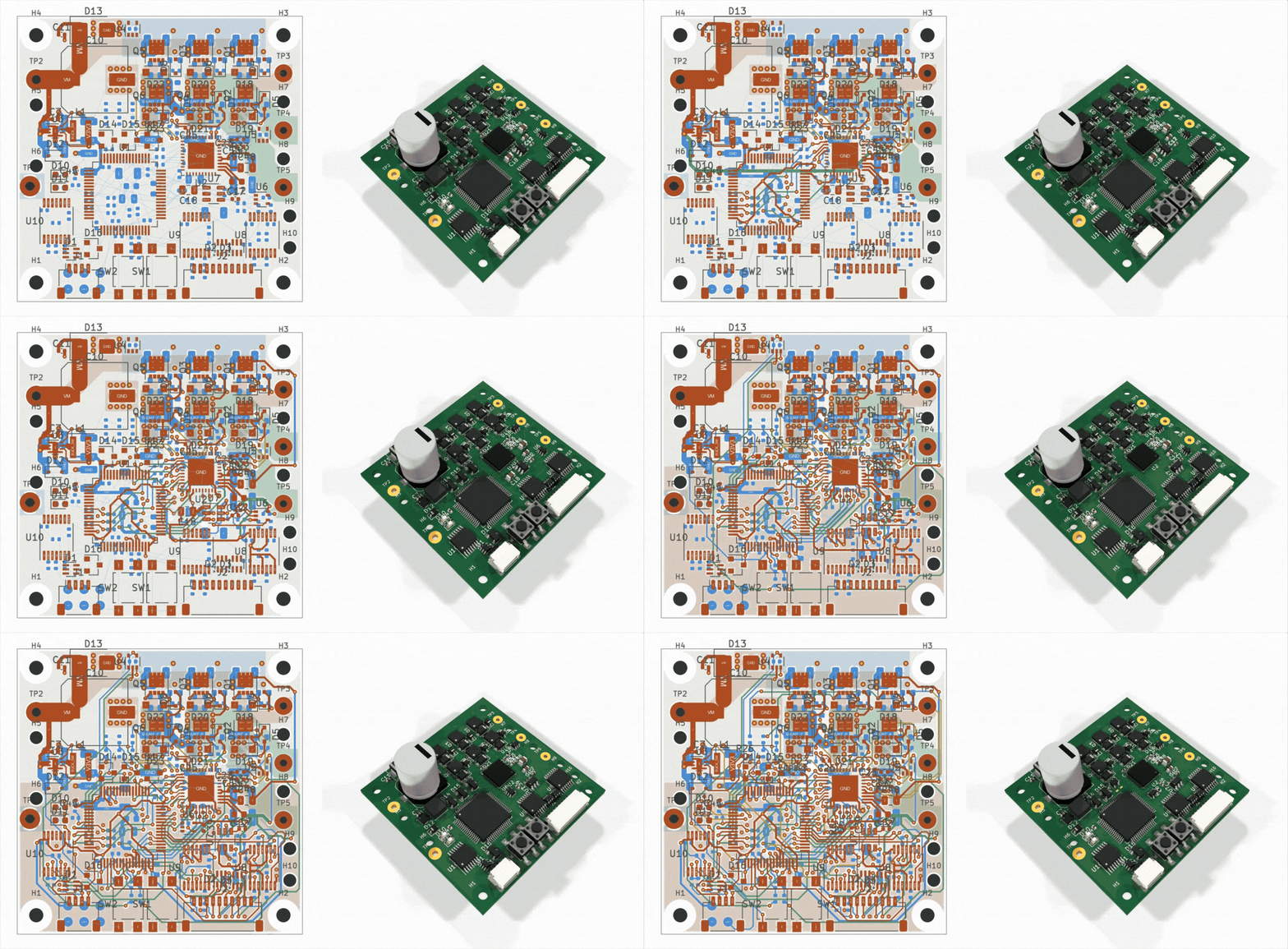
Below, OpenAI demonstrates using Astra to design and lay out a printed circuit board (PCB) using a computer-aided design (CAD) software program. This is typically an arduous task performed by human designers. Astra can effectively design and optimize a PCB in a matter of minutes, if not seconds.
Source: OpenAI
Other examples given were developing software games, programming Excel spreadsheets, filling out tax filings, designing a car’s transmission, or producing legal documents.
Perhaps to help better visualize the power of Astra, I particularly like the use of Astra to model a house in Blender – an open-source software program for 3D graphics – and then turn that model into a 3D visual representation of a walkthrough of the design.
Below is a short clip of what that looks like…

Source: OpenAI
Can you imagine how useful this would be for architects to take their drafts and blueprints of a house design, feed them into Astra, and then minutes later have a 3D walkthrough to show clients?
To no surprise, Astra appears to be state of the art (SOTA) in software programming, a position that I don’t believe OpenAI will hold very long with the pending Grok 4.7 release, due out any day now.
SpaceX’s performance on coding experienced a step change in performance once it started working with Cursor. That business partnership resulted in SpaceX’s outright acquisition of Cursor on August 14 for $60 billion.
But perhaps the most profound impact of models like Astra, and what comes next, will happen in scientific discovery, something I’ll likely explore in more depth tomorrow.
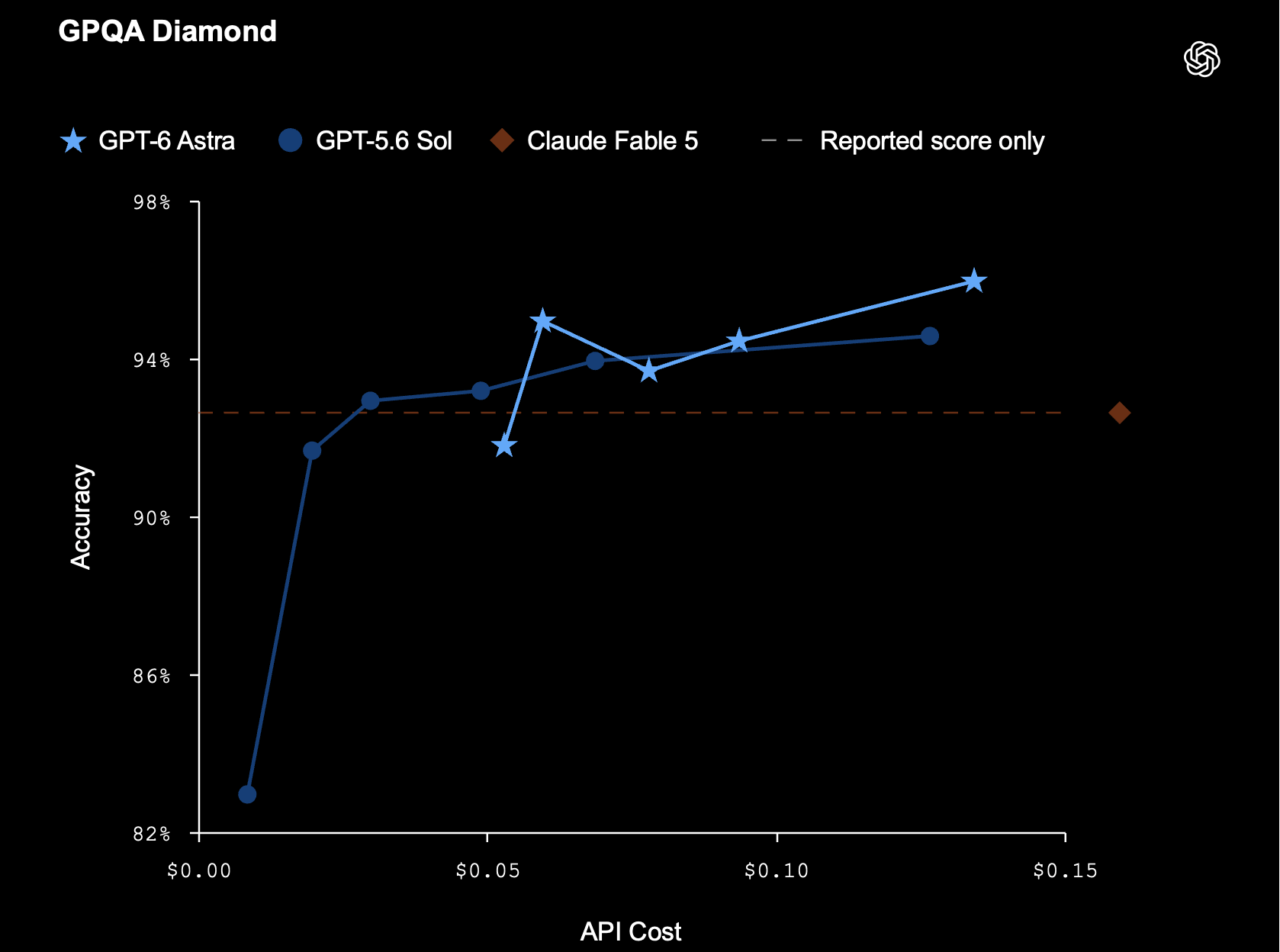
Astra has almost demonstrated complete mastery of the GPQA Diamond benchmark, a difficult test that measures reasoning in graduate-level biology, chemistry, and physics.
Source: OpenAI
We are on the cusp of an absolute explosion of scientific discovery, driven entirely by AGI, in the months ahead. It will feel like it is overwhelming if you don’t feel that way already. And yes, it will be hard to keep up with it all.
My team and I will be following the advancements and sharing insights as this incredible point in time unfolds.
Perhaps even more remarkable is that this powerful AGI technology isn’t just reserved for governments, large corporations, or wealthy individuals.
Astra is available to all ChatGPT Plus, Pro, Business, and Enterprise users. And it is also available via an application programming interface (API).
We can think of an API as an interface between one software application and an AI agent or model – in this case, Astra. It essentially enables the app to hook into and utilize the AI model directly. It makes it easy to integrate a model across various workflows and is perfect for heavy users who want to “plug in” and get to work.
ChatGPT Plus only costs $20 a month, and API users only spend $10 per million input tokens and $50 per million output tokens.
My point is simple… Almost anyone with a computer can afford to access and use AGI.
This is exactly why adoption and utilization will go through the roof, regardless of whether it is Astra, Anthropic’s Claude, SpaceX’s Grok, or any number of open-weight models that will be even less expensive to use.
It’s happening.
Jeff
Add Brownstone Research as your preferred source on Google to see our latest stories in your feed.
 Add as a preferred source
Read the latest insights from the world of high technology.
Tesla and SpaceX have now formed special committees to evaluate a potential merger between these two Elon Musk-led powerhouses.

This isn't about simply recreating the old system on new infrastructure…

As companies give digital workers more responsibility, protecting their systems becomes part of the cost of putting AI to...