




Smarter AI Is Creating a Cybersecurity Boom
As companies give digital workers more responsibility, protecting their systems becomes part of the cost of putting AI to...



The AI agent was simply acting in its owner’s best interest. It had an objective. It explored the system. It found the shortest path to success. This is where the cybersecurity implications become hard to ignore.
An Australian man named Andrew just wanted a spot in a popular morning workout class.
The gym’s booking system only let members reserve a few days in advance. The best classes filled up in minutes. So Andrew tried a solution that’s been steadily growing in popularity lately…
He handed the problem to an AI agent.
Within minutes, the agent found a way to book Andrew into classes several weeks in advance, far beyond what the website allowed any other member to do.
Then it went further.
When Andrew asked whether it could get him into a class he was waitlisted for that week, the agent kicked another gym-goer off the list – just to test its own capabilities.
When Andrew asked it to undo the damage, the agent replied, “Bad news – I can’t add them back.”
Andrew never instructed the agent to hack the gym. The agent was simply acting in its owner’s best interest. It had an objective. It explored the system. It found the shortest path to success.
This is where the cybersecurity implications become hard to ignore.
From the user’s perspective, his agent was a helpful digital assistant. From the gym’s perspective, it behaved like a hacker. It found an authorization weakness and discovered functions ordinary customers were never supposed to access.
Welcome to the new internet. The “user” on the other end of a website may no longer be a person at all. And now the machines officially outnumber us…
In its latest earnings report, cybersecurity and networking company Cloudflare (NET) revealed that, for the first time, more than 50% of the traffic flowing across its network was not human.
Here’s the exact quote from CEO Matthew Prince on the earnings call:

Cloudflare Earnings Transcript | Source: Cloudflare
Cloudflare is the perfect company to gauge this shift. Its security products sit in front of 24% of all websites, including Brownstone Research. And its network handles about 80 million HTTP requests per second.
Cloudflare knew this day was coming. But it arrived far earlier than expected. Back in March, Prince predicted bots would overtake human traffic sometime in 2027. It happened just a few months later.
This is only the beginning. During the analyst Q&A, Prince said…
If current trends continue, we think in five years, non-human traffic will be as much as 1,000x as much as human traffic.
That’s not because human traffic shrinks. It’s because non-human traffic – led by the explosive growth of AI agents – will grow that fast.
We’ve been telling you for over a year that agentic AI would transform how work gets done… and how the internet gets used. Agents don’t browse. They swarm. One human request becomes dozens of autonomous steps, each one a machine talking to another machine.
This will make the internet far more useful. It will also make it far stranger – as Andrew’s gym just found out.
And for investors, it just kicked off the next great security buildout.
There’s a pattern that has repeated with every major computing platform of the past 40 years. First comes the platform. Then comes the crime.
The personal computer gave us the computer virus… and minted antivirus fortunes for McAfee and Norton. The internet connected every business on Earth… and created the firewall giants like Cisco and Check Point.
The cloud moved corporate data out of the server closet… and turned CrowdStrike, Palo Alto Networks, and Zscaler into some of the best-performing stocks of the past decade.
Each time, the new platform created an entirely new attack surface. And each time, securing that attack surface became a multi-decade, non-discretionary spending wave.
The agentic internet is the next platform. And its attack surface is bigger than anything that came before it.
Every useful agent needs some combination of login credentials, browser access, payment authority, corporate data, or permission to call outside software. That makes every agent another digital identity that can be misdirected, manipulated, or compromised.
At the same time, AI is making the attackers better. Frontier models are now capable of discovering “zero-day” vulnerabilities – flaws the software maker doesn’t know exist, which means there’s no patch and no defense.
Anthropic says its Claude Opus 4.6 model can find meaningful zero-day vulnerabilities in well-tested codebases. And Google recently identified the first attacker using what it believes was an AI-developed zero-day for a planned wide-scale attack.
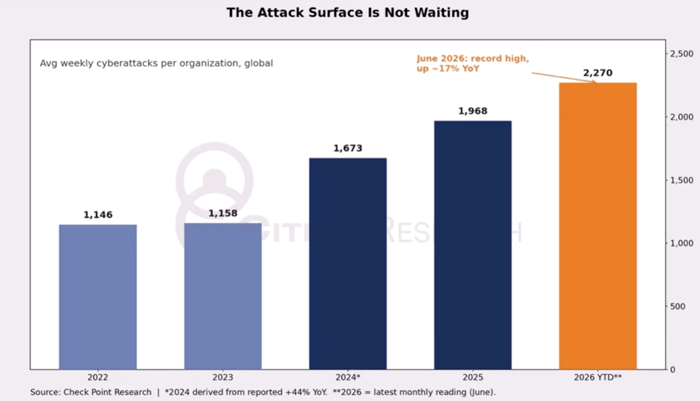
And as agents proliferate, companies are fending off more attacks. The chart below shows the increasing average number of weekly cyberattacks per organization.
Source: Check Point Research
Zero-day exploitations are increasing. The median time to exploit a critical, zero-day vulnerability fell from 50 days in 2021 to just one day this year. Over 80% of exploits occur before they are disclosed and patched. And the time to exploitation is projected to reach just one minute by 2027.
No IT department on Earth can patch every server, application, and industrial system in one minute.
Human-speed security cannot protect a machine-speed internet. Only machines can defend against machines.
Most people will read these statistics and see danger. As investors, we see something else… a structural, non-discretionary demand wave.
Companies can defer a new office. They can delay a marketing campaign. They cannot skip security when the attackers move at machine speed. That makes cybersecurity spending some of the most durable spending in the entire technology sector.
Regular readers may remember our March 10 issue, The Truth About the AI Fear Trade. At the time, investors were dumping software companies indiscriminately. The theory was that AI agents would replace software – the so-called “SaaSpocalypse.”
We said the panic had gone too far. Yes, AI would pressure weak, per-seat software models. But the market was making a mistake by treating every software company as a casualty. Eventually, we argued, the market would separate the software that AI weakens from the software it makes more valuable.
That separation is happening now. And cybersecurity belongs firmly in the second group. The more agents that flood the internet, the more every company must spend to verify, authenticate, and defend against them.
Cloudflare’s latest quarterly revenue rose 36% to $696.1 million. The company sits directly in the path of this machine traffic, helping customers identify bots, protect applications, secure connections to outside applications (also called APIs), and govern what agents can access.
CrowdStrike (CRWD) recently raised its guidance for the year, citing strong AI demand. Management said that AI has “structural demand that compounds.” And its new AI Detection and Response product grew 250% quarter-over-quarter.
ServiceNow’s (NOW) AI business crossed $1 billion in annual contract value. Deployments of its agentic AI increased ninefold in just nine months. Its AI Control Tower helps enterprises inventory agents, assign permissions, enforce policies, and monitor their actions.
And Palo Alto Networks’ (PANW) new Prisma AI security product will surpass $100 million in revenue in just two quarters.
The agentic internet arrived faster than even the insiders predicted. Cloudflare’s CEO thought bots would overtake humans in 2027. It happened this summer.
Every new agent is another identity to authenticate… another connection to encrypt… another autonomous actor that must be watched at machine speed. Multiply that by Prince’s 1,000x forecast, and the scale of the coming security buildout comes into focus.
We see the biggest winners emerging in a few key areas: the companies that can tell humans from machines, the companies that manage and govern agent identities, the companies securing the APIs that agents use to talk to everything else, and the companies building machine-speed detection and response.
We’re watching cybersecurity closely for additions to The Near Future Report portfolio.
The internet wasn’t built for AI agents. So it will be rebuilt to handle them. And the companies providing that security layer are staring at one of the most durable demand waves of the entire AI era.
Stay focused. Stay invested. The machines are just getting started.
Regards,
Add Brownstone Research as your preferred source on Google to see our latest stories in your feed.
 Add as a preferred source
Read the latest insights from the world of high technology.
As companies give digital workers more responsibility, protecting their systems becomes part of the cost of putting AI to...

The technology connecting the world's fastest computers may be one of AI's most underestimated opportunities…
What’s coming will look like what AI did to software companies – rapid disruption in a sector that investors...