



Anduril’s Arsenal
This is a landmark deal and the most significant initiative in shipbuilding and defense technology since World War II.



Most investors still think AI is just a technology story… But AI is quietly becoming something much bigger.
I was shocked when I discovered that some next-generation AI data centers might soon consume as much electricity as a small city.
Not in a year… but continuously.
At the same time, some facilities may require millions of gallons of water per day for cooling. The average American home uses about 300 gallons of water a day. One data center could consume enough water in one day to support 10,000 homes.
Some campuses now span millions of square feet and require enough concrete and steel to rival multiple skyscrapers.
That switched on the light bulb for me.
Most investors still think AI is just a technology story. Semiconductors. Software. Maybe memory chips, if they are a little deeper into the theme.
People hear AI – they think of NVIDIA. And rightly so… its whole mission was to establish itself as a leader in the sector and build products that would be the “envy” of the industry. The name itself – NVIDIA – is based on the Latin word “Invidia,” meaning envy…
But AI is quietly becoming something much bigger.
It is becoming a massive physical infrastructure buildout spreading across the economy in real time.
The market still likes to organize itself into neat little sector boxes. Technology. Industrials. Utilities. Communications. Energy.
But AI doesn’t care about those labels.
That is why I increasingly think traditional sector investing misses what is actually happening beneath the surface.
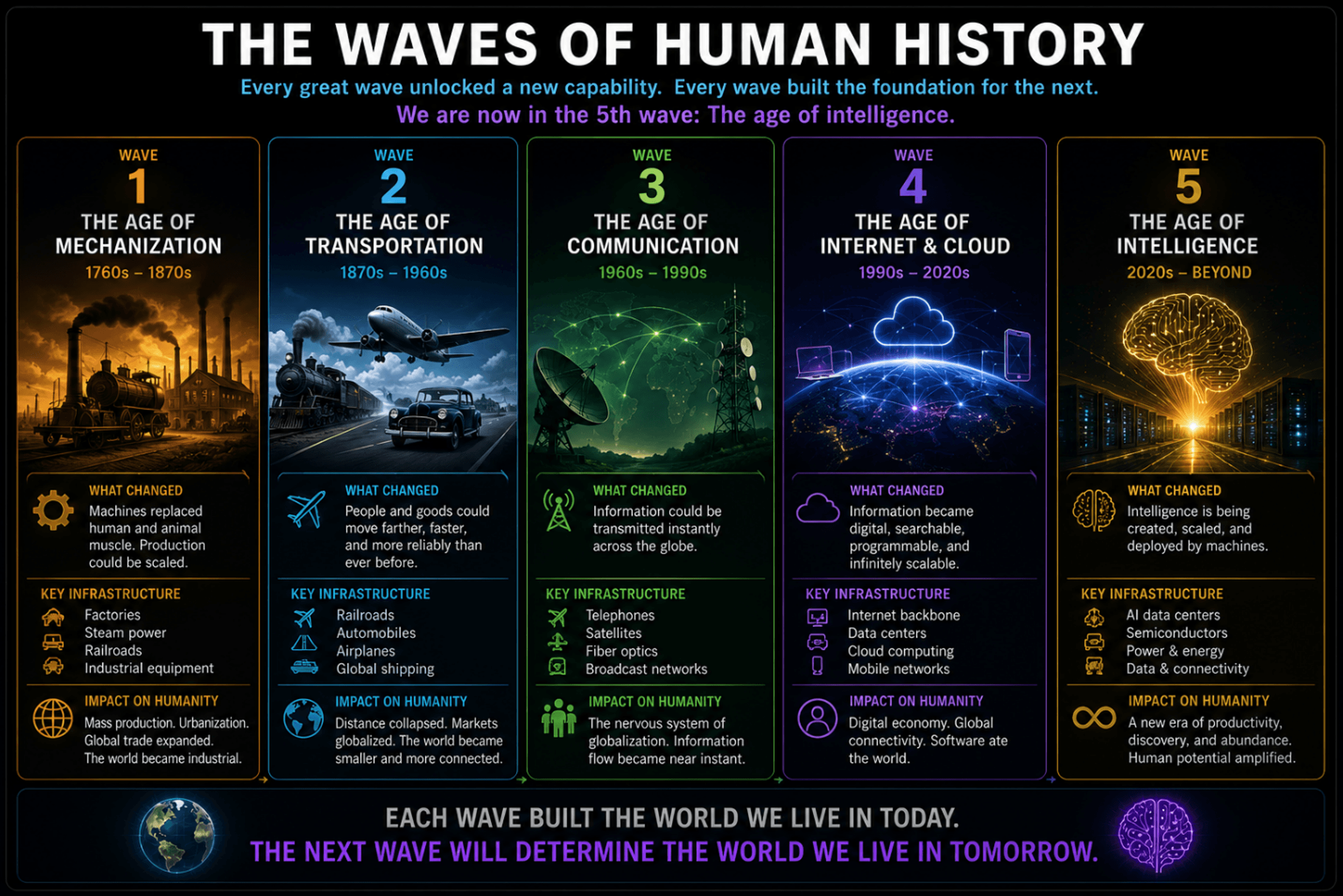
Artificial intelligence is starting to resemble earlier transformational periods in human history. The Industrial Revolution mechanized labor. Railroads and aviation collapsed distance. The internet digitized information and commerce.
Now, AI is industrializing intelligence itself.
But unlike the software booms of the last twenty years, this wave has a physical footprint.
A very large one.
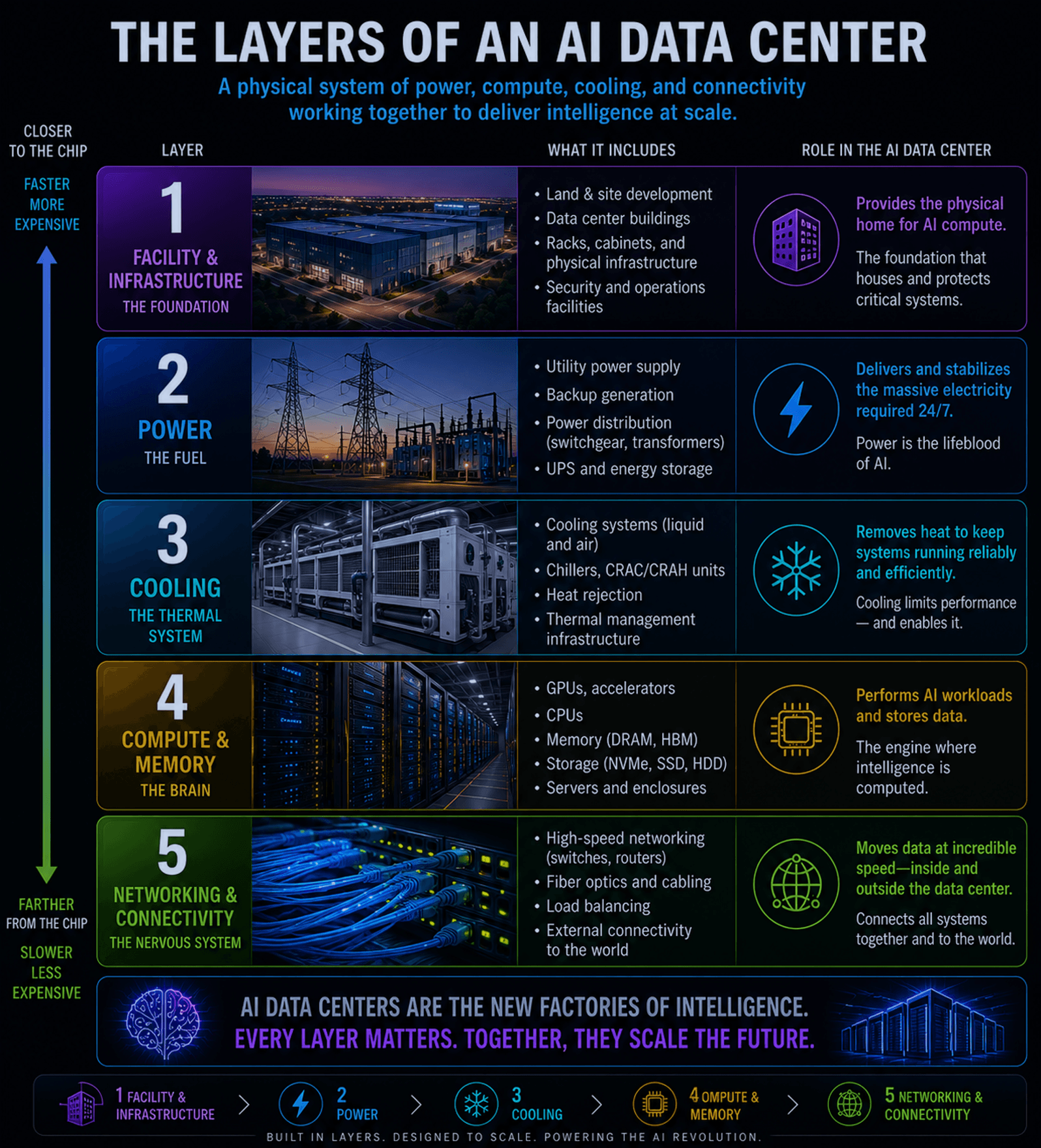
I have spent time discussing compute power, memory, networking, and optics. These areas occupy just the last two layers of the AI stack in my concept. They are the essential digital nervous system feeding the AI system.
But today, I want to focus on something far less glamorous, but arguably just as important… if not more.
The physical buildout underneath it all.
Before artificial intelligence can change the world, somebody has to physically build the place where it lives.
The modern AI economy runs inside data centers: massive industrial campuses filled with servers, cooling systems, backup generators, electrical infrastructure, fiber networks, and increasingly, extraordinary amounts of compute hardware.
The cloud used to feel abstract. Invisible. Weightless.
Now it arrives on fleets of cement trucks.
That may sound dramatic until you look at what is actually being built.
Some hyperscale AI campuses now span millions of square feet. For each, roads must be cut, underground utilities installed, steel frameworks assembled, and massive foundations poured. Dedicated substations were constructed nearby just to support future electricity demand.
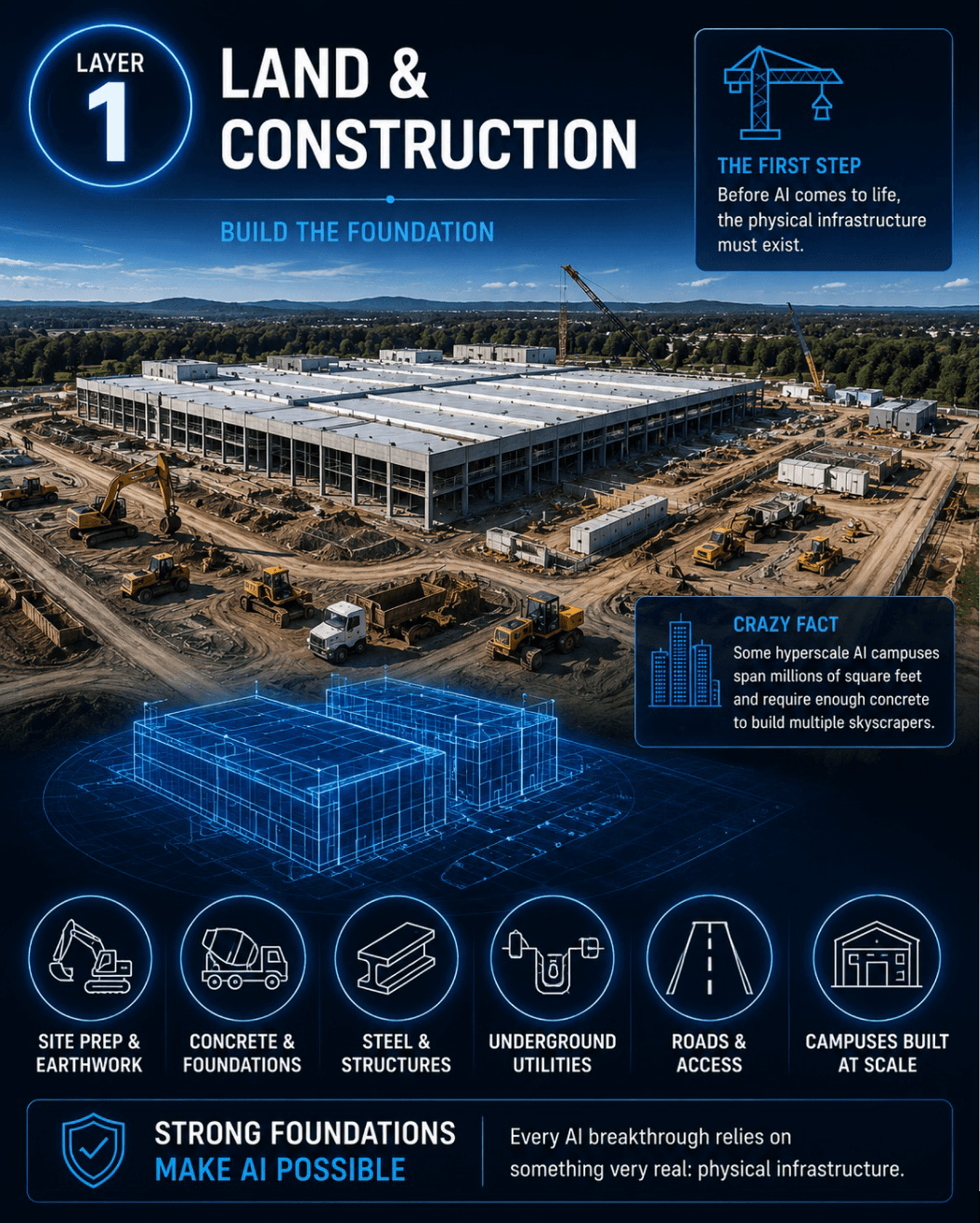
One advanced AI campus can cost billions of dollars before a single AI model is trained inside it.
And this isn’t just in Silicon Valley… It’s spreading.
Northern Virginia has the largest concentration of data centers on earth, earning it the nickname “Data Center Alley.” Arizona continues attracting semiconductor and AI infrastructure projects at a staggering pace. Texas is seeing explosive demand tied to land availability, energy access, and hyperscale expansion.
Entire regional economies are quietly reshaping themselves around AI infrastructure demand.
The interesting part is what this means for investors.
The opportunity stack suddenly becomes much broader than most people realize.
As I said, it’s not just the tech sector…
Sure, semiconductors matter. Of course, GPUs matter.
But somebody still has to clear the land, pour the foundations, install the electrical systems, build the roads, connect the utilities, and physically construct these campuses, all at enormous scale.
This starts pulling industrial companies, engineering firms, infrastructure developers, electrical suppliers, materials providers, and construction specialists into the AI story.
The picks and shovels beneath the digital gold rush.
I believe this is the inflection point. It’s where things get really interesting.
Not every company participating in or exposed to a theme becomes an outlier.
Every major frontier eventually develops its own ecosystem of leaders and laggards. The internet did. Smartphones did. Cloud computing did.
AI is now doing the same thing.
Other companies made GPUs… just not like Nvidia. They became the outlier of outliers.
That’s the important distinction.
A major theme can lift an entire industry, but eventually a small group of companies separates itself from the pack through superior technology, execution, margins, demand, and institutional accumulation. Those are the names that often go on to define the cycle.
And AI is not the only frontier emerging right now. Robotics, electrification, power infrastructure, photonics, industrial automation, and defense technology are all developing their own individual layered ecosystems beneath the surface.
What an exciting time to be alive.
Inside each stack, a small group of companies begins separating itself from the crowd through accelerating sales growth, explosive earnings, rising profits, and sustained capital flows.
That is where my focus lives and has lived for the past two decades.
Not simply identifying a big theme as the market shifts. But identifying the outliers hidden inside the layers before the broader market fully understands it.
Because once you stop viewing the market as isolated sectors, the world starts looking very different.
AI is not just the tech sector… It is quickly becoming every sector.
AI is construction. Energy. Infrastructure.
It is communications.
It is an industrial expansion.
And we are still much earlier in this buildout than most investors realize.
There’s still so much more to come…
Regards,
Add Brownstone Research as your preferred source on Google to see our latest stories in your feed.
 Add as a preferred source
Read the latest insights from the world of high technology.
This is a landmark deal and the most significant initiative in shipbuilding and defense technology since World War II.
Google’s recent agreement reveals the scale of the AI power shortage and why supplying power is such an important...

There is something very special happening right now. A bloom of autonomous driving, and Austin is the epicenter.