


The Iran Oil Shock: Why Market Fear May Be Setting Up the Next Rally
Over the past week, the conflict with Iran has escalated dramatically. And the most critical chokepoint in the global...


Don’t be a panic seller…

Managing Editor’s Note: Today, we’re doing a special research spotlight and unlocking content from last week’s issue of our Near Future Report advisory…
In it, senior analyst Nick Rokke unpacked the circumstances around the panic-fueled “AI Fear Trade” and why, despite the volatility, we are more confident than ever about the trajectory of AI and the AI infrastructure buildout.
Since the beginning of last week, the iShares Expanded Software Sector ETF (IGV) rose 10% to its peak. And that’s despite the general markets falling due to the uncertainty around the situation in Iran. Our thesis is playing out, but we still think this trend will continue.
Keep calm, stay focused…
February delivered a powerful reminder of how emotional markets can become when a dominant trend like artificial intelligence emerges.
In the span of a single trading session, a former $3 million karaoke-machine company wiped $17.4 billion off the Dow Transports – an index tracking 20 key U.S. transportation stocks, like airlines, railroads, and trucking giants.
No, that’s not a typo.
A microcap stock with negative EBITDA issued a press release about its AI logistics platform… and shares of stable, multibillion-dollar trucking companies collapsed.
That tells you everything you need to know about the environment we’re in.
I want to make two points. They may seem contradictory at first, but both are true…
The company at the center of the panic is now called Algorhythm Holdings (RIME). Until recently, it sold consumer karaoke systems… But in February, its SemiCab unit claimed its AI platform could reduce empty freight miles by as much as 70% and help customers scale volumes 300% to 400% without adding headcount.
Impressive claims. However, the announcement left us with many questions…
Most importantly, who are these customers? What do these contracts look like? And does this technology work at scale?
None of that mattered to the market, though. Trucking logistics companies plummeted on the day.
C.H. Robinson (CHRW) and Expeditors International (EXPD) both fell 14%.
Landstar Systems (LSTR) fell 16%, its worst day ever.
And RXO, Inc. (RXO) fell the most, ending down 23%.
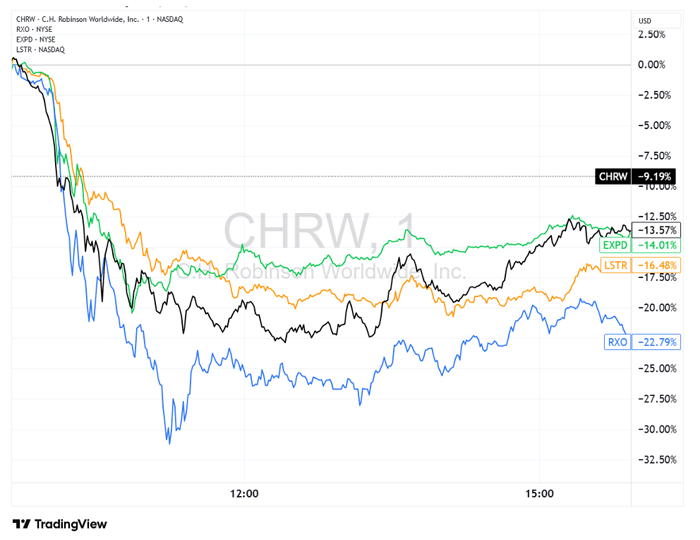
These are all stable, profitable, multibillion-dollar businesses with decades of operating history.
And they were pummeled because a microcap with $1.7 million in quarterly revenue and negative EBITDA issued a press release.
Now, most of these have already bounced back, but be prepared for more volatility.
It’s probably just a matter of time until a scare hits a majority of publicly traded companies. For many companies, the drawdown will be temporary, but it will likely feel scary holding those companies at the time.
With the market stalling for the past few months, large institutions and hedge funds are using these headlines to scare the weak hands out of their positions. This allows them to enter positions at lower prices and generate alpha in a flat market.
Don’t be a panic seller.
The weekend after this news release, a financial research firm called Citrini Research released a thought piece on the future of AI. It was a fictional piece about how they think the future may play out… This fiction sent many companies lower last Monday.
And it should be noted that this firm is known for its short reports and was positioned to profit if the companies whose business models were questioned fell. This tweet sums up the results the best.
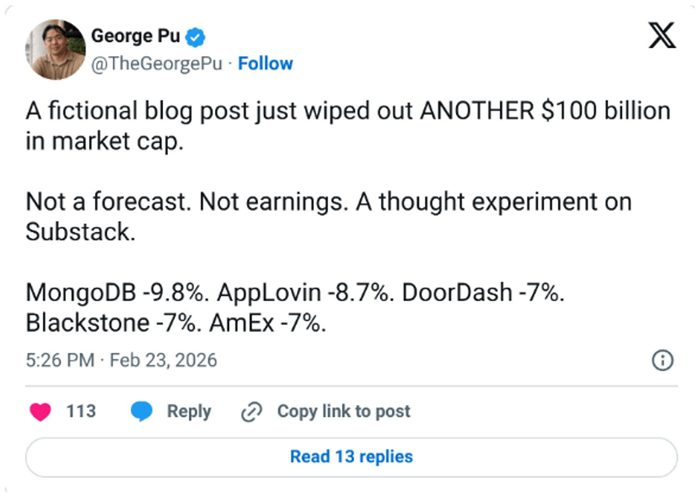
This story is stranger than fiction… And it’s the kind of reaction that occurs at the end of a large move.
Here at Brownstone Research, we deeply understand that AI advancements will transform the global economy. Entire business models will be dismantled. Middlemen will disappear. Labor productivity will surge. Margins will compress in some areas and explode in others.
That part is not up for debate.
However, what we’re seeing now isn’t disciplined forward-looking analysis. It’s panic.
The “AI Fear Trade” has turned into a sell-first, ask-questions-later stampede. Investors are dumping anything that might be exposed to automation risk.
We saw this first in software. The financial media recently labeled it the “SaaS-pocalypse.”
Personally, I’ve been calling for the death of SaaS since the summer of 2023. At that point, it was clear that the traditional per-seat SaaS model was vulnerable. If one AI system can do the work of five employees, why keep paying for five licenses?
That’s rational. And the market has responded accordingly. Former high-fliers like Adobe (ADBE), BILL Holdings (BILL), and HubSpot (HUBS) have all fallen more than 50% since then.
Now, many of these names trade at multi-year or even all-time low valuation multiples. And that’s despite still generating real cash flow and maintaining strong customer bases. When fear pushes valuations to extremes, it usually signals we’re closer to the end of a move than the beginning.
And we’re already seeing early signs of that shift.
Friend of Brownstone Research Jason Bodner has pointed out that institutional capital has quietly started flowing back into select software names. Not indiscriminately, but selectively.
The market is beginning to realize that not all software is created equal.
Jeff and I have had many conversations about this dynamic. Jeff told me that right now, “Institutional capital is struggling to understand the differences between distinct kinds of software companies and the impact of AI on those businesses’ free cash flows.”
That confusion is creating opportunities. Yes, legacy per-seat SaaS models will face pressure, but AI-native platforms like Palantir (PLTR) will thrive. Companies built with proprietary datasets like Tesla (TSLA) will have a competitive moat. And infrastructure and optimization layers that enable AI adoption, like Snowflake (SNOW), will also thrive.
Now, I’m not saying these are necessarily buys right now. But as examples of business models that can thrive in the AI age. These are very different businesses from a generic workflow automation tool charging per user. But the market is currently pricing them with the same brush.
That’s a mistake.
And now the fear is spreading beyond software.
We’ve seen sharp selloffs in real estate platforms, private credit firms, insurance brokers, and wealth managers. All simply because AI might streamline parts of their operations.
Yet many of these companies remain profitable, cash-generative, and in some cases, positioned to benefit from AI-driven efficiency gains.
This is how thematic panics evolve. First, investors identify real disruption. Then they price it rationally. Then they overshoot.
The S&P 500 sits just a couple of percentage points off its highs. But underneath that, the AI Fear Trade has created deep pockets of mispricing. That’s where we’re focused.
Because when investors are selling first and asking questions later, disciplined capital can step in and buy quality businesses at a discount.
And that’s exactly what we’re doing.
Because we are more confident than ever about the growth of the AI infrastructure buildout.
Since the release of ChatGPT in late 2022, the world’s largest cloud providers have been forced to revise their capital spending plans higher, again and again. Not because they want to, but because they have to.
The latest capital expenditure (CapEx) guidance from earnings makes this clear:
Google is effectively doubling its capital spending. Amazon and Meta are close behind.
And we haven’t even included challengers like Oracle (ORCL), CoreWeave (CRWV), and Elon Musk’s xAI. Each of those is pouring tens of billions into AI compute capacity annually.
Here’s a chart of the growth of CapEx, as well as where Wall Street’s future projections are.
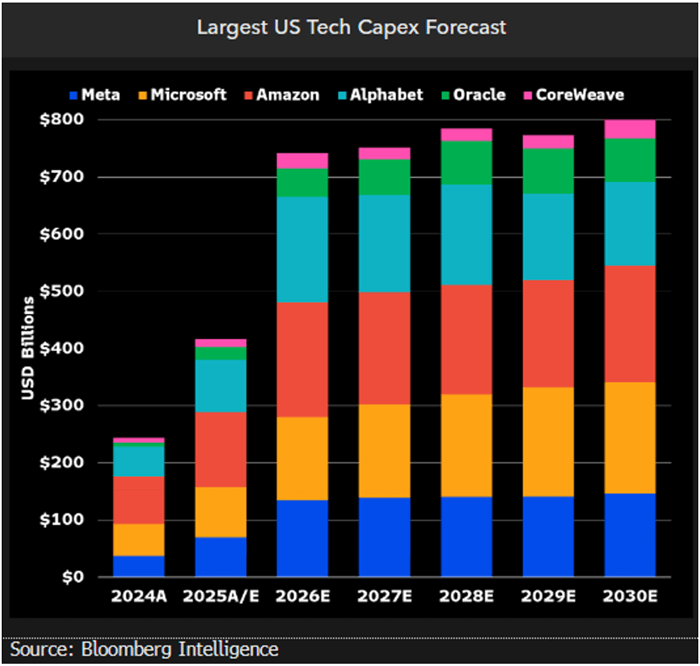
This clearly demonstrates how Wall Street remains behind on its projections of future CapEx spend. Do we seriously think that hyperscalers won’t increase spending in 2027?
I fully expect companies and analysts to update 2027 expectations throughout the year. All told, it’s reasonable to expect close to $1 trillion in spending next year as companies race to add data center capacity.
That number has rattled skeptics.
You’ll hear the usual chorus from non-technical commentators: There’s no guarantee of returns. This is speculative. It’s a bubble.
But they miss the point. As NVIDIA CEO, Jensen Huang, said during the NVIDIA earnings call last month…
In this new world of AI, compute is revenues. Without compute, there’s no way to generate tokens. Without tokens, there’s no way to grow revenues.
The more compute, the more revenue these companies make. Hyperscalers aren’t spending huge sums of money on speculation. They’re not gamblers. It’s reactive spending.
The clearest proof shows up in remaining performance obligations. RPOs are contracted revenue that hasn’t been recognized yet. Across Amazon, Google, and Microsoft, RPOs surged in late 2025.
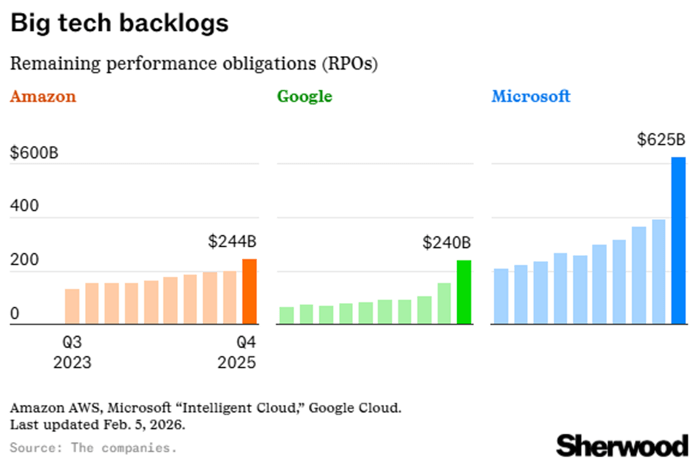
Customers are locking in long-term cloud and AI capacity faster than these companies can physically build it.
Hyperscalers aren’t overbuilding. They’re behind.
As AI systems move from novelty to necessity. AI is now embedded into enterprise software, logistics, industrial automation, and research. And the compute intensity keeps rising. That means more servers, more networking, more semiconductors, and far more power.
The result is a supply-demand mismatch that won’t resolve quickly. Permitting, power hookups, transformers, and cooling aren’t problems you fix in a quarter.
The biggest gains are still ahead. This is when fortunes are made.
Stay focused. Stay invested.
Regards,
Nick Rokke
Senior Analyst, The Bleeding Edge
P.S. Hello, Jeff’s Managing Editor here… I just want to remind you to sign up with one click to join us on Thursday for Jeff’s event.
We’re closing in on March 16… That’s when Jeff believes Nvidia is about to shake up the market… sending some popular tech stocks spiraling and others soaring.
There’s still time to go here to automatically add your name to the list… and to add your phone number to sign up for VIP and to collect a special report that spotlights one company Jeff believes is safe from the culling – Jeff’s Bulletproof AI Pick.
You’ll also receive alerts to ensure you don’t miss a thing, including our 2 p.m. kickoff on Thursday afternoon.

Read the latest insights from the world of high technology.
Over the past week, the conflict with Iran has escalated dramatically. And the most critical chokepoint in the global...

Private investment rounds like this are illiquid. It’s not trading, it’s an investment. This is a sign of what’s...

If you know what to look for, it’s actually pretty easy to find the fakers.
Thanks for signing up for The Bleeding Edge — we’re glad you’re here!
Want updates sent straight to your phone too? Sign up for SMS alerts to get the latest delivered via text.
Brownstone Research: By submitting your phone number, you agree to our SMS Terms & Conditions, Terms of Use, & Privacy Policy, and give express written consent to receive marketing text messages from BSR. Messages are recurring & frequency may vary. Reply STOP to 94703 to opt out. Reply HELP to 94703 for info. Consent is not a condition of purchase. Message and data rates may apply. For additional information, you may contact Customer Service at 888-512-0726 or smssupport@brownstoneresearch.com.