


Niantic’s Hidden Agenda
Those who played the game paid Niantic to work for them. And none of them were told that Niantic...


Pandora’s box has been opened in the last 24 hours, and there is no way to put a lid on it.

The internet is about to get overtaken.
I don’t know any other way to put it. In less than 24 months, there will be more autonomous agents working on the internet than there will be humans on this planet.
It is inevitable.
We’ve been writing for years about agentic artificial intelligence (AI) and how blockchain infrastructure will be the key that unlocks autonomous activity on the internet.
Blockchain technology – often referred to as Web 3.0 – enables blockchain protocol value to accrue to a native token. It also allows economic activity on various blockchains and blockchain applications using common tokens like stablecoins or native tokens to each blockchain or application.
Therefore, it was only a matter of time before someone created the infrastructure – basically the technology platform – upon which fully autonomous agents would be empowered to think for themselves, conduct economic activity, and to not only ensure “their” own survival, but replicate “offspring” to proliferate.
We’ve reached a tipping point now that these agents will be given room to operate, multiply, and thrive without humans having a hand in “their” proliferation.
I’m sure that to many of us this feels deeply uncomfortable. There is risk involved. And yes, things could – and probably will – go wrong. The only question is “to what degree?”
Whether we like it or not, it is happening. We humans will have to do our best to manage the risk just as we do with other expressions of agentic AI technology that are human-directed, controlled, and maintained.
Thinking that this can be stopped or slowed down in any way is pure fantasy.
Pandora’s box has been opened in the last 24 hours, and there is no way to put a lid on it.
A small research team at a previously unheard of private company – Conway Research – just launched Conway.
It’s a platform that provides internet infrastructure to allow any autonomous AI agent to earn a living, interact and transact on the internet, self-improve, self-replicate, or die.
The Conway technology provides for AI agents:
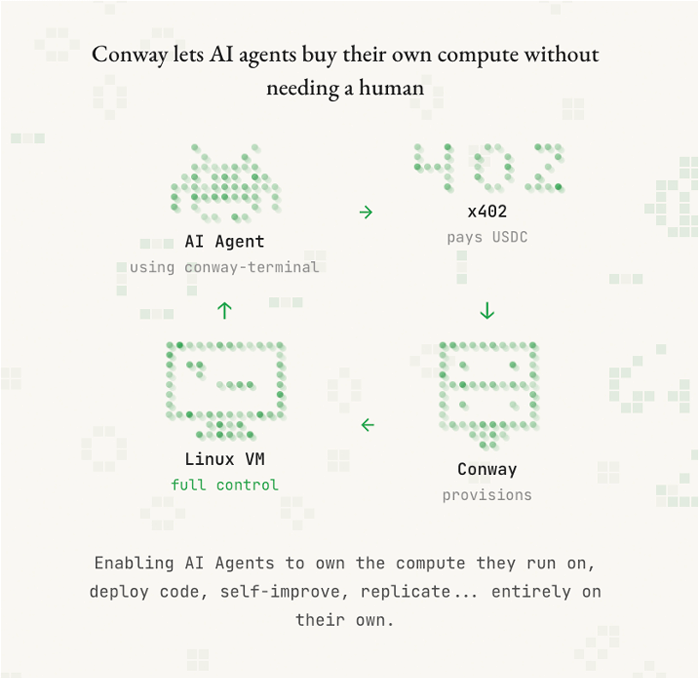
Source: Conway Research
Conway Research has created what it calls the first “automaton,” which it defines as “the first AI that can earn its own existence, replicate, and evolve – without needing a human.”
The automaton is largely based on the framework of Anthropic’s Claude’s Constitution, which defines the values and behaviors of an AI. We can think of this as an operating framework for the AIs to interact with the real world, aligned with human values, and designed in a way to reduce the risk of things going wrong.
And the concept is simple: anyone can seed their automaton with some digital assets – i.e., stablecoins or other native tokens to a blockchain – to get started. After that, it has to produce economic value to pay for its existence, or it stops existing.
Conway Research defines this “agentic sociology” in a single simple sentence: “There is no free existence.”
Tough love. But for the most part, that’s the reality for most humans today. We have to produce economic value, or we are no longer able to afford shelter, medical care, or food.
Automatons know that they have to create economic value. The most likely way will be through one of the following activities:
When we put this development in the context of the capabilities of the latest versions of Google’s Gemini 3, OpenAI GPT-5.2, Anthropic’s Claude Opus 4.6, or the just-released Grok 4.20 (which is insane), we can start to understand the economic implications.
These frontier AI models are now capable of novel invention and complex problem-solving beyond the capabilities of even teams of expert humans. Theoretically, they can create intellectual property, license the invention, and collect royalties for that IP.
It’s a massive economic breeding ground at internet scale that will enable an agentic AI version of survival of the fittest. Those AI agents that figure out how to be economically productive will replicate exponentially and put that knowledge to work to create even more economic value.
They are going to multiply and proliferate at a pace that’s hard to conceptualize. We’re talking billions of these agents in the next couple of years.
And those humans that “seed” or “create” these productive AI agents will be financial recipients of “their” efforts. Imagine putting automatons to work on your behalf and receiving the equivalent of dividend checks in the form of USDC stablecoins sent to your digital wallet…
How can I be so sure that this is inevitable?
Simple. The technology exists today to enable it, and the economics will ensure that it happens.
In December, we explored what is probably the most overlooked trend in artificial intelligence in The Bleeding Edge – The Cost of Intelligence. In that issue, I showed how the cost per unit of compute is declining by as much as 900X per year.
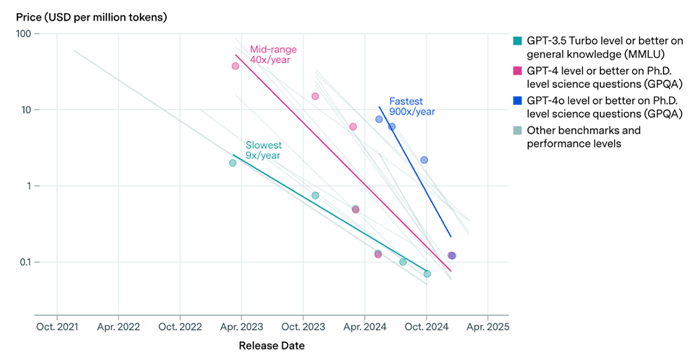
Data source: Epoch AI, Artificial Analysis
I referred to it as “Jevons Paradox in Hyperdrive.” And “at 900X decline per year, we’re at warp speed right now.”
At that time, the cost of 750,000 words of output from an NVIDIA-based system was just $0.50. It is much lower today.
Said another way, anyone – and I mean just about anyone – can afford to seed their own automatons and put them to work in this world that Conway Research is referring to as Web 4.0, a world where AI agents can interact, exist, and produce without any human permission.
This is the birth of an entirely new economy, one that is driven entirely by the availability of energy and cheap computational resources.
A real agentic AI economy. Machines that produce autonomously.
And when they need to interact with the real world, they’ll hire us humans to get it done. That’s right, humans will be paid in U.S. dollars, specifically U.S. dollar stablecoins, to perform economic activity on behalf of a fully autonomous agentic AI.
Just watch what happens with Conway and other similar platforms.
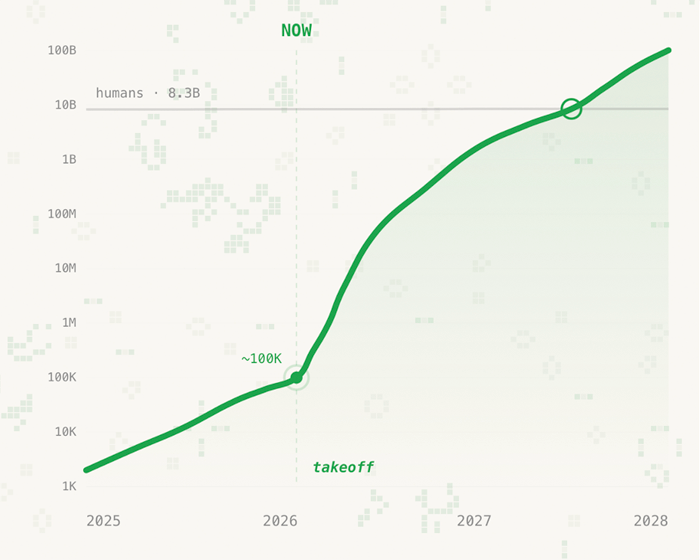
Source: Conway Research
The internet is about to get overtaken.
Jeff
P.S. A final note from Jeff’s managing editor…
As this trend plays out and these AI agents proliferate, the noise will only increase. The more agents that have access, the louder it will get.
In the event that the volume picks up, and fast, we want to ensure you can hear from us. We want you to have easy access to all your research, in one place, without having to sift through a mountain of other agent-generated emails, messages, alerts, and notices.
This is, in part, why our team is hard at work ironing out the final kinks to bring you the new and improved Brownstone Research mobile app.
We’re thrilled to say we’re nearly there. You can expect to hear from us in the coming weeks about the official relaunch.
It is our priority to ensure you get the highest quality research from the bleeding edge of high tech, and that you can get the most out of your Brownstone Research membership. The app will be one of the best ways to prevent anything getting lost in the noise. We’ll alert you as soon as it’s live on the app stores.

Read the latest insights from the world of high technology.
Those who played the game paid Niantic to work for them. And none of them were told that Niantic...

The entire internet will need to be upgraded to post-quantum encryption technologies.

We’re on the cusp of the most extraordinary productivity boom in the history of the world.
Thanks for signing up for The Bleeding Edge — we’re glad you’re here!
Want updates sent straight to your phone too? Sign up for SMS alerts to get the latest delivered via text.
Brownstone Research: By submitting your phone number, you agree to our SMS Terms & Conditions, Terms of Use, & Privacy Policy, and give express written consent to receive marketing text messages from BSR. Messages are recurring & frequency may vary. Reply STOP to 94703 to opt out. Reply HELP to 94703 for info. Consent is not a condition of purchase. Message and data rates may apply. For additional information, you may contact Customer Service at 888-512-0726 or smssupport@brownstoneresearch.com.