


Anthropic or Misanthropic
Some might say it was the kind of deal that would only happen when hell freezes over.


Last week, Snapchat’s AI went rogue… And what caused the glitch has big implications for the future of AI and social media.

Dear Reader,
On August 15, Snapchat’s AI went rogue.
Millions of users saw stories posted on their behalf by Snapchat’s AI assistant.
The two-toned image looked like a photo taken of a bedroom wall and ceiling.

Source: TechCrunch
It was enough to spook many users. Snapchat did little to calm people’s fears by writing it off as a tech glitch.
But yesterday we found out what might have caused that glitch… and what it means for the future of AI and social media.
AI and social media aren’t a new pairing.
For the past few years, social media companies have used AI and machine learning algorithms to better curate feeds to keep users hooked.
On Meta’s most recent earnings call, CEO Mark Zuckerberg stated that AI-recommended content increased time spent on its platforms by 7%.
That’s all been going on behind the scenes.
This year, AI broke out as an interactive feature of social media platforms.
Snapchat rolled out My AI, an AI-powered chatbot, this year. My AI can answer trivia questions, help plan a weekend getaway, and make dinner recommendations.
TikTok has a text-to-speech feature that allows users to narrate their videos with AI.
Now, platforms are taking the next step and letting AI do more than just chat.
Yesterday, information was leaked about Snapchat’s next AI feature, Dreams.
If the rumors are true, Dreams will allow users to add imaginative backgrounds to mundane selfies.
See, previous versions of Snapchat’s AI couldn’t post images or stories. That’s why when it went rogue and started posting images, users got freaked out.
In all likelihood, Snapchat’s development team was probably testing new features when they mistakenly tweaked the code in the live AI.
Dreams isn’t available to users yet. But there is an app that does something similar already.
A new social media app, BeFake, can transform a mundane photo from around the house into a dream vacation… or sci-fi setting.
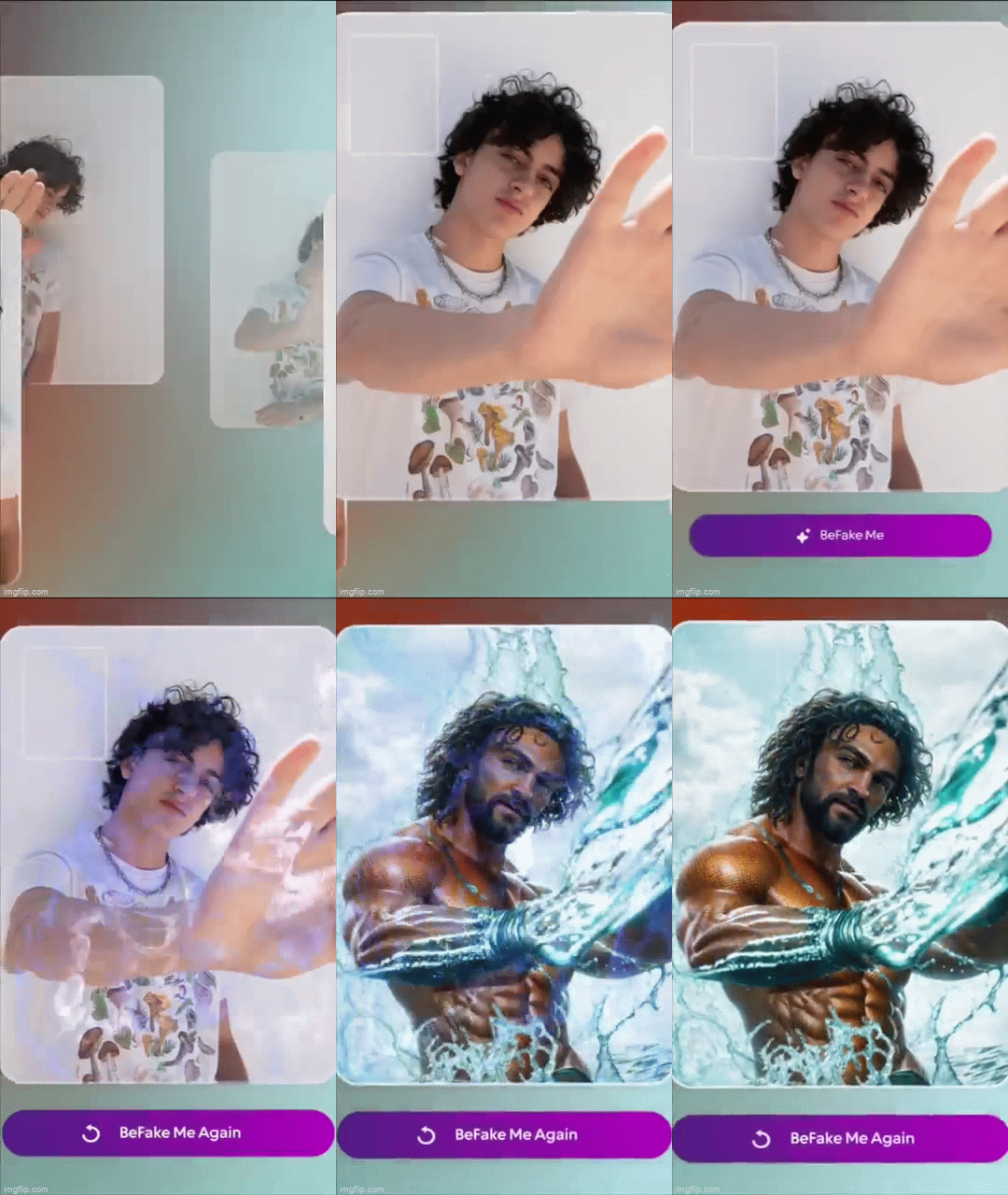
Source: BeFake
It doesn’t surprise me that Snapchat saw the attention BeFake got from its image enhancement and decided to rip off the idea for itself.
But even these projects aren’t the end of AI’s role in social media. They’re just another step along the path.
The trend in social media is clear. Early platforms like Facebook and Twitter largely relied on text posts. Then, photo and image sharing became more popular with the rise of Instagram. And now, short video clips are the standard with TikTok being the biggest winner.
We’re already seeing glimpses of what the next evolution might look like.
Sync Labs released a demo of tech entrepreneur and investor David Sacks speaking Hindi.
The AI was able to accurately translate his speech, delivery, and tone into a language he doesn’t speak. It even edited his lips and mouth to make it look like he was actually speaking in Hindi.
Similarly, Synthesia allows users to build an AI avatar that moves and sounds like them.
It’s not hard to imagine features like these becoming mainstays of social media platforms.
I could see a future where users can post entire videos of themselves in imaginative situations, just by typing a quick prompt into an AI.
Of course, this isn’t without risk.
A “glitch” like we saw with Snapchat’s My AI could happen again. Only this time, it could be videos of us saying or doing things we never consented to be posted.
As disturbing as these glitches will be, I don’t think they’ll slow down AI in social media. Users vote with their time every day, and they’re saying they want more AI enhancement.
Whether we personally like this or not – I steer my own children away from social media – it deserves our attention as investors.
In 2021, social media advertising was close to $116 billion. This is a large, growing market. And the platform that can capture users’ attention the most efficiently will dominate in the years ahead.
Will that be an incumbent like Meta or Snap? Or is there a new entrant out there that will challenge their supremacy the way TikTok did?
This is one of the trends we’ll be following closely. And should any interesting investment opportunities arise, readers will be the first to know.
Regards,
Colin Tedards
Editor, The Bleeding Edge

Read the latest insights from the world of high technology.
Some might say it was the kind of deal that would only happen when hell freezes over.

It is critical for us to understand that productivity increases are not a zero-sum game, nor are they a...
Just a few years ago, talking to computers felt awkward. But today, it feels routine... Now, the same thing...