





Adapt or Die
The financial industry can either hold onto the past or prepare for this new world. And make no mistake, this new world is coming.

The bankruptcy was the biggest of its time…
It’s also a prescient warning for the financial industry today—adapt or die.
The year was 1956. The Federal Aid Highway Act helped construct some 48,000 miles of high-speed roads. It was the birth of the interstate highway system.
It also rewired the continent and economy.
To get an idea of how big of a shift…
Around 70% of intercity travel happened by rail two decades before the act. By 1966, that figure was below 2%.
Roads could simply go where rail couldn’t. And the government was incentivizing pavement being laid.
Meanwhile, the Interstate Commerce Commission kept the railroad industry shackled. The rail lines operated under a common carrier obligation. That simply meant the rail operators had a duty to provide their services for freight and passengers…even if it was unprofitable. The result was that it was nearly impossible for these companies to abandon unprofitable lines or eliminate money-losing passenger service.
Rail companies were hurting.
In a bid to stay relevant (and solvent), large rivals Pennsylvania Railroad and New York Central merged to form Penn Central in 1968. These were some of the biggest companies of the time.
The two merged with plans to borrow more capital to finance additional acquisitions.
There was no plan to improve the business. It was simply a financial engineering game.
Failure to adapt landed them in the 10th-floor conference room of the New York Federal Reserve, awaiting a decision on a $200 million loan…
Two days later, Penn Central filed for bankruptcy after being denied. It was the largest corporate bankruptcy in history at the time.
But not all railroads suffered the same fate.
Invest in the Future
Union Pacific invested in itself. They improved infrastructure, adopted technology, and positioned themselves to take advantage of what was coming…
They understood moving passengers was not the primary business. They transferred their passenger service to Amtrak and focused entirely on freight.
This refocus on how to deliver value was done just before two pieces of legislation changed the game entirely…
Those were the Railroad Revitalization and Regulatory Reform Act (4R) along with the Staggers Rail Act.
Both eased strict regulations. The result was market-driven pricing, improved shipping contracts, and the ability to shed unprofitable routes.
Union Pacific wasn’t playing a financial engineering game to mask their weakness. They prepared for the change that was coming.
They are now the second-largest U.S. freight railroad, commanding a $150 billion market capitalization.
So far so interesting. But what does any of this have to do with digital assets and blockchain technology?
Let me show you…
The Onchain Substitute
Today, traditional finance (TradFi) is the rail companies circa 1956. Before their eyes, a more advanced, more convenient network is being built. As I write, approximately $30 billion worth of assets—stocks, bonds, Treasuries, commodities—trade onchain. These assets trade 24/7, 365. Eventually, these figures will be measured in trillions of dollars.
That is the future. The financial industry can either hold onto the past or prepare for this new world. And make no mistake, this new world is coming.
The proverbial starting gun was fired with a new regulatory regime under the current Trump administration. It’s not necessarily deregulation; it’s simply an easing of current regulations.
Under the previous administration, the Securities and Exchange Commission (SEC) was led by Chair Gary Gensler. The former Chair took a “regulation by enforcement” approach.
During his reign of terror, enforcement actions accelerated as seen in the turquoise area below.
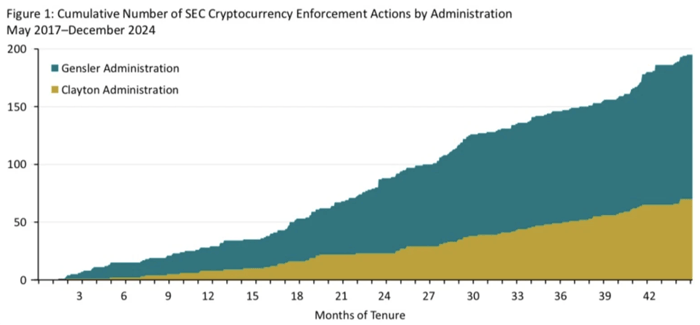
Source: Cornerstone Research
The crypto industry was treated like a villain. Not an industry ripe for innovation, entrepreneurship, and profitable enterprises.
This aggressive stance meant any project issuing a token wanted to stay as far away from securities law as possible. And to avoid scrutiny of the SEC, projects released tokens that were not dependent upon the actions of the founders, CEO, or anybody related to the project.
The industry was avoiding the SEC at all costs. Because for a startup with limited funds and resources, an SEC enforcement letter was a virtual death sentence.
This is why governance tokens became the industry standard. These are tokens that give holders the right to vote on proposals that can dictate how the protocol functions, how grant money gets allocated, and even plan future initiatives.
But it was a distinction without a difference.
In reality, most founders and projects hold a majority of the tokens. It led to the term governance theater. The voting process was nothing but an act, a way to avoid the scrutiny of the SEC.
The unfortunate side effect…
Tokens didn’t accrue earnings. Holders had no legal standing. And since governance was mostly for show, tokens barely satisfied their most basic function.
To be blunt, the assets themselves were not very attractive for investors.
But that was then…
A New Regime
The SEC and Commodity Futures Trading Commission (CFTC) have new leadership. There is no longer regulation by enforcement.
Some have gone so far as to say that the SEC is doing an “apology tour”.
Just last week, Chairman Paul Atkins admitted that registration-based crypto actions filed since FY2022 produced “no investor benefit or protection”. And there was “a bias for volume of cases brought versus matters of investor protection.”
Translation: The Gensler reign produced nothing but fear with no discernible benefit to investors.
This resulted in lawsuits and investigations involving Coinbase, MetaMask, Consensys, Uniswap, OpenSea, Kraken, Robinhood, Yuga Labs, Ondo Finance, Crypto.com, Binance and others being dropped under this new leadership.
But regulators aren’t stopping with a public mea culpa. They’re actively fostering and valuing the digital asset industry as a national priority.
Project Crypto
The current administration has an initiative called Project Crypto. The plan is to make the U.S. the crypto capital of the world. It’s a formal push to not just accept digital assets but literally move finance onchain.
The promises seem grand. But regulators are walking the walk. Just in the last 30 days, we’ve seen:
- A Token Taxonomy was delivered on March 17 that breaks crypto assets into five categories, four of which are not securities.
- As of Monday, certain decentralized finance frontends and self-custodial wallets do not require registration as a broker-dealer.
- Intent to release a Safe Harbor rule for public comment that would grant security law exemptions in the early stages of a project.
- And most recently, the SEC is expected to issue guidance on tokenizing stocks within the coming days to weeks.
The tune has changed.
Regulators are trying everything they can do to right the wrongs of the past and move the industry onchain.
It’s why we see the New York Stock Exchange and Nasdaq preparing their systems for 24/7 tokenized markets and working with the SEC to make sure the projects are sound. Even the Depository Trust & Clearing Corporation (DTCC), which, via its subsidiary DTC, acts as the central depository for almost all U.S. equities is involved in the tokenization game with a green light from the SEC.
This upcoming tokenization guidance could feel like a starting gun for trillions of dollars in stocks to move onchain.
With $1 billion in stocks tokenized today, it would not be surprising to see $50 billion by the end of the year.
What this will mean for capitalism, finance, and your investments will be the subjects we’ll explore in the weeks, months, and years ahead.
Stay tuned…
Your Pulse on Crypto,
Ben Lilly
Editor, Chain of Thought
Continue following Brownstone Research
Add Brownstone Research as your preferred source on Google to see our latest stories in your feed.
 Add as a preferred source
More stories like this
Read the latest insights from the world of high technology.
-
-

Suddenly, the Pond is Covered
It’s a good way to visualize how big, consequential changes can sneak up on you.
-