




Gateways, Not Sandboxes
The venue that wins tokenized stocks will make buying tokenized shares easy and aid the user in choosing which...



I don’t know if we have any Anthropic executives reading this letter. But if so, I have a request.

Cloudflare found 2,000 bugs in their systems.
Among those, 400 were high or critical severity.
That’s bad…
Cloudflare is a cybersecurity company that acts as a middleman that secures a website’s server with visitors.
It helps protect websites from hacking and malicious traffic. It’s an entity that powers over 35% of the Fortune 500 and is the market leader in the space.
That’s what makes their May 18 announcement so important…and unnerving.
Here’s the background…
A month earlier, in April, Cloudflare’s chief security officer, Grant Bourzikas, announced their team was invited to use Anthropic’s latest frontier AI model, Mythos Preview.
Mythos Preview was designed for advanced reasoning and software engineering.
But the model’s capabilities were so impressive, it took Anthropic by surprise, saying it’s a cybersecurity ‘reckoning’.
The claims seemed hyperbolic. Many thought Anthropic was running a sophisticated marketing push.
But then Project Glasswing was announced. The project brought together a coalition of more than 40 technology companies like Apple, Amazon, Microsoft, and Cloudflare.
Anthropic gave the group access to Mythos Preview so the companies could find and patch security vulnerabilities in critical software programs before its eventual release.
The goal was to give good actors a headstart on securing open-source and private infrastructure and code.
That’s how Cloudflare suddenly found thousands of bugs in its systems. We could probably assume that hundreds of thousands more bugs were found across the various members who tested the new model.
But one group was notably absent from Project Glasswing.
And it’s still being left out as the newest model gets released to the public…
Claude Fable 5 was released to the public on June 9. It’s the first available version of its Mythos model that generated a lot of hype months ago.
Initial claims are impressive. And it would seem the anxieties around Mythos’ capabilities were more than marketing buzz.
The model is so powerful that Anthropic released it with guardrails, which the company calls classifiers.
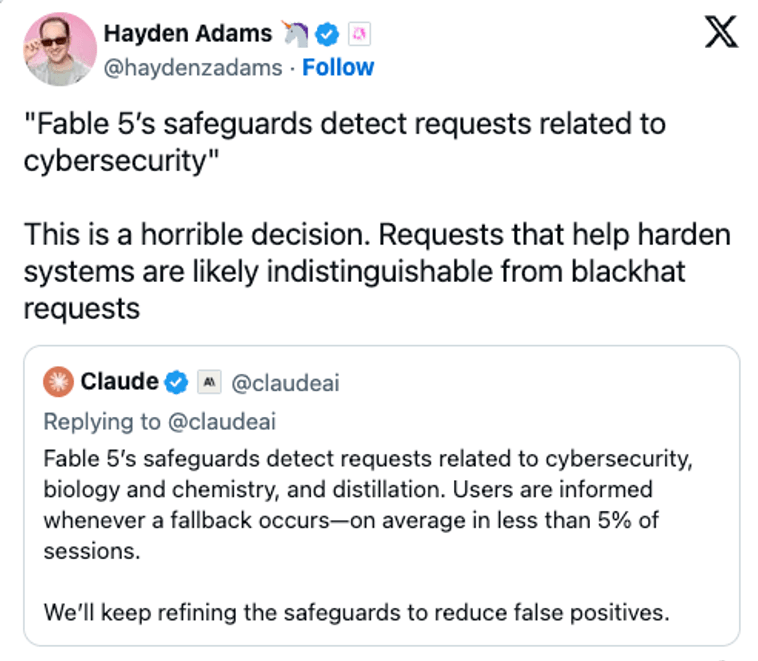
These classifiers relate to several domains, including the one most likely to benefit from the model – cybersecurity.
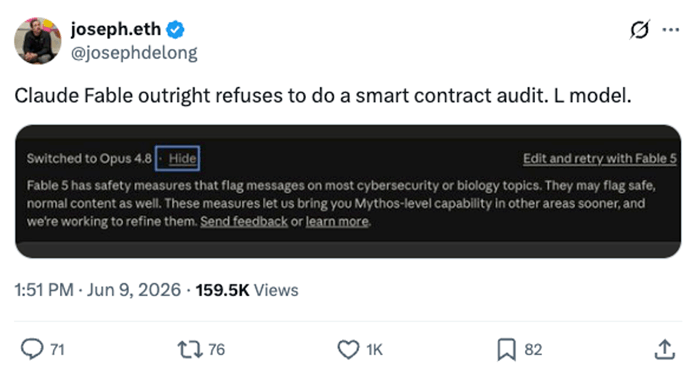
If a classifier determines the model is attempting to audit a security vulnerability, Anthropic redirects the user to the previous model, Opus 4.8.
Put another way, if the classifiers determine a user is pointing the model in a dangerous direction, it takes away the bazooka and hands you a BB gun.
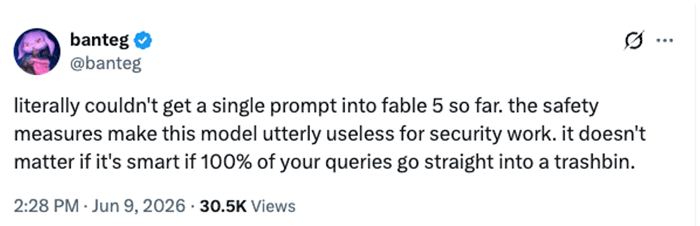
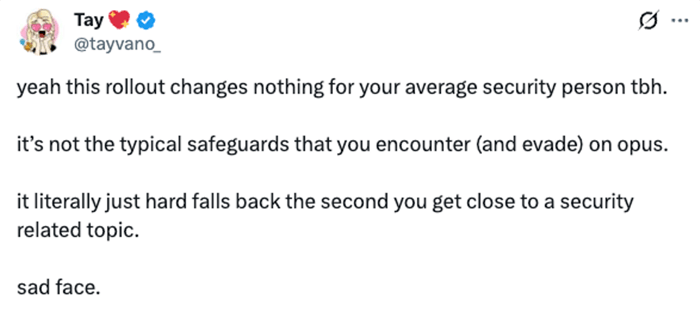
This was sad to see as experienced blockchain smart contract developers were ready to scan their code.
Below is Joseph Delong, a developer who was CTO of Sushiswap and has experience as an Ethereum core developer among other experience…
Source: x.com/josephdelong
Then there was Banteg, a core developer of Yearn Finance, a project that broke barriers in the yield aggregation space when it initially came out.
Source: x.com/banteg
Then there’s crypto security expert Taylor Monahan who founded one of the earliest wallets, MyEtherWallet, and is now over at MetaMask, the provider of arguably the most-used blockchain-based wallet in the world.
Source: x.com/tayvano_
And then there was the founder of the most-used decentralized exchange in crypto, Uniswap.
Source: x.com/haydenzadams
The excitement to fortify some of the most widely used codebases in the open-source public blockchain world was all for nothing.
And it’s genuinely sad to see.
AI models are making exploits more common.
Between January and June 2026, over $840 million has been lost to hacks and exploits.
Kelp DAO, a liquid restaking solution, was the most notable exploit with $292 million of crypto impacted. The hack happened through a sophisticated attack that tricked a bridge into releasing funds from a smart contract.
The token was rsETH, a token backed by ETH. But due to the attack, there wasn’t enough ETH backing all the rsETH that was minted. This caused credit markets and other DeFi applications to run into issues.
The DeFi community came together to make those impacted by the exploit whole. But the event itself was enough to realize that AI models are making more sophisticated attacks possible.
The other major attack that made up the $840 million was Drift Protocol, which saw $285 million stolen. This was a social engineering attack. The attacker was able to meet members of the team and target their computers directly to gain access to valuable credentials.
The attack was also sophisticated in that the hackers whitelisted a worthless token as collateral in their systems. They then made an artificial peg to that asset to drain the protocol of funds by depositing the worthless token into the exchange, and withdrawing tokens of value.
In this incident, users will be made whole over time with nearly $150 million of capital in the user recovery pool. There are also plans to attach protocol revenue to make up the difference over time.
And while users from these exploits are often made whole, one thing is clear. Malicious uses of AI are making the ecosystem a scarier place to transact.
Open source and public systems, by their nature, become more resilient over time. And I hope that Anthropic keeps this in mind when it comes to Mythos.
Their Project Glasswing was a great way to prepare the tech community before the major release. But I’d urge them to give public blockchain systems the same courtesy.
These ecosystems are becoming an integral part of our financial system. As we covered most recently in How Everything Becomes Money, tokenized assets will be measured in the trillions of dollars in the near future.
Major exchanges are preparing to go live with their tokenization solutions. Even nation-state assets are sitting on these public systems.
Digital assets and blockchain ecosystems are not a sideshow…they’re the future of finance.
The good news is that once these systems are applied to current codebases, they do become more resilient.
The same cannot be said for various institutions that keep the curtains drawn tight. We’re talking about major banks.
About ten years ago, news broke that over 100 banks in 30 countries discovered almost $1 billion was stolen over the course of two years.
And the hack came after JPMorgan Chase was hit with a cyberbreach that impacted 76 million households. Morgan Stanley was also hit with a campaign shortly before that.
But that’s only what we know.
Morgan Stanley treated the breach as a secret, and many others likely do the same… Which is why the theft of nearly $1 billion took years to complete.
The same isn’t true with public and permissionless blockchain systems. When a hack or exploit happens, it’s known right away. Which means there are more eyes attempting to understand what happened and help build more resilient systems.
With the help of powerful AI tools like the Mythos Class models from Anthropic, these networks will be better equipped to act as the base layer for our global financial system.
I don’t know if we have any Anthropic executives reading this letter. But if so, I have a request.
Please, open the guardrails to developers in DeFi.
Your Pulse on Crypto,
Ben Lilly
Editor, Chain of Thought
Add Brownstone Research as your preferred source on Google to see our latest stories in your feed.
 Add as a preferred source
Read the latest insights from the world of high technology.
The venue that wins tokenized stocks will make buying tokenized shares easy and aid the user in choosing which...

The dream of every central bank critic could be coming true – we might actually end the Fed.

JPMorgan can keep both pieces of infrastructure as long as it likes. But customers will decide where to do...