




The (Temporary) Death of CLARITY
There’s plenty of blame to go around, and I’m more than happy to name names.



As interesting as this project is, there is one aspect that really grinds my gears.

There’s an ugly secret with cryptocurrencies.
Most exchanges and insiders don’t want you to know.
It’s this: The lack of needed disclosures works in their favor and against the average investor.
Keeping things opaque—or even just unclear—is like rigging the game in their favor.
I’ll share an example in just a moment…
But this is why regulatory clarity is essential to the industry. And it’s why we’ve been tracking the progress of the CLARITY Act for nearly a year.
Investors deserve answers to basic questions like “How many tokens for a project will be in the market tomorrow?” “How many in a year?”
It’s straightforward stuff. But, very often, those answers are (intentionally or unintentionally) obscured.
They’re obfuscated behind incentive campaigns, vesting schedules, foundation allocations, team allocations, and even when the clock on vesting schedules began.
Your head begins to spin.
Say what you want about traditional finance, but that sort of nonsense would never fly.
Companies must report outstanding shares, vested shares, equity compensation, and even substantial holders of the stock in their quarterly reports, annual reports, and other disclosure documents.
It’s these small, sometimes mundane, details that make America’s financial markets the most trusted in the world. The blockchain industry deserves similar investor protection.
I’m hopeful that these disclosures become mandatory and normal in the years to come. If projects are thoughtful in how they launch a token and manage their token’s supply, this asset class will become more attractive.
That day will come. But it’s not here yet.
Let me show you what I mean…
I’ve been following 3Jane for a while.
It’s an Ethereum-based protocol that offers unsecured credit.
That simply means it offers loans based on the creditworthiness of the borrower and not on any assets used as collateral.
3Jane isn’t the first to try this. There’s an entire graveyard filled with ill-fated projects that tried to pull it off. Celsius, Genesis, and many of the bankruptcies in 2022 were attempting this model in some capacity.
But 3Jane might be the one to do it.
Users can connect their Ethereum wallet to their bank account via Plaid. The project also considers traditional credit scores. It happens privately, so the data never lands onchain where anybody can see it.
3Jane can assess the creditworthiness of a borrower without exposing their information to the entire ecosystem. It’s a monumental moment for blockchain technology.
And tomorrow, May 12, the protocol is going “risk-on” by ramping up its rollout to prove its model works.
I’ve been eager for 3Jane to reach this stage. I originally came across them in early 2025. This was before they raised $5.2 million in a June 2025 seed round with strong backing from well-known crypto VCs such as Paradigm, Coinbase Ventures, Wintermute Ventures, and Robot Ventures, among others.
I expect to track this project closely. It’s doing something truly novel in decentralized finance (DeFi). And whether it proves successful or not, this will be a sector of the market that more teams will want a piece of.
Now, as interesting as this project is, there is one aspect that really grinds my gears.
It’s the transparency…or lack thereof.
The protocol is currently bootstrapping itself by offering its native JANE token in exchange for capital. Users who lend capital can earn JANE tokens. This capital can then be deployed into loans for the protocol to generate revenue via financing.
It’s essentially a way to pay for borrowed capital to prime the pump.
This is pretty common practice in DeFi.
But you may be wondering how much compensation users get.
That’s where it gets…murky.
Reading the documents on 3Jane’s website, the supply of tokens is about as clear as the muddy Mississippi.
See for yourself:
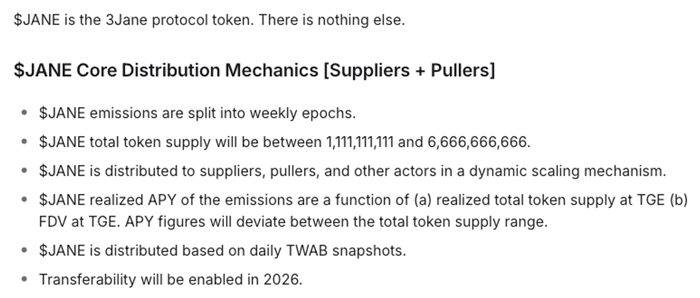
Source: docs.3jane.xyz/jane/liquidity-mining
It’s my literal job to analyze blockchain projects. And even I shook my head in disbelief on this one.
Let’s start with the second bullet point. It says the token supply could be anywhere from 1.1 billion to 6.6 billion. That’s a 5.5 billion token supply margin.
Imagine if a traditional IPO tried to pull this move:
Company: “Hey, we’re holding an IPO.”
Investors: “Great! How many shares will be offered?”
Company: “Oh, I don’t know. Somewhere between 1.1 and 6.6 billion.”
Investors: […]
The market doesn’t seem to know what to make of it either…
Pendle is a market that is almost purpose-built for this type of situation. It creates a market where traders can either lay claim to all token incentives or essentially sell the token for straight US stablecoin yield.
I’ll spare you the math as it’s quite complex — creating even more opacity — but the market is pricing JANE tokens at 2.76 tokens per dollar per day of liquidity.
We can use the 4% yield that exists on Aave to determine the current cost of capital. That gives us a price-per-token with JANE of about $0.03.
That means the project could be worth anywhere from $33 million to $200 million based on the supply range they listed. It’s a wide range.
But we also don’t know anything about how much the VCs or the team own. We don’t even know anything that would allow us to guess. I’m not even entirely certain that’s the upper cap of total JANE tokens that could ever be in circulation.
It feels like gambling, which is unfortunate. This is a unique project. And it’s coming to market at a great time, with improving prices, sentiment, and regulatory clarity.
Yet we’re hamstrung by poor disclosures.
This needs to change. Investors deserve it. The industry deserves it.
Projects that do disclosures right will be rewarded as the bull market strengthens. It’s a thesis we’ve held at Permissionless Investor, one that looks primed to play out in the coming months.
For this industry to shine, the era of murky disclosures needs to end.
I’m confident it will in time.
Your Pulse on Crypto,
Ben Lilly
Editor, Chain of Thought
Read the latest insights from the world of high technology.
There’s plenty of blame to go around, and I’m more than happy to name names.


If CLARITY stalls, for whatever reason, the industry will look to its fallback plan...