




The Biggest Portfolio Innovation in 50 Years Has a Problem
New business models will spring up, and old models will not survive.



By now, investors have learned the “don’t fight the Fed” rule. Very soon, they might have to learn a new rule.

There’s one lesson every investor learned over the last 15 years …
Don’t fight the Fed.
The expression came about after 2008. In response to the crisis, the Fed cut its key rate to essentially zero, but it didn’t stop there.
The Federal Reserve purchased various bonds from the market. That new demand for bonds forced down yields and flooded the markets with liquidity. That liquidity backstop coaxed investors down the risk curve. Put more simply, the Fed was incentivizing investors to buy stocks. And, with a little time, that’s exactly what they did.
Today, you know this maneuver as “quantitative easing,” or “QE.” And the Fed’s been doing it off and on for nearly two decades. We saw this with QE1, QE2, Operation Twist, QE3, and the helicopter money era of 2020.
All these asset purchases had to go somewhere. And that “somewhere” was the Fed’s balance sheet, which swelled from roughly $900 billion in 2008 to nearly $9 trillion by 2022. And as a result, the S&P 500 ran more than 600% off its 2009 low.
“Don’t fight the Fed” is the recognition that the central bank effectively has a money printer in the basement. And when it decides to fire it up, you just have to go along for the ride. It’s been one of the most profitable slogans in markets.
I mention all this because it looks as if another liquidity bazooka is aimed at the markets. But this time, it’s not coming from the Fed. It’s coming from the Treasury.
The U.S. Treasury is knowingly selling more debt than the market can naturally absorb, then turning around and engineering the buying itself.
It’s not technically QE, but it should amount to the same thing: Scott Bessent of the U.S. Treasury is engineering the next liquidity boom.
Let me show you what I mean …

When your household bills spike, Wall Street cashes in. Hedge fund veteran Larry Benedict says it's all down to one ticker. With the current inflation, it's already made payouts like $7,623 in eight days possible. Click here to get the free ticker now.

According to this document Jeff is holding in his hands, this hated tech sector is finally set to boom… And if you know what to do, you could make more money in the next 60 days than most people make in an entire year.
It’s been two months since Robinhood Chain went live.
The total amount of assets on the chain is approaching $2 billion, with half that value attributed to stablecoins. And on Sept. 1, the chain did $1.595 billion in DEX volume.
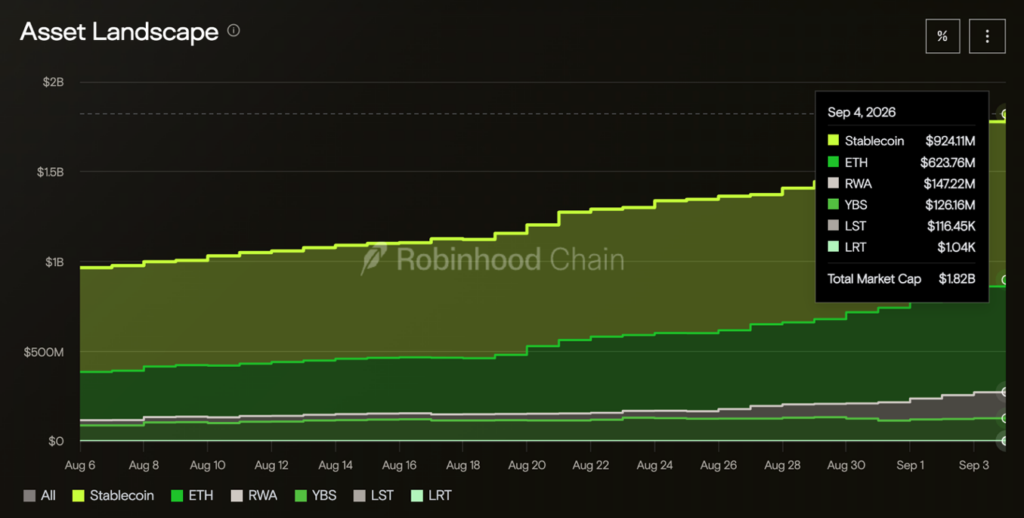
Source: arbdata.com/robinhood
The activity is surging. At the center of it all are tokenized stocks.
Most of the roughly 200 stock tokens, worth $112 million, are sitting on Uniswap.
What we need to know is that those assets on Uniswap sit in a pool. The pools consist of two assets. The first asset is the tokenized stock. The second asset is one the market wants to move in and out of, which is a stablecoin. It also gives the market an easier time pricing the stock token in U.S. dollars.
That’s important because it means that every dollar of tokenized stock generates a similar need for stablecoins. USDG is the primary stablecoin on Robinhood Chain. We can see NVDA and the S&P 500 index pools in the image below.
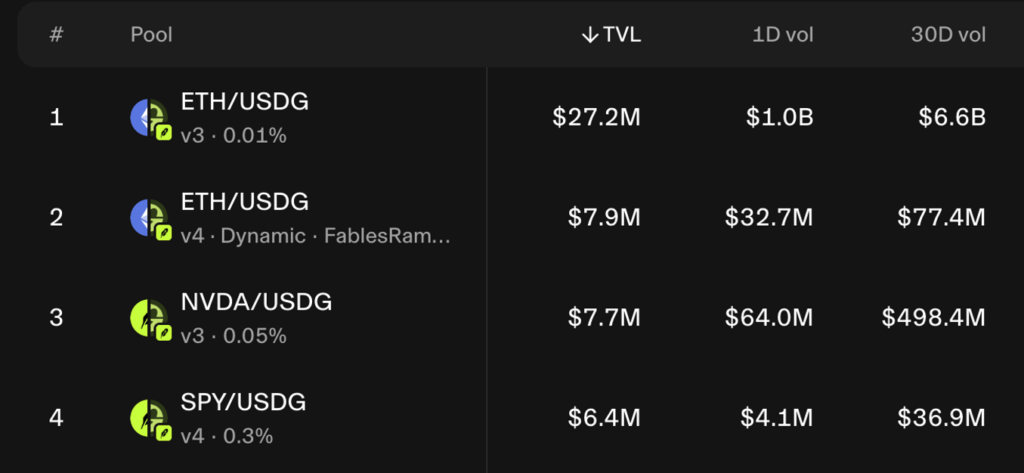
Source: app.uniswap.org/explore
This is a flywheel. More tokenized stocks mean more stablecoins, which means more liquidity, which means more tokenized stocks, which means more stablecoins, which means more liquidity.
You get the idea …
We can see this for ourselves by looking at something like Morpho, a lending and borrowing protocol. It’s grown from $260 million to roughly $488 million in assets on its platform. Maple Finance is another protocol; it specializes in originating onchain credit. Stablecoin supply on Robinhood Chain is now north of $800 million.
The bottom line is that tokenized stocks are causing a surge in stablecoin demand. This then boosts the credit markets. It’s in part why stablecoin growth will likely hit $1 billion this weekend. And the flywheel’s not going unnoticed.
Coinbase listed its own tokenized stocks nearly two weeks ago. On Aug. 24, it launched tokenized Apple, Nvidia, Meta, and Alphabet on its own chain, Base.
These assets are backed by real shares in custody, issued under Abu Dhabi regulation. The new tokens have attracted roughly 50 DeFi protocols that have committed to integrating them.
It’s early, but volumes are starting to swell with the decentralized exchange Aerodrome seeing a 5x surge in trade volume when it comes to stock tokens in the last week.
But here’s the catch…
These tokens are for non-U.S. individuals only. American capital is on the sidelines watching this boom.
But there’s every reason to believe this won’t last long.
The DTCC, the plumbing beneath nearly every U.S. stock trade, is gearing up for an October launch of its tokenization engine. It successfully processed the first live U.S. trades with tokenized DTC-custodied assets on July 15, calling it “tokenization turned into reality.”
The working group behind it reads like a roll call of American finance: BlackRock, Goldman Sachs, J.P. Morgan, Citi, Bank of America, Morgan Stanley, Schwab, State Street, Nasdaq, NYSE, and others. The initial scope covers Russell 1000 stocks, major ETFs, and Treasurys.
Which pairs up with what the SEC has been up to …
Chair Atkins’ “innovation exemption” is the relief that would make tokenized stocks legal for U.S. persons. It was drafted under Project Crypto and was supposed to be out months ago.
But SIFMA, the trade group for the banks and exchanges, warned the SEC against this exemption. The release was shelved again on Aug. 13.
But watch what the incumbents did while their lobbyists stalled: They continued pushing forward with the DTCC pilot. The banks aren’t fighting tokenization. They’re fighting to make sure it launches on their rails on their timeline.
With the DTCC engine going live in October, we should not be surprised if the exemption lands right alongside it. October is looking like the starting gun. And it appears Coinbase, Robinhood, and several other players know this as they jockey for the best starting position.
And for one man in the Trump administration, it can’t get here soon enough.
I have every reason to suspect U.S. Treasury Secretary Scott Bessent is watching this development closely.
That’s because Bessent has a problem.
He needs to tamp down yields at the long end of the curve.
Last month, the Treasury announced it plans to double the buying of 10-to-30-year Treasurys from $2 billion to over $4 billion, with reports it’s prepared to tap into the nearly $1 trillion Treasury General Account to fund more. The plan is then to reissue this debt via short-term bills.
Many look at this and see “yield curve control,” which is an attempt to coax long-term rates to where the Treasury believes they “should” be.
And it is that. But it’s also something else.
Remember, stablecoins are backed by short-term Treasurys, which are considered “cash alternatives.” Also remember that tokenized stocks need to be issued alongside stablecoins. More tokenized stocks mean more stablecoins, which means more T-bills.
Bessent sees this, and he’s controlling the spigot …
And it couldn’t be happening at a better time.
Bessent has publicly projected that stablecoins will be a $3 trillion-plus market by 2030. And in January, the GENIUS Act goes live. That law will make every regulated stablecoin a warehouse for short-term Treasurys.
In fact, USDT stablecoin issuer Tether alone holds well over $140 billion worth of T-bills, making it one of the largest sovereign holders on earth.
For Bessent, this new demand helps solve his problem. You likely noticed that the federal debt recently surpassed $40 trillion. Interest on that debt is now north of $1 trillion annually. Rising rates only make it worse.
The Treasury needs to get rates down. That means it needs to find new buyers of America’s debt. And stablecoins could be just those buyers.
None of this is a secret. Bessent has outright said, “A thriving stablecoin ecosystem will drive demand from the private sector for US Treasuries, which back stablecoins. This newfound demand could lower government borrowing costs and help rein in the national debt.”
Let’s recap how this is likely to play out:
Stablecoins get their T-bill backing. Bessent gets to tamp down yields at the long end of the curve.
Win-win.
More than a decade ago, the U.S. Federal Reserve injected liquidity into the market through bond purchases. This time, the strategy is different, but the effects will likely be the same: A wave of liquidity is coming to markets.
By now, investors have learned the “don’t fight the Fed” rule. Very soon, they might have to learn a new rule.
Don’t fight Bessent …
Your Pulse on Crypto,
Ben Lilly
Editor, Chain of Thought
Read the latest insights from the world of high technology.
New business models will spring up, and old models will not survive.

The future of finance is coming. And the central bankers, finally, are ready to accept that.

Each trust assumption in our current financial system comes with a cost...