




Wall Street’s “Blockbuster Moment”
JPMorgan can keep both pieces of infrastructure as long as it likes. But customers will decide where to do...



It’s a way to give Bessent greater flexibility when managing the issuance of the asset that the financial system will need as we get closer to GENIUS Act implementation.

Editor’s Note: Next Wednesday, our colleague – Market Wizard Larry Benedict – is holding an emergency briefing…
He says money has started leaving the AI giants that dominate millions of retirement accounts… and folks whose retirement remains tied to those former leaders while the new winners rise elsewhere may be in for a retirement reset.
But he also has his eye on the one ticker that could stand to benefit as more than $1 trillion starts to move… And he believes it could become the first major opportunity of what he’s calling the “AI Retirement Reset.” He’s explaining everything next Wednesday, August 26, at 8 p.m. ET. You can go here to sign up.
By 1948, the war was over…but Europe was still in shambles.
The U.S. had pledged to help war-torn Europe rebuild itself via the Marshall Plan.
It was a multi-year financing effort. One that resulted in $13.3 billion U.S. dollars flooding the offshore financial system.
The U.S. dollar was key. No other currency was considered stable. Currencies from other countries combated swelling debts as they tried to finance the reconstruction efforts after the war.
The postwar recovery was strong. Europe saw its GDP rise twice the rate of any other period. The two decades post-war is known as a Golden Age of Growth.
Harry Truman would describe the Marshall Plan as “one of America’s greatest contributions to the peace of the world.”
But here’s the part few know…
The U.S. dollars that helped fuel the efforts remained offshore well after the Marshall Plan was complete.
The combination of economic growth and idle U.S. dollars in the bank led to an opportunity.
A bank known as Midland in London was one of the earliest to innovate using U.S. dollar deposits.
Midland realized it could borrow money from one place at one rate and deposit it in another for a higher rate. This is a bit of an oversimplification as they also did some currency swapping, but the result was a profit from the rate difference.
It was a significant financial innovation in money markets at the time. Midland’s arbitrage strategy was so successful that U.S. dollars began to once again, flood into the region.
Midland Bank, which was later acquired by HSBC Bank, grew its U.S. dollar deposits from $0 in May 1955 to nearly $80 million in three months. We can see that in the chart below.
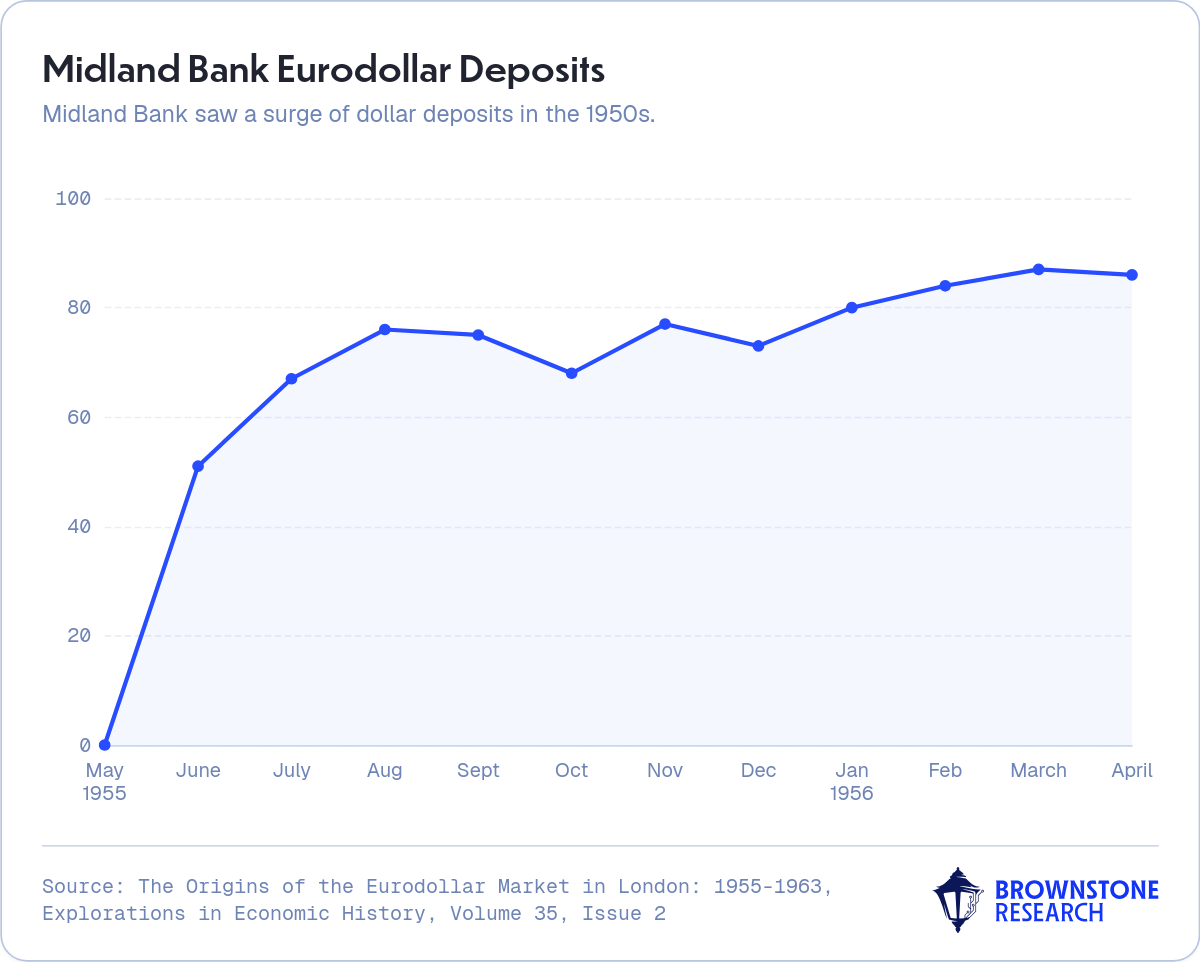
Its ability to generate profitable opportunities made it a source for U.S. dollar deposits. And its success didn’t go unnoticed.
By the summer of 1955, The Economist reported that European banks were switching their short-term assets from New York to London to take advantage of the spreads showing up in foreign markets.
It was a monumental market shift. One that spread like wildfire across banks in London and other European cities.
The financial acumen of Midland sparked the rise of what is now known as the Eurodollar market, a term given to U.S. dollars sitting in a European bank account.
The combination of a prospering Europe and institutions profiting off the difference in U.S. interest rates and other regional rates led to $30 billion held offshore by the 1960s ($285 billion in today’s dollars). Then $385 billion by the 1970s ($2 trillion in today’s dollars).
By the late 1990s, nearly 90% of international loans were happening in the Eurodollar market.
And at nearly $14 trillion, the market is still going strong today. It’s arguably one of the largest and most important financial markets that underpin global finance. It’s a market built on simply providing capital to take advantage of the differences in interest rates around the globe.
It’s an incredible figure for a financial market overseas. It’s similar in size to the U.S. market itself…
And it’s a system the U.S. monetary system does not control. As a result, the U.S. often finds itself putting out fires when issues arise.
The COVID-19 pandemic in March 2020 is a great example. The U.S. Federal Reserve responded to Eurodollar borrow rates that were becoming excessive by setting up swap lines, expanding access to its facilities, and even creating a repo facility for the world to use.
To say the U.S. would like to have greater control over this overseas market is an understatement. And it’s why the Eurodollar’s replacement will arrive faster than you think…
The stablecoin market reached a similar size to the Eurodollar market of the 1960s… But did it four times faster.
Stablecoins are cryptocurrencies, but not as volatile. That’s because they are pegged, usually to a fiat currency or a commodity.
When it comes to U.S. dollar stablecoins, they are usually backed with cash, short-term U.S. treasuries, or overnight repurchase agreements. This makes their backing very similar to cash.
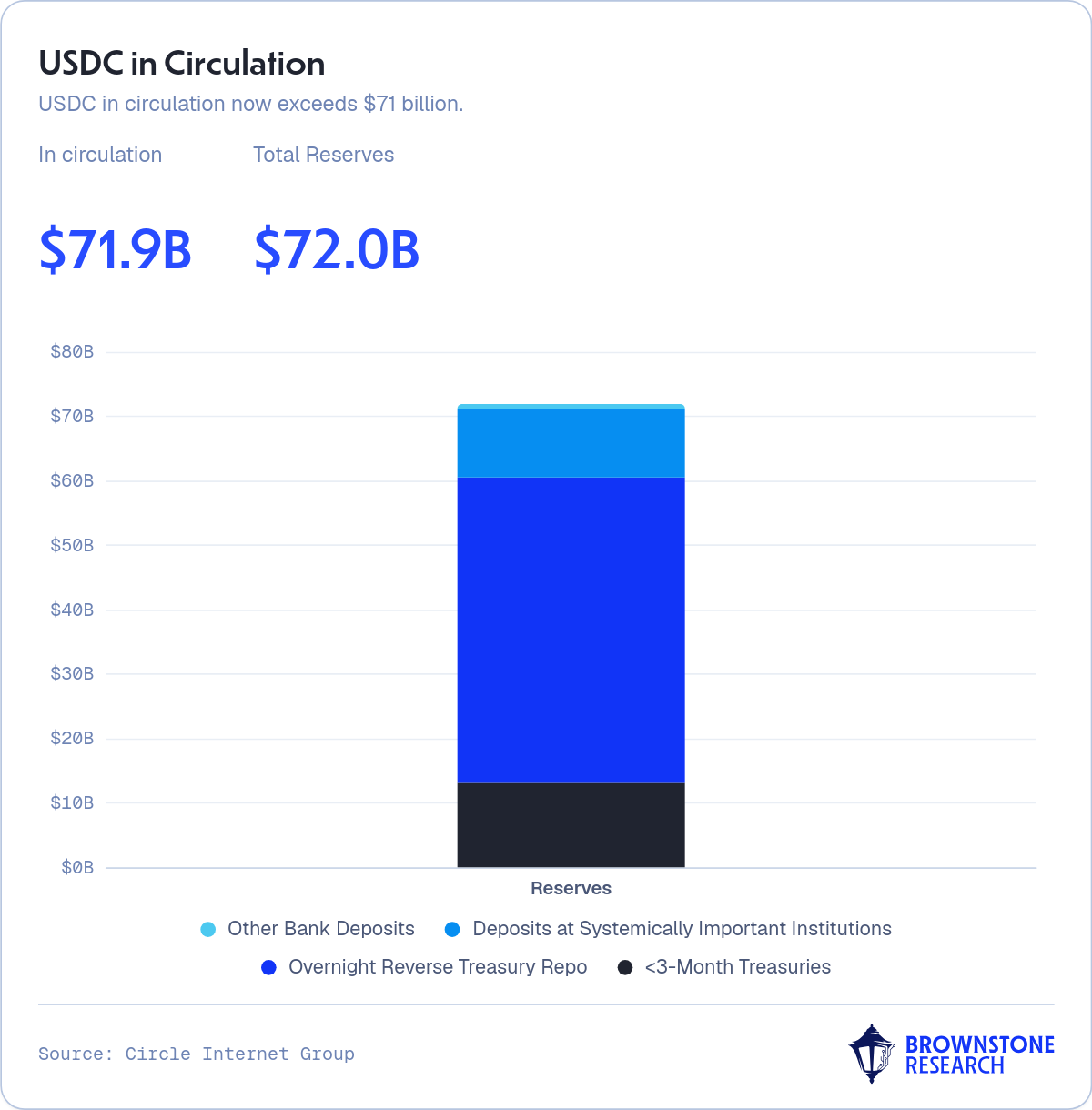
Let’s take Circle’s USDC stablecoin as an example. It has $72 billion in reserves made up of cash-like assets to support the $71.9 billion worth of USDC in circulation.
Tether’s USDT is another stablecoin. Like USDC, USDT has $187 billion in assets backing the $183 billion in circulation across 14 chains—most of it in U.S. Treasury Bills.
This is in stark contrast to the Eurodollar market, which has no treasury backing it.
Which is the exact reason why the U.S. dollar stablecoin market is of much greater strategic importance than most realize.
We’re talking about a market that already demands $100s of billions in U.S. debt. In fact, if Tether was a county, it would be the 17th largest holder of U.S. debt, putting it roughly on par with Saudia Arabia.
And soon, Tether, along with other stablecoins, will become the top holders of America debt.
That’s because the GENIUS Act, the law that regulates U.S. dollar stablecoins, is ready to go into effect on January 18, 2027.
That means that, in the weeks and months to come, various agencies are required to roll out their rules and policies as it pertains to stablecoins.
The U.S. Department of the Treasury is no different. Just a few days ago, it issued a notice on how it’ll regulate stablecoin issuance in the U.S. and abroad.
To put it bluntly, the U.S. Treasury is about to unleash the eurodollar’s replacement…
The U.S. Treasury has enormous power. It will have a prominent role regulating who can issue stablecoins while also issuing the assets that will back those stablecoins.
And it’s becoming clear that Treasury Secretary Scott Bessent knows this…
The U.S. Treasury recently announced it is doubling the maximum size of its bond buyback operations in the 10 year and 30 year maturity.
It’s a way to give Bessent greater flexibility when managing the issuance of the asset that the financial system will need as we get closer to GENIUS Act implementation.
He’s preparing himself to better manage the main product his department sells. And to do it just as demand for stablecoins, and as a result, U.S. debt ramps up.
It’s a tool the government is excited about.
Long time readers will recall we mentioned a month ago in A Stablecoin Takeover that we should expect to hear a bigger push coming for stablecoins, just as the national debt eclipses $40 trillion.
Here we are…
Bessent is writing posts on social media about stablecoins. The Office of the Comptroller of the Currency Jonathan Gould is saying, “it’s becoming ordinary course to involve and integrate payment stablecoins, etc., in the business plans that we are now seeing presented to the OCC for consideration”.
Next week is the Fed’s Jackson Hole Economic Policy Symposium. The topic this year: “Financial Innovation: Implications for Payments and Policy”.
Stablecoins will now be front and center for the coming weeks to months.
They are impossible to ignore.
And what the market seems to be missing is the fact they will be a boon for the cryptocurrency market. It’s in part why we are now seeing Bitcoin up 20% and Ether up 25% over the last few days…
Attention is coming back to the digital asset ecosystem.
What that means for us as investors will be the topic of our next few issues.
Your Pulse on Crypto,
Ben Lilly
Editor, Chain of Thought
Add Brownstone Research as your preferred source on Google to see our latest stories in your feed.
 Add as a preferred source
Read the latest insights from the world of high technology.
JPMorgan can keep both pieces of infrastructure as long as it likes. But customers will decide where to do...

The bank realizes it needs to compete in the future of finance, and it’s one where agents roam freely...