




Crypto’s Point of No Return
Get these assets so entrenched, so dug in, that no future administration can rip them out without creating systemic...



U.S. debt is about to be the currency used by everyday individuals across the globe.

U.S. Treasury Secretary Scott Bessent is head over heels for U.S. stablecoins.
It’s not hard to understand why…
The two dominant U.S. stablecoins are USDT by Tether and USDC by Circle. They account for more than $250 billion in circulation.
And Bessent takes comfort in knowing that the USDT and USDC backing is predominantly U.S. Treasuries – good old American debt.
This setup means that as more stablecoins are minted and transacted across various public blockchains, more U.S. Treasuries need to be purchased and held.
And if the stablecoin market reaches approximately $3.7 trillion by the end of the decade – as Bessent believes it will – then stablecoins will be a major source of current and future demand for U.S. government debt.
But he hasn’t yet mentioned the impact it’s already having on foreign countries and how that’s about to accelerate its adoption at just the right time.
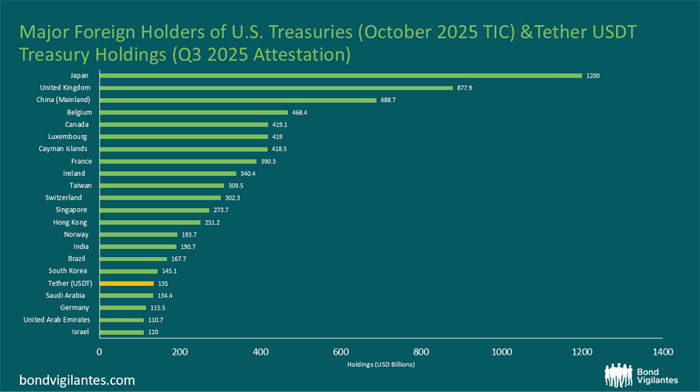
If Tether’s USDT were a nation, it would rank among the top 20 foreign holders of U.S. Treasuries.
Source: Bondvigilantes.com
Japan is at the top of the list at $1.2 trillion… far less than what Bessent expects the stablecoin market to hold by the end of the decade. A stablecoin market that is currently less than $300 billion in size.
Which is to say, if Bessent gets his wish, he has $3.4 trillion of fresh demand coming for the debt he needs to sell. An amount that far outweighs what the top countries hold to this day.
I’ll get into where this demand is about to show up from in just a bit… But first, let’s lay out why stablecoin adoption is primed to ramp up.
The first…
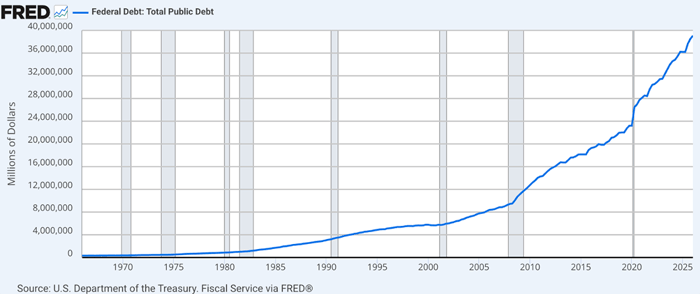
U.S. debt is about to hit $40 trillion around the beginning of September. If you were to stack $40 trillion worth of $100 bills, it would be more than 27,000 miles high. That’s higher than many satellites orbit the Earth or greater than the distance around our equator.
Source: Federal Reserve Bank of St. Louis
It’s also 130% of what the U.S. economy produced in 2025.
Which is to say, debt levels are getting out of hand.
Bessent needs an answer ready to calm a public that’s about to see our government hit this milestone in the coming weeks.
The second reason why adoption is primed to ramp up is the timing…
When the stablecoin bill known as the GENIUS Act was passed in July 2025, a one-year rulemaking deadline was put into place. That deadline requires U.S. regulators to issue final regulations needed for the industry.
That one-year mark passed last week with some regulators yet to release a final set of regulations.
While the deadline does nothing to change the date when the law comes into full effect on January 18, 2027, it does suggest we’ll hear a bigger push in the coming weeks around stablecoins since the law already demands it…
Just as the national debt eclipses $40 trillion.
It sets up a situation where Bessent will go ahead and echo what he has already stated before:
A thriving stablecoin ecosystem will drive demand from the private sector for U.S. Treasuries, which back stablecoins. This newfound demand could lower government borrowing costs and help rein in the national debt. It could also onramp millions of new users – across the globe – to the dollar-based digital asset economy.
We can expect him to get very vocal on this in the coming weeks since the adoption of stablecoins helps reduce financing costs for the nation.
And while Bessent believes demand will come from the private sector…
The GENIUS Act’s implementation is accelerating adoption far beyond that… Just as our debt woes come to a head.
The Bolivian government is running out of options. Its native currency is the Bolivian boliviano or the BOB.
From 2008 until a few weeks ago, the exchange rate was around 6.90 BOB for $1 USD.
It has now jumped higher to 10.65 BOB for $1 USD.
The jump followed the news that the Bolivian government is ending its 15-year dollar peg to restore economic stability to its country.
Removal of the peg was recommended by the International Monetary Fund, which is working with Bolivia to work out $2.5 billion in financing.
The peg removal should help normalize currency markets, as exchange rates have been inconsistent due to the country experiencing a shortage of dollars. The shortage means the U.S. dollar is valued higher than the nation’s own currency.
And the government’s peg removal acknowledges it.
What is most interesting here is that the country is trying to figure out ways to attract dollars.
And the most recent idea is to integrate Tether’s USDT into its national payments system. This would represent one of the most significant moments far stablecoin adoption.
The ramifications would mean the USDT coin would circulate alongside bolivianos and U.S. dollars in the Bolivian economy.
This is incredibly significant. Stablecoins are becoming the currencies of countries.
Said another way… U.S. debt is about to be the currency used by everyday individuals across the globe. It’s the biggest addressable market there is. And it’s how Bessent is going to make good on $3.7 trillion in stablecoins by the end of the decade.
And it seems the writing is on the wall for it to happen.
The Bank of International Settlements (BIS) published a paper titled “The impact of stablecoins on the international monetary and financial system.” In the paper, the authors discuss the topic of monetary sovereignty and digital dollarization.
It’s a topic that mentions stablecoins are overwhelmingly dollar-denominated. In fact, 99% of stablecoins are U.S. dollar-denominated.
The issue mentioned in the paper is that countries experiencing high inflation or implementing capital controls will see the highest rate of adoption for U.S. dollar stablecoins in the years to come.
The bank seems to view it as a negative threat. But in reality, it should be embraced.
Governments, realizing they can’t get away with poor monetary policy, will create a check on countries. Specifically, if they start printing endless dollars to address poor governance, their quick fix will fail even faster.
And Bolivia seems to realize it can even be used to improve the inflow of dollars.
It’s a proposal that’s worth watching in the weeks to come, particularly as Bessent prepares to address the fast-approaching $40 trillion debt milestone. Bessent already knows countries around the globe are about to adopt stablecoins…
Whether they do it willingly or begrudgingly is what we’ll watch for in the years to come.
In the meantime, it’s worth noting that these stablecoins are running on public and permissionless blockchains. They’ll use the various finance protocols for swapping, borrowing, lending, and yield solutions that exist on these networks.
It’s a reality that means the U.S.’s stated goal in Project Crypto – where regulators and the White House look to put finance onchain – is not the end destination for only the United States.
It’s the end state for how global finance will evolve in the coming year.
Public blockchains are getting ready to run transactions not just for individuals, but for nations. And most don’t see the shift coming.
Your Pulse on Crypto,
Add Brownstone Research as your preferred source on Google to see our latest stories in your feed.
 Add as a preferred source
Read the latest insights from the world of high technology.
Get these assets so entrenched, so dug in, that no future administration can rip them out without creating systemic...
There’s plenty of blame to go around, and I’m more than happy to name names.