




What Most Investors Missed at Jackson Hole
The future of finance is coming. And the central bankers, finally, are ready to accept that.



New business models will spring up, and old models will not survive.

The biggest innovation in portfolio management in 50 years just took place.
And it won’t stick…
The portfolio game changed in 1976. At the time, Vanguard founder John Bogle believed active trading or stock picking was a loser’s game. Much of this was due to fees, taxes, and human error.
As a result, most investors failed to beat the broader market.
Bogle’s solution: Buy the market.
Vanguard launched the first index mutual fund to the public in 1976. It was the Vanguard 500 Index Fund. The goal was to simply match the performance of the S&P 500.
While that was unique, it was the fees associated with the fund that were the difference maker—there were very few.
Vanguard eliminated high sales loads, reduced expense ratios, and slashed brokerage commissions. John Bogle also made a revolutionary change to ownership…
Most mutual funds are owned by outside management companies. Vanguard flipped the script and gave ownership to the very people who invest in the fund.
The move saved hundreds of billions of dollars. It set in motion the strategy of passive investing. And it endeared Bogle to millions of investors, the self-described “Bogleheads.”
More importantly, the financial industry responded by lowering the high fees charged on mutual funds. And eventually, the low-cost ETF trend launched with Vanguard won over investors.
Today, there are trillions of dollars following the market through various index-tracking vehicles. The State Street SPDR S&P 500 ETF (SPY) alone has more than $800 billion in assets under management with an expense ratio of less than 0.1%.
Bogle changed the portfolio management game. And half a century later, it’s changed again.
Only this time it’s not in our brokerage account.

If you’ve given up on cryptocurrencies, you could be making a massive mistake… Because now that we’re seeing signs of a bottom, Jeff is getting ready for a NEW boom that could help you grow a tiny stake into a six-figure payout. Click here to see the details because the next 60 days will be critical.
IPO expert, Jason Bodner, spent nearly two decades helping companies go public… and he’s learned the truth about IPOs. Today, he’s revealing a counterintuitive way to set your portfolio up for a better chance at success as OpenAI and Anthropic go public. Click here to find out more.
Bitwise Asset Management was founded in 2017 in San Francisco, California.
It is one of the largest and fastest-growing crypto asset managers. Its flagship product is also the world’s largest crypto index fund that goes by the ticker BITW.
BITW is the Bitwise 10 Crypto Index ETF, which holds more than $1.25 billion in assets. It tracks the 10 largest digital assets by market cap and gets rebalanced monthly.
The team is also involved in a variety of other services such as staking, private funds, and curated model portfolios to make crypto easier to add to a typical investment account.
It balances the complexity of crypto with the comfort of traditional brokerage accounts.
But now, it looks to be moving out of that comfort zone and creating a new way for investors to gain access to a portfolio of assets.
Last week, Bitwise launched Automated Token Portfolios (ATPs).
On the surface, we might think we know what ATPs are based on their name…
Essentially, it’s a portfolio of stock tokens that sit onchain. And Bitwise handles the rebalances automatically, just like an index-tracking ETF would.
But there’s one big difference between what Bitwise offers and a traditional index fund: Bitwise doesn’t hold the assets on behalf of investors. It’s a fully self-custodial solution.
It’s made possible thanks to what we discussed last week in Redefining Our Idea of “Money”. Specifically, tokenized stocks being offered by Coinbase.
We mentioned in that piece that the main function of these assets was their compatibility with decentralized finance (DeFi).
Since we first touched on Coinbase’s announcement, trading volume has surged. Here is the volume on Aerodrome over the last week on the heels of tokenized stocks going live on Coinbase’s layer-two Base chain.
The reason this is worth mentioning is that the Coinbase-issued tokenized stocks are at the heart of Bitwise’s ATPs. This includes tokens such as Nvidia, Apple, Google, and many others.
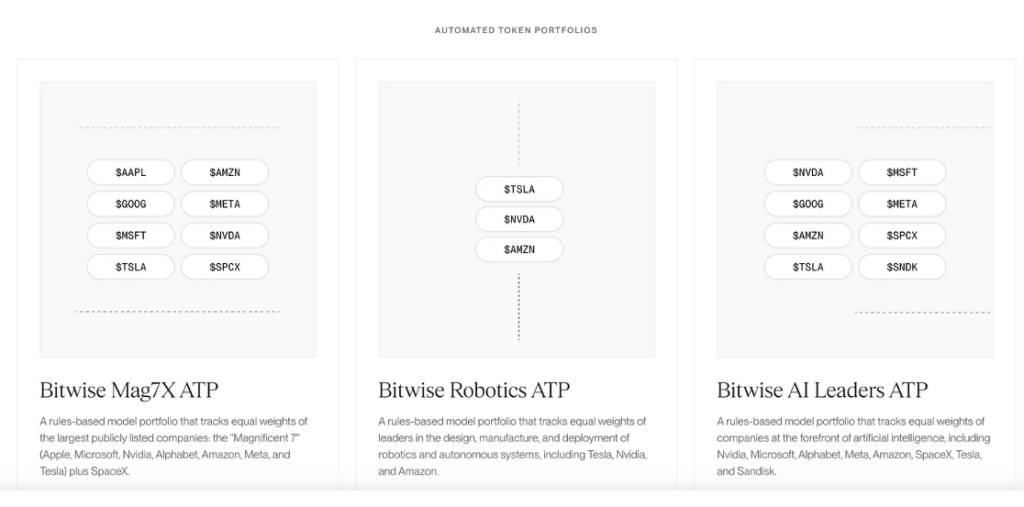
Here are a few examples of Bitwise ATPs and their constituents…
Source: Bitwise Investments
The first one is the Bitwise Mag7X ATP. It’s a rules-based model portfolio that tracks equal weights of the Magnificent Seven, the world’s largest publicly listed companies. These include Apple, Microsoft, Nvidia, Alphabet, Amazon, Meta, and Tesla (plus SpaceX).
The other two are robotics- and AI-themed ATPs.
On the surface, this sounds a lot like an ETF. But what makes them ATPs is that the tokens sit within a wallet you control instead of under lock and key at a brokerage account.
Bitwise does this by integrating Glider.
Glider’s infrastructure allows a user to keep the tokenized stocks in a wallet while the wallet rebalances its holdings based on the portfolio weights Bitwise publishes.
It happens through something called “session keys” provided by ZeroDev and Privy. Session keys allow a specified manager access to a wallet. In this case, the manager is moving those tokens via an onchain transaction similar to how an API call works.
And there are safeguards.
If something were to happen to Glider, or if somebody attempted to hack the signal being sent to the wallet, the wallet would still not allow unsanctioned transactions. Moving assets from the owner’s wallet to a new wallet or an exchange would be an unsanctioned action.
And if the investor wants to end the ATP arrangement, those rights can easily be revoked.
It’s a new way to think about portfolio management altogether.
But there is a catch…
Bitwise charges 0.15% on the assets being managed. For a $10,000 account, this comes out to $15, which is fair.
However, Glider charges 0.30% on the transaction volume of the portfolio. That means the initial transaction results in $45 worth of fees.
That doesn’t consider any fees that might be paid to the decentralized exchange processing the initial transaction.
But that’s not all…
Remember, the portfolio is automatically rebalanced. If this rebalancing happens quarterly and results in 25% of the portfolio being traded, this comes out to about $30 per year if the total assets are around $10,000.
If the rebalancing is weekly, the fees begin to get out of hand. In just one year, assuming 15% of the portfolio is rebalanced, this comes out to nearly $280.
That’s a major chunk.
Bogle’s real innovation wasn’t just popularizing index tracking. It was offering that option for pennies.
Bitwise got the first part right. It stumbled on the second. And it’s why these ATPs might be a tough sell.
But with that said…
Expect this business model to innovate more in the coming years. With time, the fees for these portfolio solutions will likely approach $0, which raises the question…
If asset managers make money on the amount of assets they manage along with the flow of those assets, how do they make money when users can simply ask Claude or ChatGPT to create a curated portfolio onchain, with no fees?
New business models will spring up, and old models will not survive.
The new financial frontier is onchain. And it’s redefining what we view as money. It’s not for the faint of heart.
Your Pulse on Crypto,
Ben Lilly
Editor, Chain of Thought
Read the latest insights from the world of high technology.
The future of finance is coming. And the central bankers, finally, are ready to accept that.

Each trust assumption in our current financial system comes with a cost...
What I don’t see discussed is what happens when people no longer need dollars at all...