



The Agentic Bank Run
If Apollo is right, a bank run is coming. But it won’t be the panicked, lines-around-the-block variety...



The picture keeps getting clearer each day… The legacy exchanges are trying to protect themselves via regulatory moat.

Jeffrey Sprecher spent $1,000 to acquire an asset that’s now worth $84 billion.
In the 1990s he purchased a near-bankrupt electronic trading company called Continental Power Exchange for what most people make in a week.
Then, he got to work…
At the time, Continental was a business that facilitated one-on-one transactions in the electrical power market. It wasn’t really an exchange in the way we’d think of one today. It was more of a nationwide “matching tool” that found buyers and sellers. But Sprecher and the team gutted the business and converted it into an online, globally distributed trading platform.
The pivot worked. By 2005, the company—now called Intercontinental Exchange (ICE)—went public via the New York Stock Exchange. Then, in 2011, Sprecher bought the NYSE outright.
The transformation of ICE is inspiring. Sprecher built a leading global exchange just as technology became more dominant.
And given what’s happening today with public blockchains and the tokenization of real-world assets like commodities, stocks, and real estate… we have to think Sprecher might be a bit jealous.
And based on recent comments, it seems like he is…
But first, a little backstory.
Reports surfaced in the middle of May that two of the most dominant financial exchanges were talking to U.S. regulators to “rein in” a blockchain-based exchange. They claimed market manipulation and sanctions evasion were the primary concerns.
These were significant accusations stemming from the CME Group and none other than Intercontinental Exchange.
But there’s another reason the incumbents are eager to slow blockchain-based exchanges—recent events have proven how superior they are to the legacy exchanges.
The U.S. attacked Iran three months ago. It kicked off a wave of attacks and geopolitical events that have sent oil prices whipsawing.
But at the time of the initial strike, U.S. commodity markets were closed. And by the time markets opened late Sunday, a major weekend gap in price emerged.
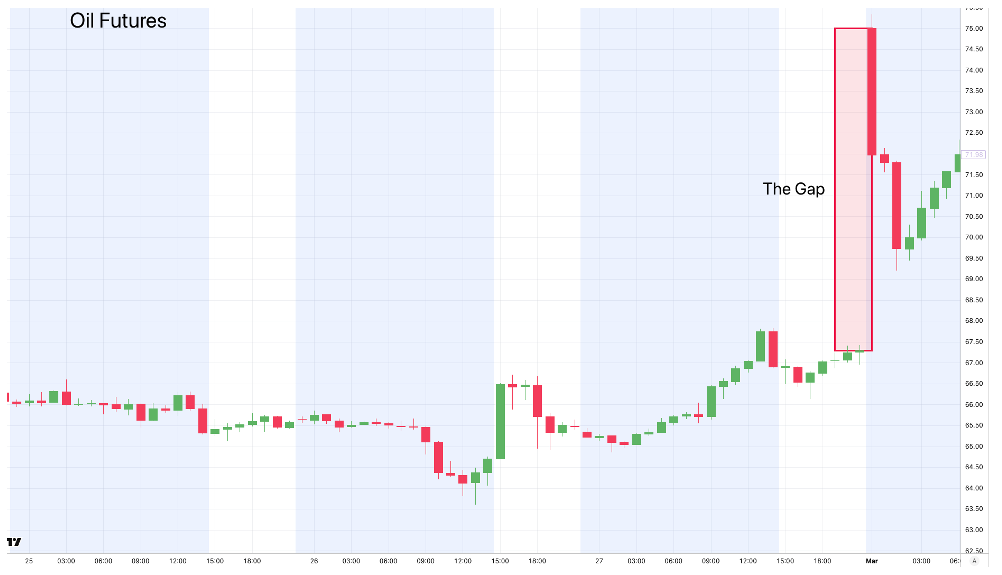
Source: TradingView
This is less than ideal. Most investors couldn’t react to the events playing out in the energy markets. They had to sit on their hands and wait for the new week to begin.
But another market was open…one that already operates 24/7. That market was Hyperliquid.
Hyperliquid is a high-performance layer-one blockchain. Its main use case is powering a decentralized exchange built for perpetual futures, spot trading, and other financial markets.
It’s an impressive piece of infrastructure with 0.07-second block times that can handle 200,000 transactions per second. The technology went live in November 2024 and hosts markets that have open interest and 24-hour volume amounts in the billions.
What’s even more interesting…
Hyperliquid lets traders speculate on the S&P 500, a QQQ-like ETF, gold, oil, and various stocks. It even allows traders to engage in pre-IPO markets like we covered recently in SpaceX Is Already Trading… .
Importantly, the 24/7 nature of the market means investors could manage their energy positions in response to the Iran War without waiting days for traditional exchanges to open.
Hyperliquid commands about 70% of the decentralized perpetuals market, and growth shows no signs of slowing.
In fact, it most recently shipped what’s called HIP-3. It’s an upgrade that allows anybody that holds enough HYPE tokens to deploy new derivatives. It’s a permissionless market framework that is innovating at breakneck speed just as many on Wall Street are learning what decentralized finance (DeFi) is.
And it’s happening just as the New York Stock Exchange and Nasdaq are crying to the SEC to pull back its tokenization proposal, which we covered last Friday in A Selfish Motto Returns.
The trend of tokenization is telling the financial industry that their time is up. A new paradigm has begun. Fight it all you want, but the writing is on the wall.
Sprecher and Intercontinental Exchange seem to know this. They’re already trying to stake out their place in this new world.
In a discussion at the 42nd Bernstein conference in New York on Wednesday, May 27, Sprecher said regarding Hyperliquid:
We know them well, and I’ve met with them a number of times personally and to talk about what they’re doing, what we’re doing, where there may be some common overlap that we can work together on. They have gotten attention because they’ve been trading oil on the weekends when our traditional oil markets are closed.
He went on to say…
What we are saying to the regulators is can we do that? Like, why are we – why are you prohibiting us from doing this when it’s already happening?
Why indeed…
The concerns from legacy exchanges about market manipulation or sanctions seem to be a front. The truth is much simpler: Sprecher is jealous.
But even if ICE was given permission for 24/7 markets, I don’t believe they can deliver a solution similar to Hyperliquid.
And that is why Sprecher is reaching out to the team. Using his words one more time:
I wish I was younger and doing it. By the way, the number of billionaires that are being created doing this. This Hyperliquid that we’re talking – if you haven’t heard about it, it’s bigger than NASDAQ, okay? It’s 11 people. You look at it, you’re like, wow, that’s pretty something.
His admiration suggests that he knows he can’t compete. And it also suggests he needs to either buy the expertise or somehow begin to loosen his grip via working with, not against, the future of financial markets.
And on the flip side…
Hyperliquid knows it can succeed.
When the reports came out that the CME Group and ICE were trying to throw Hyperliquid under the bus, founder of Hyperliquid Jeff Yan was already in Washington D.C. meeting with policymakers.
If Jeff was helping criminals evade sanctions or allowing market manipulation, he wouldn’t be at Capitol Hill advocating for digital asset policy.
The picture keeps getting clearer each day. The legacy exchanges are trying to protect themselves via regulatory moat.
It may work for a time. But it won’t work forever.
In fact, the CFTC just announced on Friday that perpetual futures contracts can now be listed on CFTC-registered exchanges.
The approval wasn’t for 5 day a week… But 24/7.
The momentum is only building for finance to come onchain. While perpetual futures will likely sit on centralized exchanges initially, we should expect them to move toward decentralized solutions soon after.
Permissionless, public blockchains will be where global financial markets exist. Before we know it, the exchange that generates an annual profit of more than $100 million per employee might acquire ICE, just like Sprecher acquired the NYSE more than a decade ago.
Your Pulse on Crypto,
Ben Lilly
Editor, Chain of Thought
Add Brownstone Research as your preferred source on Google to see our latest stories in your feed.
 Add as a preferred source
Read the latest insights from the world of high technology.
If Apollo is right, a bank run is coming. But it won’t be the panicked, lines-around-the-block variety...

The old guard is competing to build the new gatekeeper that the market uses … and the result will...

Blockchains are infrastructure built for machines. And now the machines are here.