




Gateways, Not Sandboxes
The venue that wins tokenized stocks will make buying tokenized shares easy and aid the user in choosing which...



This activity may or may not be above board. But it doesn’t look good.

It’s opening day at the ballpark, and you’ve got your hot dog slathered with mustard.
And just before you take that first bite…
Your friend asks if you know that hot dogs are known to cause cancer.
All your excitement for that hot dog—gone.
Bad timing.
That’s what President Trump has been doing to the digital asset industry lately.
First, there was the MELANIA and TRUMP memecoins. These tokens lack intrinsic value. They are, at best, souvenirs. But this lack of utility means they are exempt from securities laws.
I blame the emergence of memecoins on one man— former SEC Chair Gary Gensler. As I shared on Friday, his reign of terror scared much of the industry away from anything that might even smell like a registered security.
The MELANIA token launched on January 19. That was followed by the TRUMP token a day later, one day before his inauguration. Some of the air went out of the room that day.
Then there was his private “Crypto Ball” at his Virginia golf club. It was an exclusive event reserved for the top 220 investors of his TRUMP memecoin on May 22, 2025.
Once again, the timing was… Odd.
Legislation tied to regulating stablecoins called the GENIUS Act was being voted upon in the Senate the day before the ball. The more comprehensive digital asset framework bill referred to as the CLARITY Act was set to be introduced the following week in the House of Representatives.
There’s a pattern here. And Trump just did it again… with World Liberty Financial.
World Liberty Financial is a business run by the Trump family. Trump has been cagey about his ownership stake in the project. In the past, he’s said that his family is “handling it.” But whether the president really knows what’s going on or not, it still falls at his feet.
At one point, the president was even featured on the Meet our Team portion of the website. So, on the surface it’s hard to separate the project from President Trump directly.

Source: Nevada Current
More important are World Liberty Financial’s recent actions with its WLFI coin and its connection to a project called Dolomite.
Dolomite is a lending and borrowing platform originally launched in 2018. It has since gone on to operate on various networks.
And while there are many types of lending protocols in the market, Dolomite is unique in that it supports over 1,000 different assets. It also provides pre-built yield strategies that use leverage to boost yields.
Dolomite is a destination for projects early in their lifecycle. That’s opposed to projects like Aave, which are more risk-averse in their asset selection. Dolomite caters to these earlier projects and provides opportunities for high-risk yield traders.
It’s been a successful niche.
This is relevant to World Liberty Financial because team members recently deposited 5 billion WLFI tokens on the protocol. At the time of the latest deposit on April 8, these assets were worth about $505 million.
That’s a significant sum considering Dolomite only had $150 million of total value locked up days beforehand, according to DeFi Llama.
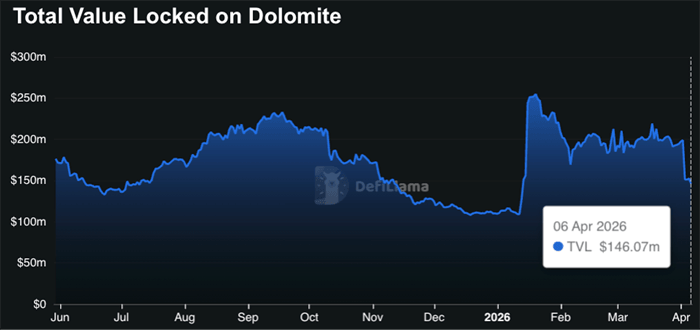
Source: DeFi Llama
World Liberty Financial then borrowed $40 million of its own stablecoin USD1 along with USDC.
The real issue isn’t that the company used its supply of a token to borrow its own stablecoin, although it is questionable.
The issue is liquidity.
Permissionless lending protocols like Dolomite lean on lenders. These lenders can be virtually anybody with onchain capital. This means there are retail, family offices, market makers, and other parties likely acting as lenders.
And these lenders can deposit or withdraw as they please. But that assumes there is capital to be withdrawn.
If 100% of all the capital being lent is used via a loan, then there is no capital to remove. That’s a liquidity freeze.
It’s where lenders are stuck. And that’s what World Liberty Financial just did.
When World Liberty Financial took out its loan, it sent utilization rates to 83% for USD1 and more than 90% for USDC.
In essence, this borrowing sucked up the liquidity on Dolomite. And while the utilization rates have since come down slightly, it’s not by much.

Source: app.dolomite
This isn’t normal.
But the issue doesn’t stop there…
The collateral behind the loans is WLFI token. 5 billion tokens represent nearly 16% of all circulating supply. And according to risk firm Chaos Labs, it represents four times the amount of tradable supply that exists on the most traded exchange in the world, Binance.
It’s a scenario that essentially holds the lenders captive. The collateral can’t be liquidated very easily. And the capital is already being loaned out.
The only play from here is to pull whatever liquidity remains in Dolomite and drive the borrow rates to unsustainable levels. This would force repayment on the loan and start a slow unwind.
A protocol would normally place a limit on certain tokens to avoid something like this. It’s why this situation is so odd.
So why was WLFI the exception?
An educated guess: The co-founder of Dolomite is Corey Caplan.
He’s in the red box below…
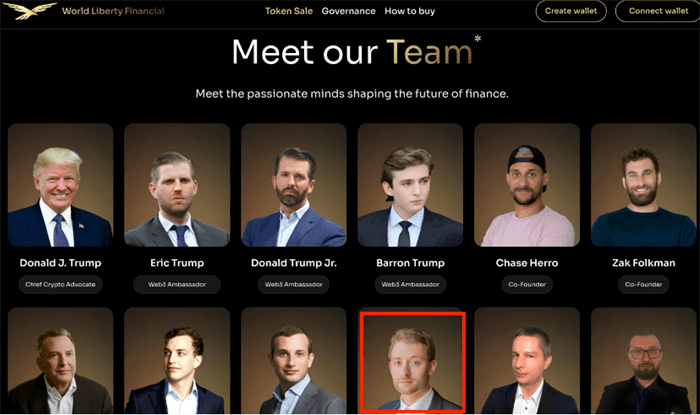
Source: Nevada Current
I apologize for the image being cut off, but the Meet our Team page was recently taken down… Likely due to the events being discussed here.
The co-founder of Dolomite is part of the World Liberty Financial advisory team.
Maybe all this activity is above board. But it doesn’t look good.
Imagine if a company issued shares to the public. Then, the team used those shares as collateral to borrow customer deposits at the bank another team member founded.
The entire thing just feels…off.
And the timing couldn’t be worse.
The regulatory progress being made in Washington, D.C. is incredible. It’s not only moving forward at great speed, but the legislation is thoughtful and constructive. Many of the industry’s best and brightest are helping Congress craft appropriate regulatory language.
The administration has helped make great progress on the regulatory front. But sideshows like the WLFI situation keep leaving a bad taste in my mouth.
With Federal Reserve Chair nominee Kevin Warsh set to undergo his hearing tomorrow, the Senate Banking Committee is expected to mark up the CLARITY Act next week, or the second week in May.
The CLARITY Act has been making its way through Congress for nearly a year and has been stuck in the Senate Banking Committee since October of last year.
The contentious language related to yield-bearing stablecoins has been negotiated at length. Much of the decentralized finance language has been ironed out. And we’re simply homing in on a few remaining issues.
One of which is ethics and conflicts.
It’s a section that introduces language that aims to prevent federal officials from using their position to benefit from personal cryptocurrency ventures or investments.
It’s a provision that Democrats seem to have zero flexibility on.
And here we are again, wincing in disappointment with the timing of it all.
Expect to hear more about World Liberty Financial’s recent activity as we get closer to the markup session.
I’m sure this isn’t the end of this story.
Your Pulse on Crypto,
Ben Lilly
Editor, Chain of Thought
Add Brownstone Research as your preferred source on Google to see our latest stories in your feed.
 Add as a preferred source
Read the latest insights from the world of high technology.
The venue that wins tokenized stocks will make buying tokenized shares easy and aid the user in choosing which...
The dream of every central bank critic could be coming true – we might actually end the Fed.

JPMorgan can keep both pieces of infrastructure as long as it likes. But customers will decide where to do...