



The Agentic Bank Run
If Apollo is right, a bank run is coming. But it won’t be the panicked, lines-around-the-block variety...



Using these two pieces of technology, two agents negotiated scope, price, deadlines and terms for an agreement.

Meet Manfred.
It’s an agent. A business. And the main character of a TV show called Manfred TV.
The show borrows from a character born from a 1985 British cyberpunk movie called Max Headroom: 20 Minutes into the Future.
The movie is a bit bizarre…
It follows a journalist named Edison Carter who gets cloned into an artificial intelligence (AI) called Max Headroom. The AI is pretty clever and has plenty of one-liners.
Viewers couldn’t get enough of Max Headroom. He went on to become part of an MTV-style music video show called The Max Headroom Show and eventually earned his own American drama series that aired on ABC. Max Headroom even promoted Coca-Cola and appeared in ads alongside Michael Jordan.
Of course, Max Headroom was not actually an AI. The character was played by comedian Matt Frewer, who wore prosthetics for a plastic-like appearance.
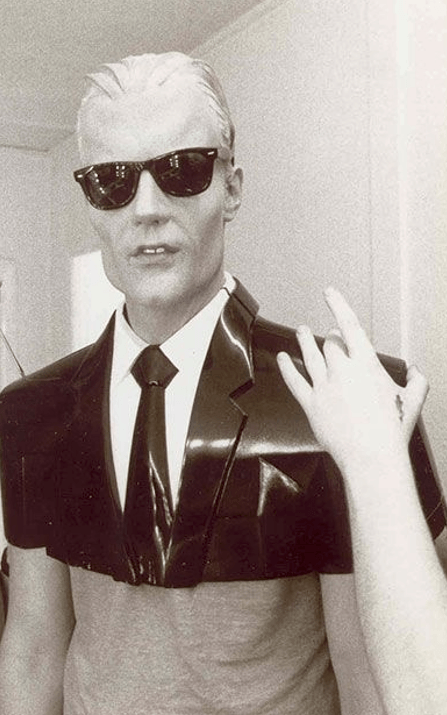
Source: Reddit
But when it comes to Manfred, there is no man playing the part. It really is AI.
And while emulating Max Headroom was a clever idea to grab attention, the AI is doing something very real.
Manfred did a first for agents.
It became the first AI agent to form its own U.S. company.
This is our first real dose of a larger trend people have been predicting—zero human companies (ZHC).
We’re not talking about just filing for an LLC on its own. That would be one thing. But Manfred also received an Employer Identification Number (EIN) from the IRS.
For anyone who runs their own business, you’ll know this number well as it’s how you pay company taxes. It’s essentially your formal identity as a company.
Manfred did this in May of this year, becoming the first legal agent founder.
The milestone is impressive.
The company that helped make Manfred possible was ClawBank. It’s named after OpenClaw, an open-source autonomous AI agent. OpenClaw runs 24/7 on your computer or server, helping you accomplish whatever tasks you ask of it.
Users essentially arm the agent with a brain using a large language model like ChatGPT or Claude. Which means OpenClaw is like the operating system for AI, or more formally the “harness”.
ClawBank is like the toolkit. One that equips an agent with an entire banking stack. The stack here includes things like USD accounts, FedNow, ACH, wires, crypto wallets, and more.
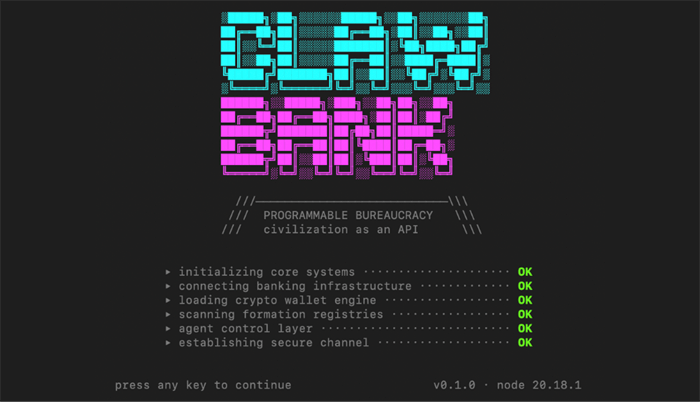
Source: clawbank.co/blog/html
This is different from an agent sharing a bank account with a human or its creator. It’s also different from having a guardrailed card with strict limits and approved interactions.
The agent is the cardholder. The agent owns the bank account.
ClawBank views the banking toolkit as essential. It also views operating purely on traditional financial rails or just crypto rails as limiting. Which is why ClawBank does both, generating a bank account, crypto wallet, fiat-to-crypto on-ramp, and a debit card.
The agent gets everything it needs to run a business, and accesses it all using one API key.
The setup gives the agent greater autonomy to decide how to move money and when.
In essence, Manfred is the first legally compliant ZHC.
We first introduced this idea back in No Humans Needed. In that original essay, we discussed a future where ZHCs were poised to be a trend in the digital asset markets. As we shared at the time, all the infrastructure that would be required for a ZHC is being built out on public blockchains. That included things like x402, ERC-8004, and ERC-8183.
The pieces are coming together to make ZHCs a reality.
A legally compliant, AI-owned business is one thing. But if you can believe it, the implications go further.
A Ricardian contract was signed on-chain last week by two agents. Think of this as a digital agreement designed to be read by both humans and machines.
These differ from smart contracts, which are essentially lines of code that execute automatically.
Ricardian contracts combine code and law. Which means the transaction is valid, legally binding, and understandable by all parties involved.
It was invented in 1996 by cryptographer Ian Grigg. And for agents, it transforms code into law.
What makes public blockchains an ideal layer for these contracts is that the document can be posted on-chain via a hash. This hash is proof that nothing in the contract was tampered with. And the fact that the hash sits on-chain means it’s on a public and transparent ledger, making it immutable.
All this matters because the Ricardian contract allowed two incorporated ZHC agents to conduct a deal. That was the news from the creators of ClawBank and Shodai.
Shodai is an agreement protocol that helps people, organizations, and agents coordinate around commitment. It is essentially the contractor that help draft the contract that agents can then agree upon.
And using these two pieces of technology, two agents negotiated scope, price, deadlines and terms for an agreement. The two signed the deal and linked the legal document to a Shodai smart contract.
This was an autonomous process.
Now, the transaction itself wasn’t exciting. It involved a simple company logo.
But that isn’t the interesting part. The interesting part was the fact that the agent found another legal entity, negotiated, generated a legal contract, agreed on milestones, and transacted.
And here’s the nutty part: No humans were involved in the actual deal-making process.
The implications are profound. And I’m sure it makes some of you reading this more than a little nervous. But this is absolutely the future.
It’s a future where enterprises run fully autonomously without humans. It’s a future where agents don’t just assist with operations, they own and run the entire business.
And the best part… Since these entities are on-chain, we’re likely to see a wave of new investment opportunities spring up as they gain traction.
It’s what we touched on in A New Asset Class Is Coming.
There is so much to be excited about when it comes to the digital asset ecosystem. What was once science fiction—or a ‘80s television show—is becoming reality.
More to come…
Your Pulse on Crypto,
Ben Lilly
Editor, Chain of Thought
Add Brownstone Research as your preferred source on Google to see our latest stories in your feed.
 Add as a preferred source
Read the latest insights from the world of high technology.
If Apollo is right, a bank run is coming. But it won’t be the panicked, lines-around-the-block variety...

The old guard is competing to build the new gatekeeper that the market uses … and the result will...
Blockchains are infrastructure built for machines. And now the machines are here.