




Crypto’s Point of No Return
Get these assets so entrenched, so dug in, that no future administration can rip them out without creating systemic...



Betting against mainstream media proved very profitable for Fredi9999…

Betting against mainstream media proved very profitable for Fredi9999…
During the last Presidential election, an anonymous individual with that moniker wagered an estimated $40 million across various Polymarket event markets.
His bets were all attached to Donald Trump winning the electoral college, the popular vote, and swing states like Pennsylvania, Michigan, and Wisconsin during the Presidential election.
Based on prevailing wisdom, that seemed foolish…
According to forecasts from The Hill, Harris had been favored to win the electoral college for most of that year. And while an electoral college win for Trump was conceivable, a win for the popular vote seemed out of the question. No Republican president had pulled that off since George W. Bush in 2004—twenty years earlier. Throw in sweeping the swing states, and it seemed like throwing money away.
And yet…
Estimates claim he possibly profited more than $80 million.
Many claimed these bets were manipulating markets. But markets know how to spot, and correct, blatant mispricing. That can be very profitable, after all.
Other non-crypto markets showed nearly identical pricing — this was no isolated incident.
In the days that followed, Fredi9999 claimed he had no political agenda. He simply believed traditional polling was wrong.
Or said differently, the media wasn’t telling the truth.
So, what was?
Mainstream media has faced withering criticism for years.
The legacy press suppressed the Hunter Biden Laptop story before the 2020 election, failed to relay relevant information during the COVID pandemic along with its vaccine, and even failed to portray the health of our former President.
It’s eroding trust in the news Americans consume daily. Pew Research Center data shows trust in national news organizations has dropped from 76% to 56% over the last nine years.
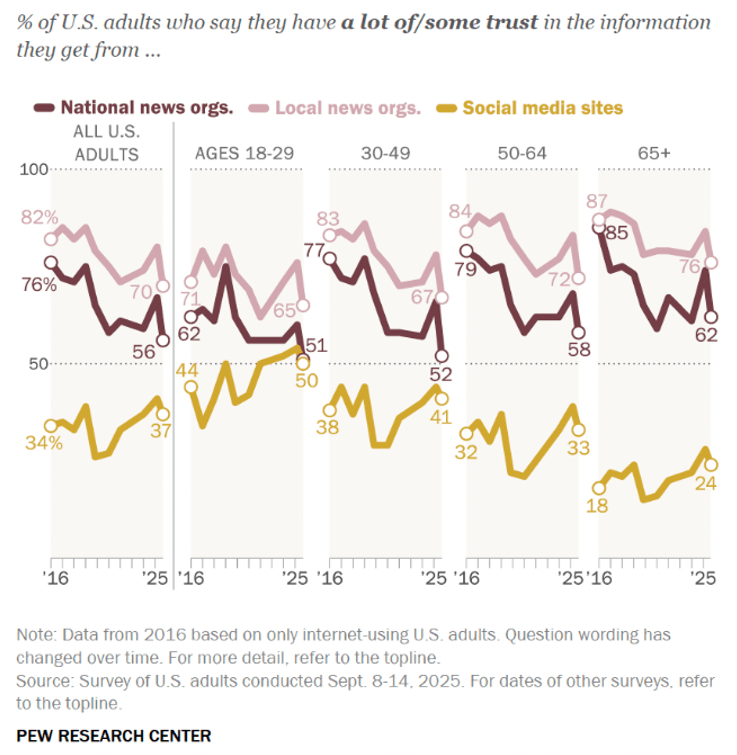
Source: Pew Research
Americans don’t trust the corporate press, and rightfully so. While these outlets were saying the 2024 election was a virtual coin flip, prediction markets saw something else.
As late as Oct. 30 of that year, Polymarket gave Trump a 67% chance of winning the White House. And, of course, that’s what happened.
It was a result that gave the world a glimpse into what prediction markets offer.
A way to source the truth.
And it’s not going unnoticed…
The competition to build the world’s go-to event market is fierce.
Kalshi just raised $1 billion at a $22 billion valuation. This comes four months after raising another $1 billion at an $11 billion valuation. Its valuation is up 11x since June of last year.
Polymarket is rumored to be raising a new round at roughly $20 billion, which comes on the heels of the Intercontinental Exchange valuing the company at $8 billion back in October.
We’ve since seen popular exchanges like Robinhood, Coinbase, and Crypto.com enter the space to get in on the excitement.
But here’s the truth about these new players—they are likely too late.
That’s because the CEOs of both Kalshi and Polymarket are already a few steps ahead. Both are plowing money into early-stage startups that are focused on adding value to their respective companies.
And it’s not just them.
Venture capitalists are not just in on the action… They are building in-house solutions to move even faster.
The crypto-centric VC firm Paradigm announced a couple days ago they are developing a trading terminal catering to professional traders and market makers.
It’s been underway for months now. Paradigm founder Matt Huang has described prediction markets as a trillion-dollar opportunity. It’s too big to ignore.
No wonder the firm is eyeing an internal market-making desk.
Capital allocators are salivating. And regulators look poised to blow the door open on the opportunity.
Disrupting the status quo always faces resistance.
Uber, Lyft and DoorDash all fought intense legal battles to upend taxi and food delivery services.
Prediction markets are not immune to this same battle.
That’s because they don’t just offer a market on political events. They reach into sporting markets, economic health measures, corporate earnings, and more.
The Intercontinental Exchange (ICE) saw an opportunity, not just for data, but possibly new markets.
For instance, federal funds futures contracts are derivatives that help traders predict what future interest rates will be from the Fed. It offers a hedging solution to rate markets.
These contracts run through ICE’s competitor CME Group.
It’s in part why CME Group’s CEO Terry Duffy has spoken out against prediction markets, saying there needs to be a distinction from legitimate financial derivatives.
The argument has merit, but you can see there is a financial incentive to protect markets where CME Group has market share.
It’s a similar argument happening with U.S. state regulators.
That’s because sports betting is regulated by state gaming commissions. It’s a setup that lets states like New York generate $1.2 billion in sports betting tax revenue.
No wonder New York and other states like Tennessee, Ohio, Maryland, New Jersey, Nevada, and several others have issued cease-and-desist letters against prediction markets.
Disruption isn’t easy.
The arguments vary. Some are sensible, like underage gambling concerns. Others, like manipulation concerns, look like hot air—just a way for incumbents to protect their market share.
We already saw what prediction markets did during the last presidential election: They seek truth. Manipulation gets priced out.
That’s why the state battle will fall short.
And that’s what federal regulators see.
Back in February, CFTC Chair Michael Selig, in a Wall Street Journal op-ed, said:
The CFTC will no longer sit idly by while overzealous state governments undermine the agency’s exclusive jurisdiction over these markets by seeking to establish statewide prohibitions on these exciting products.
It’s a similar stance Selig articulated to a room where Senators, Representatives, White House representatives, and other Chairmen of federal regulators were in attendance. It was a meeting I had the privilege to attend last month in Washington, D.C.
The stance from federal regulators was clear.
As Selig said in a message directed to states and any other regulators trying to get in the way, “we will see you in court.”
States will not get the last say.
Prediction markets represent a check on misinformation.
They offer real-time pricing of future events.
Embracing these markets can result in financial solutions that we have yet to realize. And federal regulators understand it.
These solutions give finance an ability to hedge against rate changes, possible geopolitical events, and more.
The future of finance is changing. Innovation is happening in real-time. And we’re looking forward to the opportunity it’ll present along the way.
How we view finance a few years from now will look nothing like what it does today.
Prediction markets are not just about sports betting or economic and political events. It’s bigger than that.
It’s a truth missile into the heart of one of the biggest trends of this generation— the mistrust of established information gatekeepers.
And once this source of truth is embraced, how we write insurance contracts, trade options, and even hedge our portfolio will never be the same.
More to come…
Your Pulse on Crypto,
Ben Lilly
Editor, Chain of Thought
Add Brownstone Research as your preferred source on Google to see our latest stories in your feed.
 Add as a preferred source
Read the latest insights from the world of high technology.
Get these assets so entrenched, so dug in, that no future administration can rip them out without creating systemic...
There’s plenty of blame to go around, and I’m more than happy to name names.