



The Last Stand of the Old Guard
The old guard is competing to build the new gatekeeper that the market uses … and the result will...



We’re entering an era where we won’t be required to hand over all our data and video and hope it stays secure.

Your robot is spying on you…
And it could be giving malicious actors a blueprint to your home.
If you’re like many people, you likely have a robotic vacuum cleaner in your house. It’s a little device wheeling across your living room floor throughout the day. It vacuums up debris, pet hair and dirt. It’s convenient… Innocent.
The vacuum does its job by scanning the room and floor to make sure it doesn’t run into pets, humans, cords or anything it might get stuck on. It does this using LiDAR to map out your home.
LiDAR stands for light detection and ranging. It works via a little laser that spins itself like a turret to bounce light off anything and everything to determine distance. It’s a robot’s version of echolocation.
Then it pairs this information with optical cameras that label things throughout the room so it can navigate more easily.
The data is used to then generate a map. One that continues to update itself as you move furniture around or redo your home.
What most don’t realize is that this information is not stored on the device. It’s in a cloud that the company manages.
And it means that the $700 vacuum that is making your life easier is sending detailed information about your home to some server that is prone to being hacked.
This might seem far-fetched, but a few years ago a data leak made this all the more likely…
A few years back, robotic vacuum company iRobot found itself in trouble.
As part of its terms and conditions, users agreed to have data, including images, collected by the robot. What the customers did not agree to was having pictures of their homes posted across the internet. But that’s what happened.
Pictures included individuals in the bathroom, children playing on the floor and other sensitive images that no individual would want on the internet.
The leak was due to an iRobot third party hired to process and analyze the data. It was a major breach of trust, and the company eventually apologized for it.
But most customers were likely unaware that their data was being sent to a third party in the first place. Yet it was spelled out in the terms and conditions, the ones that nobody ever reads.
It’s a painful reminder…
The same data used to train robotic vacuums and devices like doorbell security cameras can and do fall into the hands of a malicious actor.
And if that makes you uneasy, you might be interested to learn about two recent developments. Each paves the way for us to feel more secure with robots and cameras entering our home.
An individual who goes by the name Ilian O is the creator of makerspet.com. It’s a website that sells a self-build robot pack and the corresponding electronics. The organization recently published a piece detailing “OOMWOO.”
It’s an open-source robotic vacuum, which means all the parts, assembly instructions and even manufacturing files are free to download and even iterate upon.
Here’s a picture of what the robot looks like based upon the design files.
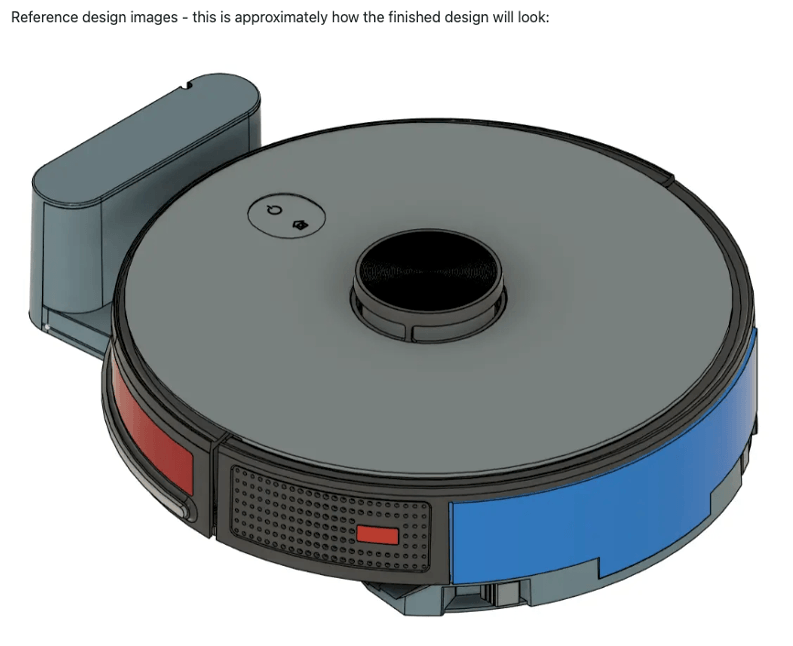
Source: github.com/makerspet/oomwoo/
It’s an interesting project…
A few files can enable anybody with a 3D printer—which costs a few hundred dollars—to turn this image into parts that can be assembled into a usable vacuum for their home.
But that’s not the really interesting part. Two details caught my eye.
First, the robot is not sending data or images to a cloud. It’s able to run using affordable LiDAR technology and a $15 Raspberry Pi computer that sits inside the vacuum.
This makes sure video isn’t getting leaked on the internet or falling into the hands of malicious actors. If you care about your privacy, that’s a big win.
The reason robotics companies don’t do this already is that the video they secure helps train future robot models. They’re also able to attach various cloud services to the vacuum, which require a subscription.
So, without collecting data, how will OOMWOO get better over time?
That’s where things get very interesting…
Decentralized AI (DeAI) is a topic we’ve hit on recently in Bigger Than Anthropic and OpenAI Combined.
One area within DeAI that we haven’t discussed in Chain of Thought, but our members of Permissionless Investor might be familiar with, is solutions around open-source, decentralized video intelligence trained using blockchain.
What we are witnessing is bleeding-edge solutions that can produce video models that can help a camera understand what it’s looking at. And the model itself is only around 20 MB in size, meaning it requires substantially less than 1% of storage space that you might have on your smartwatch.
And these models are producing results better than the frontier models.
All of this is made possible through incentives. Miners compete to train the models using their own solutions, and based upon how well they do, they earn rewards.
These aren’t frontier labs or some new startups securing billions in funding. These are individuals or small groups helping create the future of video intelligence thanks to blockchain solutions enabling coordination.
The early work suggests it won’t take long until we can download one of these open-source AI vision models into a 3D-printed device like OOMWOO.
I understand this may seem small. At the end of the day, it is just a vacuum. But it’s a proof of concept for something much bigger.
We’re entering an era where we won’t be required to hand over all our data and video and hope it stays secure. We are nearing the moment where individuals can build tech solutions in their home with a press of a button and a few minutes of assembly.
Consider other devices like doorbell cameras, toys, drones or even home training aids that can help you improve your golf swing. All of these devices collect data on us that may (or may not) stay secure.
But thanks to blockchain technology facilitating the coordination of individuals to help train models and get rewarded, our future is looking a lot more secure, private and intelligent.
Not to mention cheaper.
More to come on the nexus of decentralized AI and robotics.
Your Pulse on Crypto,
Ben Lilly
Editor, Chain of Thought
Add Brownstone Research as your preferred source on Google to see our latest stories in your feed.
 Add as a preferred source
Read the latest insights from the world of high technology.
The old guard is competing to build the new gatekeeper that the market uses … and the result will...

Blockchains are infrastructure built for machines. And now the machines are here.

If the cycle holds, we’ll look back at this moment in the fall of 2029 and realize that was...