



AI Apocalypse?
To be completely fair, there is a non-zero chance that things go horribly wrong



If the Fed has gone back to raising rates, why was the post-hike bounce in stocks so strong?


Markets assigned a 90% probability to Wednesday’s rate hike, and the Fed didn’t disappoint.
America’s central bank delivered a unanimous quarter-point increase. Its message was direct, too: Inflation remained too high, and restoring price stability was the priority.
That wasn’t the surprising part. What came after was.
I believe the market priced in a rate hike with some dovish commentary from Fed Chair Kevin Warsh at the press conference. In other words, the market likely expected the Fed to raise rates, but reluctantly.
But I think few expected his messaging to be as hawkish as it was. And this interest rate increase might not be the last. As I write, the market is assigning a 53% probability to another quarter-point hike when the Fed meets in October.
During Warsh’s presser, the Dow’s loss deepened to over 700 points. But as is often the case, the initial move was a fakeout. The real Fed move tends to happen the day after the announcement as people process the second-order effects.
And on Thursday, the markets rallied. The S&P 500 Index gained 1.1%, and the Nasdaq closed about 1.7% higher.
So why did stocks rally?
To answer that, we need to put the rate hike in context.
Warsh isn’t wrong. Inflation is still a problem.
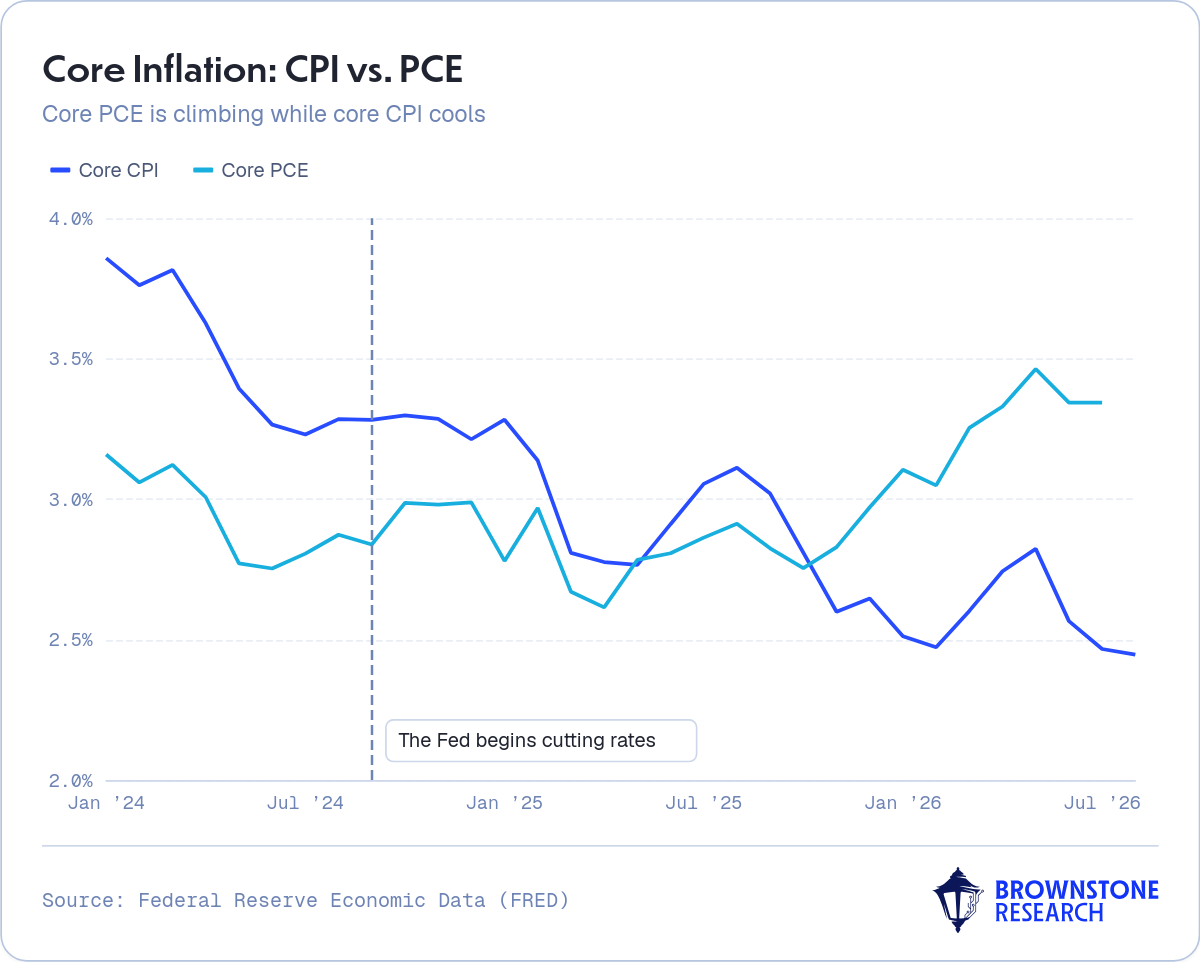
August’s Consumer Price Index (CPI) showed core inflation—which removes the volatile food and energy categories—at 2.4%. Not great. But not terrible.
But the Fed’s preferred inflation measure is the Personal Consumption Expenditures (PCE) Index. And that measure shows inflation increasing.
Core CPI has cooled. But core PCE remains above its level when the Fed began cutting rates in 2024.
What’s the difference between the two measures?
CPI focuses on prices paid directly by urban consumers. PCE covers broader spending, including healthcare paid for by employers and government programs. It also adjusts more quickly when consumers change their buying habits. PCE gives healthcare more weight and housing less weight than CPI.
And by excluding the volatile food and energy prices, the “core” readings help reveal the underlying trend. The Fed’s formal 2% target applies to overall PCE inflation, not core PCE alone. But persistent core inflation helps explain why policymakers weren’t declaring victory over inflation.
As Warsh put it: “Trends matter. Data points are noisy.”
When it comes to inflation, the trend still isn’t where the Fed would like it to be.
So, if the Fed has gone back to raising rates, why was the post-hike bounce in stocks so strong?
Going into the Federal Open Market Committee (FOMC) meeting, uncertainty was hanging over markets: Would the Fed make decisions independently of political pressure? Or would it cave to President Trump’s desire for lower rates?
On that front, the market got an answer.
The market interpreted the unanimous hike as evidence of the Fed’s independence.
Congress assigns the Fed its goals of maximum employment and price stability. Staying independent from political pressure is the only way it can pursue these goals.
Rising rates may mean higher financing costs, which can be a challenge for capital-intensive businesses. But uncertainty about future prices complicates investment decisions, too. Price stability helps businesses plan beyond the next quarter.
A rate hike doesn’t deliver that stability overnight. But Thursday’s rebound was consistent with investors welcoming greater confidence in the inflation outlook. Cheaper money isn’t the only thing markets value. Confidence in what that money will be worth matters, too.
Warsh instilled confidence that his Fed would remain independent and keep its focus on price stability. And that’s why the markets have rallied.
Nearly half of the world's biggest money allocators are scrambling to reposition for what they expect to be the most volatile market in years. Larry Benedict isn't scrambling. He's seen this before. He says the Warsh Shock is setting up the most predictable
wealth-building window he's seen in 20 years… and there's one ticker right at the center of it. Click here to see how Larry is playing it.

It is designed to foresees the future prices of 2,334 stocks, to the penny, with 85% backtested accuracy. This year, you could’ve already crushed the stock market by 218%, as of August. Including gains of 46.8% in five days on (RVMD)... 36.8% in 29 days on (ALB)... 32.4% in two days on (BE), and dozens more. Until Tuesday, get free access here (no purchase required).

Earlier this week, the Federal Reserve announced a 0.25-percentage-point interest rate hike.
Rising rates usually pose a risk for commodity prices and junior stocks. In the past, gold and silver often declined during times of rising rates, bringing down associated stocks.
That’s for a few reasons …
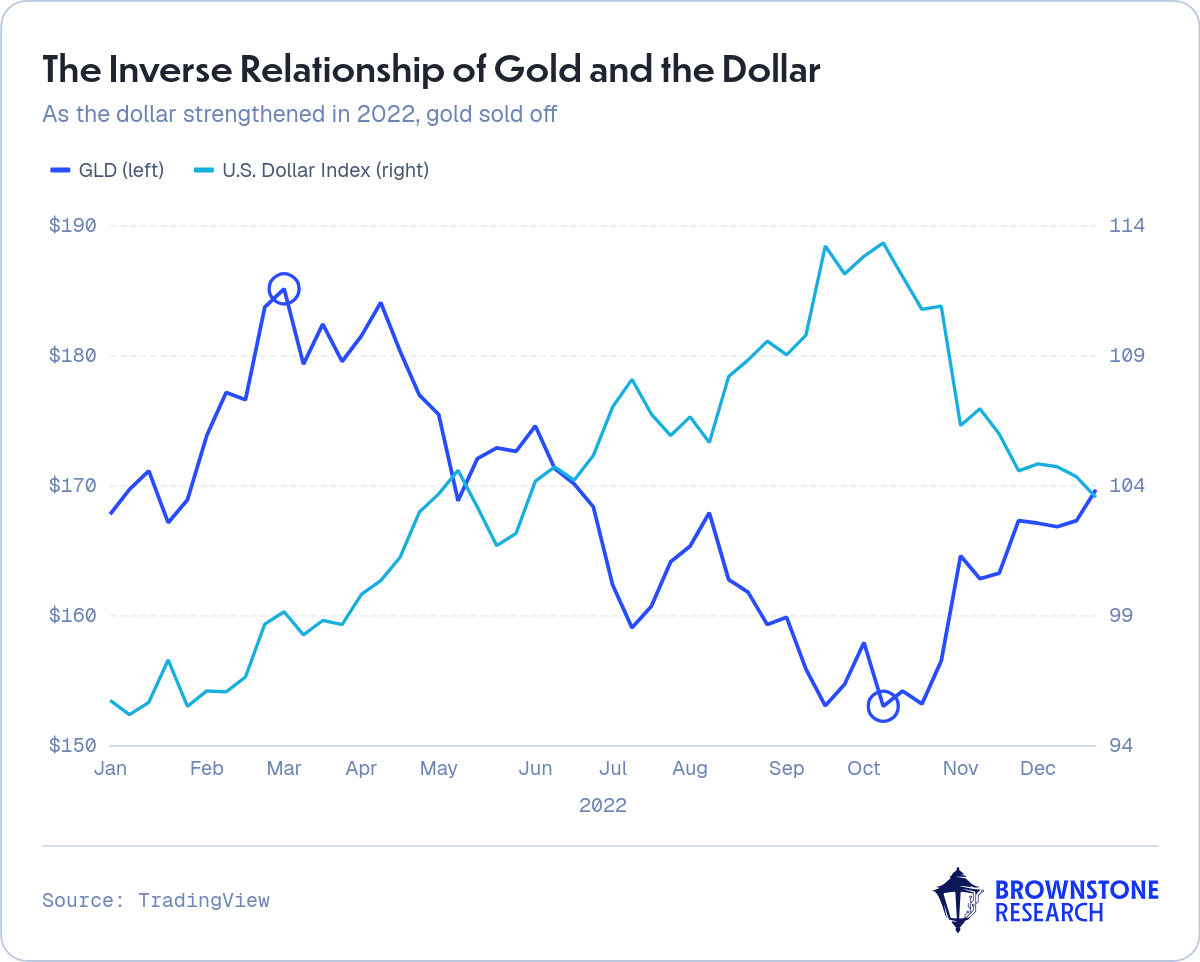
First, rising rates mean rising yields on assets such as bonds. All else equal, that makes precious metals, which have no yield, less attractive by comparison. Rising rates also tend to strengthen the dollar. And since precious metals are predominantly priced in dollars, a stronger dollar makes gold purchases more expensive for international investors. Demand falls, and gold usually sags.
That’s what happened in 2022. As the dollar climbed, gold sold off:
But the immediate market response to this week’s hike has been pretty much nothing.
As we write, gold and the wider precious metals complex are holding almost exactly even. Ditto copper and oil.
That said, several resource companies did decline heading into the Fed decision as traders increasingly anticipated a hike. In essence, investors were selling resource stocks to get ahead of the announcement.
But the fact that metals and stocks are doing fine after the rate hike is interesting. It could imply two things:
Time will tell about No. 1. But No. 2 is absolutely the case.
Western nations, including America, still need more copper, battery phosphate, and rare earth metals than existing mines can supply. Rate hikes don’t change that.
If anything, the hunt for resources is accelerating. Robert Friedland, the mining legend running copper producer Ivanhoe Mines (OTCQX: IVPAF), said on Sept. 8 that he’s been approached by Silicon Valley hyperscalers interested in paying Ivanhoe to build new copper mines so they can secure the metal output.
That revelation about big tech getting into mining came as Ivanhoe announced an updated mineral resource estimate for its Western Forelands project in the Democratic Republic of Congo.
For context, Western Forelands isn’t one of Ivanhoe’s three current mines. It’s a completely new discovery the company recently made using its knowledge of the local geology.
And it’s turned out to be a massive find.
In the copper industry, a geologic deposit is usually considered “world class” if it contains more than 1 million tonnes of copper metal.
Ivanhoe’s Sept. 8 announcement revealed that Western Forelands blows past that threshold. Technical studies show that Western Forelands now holds nearly 13 million tonnes of copper metal.
To reiterate—that’s the equivalent of 13 world-class copper projects, all owned by one company, Ivanhoe, in addition to the company’s producing Kamoa-Kakula copper mine and Kipushi zinc mine in Congo, and its soon-to-be-commissioned Platreef nickel and platinum mine in South Africa.
No wonder Ivanhoe is now the first call for big tech companies seeking copper supply. We expect it won’t be long before we see a data center or AI giant invest directly in copper mining—a major catalyst for the industry.
Many resource investors fretted over the prospect of higher rates. But a rate-hiking cycle isn’t nearly enough to overcome the powerful tailwinds of tech demand for critical metals.
If you thought trading around the Federal Reserve would be easy … guess again.
Investors were bracing for a bearish reaction to the Fed’s latest meeting. That’s because market expectations for a Fed rate hike kept building until a hike became a near certainty. Just a day before the meeting, odds pointed to a 90% chance of a rate increase.
All else equal, rising rates are bearish for stocks. That’s a big reason why the major indexes were soft heading into Wednesday’s FOMC meeting.
As it turns out, the Fed delivered.
In a unanimous decision, the Fed hiked rates by a quarter point. It was the first rate hike in over three years.
During his press conference, Fed Chair Kevin Warsh continued to strike a hawkish tone. He described the hike as removing a “dose of accommodation.” That implies monetary policy is still stimulative and there could be more hikes ahead.
Fears had been growing that a hawkish pivot would arrive, and now it’s finally here. But the market’s response surely caught everyone off guard.
As Nick mentioned above, the market reaction was initially negative, but indexes jumped the following day.
And as Dave shared, rising rates are also supposed to be trouble for precious metals, but gold and silver soared anyway.
It goes to show that trying to trade around the Fed and guess the market reaction is notoriously difficult. Thankfully, a better way to profit from the Fed is now here in the form of prediction markets.
You may be familiar with platforms such as Kalshi and Polymarket, which have become popular for trading on sports events. But prediction markets also offer a way to wager on outcomes tied to financial markets.
That could be stock index prices, crypto movements, the daily settlement in oil prices … and even outcomes tied to economic events.
That includes the Federal Reserve. Let me show you a recent Fed trade Larry Benedict and I alerted our Prediction Profits subscribers to.
Back on Aug. 13, we recommended buying YES on the Kalshi contract “Fed decision in September? Hike 25bps.” The contract was trading at just $0.27, which implied a 27% chance of a hike occurring at the time.
A month ago, a rate hike looked unlikely. But Kalshi odds were also lagging behind another well-known data source.
The CME Group’s FedWatch tool publishes widely followed probabilities for the federal funds rate based on 30-day fed funds futures prices. At the time we added the contract, the CME’s data showed the market-implied probability was running well ahead of Kalshi pricing.
That was an important piece of the trade thesis: Even though we were right about the rate hike, we didn’t need to be. We just believed the odds presented on Kalshi would eventually rise to match the CME data.
When all was said and done, we exited our contract with an 85% gain.
It used to be impossible for average investors to trade directly on Fed outcomes. Instead, investors had to guess how stocks, bonds, or metals would react.
But now prediction markets offer a way to trade the Fed directly.
At Prediction Profits, we’ve already closed out two Fed-related contracts for a nice win. And we’ll likely have plenty more thanks to the central bank as monetary policy undergoes a major pivot.
Add Brownstone Research as your preferred source on Google to see our latest stories in your feed.
 Add as a preferred source
Read the latest insights from the world of high technology.
To be completely fair, there is a non-zero chance that things go horribly wrong


The process begins with a simple question: What should the chip do?