



This ‘Hidden’ Market Is Quietly Essential
The process begins with a simple question: What should the chip do?



We expected bumpy. It got bumpy.

Managing Editor’s Note: This IPO season is shaping up to be one for the history books…
It started with SpaceX… but Anthropic and OpenAI are hot on its heels, lining up to be the next trillion-dollar-plus IPOs this year.
That’s why Jeff is hosting a briefing this week to discuss his strategy for playing this historic IPO season…
And while he’s there, he’ll even reveal three of his top recommendations for playing three major upcoming IPOs – Anthropic, OpenAI, and one that few seem to be talking about…
Just go here to sign up with one click to join him this Wednesday, September 16, at 8 p.m. ET…

Oil drives everything right now.
The Strait of Hormuz handles one-fifth of global oil. Disrupt that flow and oil spikes, inflation rises, bond yields ramp, and the Fed faces pressure even though monetary policy can’t produce oil.
$107 Brent into midterms is economically and politically untenable. The recent Venezuelan deal securing a 35% equity stake in 65 billion barrels of reserves suggests preparations began before the escalation. The incentives for resolution are enormous.
The latest CPI report shows why you need to look beneath the headline. CPI rose 0.4% in August. Strip out food and energy and core CPI rose 0.3%, above the 0.2% expected.
Unpack further and hotels and airline fares rose. August was a heavy travel month. Medical care and car insurance costs fell. Inflation wasn’t accelerating everywhere.
Still, the CME FedWatch probability of a September rate hike blasted to roughly 90%.
That puts the Fed in a tough spot. Higher rates can squelch demand, but they won’t make more oil or reopen Hormuz. They only add pressure to consumers getting killed at the pump.
When the oil shock fades, inflation pressure fades with it. If it doesn’t, the Fed’s job gets harder.
But don’t fear the big-bad rate hike yet. History says stocks do fine after hikes as long as they are smooth and not fast.
Let’s see some useful data. Using daily Nasdaq returns since 1990, we can identify weak months and which weeks within those months carry the most historical weight.
September’s third and fourth weeks are historically the weakest of the month, averaging negative daily returns with less than 48% of days positive. We are entering that window now. In midterm election years, the pattern is even more pronounced, with the fifth week of September averaging losses in more than 90% of historical instances.
October’s first week is historically the worst of the entire month in midterm years, averaging a daily return of negative 0.49% with only 36% of days positive. That is typically the capitulation window.
But October’s third week is the strongest of the month, averaging positive 0.62% per day with 62% of sessions higher. The turn happens fast when it comes.
Midterm Novembers have been consistently positive all four weeks. Week four of November averages positive returns with a 69% win rate, historically the moment the midterm rally locks in. December is modest by comparison. The heavy lifting happens in November.
We expected bumpy. It got bumpy.
The data say relief comes in October.

Its “golden tablet” can produce intelligence up to 1,000 times FASTER than regular AI. And Jeff believes by November 11…. Elon Musk is going to accelerate the demand for this company’s patented technology… Sending shares higher than anyone can imagine. Click here to see the details.
Three reasons:
It all happens Wednesday, September 16, at 8 p.m. ET, on an exclusive website. The event is free – but access is limited. Save your seat here.
“I am the house now and you can bet against me if you want.”
That’s what Treasury Secretary Scott Bessent had to say to traders last week.
It was a proclamation, and perhaps also a warning …
The comment was directed at currency traders targeting the U.S. dollar/Japanese yen trade. Back in July, Bessent worked with Japanese officials to strengthen the yen against the dollar.
Ever since, currency traders have been wondering if the U.S. Treasury had the willpower (and the firepower) to see it through. In recent history, interventions in the yen have run out of steam. Would Bessent’s latest move be just another speed bump in the long trend of a stronger dollar against the yen?
Bessent’s quote was, in essence, his answer.
Bessent’s motivations are straightforward enough. He wants to avoid disorderly yen markets, which can trigger forced “unwinds.” But that’s not all.
Bessent’s interest in supporting the yen isn’t really about currency fluctuations at all … it’s about U.S. interest rates.
You see, Japan is the single largest foreign holder of U.S. Treasury securities. It owns about $1.1 trillion in U.S. debt.
The weakening yen is presenting all sorts of problems for Japan. The country imports most of its energy commodities. Therefore, a weak yen makes Japan’s energy imports more expensive. Japan also imports roughly 60% of its food. Same problem.
Japanese officials need a stronger yen. One way to achieve that is to sell their Treasury securities (and thus U.S. dollars) and use the proceeds to buy up yen-denominated debt.
But Japan dumping Treasurys, especially in a chaotic fashion, would only cause American interest rates to move higher. This at a time when the 10-year Treasury yield is flirting with 5%. Meanwhile, the 30-year Treasury rate sits at 5.33%. Japan dumping Treasurys would only put more upside pressure on rates. Bessent wants to stave that off any way he can.
The Treasury just revealed that a bond buyback program would triple in size to $6 billion from an initially planned $2 billion. While those amounts are trivial against the $30+ trillion market for Treasury securities, they show Bessent is serious about tamping down rates.
This could be viewed as an act of desperation. Federal debt surpassed $40 trillion recently. Multitrillion-dollar annual deficits stretch from here to the horizon. Rising interest rates don’t help that situation.
Investors need to understand this for one reason. Bonds are a cornerstone of retirement portfolios. Rising rates can pull returns lower (since bond prices fall when interest rates rise).
And the level of interest rates on Treasury securities affects borrowing costs for mortgages, consumer and business loans, and everything in between.
That’s why investors need to take note of these actions, especially if they don’t work. If officials at the top are growing concerned about rising rates, so should you be.

The chair of the Federal Reserve might as well be a wizard.
At least, that’s how markets treat them…
Alan Greenspan was a member of “The Committee to Save the World,” according to a 1999 Time magazine cover.
The Atlantic went one step further with Greenspan’s successor, Ben Bernanke. Ol’ Ben made the cover in April 2012 and was dubbed simply “The Hero.”
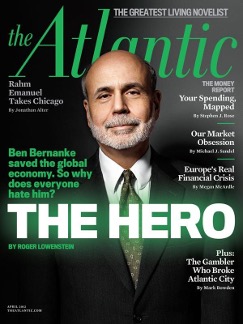
Source: The Atlantic
After Bernanke came Janet Yellen, who famously (or infamously) said in 2017 that she did not expect another financial crisis “in our lifetimes.” As it happens, a financial crisis occurred three years later.
But the point is that—at least in the modern era—central bankers are often treated as quasi-godlike figures with immense power and foresight. And with that in mind, the man currently in the top job is an oddity.
When Fed Chairman Kevin Warsh stepped up to the podium at the recent Jackson Hole Symposium, he talked for 20 minutes or so. What was most interesting was what he didn’t say: He didn’t commit to raising or lowering interest rates. He didn’t even hint at what would prompt him to do either.
In fact, when speaking about the future, Warsh said: “our knowledge just doesn’t extend that far … at least not yet.”
That’s it.
For the Fed-watching world, this was a stark departure from Warsh’s predecessor, who regularly spoon-fed forward guidance to the markets.
But within minutes—before the transcript was even fully out—the two-year Treasury yield jumped to its highest level in a month. And for some reason, the odds of a September rate hike, according to the CME FedWatch tool, nearly doubled overnight.
It’s a small thing, but we’re watching an institutional sea change with Warsh. Far from trying to direct where the markets “should” go, Warsh appears humble about the central bank’s abilities and foresight. And investors will have to learn how to adapt.
It reminds me a lot of when Jerome Powell started hiking interest rates in 2022. Everyone seemed convinced that he wouldn’t go very far, that the Fed would have to reverse course. The conventional wisdom was that the “Powell pivot” was imminent.
It wasn’t…
The market didn’t realize that the paradigm had shifted. Powell stuck to his guns and hiked the Fed’s rate north of 5%.
Something similar is happening today.
Forward guidance became so standard that bond traders started treating it like a promise. That made it almost like a self-fulfilling prophecy. Warsh is now denying them that.
Treasury yields jumped after Warsh’s speech not because he promised rate hikes, but because he didn’t promise anything! The market assumed the worst and sent Treasury rates higher.
Like Powell during the hiking regime of years past, Warsh seems to be breaking the mold. And the market is still figuring out how to deal with one of the most surprising things.
A humble Fed chair …
Read the latest insights from the world of high technology.
The process begins with a simple question: What should the chip do?

The move in commodities will keep pushing inflation higher, which will put pressure on the Fed to act on...

I guess Salesforce (CRM) didn’t get the memo...