



Attack of the “Ants”
In South Korea, individual stock traders have an unusual nickname: gaemi, the Korean word for ants.



The move in commodities will keep pushing inflation higher, which will put pressure on the Fed to act on rates.


It wasn’t that long ago that investor optimism was being fueled by AI hyperscalers’ massive capex spending, which is now projected to top $1 trillion next year.
Those hopes are now switching to concerns over the macroeconomic outlook—especially things like rates, inflation, and currency debasement.
On Aug. 19, the U.S. Treasury announced that a buyback program targeting long-term bonds would double in size from $2 billion to at least $4 billion. The move followed an increase in the 30-year Treasury yield to 5.31%, the highest level in nearly two decades.
It’s not just the long end of the yield curve seeing action, either. During his widely watched speech at the Kansas City Fed’s Jackson Hole Economic Policy Symposium, Fed Chair Kevin Warsh kept up his hawkish rhetoric over inflation. That’s pushing short-term rates higher.
Rising rates are being fueled by two forces that aren’t going away anytime soon. The first is debt levels and deficit spending. In the U.S., federal debt relative to gross domestic product (GDP) stands at 121% and matches the high coming out of World War II.
Those levels look to get worse with deficits running high. The U.S. budget deficit relative to GDP is expected to top 6% this year. Deficits surpassing 5% of GDP are rarely seen during good economic times.
The other force driving rates higher is inflation. Core consumer inflation has stayed above the Fed’s 2% target for over five years now. And a broad rally that’s unfolding in commodities could make things worse.
Commodities are among the most sensitive assets to rising inflation. They historically deliver strong performance during periods of high inflation. They also show strong correlations to inflation expectations.
And right now, inflation warnings are stacking up all across the commodity sector.
For instance, energy is the best-performing sector in the S&P 500 this year. It’s up 41% year to date.
And then there’s copper, which is used in a wide variety of end markets. Copper prices on the London Metal Exchange (a good global benchmark) are up 68% in just the past year.
Agricultural commodities like wheat and soybeans are moving higher as well and are trading near their highest levels in years. That’s contributing to food inflation.
The movement across energy, metals, and agriculture is helping push commodities toward another key breakout.
We can track a broad basket of commodities with the iShares S&P GSCI Commodity-Indexed Trust (GSG). Back in February, GSG saw a breakout from a massive basing pattern that stretched back several years.
The catalyst for the rally was the jump in oil following the outbreak of war between the U.S. and Iran, which helped drive the Consumer Price Index (CPI) from 2.4% in February to 4.2% in May. Now GSG is breaking out from another bullish pattern in the chart below:
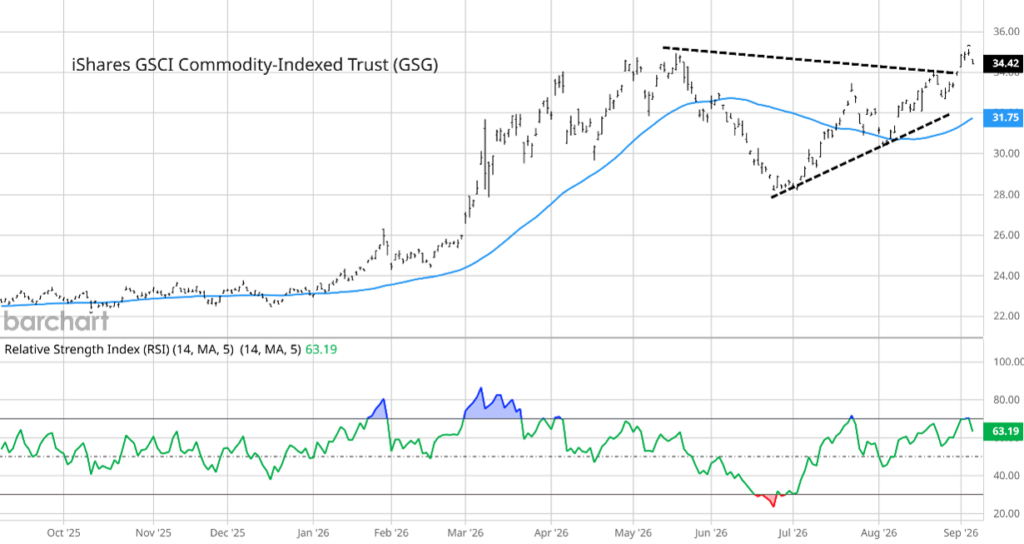
GSG is rallying from a symmetrical triangle, shown with the dashed lines. Triangles usually act as continuation patterns. That means price tends to keep heading the same way it was moving before the triangle formed.
The move in commodities will keep pushing inflation higher, which will put pressure on the Fed to act on rates. At the same time, actions by the Treasury are bringing back memories of the Fed’s quantitative easing program, in which it created money to buy bonds.
For active traders, this isn’t all bad news.
Volatility from macroeconomic sources should create more trading opportunities in several themes, especially those leveraged to the macro crosscurrents that are picking up.

Imagine if the world’s gold production was suddenly cut in half …
What would happen to the price of the asset?
All else equal, the price of gold moves higher.
That, in a nutshell, is what has happened to Bitcoin every four years. And, like clockwork, it’s been a catalyst for the asset price.
Longtime digital asset investors will know this as “the halving.” It’s the event that cuts the daily rewards Bitcoin miners receive for validating network transactions in half.
It’s a process that happens programmatically every four years without exception. The next one is expected in April 2028.
But because the halving is so well telegraphed, the market doesn’t wait for the actual event to begin pricing it in. Historically, Bitcoin has moved higher months before the actual event.
See for yourself:
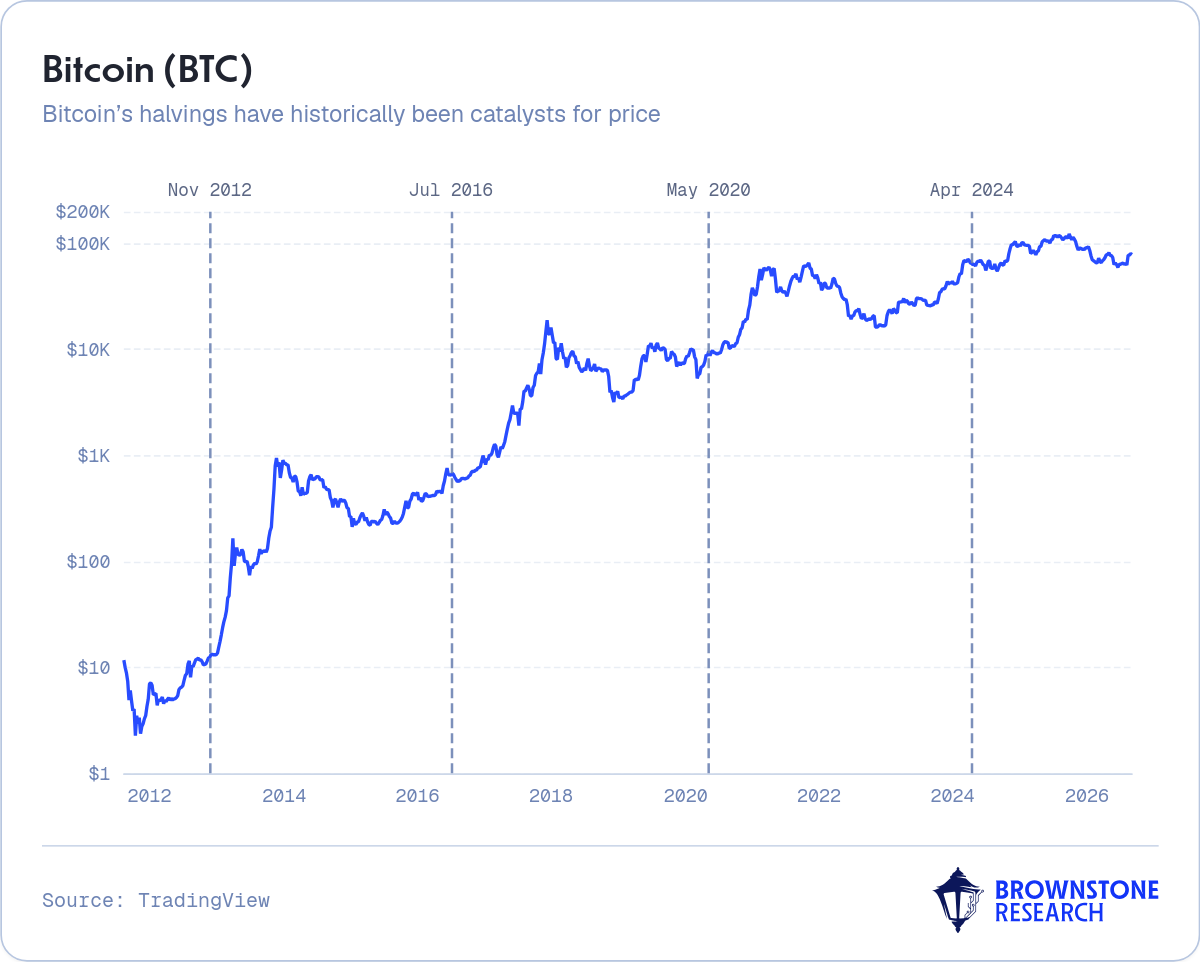
What should stand out from the chart above is that each halving is indeed a catalyst for BTC. But the market does not wait for the actual event. Bitcoin has rallied well before each prior halving.
This cycle has only become more pronounced as the market has matured. Should the asset follow the same pattern, BTC could be trading at new all-time highs 6 to 12 months prior to the April 2028 halving. And the market is already showing signs of positioning.
Back at the start of August, we told you here in First Signal that ETF Buyers Aren’t Waiting on CLARITY.
At the time, we said that Bitcoin spot ETFs are the primary way institutions get their BTC exposure. We also said these ETFs had seen $865.3 million of net inflows to start off August.
Well, by the end of August, Bitcoin spot ETFs pulled in over $3.5 billion of cumulative inflows for the month, marking their best performance since July 2025.
This was followed up by an additional $1 billion plus in September’s first three trading days.
These flows, along with the cyclical halving pattern, suggest one thing: Large investors understand the halving catalyst is just on the horizon, and they’re building positions now.
Self-directed investors interested in Bitcoin might consider doing the same.

This IPO season is shaping up to be one for the history books …
In June, SpaceX (SPCX) held its market debut, the largest in history. Anthropic—creator of the Claude LLM—is expected to make it out of the gate in the coming months. And OpenAI, creator of ChatGPT, is expected to follow.
But among those high-profile names, there’s another IPO that few investors know about. But it’s worth paying attention to as evidence of how AI could shape the consumer wearables market.
The company is Oura, the maker of the popular Oura Ring.

Source: Oura
At first glance, Oura may look like another consumer electronics company selling a wearable device. But underneath the hardware business is a fast-growing subscription platform built around health data, preventive care, and artificial intelligence (AI).
That makes the company considerably more interesting than a typical gadget maker.
Oura’s recent financial performance has been impressive. Revenue for the first nine months of its latest fiscal year reached about $1.2 billion, up 74% from the previous year.
The company is also profitable. Hardware still generates most of Oura’s sales, but its membership business is growing much faster. Oura now has around 5 million paying members, about twice as many as a year earlier.
The subscription business may be the most valuable part of Oura over the long term.
Members pay a monthly or annual fee to receive detailed information about sleep, recovery, stress, heart rate, and other health measurements. This subscription revenue has very high profit margins (~90%). If subscriptions continue growing faster than hardware sales, Oura could gradually become a higher-margin and more predictable business.
The typical Oura customer wears the ring for around 23 hours per day. That allows the company to continuously collect health information during sleep, exercise, work, and normal daily activities.
This large amount of real-world health information could become an important competitive advantage, especially as artificial intelligence becomes better at finding useful patterns in medical and lifestyle data.
This is also why Oura’s AI strategy may be more meaningful than the AI claims made by many other companies.
Artificial intelligence models are becoming widely available. What is much harder to reproduce is years of continuous health data from millions of people. Oura has that, and it could help the company improve its algorithms, provide better health recommendations, and potentially expand further into preventive medicine.
Oura is already moving in that direction.
The company is exploring areas such as metabolic health, fertility, blood testing, medication monitoring, and cardiovascular health. Eli Lilly has also invested in Oura, which is particularly interesting because wearable health data could eventually be combined with drugs such as GLP-1 obesity treatments.
In the future, Oura could potentially help patients and doctors understand how medications affect sleep, activity, weight, recovery, and other health measurements in the real world.
There are still important risks. About 80% of Oura’s revenue currently comes from hardware, meaning it remains heavily dependent on selling rings.
Competition is another concern. Apple, Samsung, Garmin, Google, and others have enormous financial resources and could continue improving their own health-monitoring products.
The biggest question, however, may simply be valuation. Oura’s recent private valuation was around $11 billion, which already represents an expensive price compared with its current revenue and profits.
Overall, Oura appears to be much more than a smart-ring manufacturer. It might not be the highest-profile IPO, but it could prove to be a bellwether for AI adoption in the consumer health monitoring space.
Add Brownstone Research as your preferred source on Google to see our latest stories in your feed.
 Add as a preferred source
Read the latest insights from the world of high technology.
In South Korea, individual stock traders have an unusual nickname: gaemi, the Korean word for ants.

The GPUs are being deployed in a timely manner. What isn’t arriving fast enough is the electricity to power...