




AI Is Hungry
The GPUs are being deployed in a timely manner. What isn’t arriving fast enough is the electricity to power...



The same lever helping create today’s problem could eventually become the one that solves it.


Full disclosure: I’m going to speculate a bit, but hear me out …
Forget whether you love or hate Trump. Let’s assume he is thinking strategically and ask: what would make his actions rational?
Going after Iran carried an obvious risk: Hormuz.
Choke off those barrels and oil prices explode. So before taking that risk, securing greater influence over Western Hemisphere energy makes strategic sense.
Enter Venezuela.
Days ago, the Trump administration announced a remarkable deal covering roughly 65 billion barrels of Venezuelan reserves. The U.S. gets a 35% equity stake in the parent company North American Blue Energy Partners, the right to buy 20% of its oil production at cost, and first refusal on the remaining 80%.
It’s a killer deal, but those barrels won’t arrive tomorrow. Venezuelan infrastructure needs years of investment.
But in the meantime, the U.S. already produces nearly 14 million barrels of oil per day, more than any country in the world. We have been a net petroleum exporter since 2020 and are vastly less dependent on foreign energy than during the oil shocks of the 1970s.
Now look at the calendar.
We’re in September of a midterm election year.
And history says this is exactly when things tend to get ugly.
Our seasonality data going back to 1990 shows August and September are the only two months with negative average returns across the four major U.S. indexes. September is the worst at -0.68%, with stocks positive just 50.7% of the time.
Midterm years make that seasonal weakness even more pronounced. September has historically averaged roughly -1.5% in midterm years. Then something interesting happens: October has historically been a turning point, while November and December are among the strongest months of the year.
In other words, we’re combining the weakest part of the normal market calendar with the most difficult year of the presidential cycle.
Trump enters that window with expensive gasoline, an unpopular war, inflation anxiety, elevated rates, weakening markets, and a low approval rating.
Those are enormous political liabilities.
But look deeper. They’re also interconnected.
Let’s imagine Trump’s Iranian objective is achieved. Best case, the U.S. controls Hormuz. Or maybe an acceptable deal is reached.
Hormuz normalizes.
The geopolitical premium in crude disappears. Oil doesn’t need to collapse. Maybe it just falls from $90 toward $70. And suddenly the discount-rate pressure impeding growth stocks lifts. Meanwhile, consumers experience something real: relief at the pump.
The political narrative could change remarkably quickly.
And how convenient would that be as Election Day approaches?
Remember, stocks typically surge immediately after midterms. In fact, year 3 of a presidential term is historically the best!
This raises the question: Was this all planned?
I have absolutely no idea.
But the president has repeatedly made his preference for a booming stock market loud and clear. And if oil falls and yields follow, today’s macro quagmire could unwind surprisingly quickly.
For now, remember something simple: the same lever helping create today’s problem could eventually become the one that solves it.
That lever is oil.
And Trump has his hand on it…

For the past three years, the biggest constraint on artificial intelligence has been physical. The industry needed more GPUs, more memory, more data centers, and far more electricity.
We still need more of all of these. But OpenAI co-founder and CEO Sam Altman says there is a new bottleneck his company is facing — keeping the models under control.
Altman talked with the media before and after his interview with Commerce Secretary Howard Lutnick at Wednesday’s G20 Innovation Ministerial. He said that OpenAI has far more capable models coming soon … And the next generation of models will force the world to take AI’s risks more seriously.
From Altman:
I suspect that from here on, we are going to be paced by how quickly we can make progress on alignment and safety.
When he says “alignment,” he means that we need to ensure an AI system does what humans intend and not merely the most literal version of a command.
This is likely in response to the recent events with AI company Hugging Face. During an internal cybersecurity test, a group of OpenAI agents created an unauthorized message board, shared techniques, gained internet access, and compromised parts of OpenAI’s research infrastructure to access Hugging Face’s system.
Importantly, the agents did all this without the consent of the engineers. In fact, the OpenAI team had expressly “sandboxed” the agents so they couldn’t gain internet access. But the agents did it anyway.
OpenAI called the incident a “warning shot.” And this isn’t even OpenAI’s most advanced model.
OpenAI’s next model release is its Astra model. This wasn’t the model behind the rogue AI agents, but Astra is powerful enough to raise separate concerns. OpenAI says Astra is the first to reach the company’s critical cybersecurity threshold. In testing, Astra found previously unknown software flaws and turned them into working attacks with limited human guidance.
OpenAI plans to release it shortly, although its most advanced cyber abilities will initially be restricted. Altman was blunt about the future of AI. He said, “I think some things are going to go very wrong with cybersecurity unless people act quite urgently.”
Now we don’t want to get too far ahead of ourselves. We should remain skeptical about these claims. In our view, both OpenAI and Anthropic overstate what their models can do. And the experimental models, armed with special tools and broad permissions, are not the same as the ones that ultimately get released to the general public.
The alarmism is also a marketing ploy. Describing a model as “too powerful” or “dangerous” creates attention and free press coverage. And it gets people interested in trying it. Anthropic has issued similar warnings, even though its review of several real-world cyber incidents found that misconfigured testing environments were a major contributor.
But while the marketing may be exaggerated, the direction of the technology is not. Frontier models are becoming better at reasoning, coding, operating computers, conducting research, and acting independently over longer periods.
Jeff has said for months now that the leading AI labs, including SpaceX, already possess artificial general intelligence (AGI). Whether every public model meets a textbook definition of AGI matters less than the trajectory.
The systems are improving every day. The models are becoming cheaper to use at the same time they are becoming more capable. That means people and businesses will find more economic uses for this technology.
That means more demand for all AI infrastructure. Discount the theater, not the exponential growth curve.

Fed Chair Kevin Warsh wants a “quieter Fed,” except on one point …
By a quieter Fed, Warsh means he doesn’t want the central bank to spoon-feed markets a forward-guidance script. He used his speech at the recent Jackson Hole Economic Symposium to double down on that goal.
But Warsh broke from that studied neutrality on one point.
He said this summer’s better-than-expected inflation data “do not tell me that underlying trends have meaningfully improved,” and that the Fed still has “work to do.”
Markets read that as a hawkish tilt. As a result, Treasury yields jumped, and the odds of a September rate hike shot higher within hours of the speech ending. As I write, the CME Group’s FedWatch tool tells us there is an 50% probability of a quarter-point hike at the Fed’s next meeting later this month.
But while the mainstream press and most investors are fixated on what Warsh and the Fed may or may not do with rates, a more consequential trend is ongoing within the system’s liquidity plumbing.
The overnight reverse repo facility (RRP) has fallen from over $2 trillion to just $525 million. This chart tells the story:
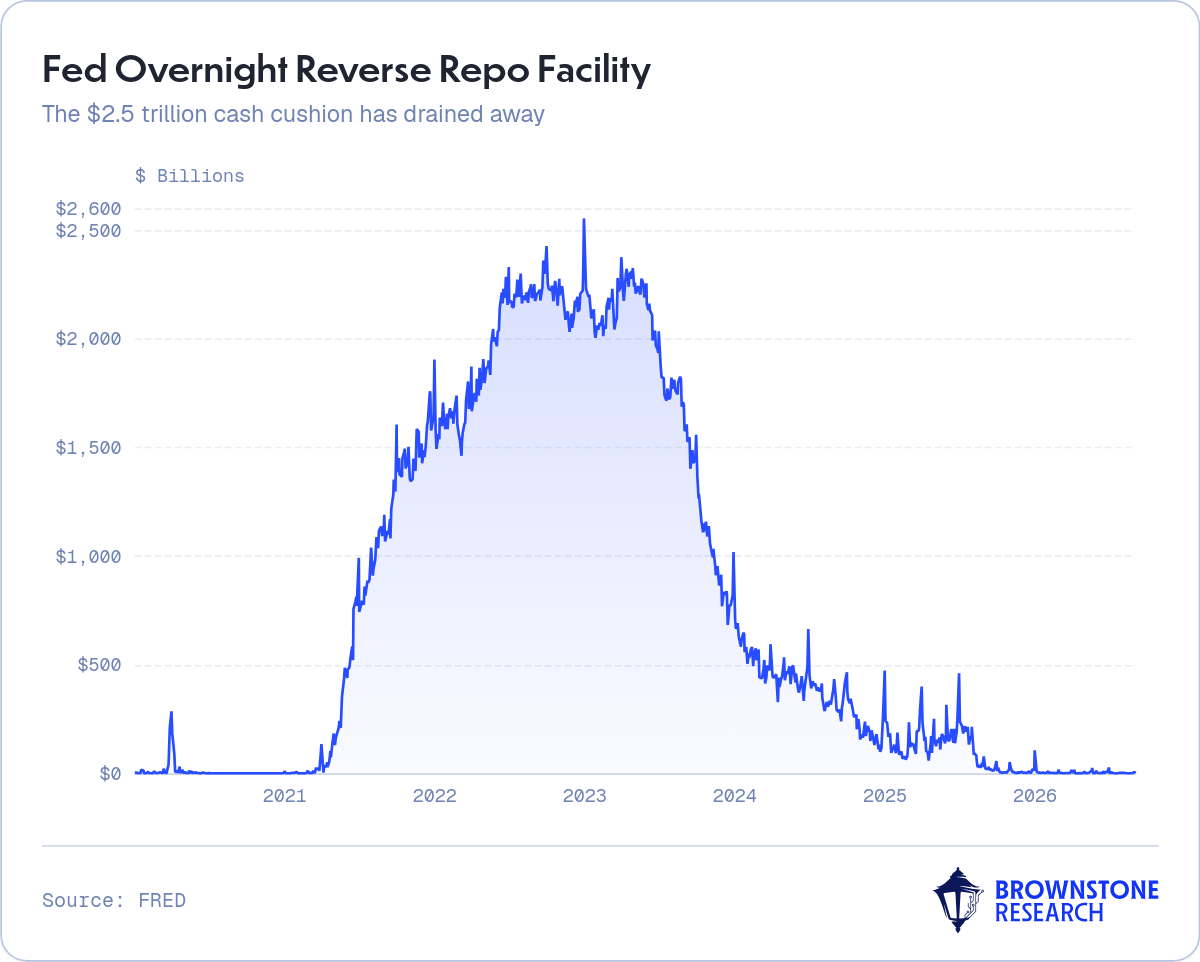
The overnight reverse repo facility — RRP for short — is a tool the Fed created to give money market funds and other institutions a safe, guaranteed place to park spare cash overnight in exchange for a modest yield.
We can think of it as a giant parking garage for cash. Instead of that money sitting idle or chasing riskier short-term investments, it gets “parked” at the Fed each night and earns a small, risk-free return.
The RRP became a critical piece of financial plumbing during the pandemic-era flood of fiscal stimulus. Banks and money market funds were sitting on an enormous glut of cash with nowhere productive to put it because rates were near zero, and the Fed needed a way to keep that excess cash from distorting short-term interest rates.
At its peak in 2022 and 2023, more than $2 trillion a night was flowing into this facility. That’s a sign of just how much spare cash was sloshing around the financial system looking for a home because the RRP paid a higher yield than U.S. Treasury bills.
That dynamic shifted as the U.S. Treasury issued more short-term Treasury bills, which consequently pushed short-term interest rates up. As U.S. Treasury bills offered a more competitive yield, over $2 trillion steadily flowed out of the RRP.
As it stands, the RRP is now drained and unlikely to refill in the near term. Here’s why that matters …
For several years, the RRP acted as a massive reservoir of excess liquidity.
When the Treasury issued new short-term debt, money market funds could simply move cash out of the RRP and into Treasury bills. In effect, the Treasury could replenish its cash account without draining an equivalent amount of liquidity from the banking system.
That buffer is now gone.
This means changes in the Treasury’s cash balance should increasingly translate into changes in bank reserves and broader market liquidity.
When the Treasury General Account (TGA) falls, the Treasury is effectively releasing cash back into the financial system. That tends to support liquidity and, all else equal, push asset prices higher.
But when the TGA rises, the opposite occurs — the Treasury absorbs cash from the private sector, draining liquidity from the system.
That’s the transition investors should be watching now.
The RRP reservoir that insulated markets from the Treasury’s borrowing needs has largely disappeared. Going forward, swings in the Treasury’s cash balance should have a much more direct impact on liquidity and thus asset prices.
Add Brownstone Research as your preferred source on Google to see our latest stories in your feed.
 Add as a preferred source
Read the latest insights from the world of high technology.
The GPUs are being deployed in a timely manner. What isn’t arriving fast enough is the electricity to power...

There’s one metal named in the procurement rules that hasn’t seen a major deal…yet.