



Nvidia’s Not Done Yet
It was an amazing quarter from a company that has been defined by amazing quarters.



Every ingredient for a risk-off week was present. Then Nvidia presented…

The headlines last week gave investors every reason to look away…
Trump imposed 50% tariffs on Canadian goods, threatened new levies on vehicles and steel, and issued an executive order to rename Lake Ontario to “Lake America.” Canada retaliated with tariffs on 700 American products.
Citadel continued distributing the Aschenbrenner portfolio that it picked up during the liquidation of Situational Awareness. Citadel executed more than 100 block trades, representing over $4 billion in market value, including the largest single-session block trades of the year in 10 separate names.
Core PCE inflation remained stuck at 3.3%. Fed Chair Warsh used his appearance at Jackson Hole to say that America’s central bank might have more work to do on that front.
Every ingredient for a risk-off week was present.
Then Nvidia presented…
Revenue hit $96.2 billion for the quarter, up 106% from a year ago. Data Center revenue reached $89 billion, up 117%. The stock gained 8.74% Thursday, the second-largest single-day market cap addition in U.S. stock market history, adding $442 billion in value.
But the real surprise was guidance.
Nvidia projected revenue growth of approximately 70% for fiscal 2028, nearly twice what analysts expected.
Let me repeat that.
A company with a market capitalization north of $5 trillion believes its revenue will grow by 70% in its next fiscal year.
“AI has reached its inflection point,” Huang said. “It’s doing useful work. Its tokens are productive and profitable. Now, compute is revenue. And demand is accelerating.”
Meanwhile, SK Hynix’s CEO said the global memory industry is heading for its worst-ever supply shortage in 2027, forecasting that demand will continue exceeding supply well into the next decade.
The company announced $38 billion in new memory chip plants, with analysts noting memory prices are unlikely to soften before the end of 2028. Dan Ives called the memory trade “foundational, not cyclical.”
Micron’s CEO said memory supply shows no sign of catching up with AI-driven demand until 2028 at the earliest.
That’s not a trade. That’s a multiyear structural reality.
The noise last week: Canada, tariffs, Jackson Hole, Citadel.
The signal: Memory CEOs confirm the demand. Nvidia’s earnings confirm the revenue.
The signal was louder.

IPO expert, Jason Bodner, spent nearly two decades helping companies go public… and he’s learned the truth about IPOs. Today, he’s revealing a counterintuitive way to set your portfolio up for a better chance at success as OpenAI and Anthropic go public. Click here to find out more.

The first time we heard about this 24-hour AI phenomenon from Jeff, we thought he had lost his mind… Until he showed us what happened with some of his readers in 2019. Click here and see it for yourself.
On Aug. 26, 2022, Jerome Powell freaked out the markets…
At the time, Powell was still the chair of the Federal Reserve. And he was speaking at the Federal Reserve’s Jackson Hole Economic Symposium, a confab that draws central bankers from all over the world to present research papers that would put most of us to sleep.
But that year, Powell’s speech was eventful…
Two months prior, the Consumer Price Index (CPI) had printed a year-over-year change of 9.1%. The Fed had already started hiking its key rate, bringing it from close to zero in January to between 2.25% and 2.5% at the time of Powell’s speech.
But many investors still wondered if Powell’s Fed had the stomach to continue aggressively raising rates. The speech in Jackson Hole that year put that question to rest.
Powell said the Fed would use its tools “forcefully” to bring down inflation. He also referenced Paul Volcker, the Fed chair who hiked rates to nearly 20% in the 1980s to combat the inflation of that period.
Investors got the message. The S&P 500 was down as much as 15% in the weeks that followed.
Ever since, investors have watched Jackson Hole, scanning for any indication of what the Fed’s next move might be.
This year, Kevin Warsh is in the hot seat. He commented that the Fed must “be confident that underlying inflation is moving to our objective, clearly and at sufficient speed. Otherwise, we have work to do.”
For the Fed, that means returning inflation to its 2% target … something that hasn’t happened in over five years.
The most recent PCE price index—the Fed’s preferred inflation measure—was reported at 3.7%. The core measure rose by 3.3%.
Put another way, inflation may not be “hot,” but it’s still on the warmer side. And it’s possible inflation reignites from here. That’s because one key commodity is flashing a warning.
Copper is a foundational base metal used in a variety of end markets, including construction, data centers, machinery, and electrical equipment.
Given copper’s ubiquity, higher copper prices mean costs get passed down. That means more inflation.
One study pegged a 10% rise in copper as adding 0.2 percentage points to headline and core inflation within 12 months. The effect on inflation doesn’t peak until two or three years later.
So, where is copper now?
Copper prices traded on the London Metal Exchange (which is a good global benchmark) are up 68% in just the past year.
Here’s the LME copper chart.
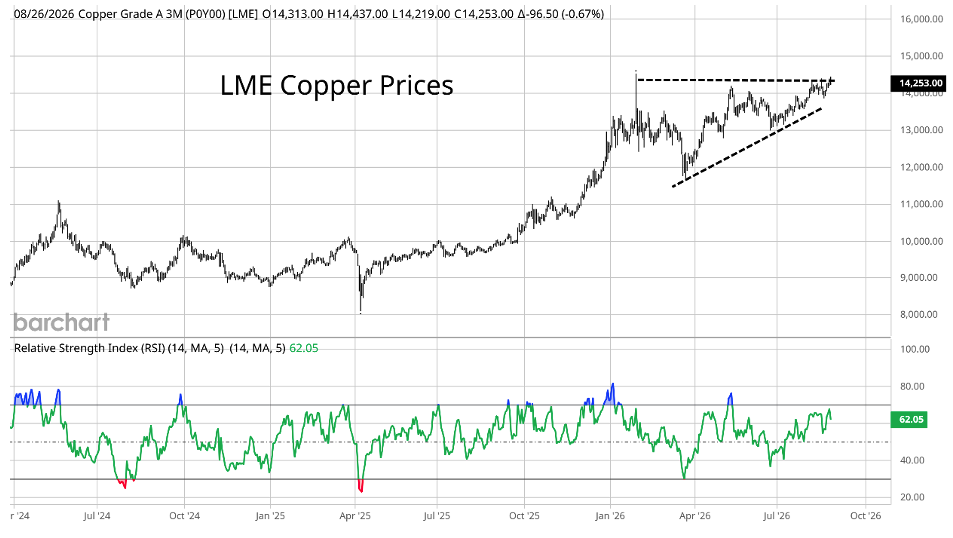
Copper is trading in a pattern called an ascending triangle. As the pattern forms, the higher lows in price (lower dashed line) point to increasing buying pressure. That’s why ascending triangles tend to result in a move higher. If copper prices break out, inflation could be headed higher.
Warsh and the Fed can kick the can for now. But copper says the Fed’s inflation problems aren’t going away. Sooner or later, America’s central bank will have to deal with this problem. And when that happens, rates are headed higher.

On Aug. 18, the yield on the 30-year Treasury bond reached roughly 5.32%. It was the highest level since June 2007.
The very next day, U.S. Treasury Secretary Scott Bessent announced that the Treasury would double the size of its “long-end buyback operations,” enabling Bessent to buy back up to $4 billion worth of long-dated U.S. Treasuries over the next three months.
The mainstream press had plenty to say about that…
The Guardian painted Bessent’s buyback expansion as a “panicky intervention” that “smacked of rising anxiety about how markets now view the U.S. fiscal position.”
UC Berkeley economist Barry Eichengreen stated that “the dollar is not the attractive reserve currency it once was.”
Adam Posen of the Peterson Institute declared that “the entire world is now doing business, investing, and trying to make a living in the post-American world economy.”
And even Zero Hedge got in on the act. The alt-finance news site ran a piece titled “Our Debt Is Grotesque…And Will Kill The Dollar.”
I’m not here to tell you that the government debt isn’t high (it is). And I won’t say that it couldn’t have an effect on the dollar (it could).
But while yields on long-dated American debt were rising, here’s what was happening with other government bonds:
The point is that rising bond yields are not an American phenomenon. It’s a global one.
But how many articles have we seen suggesting Britain, Germany, or France are on the verge of collapse? Even Japan, with its debt-to-GDP ratio north of 200%, seems free of that prediction.
Rising U.S. Treasury yields are not a function of capital flowing into other sovereign bond markets. In fact, as my colleague Ben Lilly showed recently, there’s still appetite for America’s debt. Bond buyers just need to be enticed with a higher yield.
On its current trajectory, the American government’s debt addiction may cause serious trouble in the bond market.
But that day’s not today…
Read the latest insights from the world of high technology.
It was an amazing quarter from a company that has been defined by amazing quarters.


This could mark an important turning point in the fight against cancer…