




AI Is Hungry
The GPUs are being deployed in a timely manner. What isn’t arriving fast enough is the electricity to power...



Bitcoin’s back…but is it here to stay?
Managing Editor’s Note: On August 26, NVIDIA’s earnings report could trigger a historic shift in the market… Potentially sending more than $1 trillion flooding into an overlooked part of the market.
That’s according to our colleague – Market Wizard Larry Benedict.
Larry has identified one ticker that sits directly in the path of that $1 trillion…, and he believes it could become the first major opportunity of this shift. He’s getting into all the details tonight.
Just go here to add your name to the guest list with one click.

Bitcoin’s back…but is it here to stay?
We have relentlessly tracked the world’s first digital asset since our first update on June 10. At the time, BTC was trading around $61,000. But last Wednesday, BTC rocketed, closing the week up over 20%, nearing $80,000.
Exactly why that happened was the subject of Monday’s edition of Chain of Thought.
But now, the important question: What happens next?
We should recognize that BTC’s price remains inside the same range it has traded in all year. Last week’s move carried us from the bottom of that range in the low $60,000s to the top near $80,000. Now, we’re right back to a resistance level that was previously rejected in mid-May.
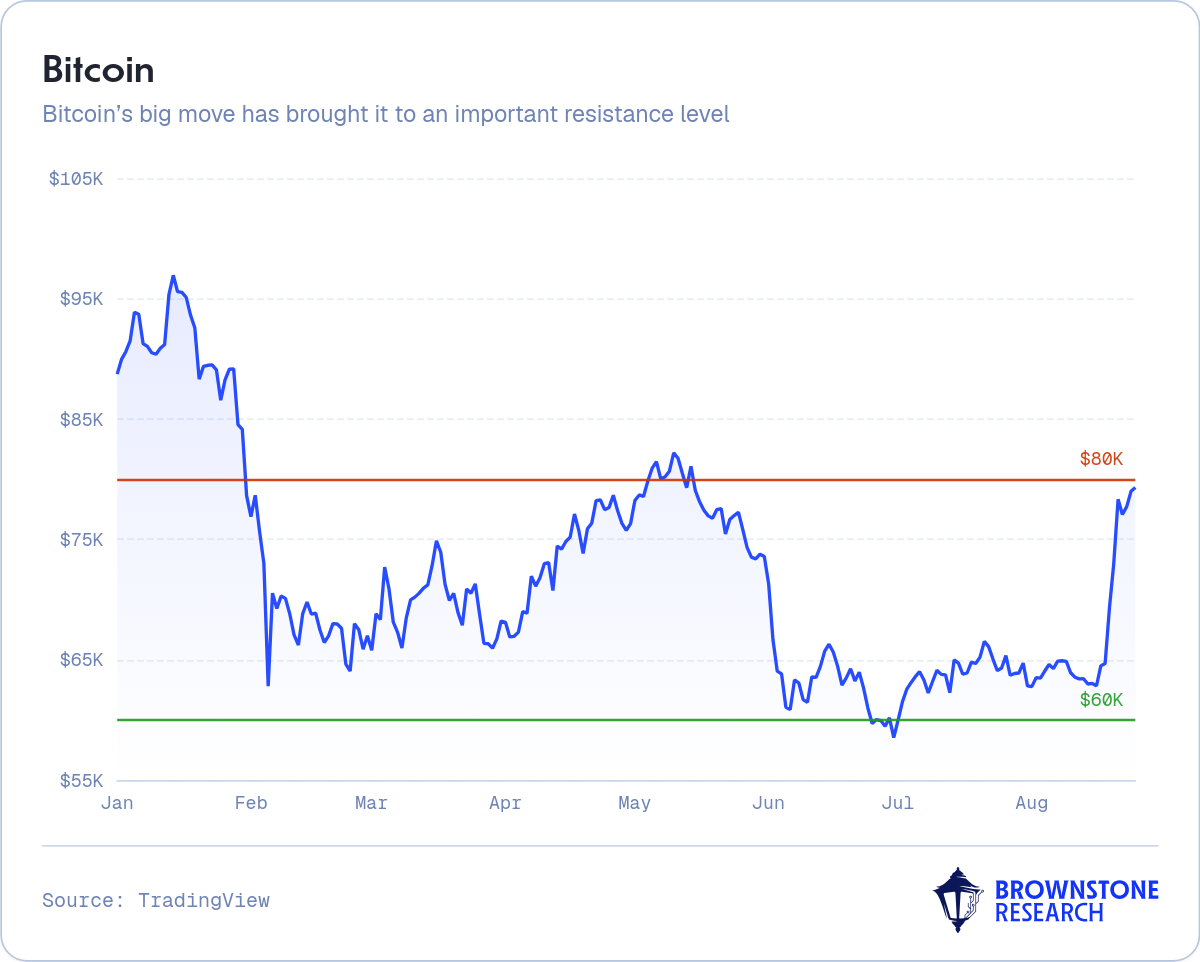
Price temporarily popped above this level Monday night before reversing. Before we can declare a new bull market in BTC, the asset needs to clear this hurdle definitively. And there’s every reason to expect things to be bumpy from here. That’s because of what’s taking shape in the options market.
Last week’s move sent implied volatility (IV) soaring along with price.
IV can be thought of as a measure of how much traders expect the market to move up or down. The higher IV is, the more volatility is expected. The smaller the figure, the flatter price is expected to be going forward.
IV was just around 27% prior to last Wednesday’s big price move higher. Within days, IV nearly doubled to over 48%.
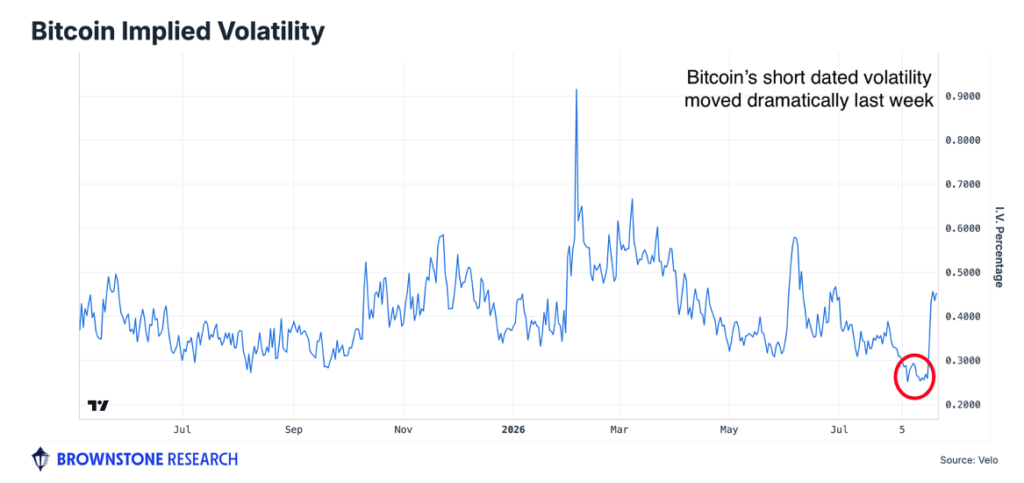
This big change in IV isn’t surprising. A big move like this liquidated more than a few shorts. And traders were scrambling to buy up options to hedge themselves. It’s a reactive move.
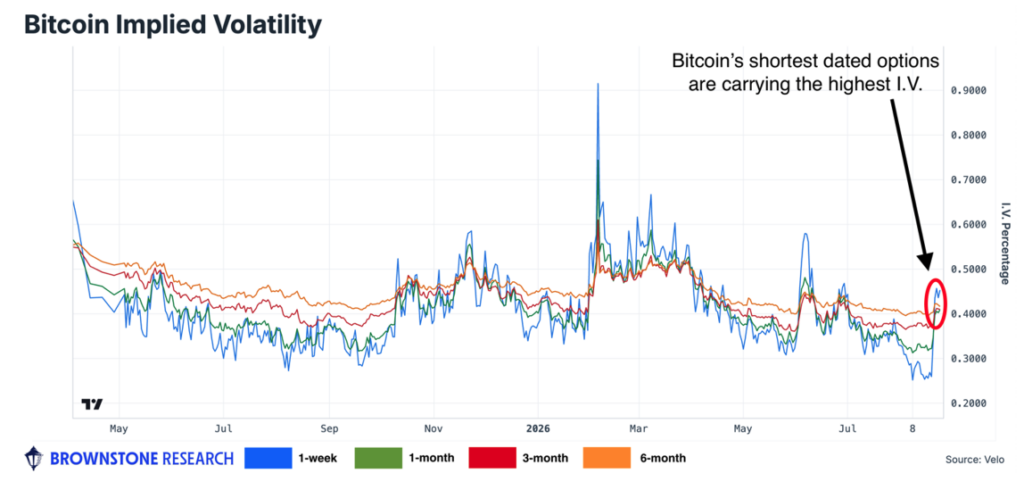
But, importantly, longer-dated volatility rose far less.
The three-month and six-month IVs, for example, climbed modestly from 37% and 40%, respectively, last week to around 42% each today.
That gap creates an opening for patient institutions looking to take on BTC leverage into the end of the year to sell rich short-dated calls and buy cheaper longer-dated strikes.
This is what’s known as a “calendar call spread,” which is a trade that lowers the cost of upside exposure.
When we plot various option expiries and their IVs on a chart, it produces a curve we refer to as a term structure chart.
As we’ll see below, the shortest-dated options are carrying the highest IV. These options are being sold to take advantage of the recent spike.
Meanwhile, the options that don’t expire for quite a while have lower IV. We’ll likely see these climb higher as more traders open up this calendar call spread.
This is why big IV spikes like we just saw often don’t last long.
Institutions and larger investors will wait for that IV bleed before they build size. That means the most likely course for BTC in the near term is sideways.
In the interim, let’s keep an eye out for a moving average we highlighted last week.
We’re talking about the 200-day moving average, which currently rests around $69,000.
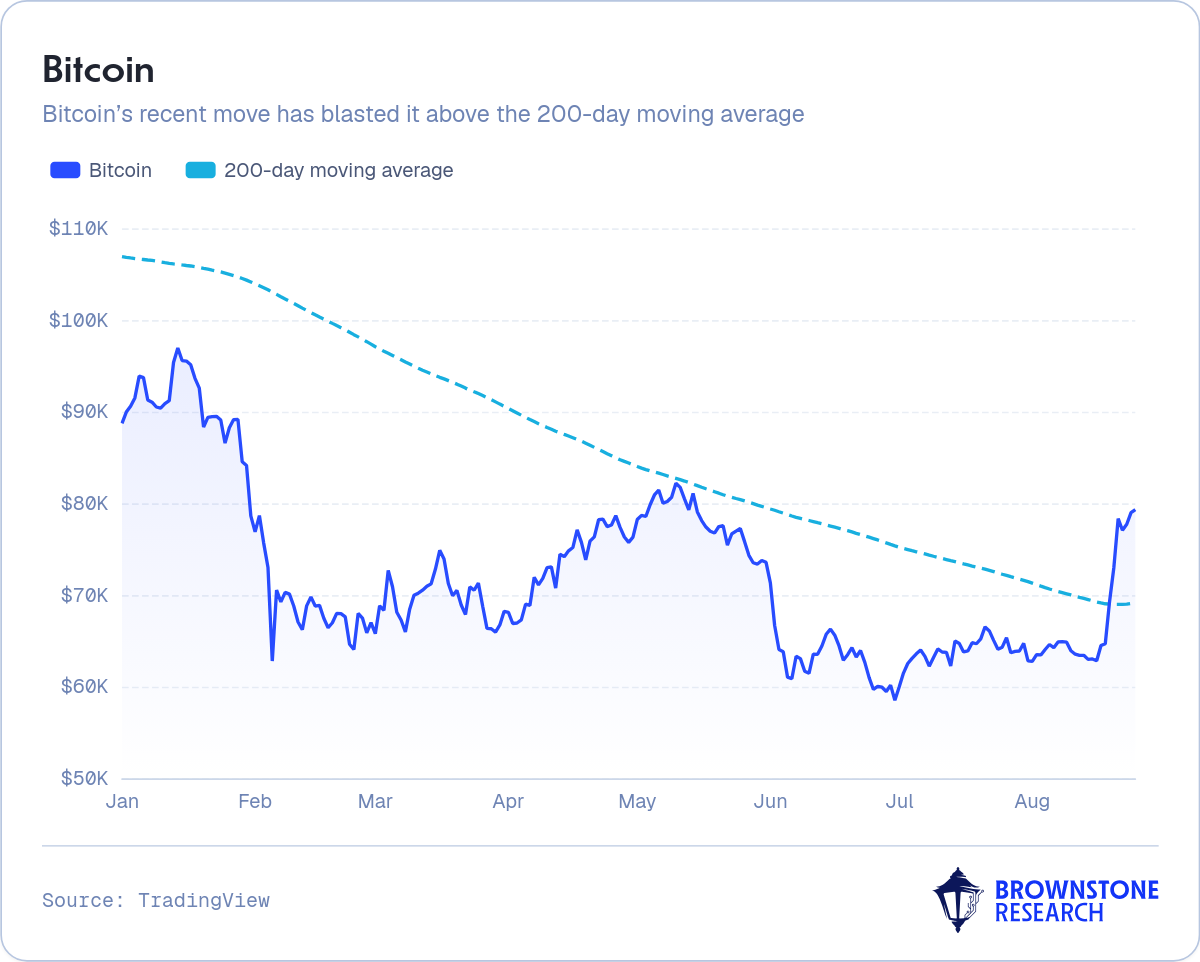
After last week’s surge, that level now represents possible support.
If momentum cools from here, and we see some downside reversion over the coming weeks as IV compresses, look for a retest of that level.
More to come…

There’s no shortage of news events this week, and all have the potential to move the market.
The stock that embodies so much of the AI story, Nvidia (NVDA), reports earnings today. And given the pressure we saw across AI and semiconductor stocks last week, those earnings could prove crucial to the broader market. (The VanEck Semiconductor ETF (SMH) lost 4% last Tuesday alone.)
And we’ll be watching more than just the headline numbers. Investors will be paying just as much attention to forward guidance and what management has to say about AI infrastructure spending and demand.
Also today, we’ll get July’s core Personal Consumption Expenditures (PCE) data — the Fed’s preferred inflation gauge. With the September Federal Open Market Committee meeting increasingly in focus, a slightly higher-than-expected inflation print could push Treasury yields higher and strengthen the argument for a rate hike inside the Fed.
Right now, the markets are factoring in around a 39% probability of a 0.25-percentage-point rate hike. Clearly, any higher inflation print is going to see that rise sharply, putting further pressure on stocks.
Then on Friday, all eyes will turn to Jackson Hole, where Fed Chair Kevin Warsh will deliver his first keynote address at the annual economic policy symposium. Already, Warsh has shown that he’s determined to forge his own path.
But after the more hawkish tone of the July meeting’s minutes, markets will be on the lookout for any clues about how Warsh views inflation, the economy, and the likelihood of a September rate move.
And, of course, there’s the ongoing situation in the Middle East.
With tensions surrounding Iran and the Strait of Hormuz still unresolved, any fresh escalation of hostilities could quickly push crude prices higher and add more pressure to inflation and interest rates.
Either way, there is plenty for markets to digest this week. Traders should expect more volatility to sweep through the market, potentially providing more opportunities to trade.

We’re living through an era where biotechnology and artificial intelligence are converging to supercharge our understanding of human biology.
And the evidence for this trend keeps piling up…
Last week, one of the largest drugmakers in the world, Bristol Myers Squibb (BMY), teamed up with an AI startup named Chai Discovery.
The goal is to use AI to design a special kind of medicine called antibodies, which are proteins the body uses to fight disease. Scientists can turn these therapeutic antibodies into powerful drugs to fight cancer or other diseases.
In July 2026, Chai raised around $400 million in Series C funding at a $3.8 billion valuation, which was nearly triple its $1.3 billion valuation from December 2025. That’s a huge jump for a company founded only two years ago, in 2024.
Traditionally, finding a new antibody drug is very slow, expensive, and mostly a trial-and-error process. Scientists test thousands of options in the lab hoping a few will work. Usually less than 1 in 1,000 attempts succeed.
Chai’s AI does something remarkable.
It can design brand-new antibodies from scratch on a computer, just by telling it what disease target to aim at. In testing, Chai’s system succeeded about 16% of the time.
That might not sound impressive, but it’s over 100 times better than older computer methods (most computational platforms show around 0.1% success rates).
Even more impressive, it only needed to test around 20 designs per target instead of thousands, and it went from computer design to lab-confirmed results in under two weeks instead of many months. It even cracked targets that scientists had long considered nearly impossible to hit.
Of course, these are early lab results, not finished, proven drugs. There’s still a lot of testing ahead before any of these become medicines people can take. But it’s a process that shows a lot of promise. And, if it’s successful, it couldn’t come at a better time. That’s because Bristol Myers Squibb is facing what we call “The Patent Cliff.”
Some of BMY’s best-selling drugs such as Eliquis and Opdivo are about to lose their patent protection. When that happens, cheaper copies will soon compete with them and cut into the company’s income. BMY needs new medicines in its pipeline to make up for that, and AI offers a faster, cheaper way to find them.
Bristol Myers Squibb isn’t alone. Within about eight months, Chai has now signed deals with four of the biggest drug companies in the world: Eli Lilly (LLY), Pfizer (PFE), Novartis (NVS), and now BMY. And Chai isn’t the only AI firm. Throughout 2026, other AI startups struck similar deals with major drugmakers.
When that many major players line up behind the same AI tool, it’s a strong sign the industry sees this technology as the new standard for discovering antibody drugs.
It also points to a bigger shift…
Chai doesn’t own or sell any medicines itself; it just provides the AI “design tools.” Yet investors value it at billions of dollars.
That suggests they believe the companies building the AI behind drug discovery could end up capturing much of the value, not just the traditional drugmakers.
This deal is a small but telling example of how the drug industry is racing to replace slow, costly trial-and-error with faster, smarter AI-powered design tools.
Add Brownstone Research as your preferred source on Google to see our latest stories in your feed.
 Add as a preferred source
Read the latest insights from the world of high technology.
The GPUs are being deployed in a timely manner. What isn’t arriving fast enough is the electricity to power...

There’s one metal named in the procurement rules that hasn’t seen a major deal…yet.