



Bessent Finds His Buyer
Fortunately for Bessent, there’s one group of buyers with a voracious appetite for short-term U.S. debt.



The winners of the next phase of the AI infrastructure buildout have already been determined...


For much of the last three years, the story of the AI buildout has been a story about AI servers and GPUs—who could secure enough of them and who couldn’t.
But the constraint for artificial intelligence today is not silicon. Nvidia can manufacture Blackwell and Rubin-class processors faster than the world can plug them in.
The big bottleneck now is electricity—specifically, base-load power that is already connected to a transmission grid that’s permitted, energized, and available for industrial applications.
This is a scarcity with no near-term solutions.
Consider this…
In PJM Interconnection—the largest wholesale electricity market in the United States—a developer who wants to connect a new large-load facility to the grid must wait as long as eight years for approval.
That’s eight years just to get the approval… not to construct the facility or secure the hardware.
Meanwhile, the companies training frontier AI models are operating within a completely different time frame. Each frontier AI company releases a new model in just months. And every few weeks at least one leading AI company announces a new breakthrough.
No one has the luxury of time in this industry. The major players cannot afford to wait one year, much less eight.
Demand for compute is compounding on a six- to 18-month cycle, but the supply of grid-connected power is expanding on an eight-year cycle.
To give you an idea of what this means, consider that Microsoft recently signed a rental agreement to gain access to a facility in West Texas that brings in 750 megawatts of electrical capacity—enough to power 600,000 American homes.
And get this… Microsoft’s rental contract will cost $9.7 billion over the five-year term. And Microsoft had to pay 20% of that total upfront.
And the reason Microsoft has to rent in the first place, despite having seemingly unlimited capital on hand, is that power—specifically grid-connected, high-capacity electrical infrastructure—is a dramatically scarce bottleneck.Even a company with Microsoft’s resources cannot quickly create large-scale, high-density data-center power.
Securing land with abundant low-cost electricity, obtaining grid interconnections, building or upgrading substations and transmission systems, and navigating multi-year permitting and utility queues typically take years.
Simply put, AI demand has outstripped the power grid’s ability to deliver new capacity on the needed timeline.
What that means in practice is this: The winners of the next phase of the AI infrastructure buildout have already been determined.
They are whoever happened to secure large blocks of grid-connected power before anyone understood what it was going to be worth.

This afternoon, the crypto industry finally gets its seat at the table.
Top executives from crypto and prediction-market companies such as Coinbase, a16z, Paradigm, and Polymarket, among others, will meet directly with regulators at the White House today.
The session is scheduled to begin at 2:30 p.m. in the Eisenhower Executive Office Building. SEC Chair Paul Atkins confirmed he will attend. CFTC Chair Mike Selig is expected too, alongside President Trump himself.
Executives from the New York Stock Exchange and Nasdaq were also invited.
This will put the legacy incumbents, the crypto upstarts, and the regulators in the same room for the first time since the fight over crypto regulation began.
The setup looks like a deliberate answer to the endless politics that have stalled the CLARITY Act all year. As a reminder, CLARITY is intended to give the digital asset industry something it’s been begging for—regulatory clarity. But as I’ve been telling readers of Chain of Thought, the legislation has been gummed up by the incumbents that fear disruption.
Rather than let the lobbyists work the process from the shadows, the White House is putting everyone at one table and making them hash out the path forward face to face, with just four weeks until the Senate takes the bill back up.
That Senate cloture vote on CLARITY is scheduled for September 15, the day after the chamber returns from recess.
To clear cloture, the bill will need 60 votes, and with the midterms looming in November, the September window is likely its last shot at passage this year.
Time is of the essence, and the White House knows it. This afternoon represents a concentrated push to get the major parties aligned before the vote.
It also helps policymakers advance their contingency plan should politics block CLARITY once again.
This is a topic we covered a couple weeks back in The Clarity Act’s 11th Hour Push (and The SEC’s Backup Plan). The SEC and CFTC have already begun drafting rule sets of their own, ready to move forward if the Senate refuses to pass CLARITY next month.
This meeting is a chance to make sure those rules work for both the incumbents and the crypto upstarts, and to smooth the transition as our financial markets upgrade onto 24/7/365 blockchain rails.
As for the market heading into this meeting, we currently sit at an impasse. In Monday’s Chain of Thought, we discussed how Bitcoin and digital asset markets are lethargic as we sweat through Crypto’s Dog Days.
In that issue, we highlighted this chart, which shows us Bitcoin’s 50-, 100-, and 200-day moving averages.
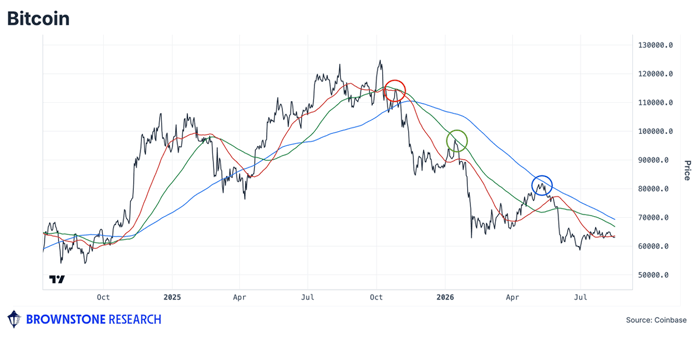
We haven’t seen price trade above all three at once since early last October, when the market sat at all-time highs.
Currently, price hovers right around the 50-day, with the 100- and 200-day moving averages overhead at roughly $66,500 and $69,100.
The market’s base expectation for the rest of summer seems to be more apathy and boredom. But that could change quickly if material agreements come out of today’s meeting.
A faster path toward CLARITY, or an expedited rulemaking process at the SEC and CFTC, would be the shot in the arm this market needs.
If either comes out of today’s meeting, expect the market to rapidly recover its lost ground and flip back into an uptrend as we close out August.
We’ll be watching closely…

Novo Nordisk recently announced a new partnership with Amazon Web Services (AWS) to expand the use of artificial intelligence (AI) across its business.
At first glance, the announcement may sound like another technology partnership.
However, a closer look suggests something much bigger is happening. Rather than simply testing AI in a few research projects, Novo Nordisk is making AI a core part of how the company discovers medicines, develops treatments, and operates its business.
The new collaboration will support scientists in identifying new drug targets, analyzing large amounts of biological and clinical data, and designing potential new medicines more quickly.
But the partnership goes well beyond research.
According to Novo Nordisk, AI is already helping improve clinical documentation and has increased the productivity of more than 25,000 employees across the company. That is an important milestone because it shows AI is no longer just an experiment—it is becoming part of employees’ everyday work.
Another important part of the announcement is the creation of a new AI Innovation Hub in London, where Novo Nordisk scientists will work side by side with AWS engineers.
This reflects a growing trend in the pharmaceutical industry.
Instead of simply purchasing software from technology companies, drugmakers are forming long-term strategic partnerships that combine expertise in biology, engineering, cloud computing, and artificial intelligence. These collaborations are designed to solve complex scientific problems faster than either company could on its own.
This partnership also shows how the role of cloud computing companies is changing.
In the past, AWS was mainly known for providing secure data storage and computing power. Today, the company offers advanced AI tools, engineering support, and specialized technology designed specifically for scientific research.
When viewed together with Novo Nordisk’s other recent AI initiatives, an even larger picture begins to emerge.
Earlier this year, the company announced a partnership with OpenAI to apply artificial intelligence across research, manufacturing, supply chain operations, and commercial activities. Combined with the new AWS collaboration, these investments suggest that Novo Nordisk is building an integrated AI ecosystem rather than pursuing isolated technology projects.
AI is becoming part of nearly every stage of the company’s work, from discovering new medicines to improving everyday business operations.
At the same time, companies such as Bristol Myers Squibb are investing in AI supercomputers to accelerate drug discovery, while GSK is improving operational efficiency to free up more resources for future innovation.
Novo Nordisk appears to be combining both approaches by using AI to improve scientific research and day-to-day operations at the same time. Although each company has chosen a different path, all are moving toward the same goal: developing better medicines faster while becoming more efficient organizations.
In the future, success may depend not only on scientific expertise, but also on how effectively companies combine biology, artificial intelligence, engineering, cloud computing, and data science into one integrated system.
Add Brownstone Research as your preferred source on Google to see our latest stories in your feed.
 Add as a preferred source
Read the latest insights from the world of high technology.
Fortunately for Bessent, there’s one group of buyers with a voracious appetite for short-term U.S. debt.

Stocks were climbing out of bear territory, but then the bond market spoke up.

These factories will cost billions before even a single working chip is produced…