




The Most Valuable Building on Earth
These factories will cost billions before even a single working chip is produced…



Stocks were climbing out of bear territory, but then the bond market spoke up.

Managing Editor’s Note: Every four years, something strange happens in the market. Jeff Brown calls it “the million-dollar cycle.”
You won’t hear about it on the evening news. Most financial advisors couldn’t explain it if you asked. And yet, like clockwork, it’s shown up again, and again, and again.
Most people don’t notice until it’s already played out. But a small group of investors knows exactly what to watch for. And each time this shift has taken hold, they have had the chance to turn a single $1,000 stake into six figures…
If you’d like to potentially be one of them, make sure to RSVP for Jeff’s upcoming event with one click here.

Near Manaus, Brazil, two giant rivers meet but don’t mix.
The Rio Negro is dark as coffee, warm, and slow. The Solimões is sandy, cool, and moves two or three times faster. For about 3.75 miles, they flow side by side in the same channel, one black and one tan, with a line between them you can see from space. They don’t fully blend until about 38 miles downstream.
That’s the stock market right now: two rivers in one channel.
The indexes are one river.
On Tuesday, October 6, the S&P 500 closed at a record 7,818.93, and the Nasdaq hit a record too. The market underneath is the other river, and it’s been running cold and heavy for a month.
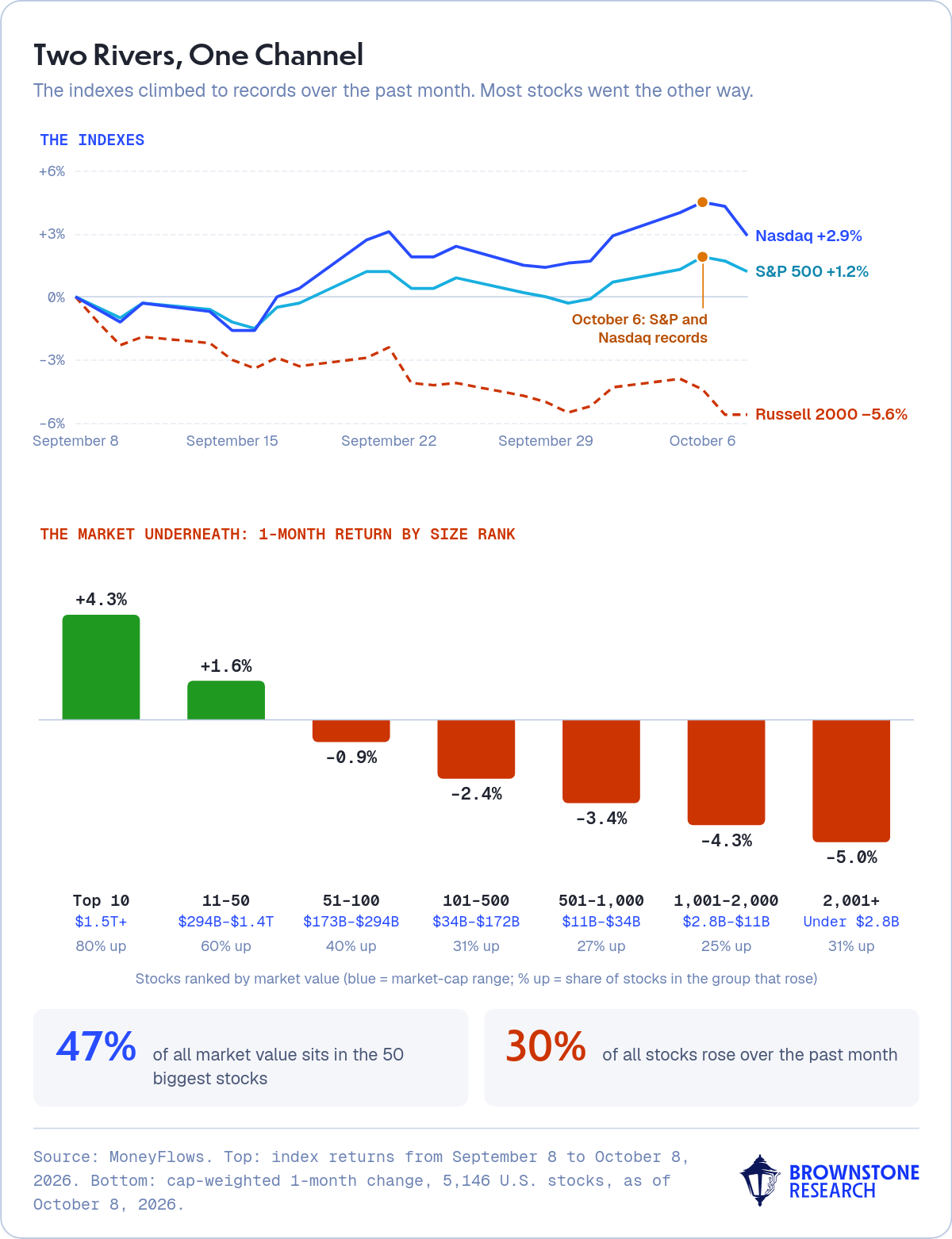
Here’s the thing: that same Tuesday was also the best day for the market underneath in weeks. We flagged October 6 to 14 as the likely low window for the market under the indexes, and Tuesday fit the script.
Outflows dropped to 78, the lightest day since the selling began on September 9. ETF outflows nearly vanished, with just three. Stocks were climbing out of bear territory from the top of the cap ladder down.
Then the bond market spoke up.
On Wednesday, the 10-year Treasury yield touched 5.35%, its highest level since 2002. The 30-year hit 5.70%. On Thursday, a report questioning OpenAI’s revenue numbers spanked chip stocks, and the Nasdaq fell 1.25%. Oil jumped 3.6% on new attacks on shipping near the Strait of Hormuz.
Outflows responded by spiking back to 186 on Wednesday. By Thursday, 253 stocks hit new 52-week lows. But 154 stocks hit new 52-week highs on the same day. The equal-weight S&P actually rose 0.6% while the Nasdaq fell. That’s not a market panicking. That’s two rivers moving at different speeds.
So, was October 6 the low?
I think it was the turn, and this week is the retest. Small caps never got the repair, and everything else gave some back.
Lows are rarely one clean day.
But consider this…
Since 1990, there have been 229 days with selling that heavy, grouped into 16 separate episodes. The S&P 500’s forward returns were strongly positive across the curve, from one week to two years out.
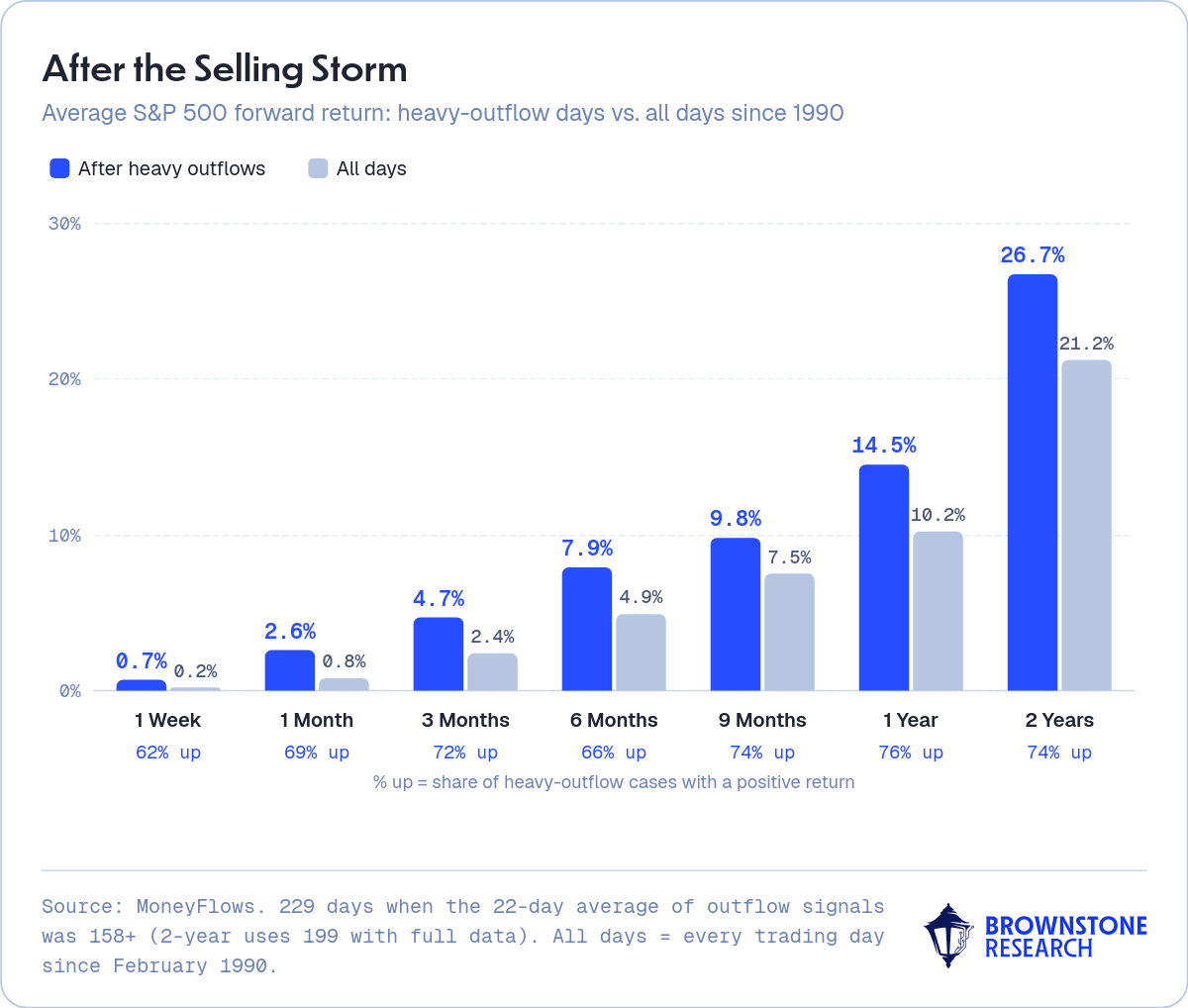
And here’s the midterm kicker. Five of these episodes happened in midterm years: 2002, 2014, 2018 (twice), and 2022. The S&P was higher a year later in all five, by an average of 19%. Two years later, it was still five for five.
The indexes and the market underneath are flowing side by side and not mixing yet. Rates are the wall between them. October 6 looks like the turn under the surface, and this week is the test.
The rivers always mix eventually. Downstream, it all becomes the Amazon.

What Jeff Brown has to say this coming Wednesday, October 14 at 8 p.m. ET… During his new strategy session he’s calling The October Million-Dollar Cycle. Click here to automatically save your seat… Because Jeff is going public with what could be the biggest AI secret of his career.

Where should you invest $100 right now? Elon Musk just invented and patented this new AI technology… And he’s predicting it will launch a NEW industry that will grow more than 7 million percent in the coming years. Even if he’s only 10% right, that would still be enough to grow $100 into more than $700,000. Click here to see the details on what Elon Musk called “an infinite money glitch.”
A combination of bearish catalysts is pushing precious metals back toward their lowest levels of the year.
Gold and silver both peaked in late January following a massive rally to record highs. Gold ultimately pulled back 27% to around the $4,000 per ounce level during the summer months. Silver fell by 52% to the $56 per ounce level.
Both metals rallied from those levels during August but are now testing the summer lows once again.
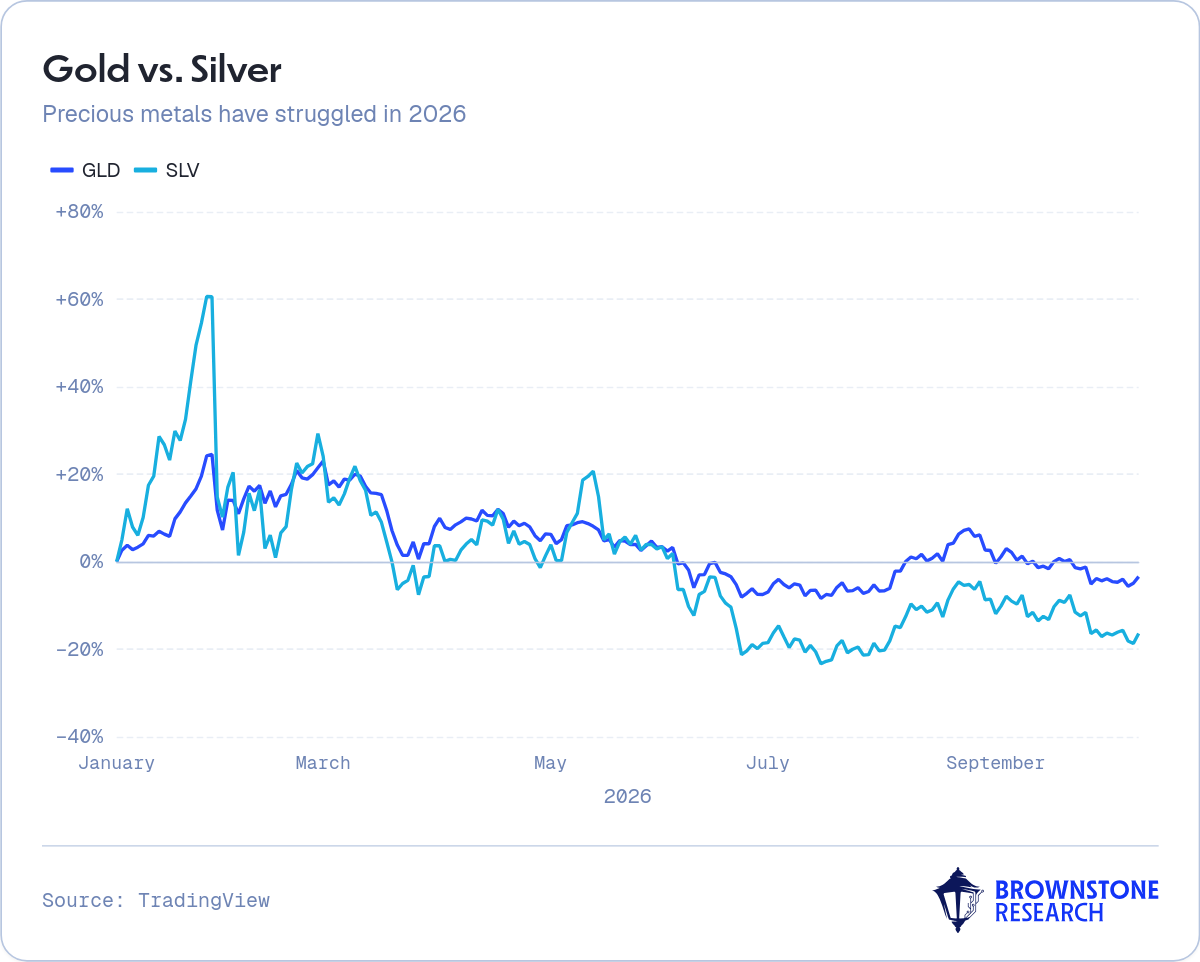
Two major forces are weighing on gold and silver. The first one comes from the ongoing increase in Treasury yields. While gold and U.S. Treasury bonds are both viewed as safe havens during times of market uncertainty, Treasurys make a coupon payment and gold does not.
That’s a big advantage Treasury bonds have over gold and silver. With 10- and 30-year yields hitting their highest levels since the early 2000s, the yield advantage is the best in decades. As a result, the metals typically sell off when yields rise.
Another bearish force at play has to do with the U.S. dollar.
When the dollar strengthens, it makes dollar-denominated purchases more expensive for international buyers. And since gold and silver are predominantly priced in dollars, demand falls off when the dollar climbs. Since the start of September, the dollar has been making an aggressive move higher and is at the highest level in over a year.
Here’s the chart of the U.S. Dollar Index, which tracks the dollar against a basket of other currencies such as the euro, yen, and pound, compared with gold.
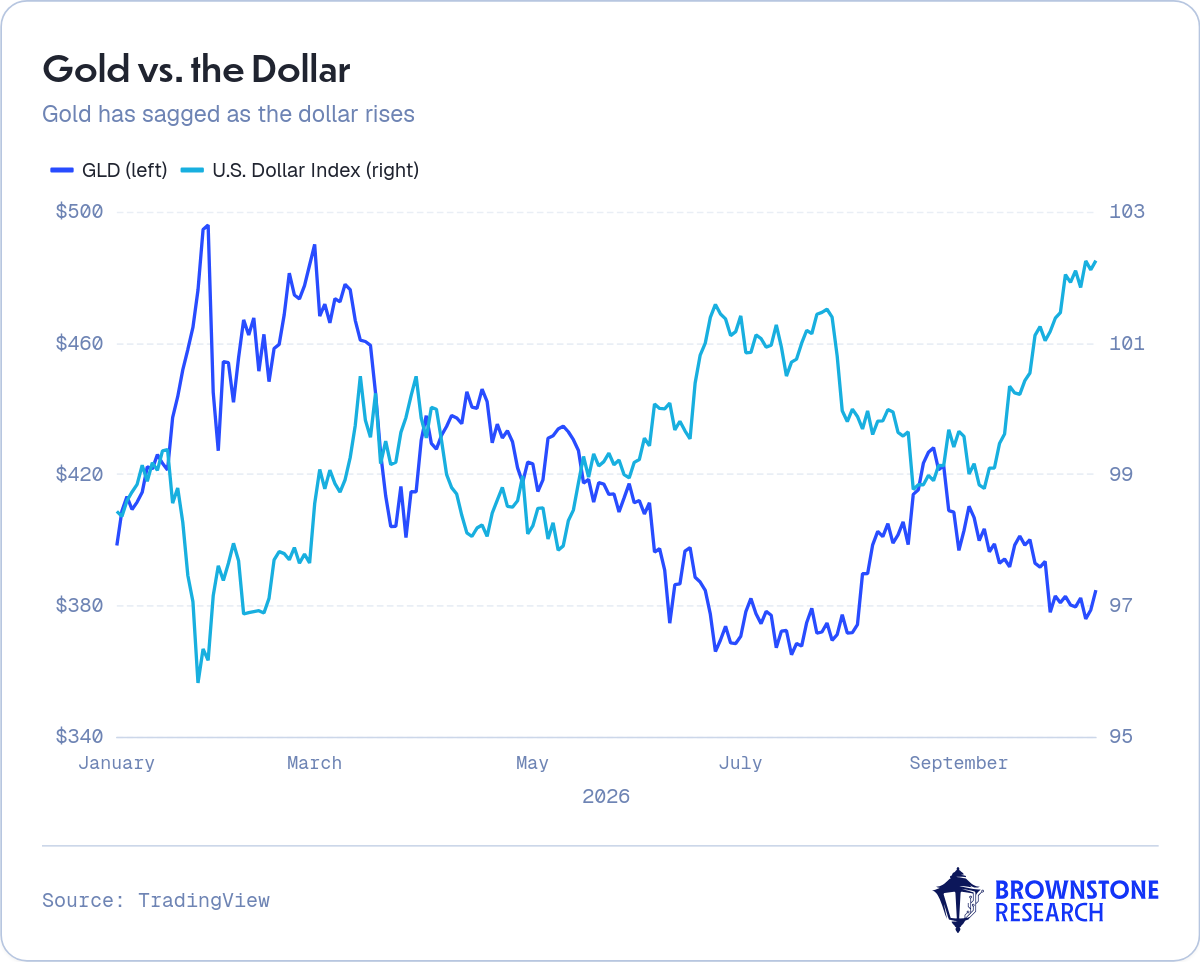
The most recent jump in the dollar has coincided with the pullback in gold and silver since late August.
Part of the dollar move could be linked to rising rates in the U.S. and the Fed’s recent rate hike. That shows how interest rate movements can permeate various corners of the market and ultimately flow through to precious metals.
If gold and silver are going to hold the lows seen during the summer, a couple of things need to happen.
First, the headwinds from rising rates and dollar strength need to reverse. Both interest rates and the dollar look overbought and extended to the upside. A pullback in both would help alleviate the pressure on precious metals.
We can also look to the charts for clues that downside momentum is fading… similar to the hints delivered during the summer lows. Look at the silver chart for an example of what to watch.
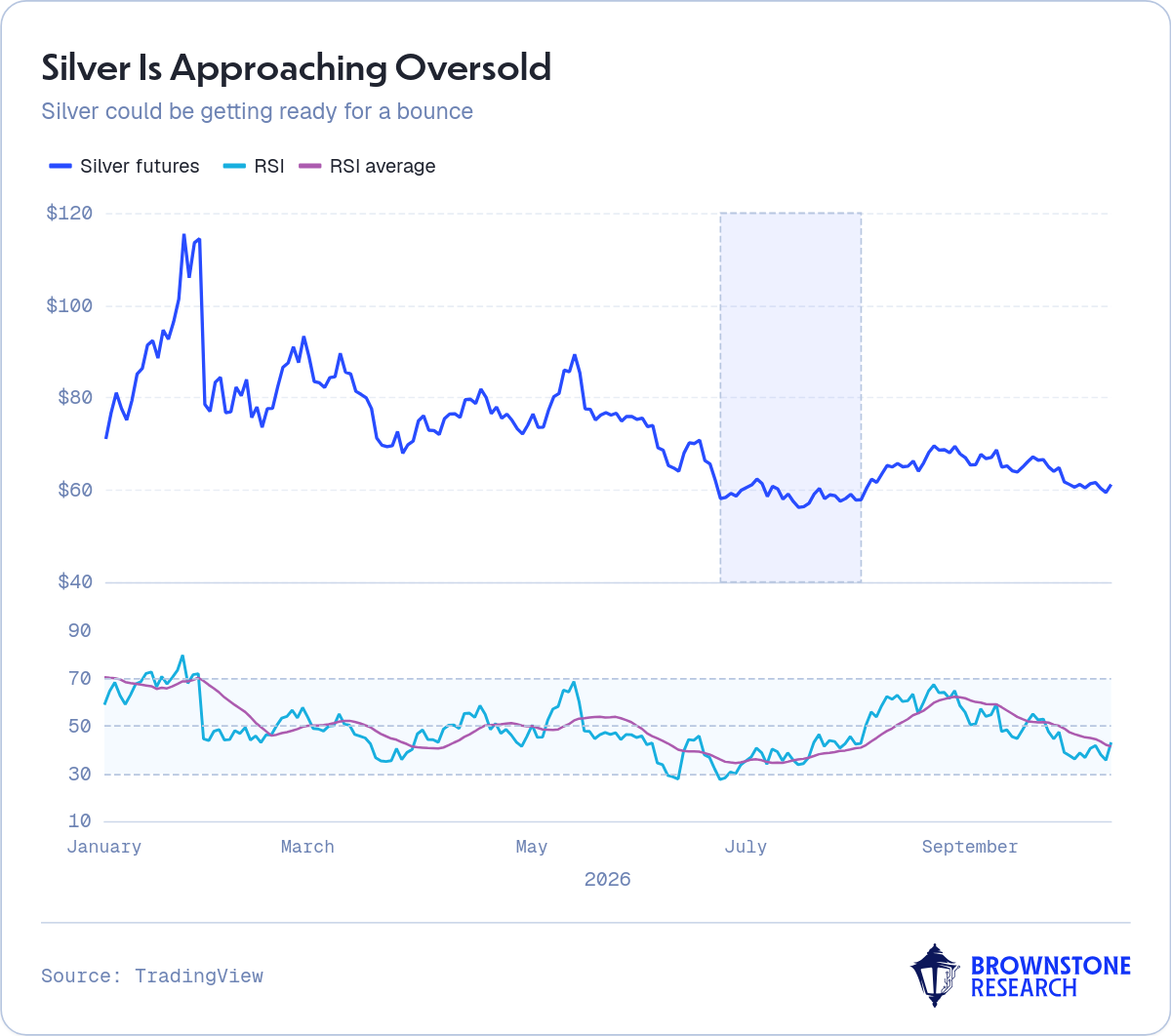
As silver came back to test the $56 per ounce level shown with the shaded area, the Relative Strength Index (RSI) was making higher lows. The RSI measures the strength of price trends, and it showed that the downside momentum was fading. That helped set the stage for a reversal higher.
With gold and silver both pulling back toward this year’s lows, watch for a similar positive divergence to form and hint at a reversal higher.
On the other side, if Treasury yields and the U.S. dollar continue rallying, the lows for precious metals might not be in yet.

During its latest earnings, Marvell (MRVL) stunned the markets by forecasting its revenue to grow tenfold in five years.
The custom semiconductor company set a revenue target of $70 billion to $90 billion for its 2031 fiscal year, which ends January 31. That’s about double Wall Street’s consensus number of $43 billion.
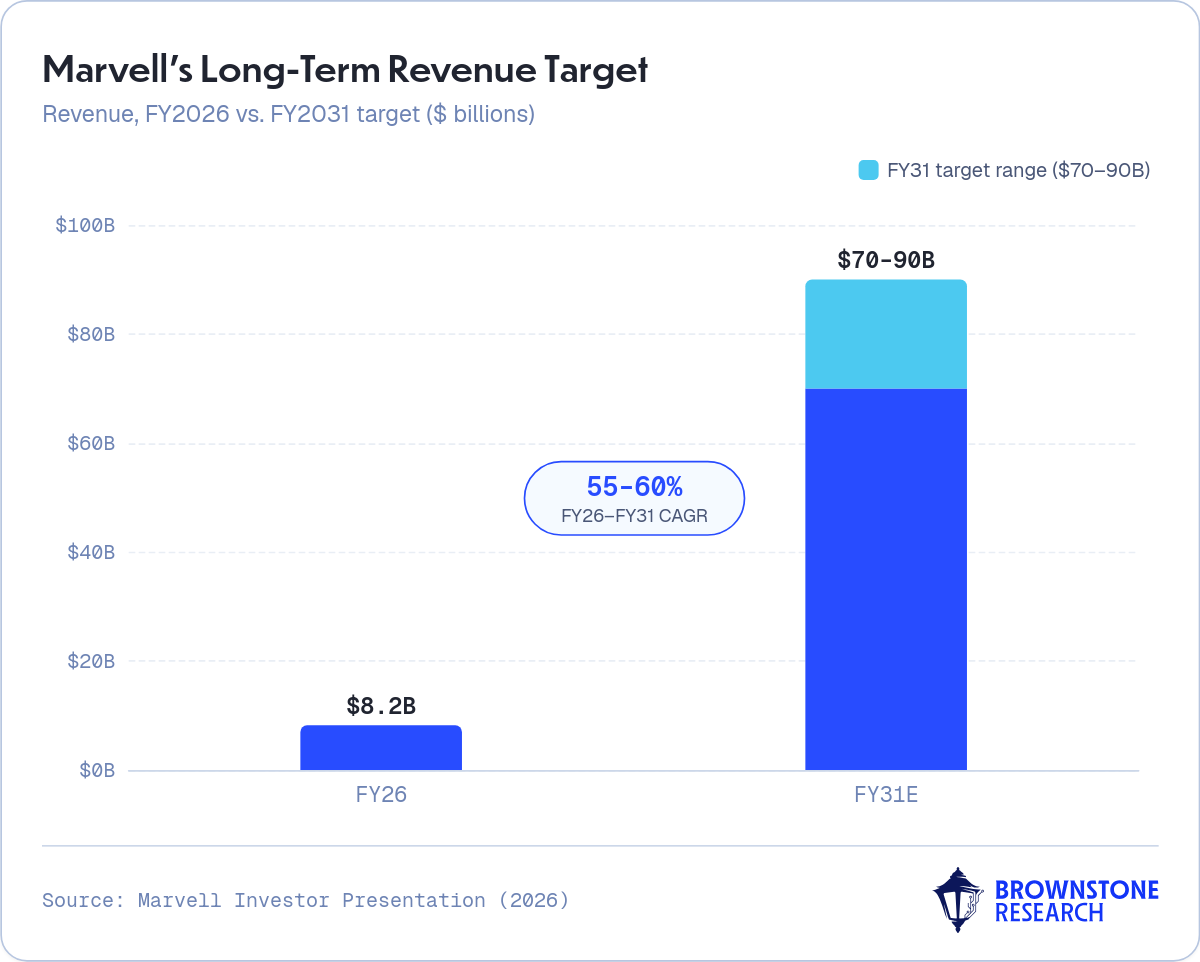
That is an extraordinary forecast.
CEO Matt Murphy explained that Marvell built its outlook from individual customers, products, and design wins. Design wins are programs in which customers have selected Marvell’s technology for their systems.
As Murphy put it, “All of this is grounded in business we have today, our customer positions, and the opportunities that are already right in front of us.”
Marvell works directly with the companies building the world’s largest AI networks. Its engineers help customers design custom chips and the connections those systems need. That requires close collaboration well before the finished infrastructure goes into service.
Those relationships give management a window into future demand that outside investors cannot easily replicate.
Putting an $80 billion target in front of investors takes considerable confidence in those customer plans. Management is staking its credibility on turning that work into a much larger business.
This opportunity extends across the infrastructure supporting AI.
Marvell designs custom processors, along with chips that move and store information. As AI systems grow, those supporting functions become increasingly important. Even the most powerful processor cannot do useful work while it waits for data.
That helps explain why management expects its interconnect business – the technology linking these systems – to generate $37.5 billion in fiscal 2031. That exceeds its $30 billion target for custom chips.
The implications reach well beyond Marvell.
Its customers are planning systems that require more processors, memory, networking equipment, and the facilities housing them. Marvell’s presentation projects annual data center investment reaching roughly $3.1 trillion by calendar 2030, more than quadrupling the $711 billion in 2025.
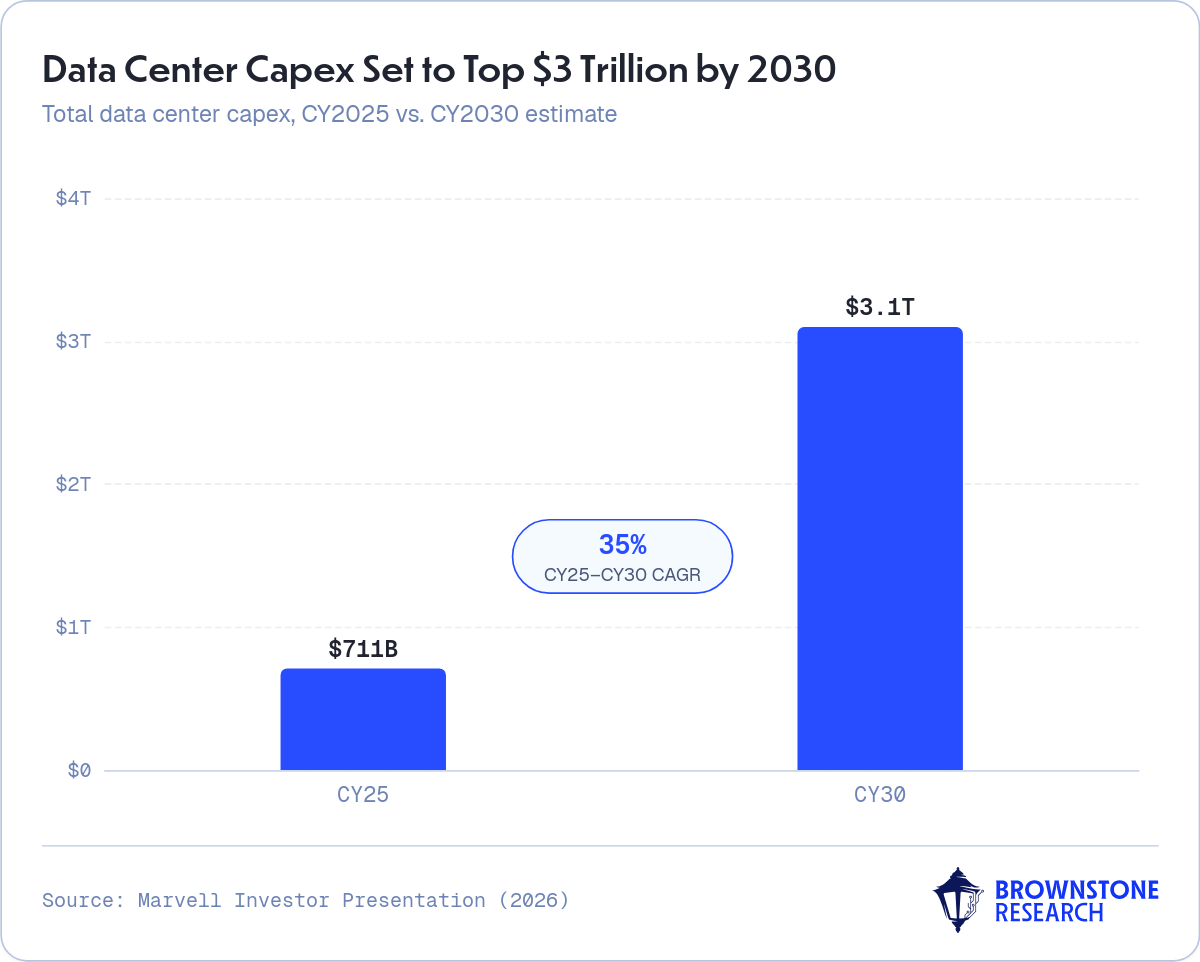
This is why we remain focused on the companies supplying the essential technology behind the AI buildout. Their customers are already designing the next several generations of infrastructure. Each generation creates demand throughout the supply chain.
For investors, the opportunity lies in identifying suppliers whose future growth is still underestimated. When revenue and profits outgrow expectations, that can support higher share prices over time.
Marvell just showed us how wide that expectations gap can be. And it gives us another reason to believe the AI infrastructure buildout has years of growth ahead.
And that means shares of these companies remain undervalued, and we should see them continue to rise in the coming years.
Add Brownstone Research as your preferred source on Google to see our latest stories in your feed.
 Add as a preferred source
Read the latest insights from the world of high technology.
These factories will cost billions before even a single working chip is produced…

This is just a tinge of what we’ll be grappling with as the humanoids become more intelligent and more...

The index never felt the cold. The market underneath took all of it.