




Bonds Call BS on Inflation
The bond market quickly caught on that the PCE numbers could’ve been fudged...



The index never felt the cold. The market underneath took all of it.


December 21 may be the shortest day of the year, but it’s not the coldest – it’s not even close.
East of the Rockies, the coldest stretch usually shows up about a month later. Land, air and water hold on to heat, so it takes weeks for the lost sunlight to catch up. Scientists call this seasonal lag.
The sun hides first – the thermometer catches up later. Markets work the same way. I think we’re very close to the market’s winter solstice right now.
If you only watched the headlines, you’d think everything was fine. The S&P 500 sits just 1.7% below its August high. The Nasdaq 100 is even closer.
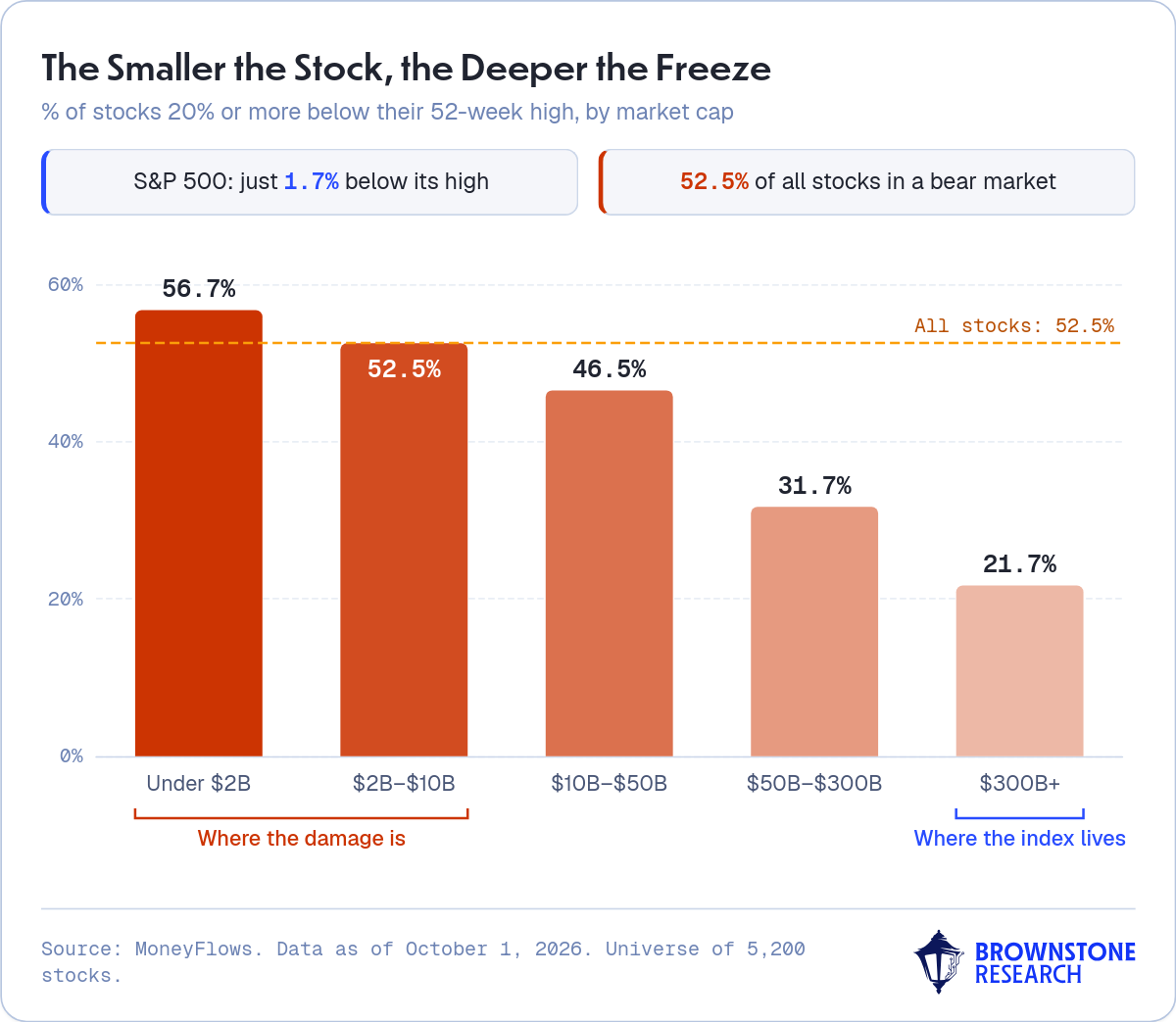
Those are indexes, though. The market underneath tells a different story. The Russell 2000 is 8.5% off its high. Of the more than 5,000 stocks we track, 52.5% sit 20% or more below their highs. More than half of all stocks are in a bear market.
The smaller the company, the worse it gets. Among stocks under $2 billion, 57% are in a bear market. For giants worth over $300 billion, it’s just 22%. A handful of huge names are holding up the index while everything beneath them freezes.
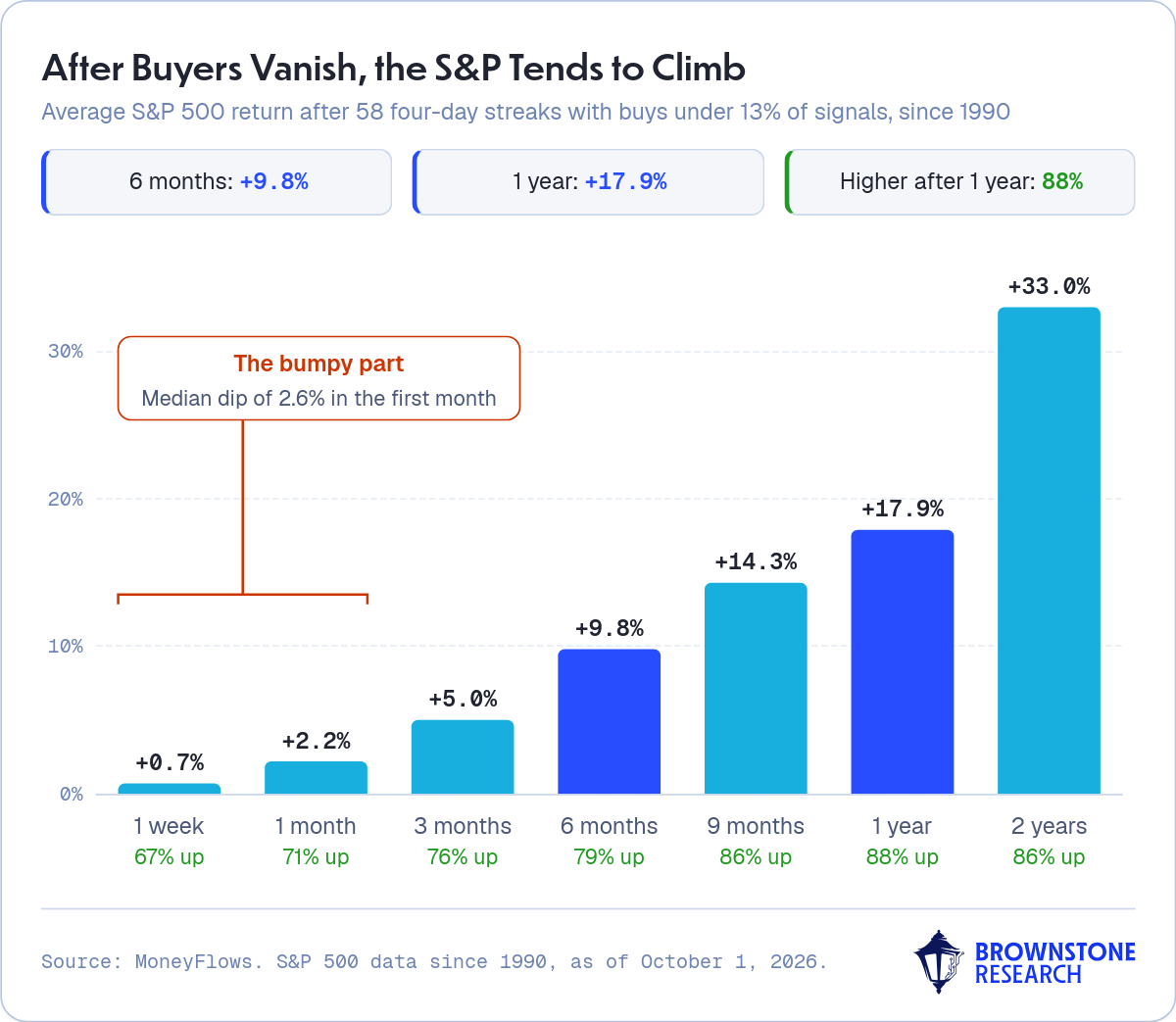
Last week, buying nearly dried up. For four straight days, inflows were less than 13% of all signals. We’ve seen 58 streaks like that since 1990. The S&P was never this close to its high during any of them.
What came next was strong. Six months later, the S&P averaged a 9.8% gain. A year later, it averaged 17.9% and was higher 88% of the time.
ETFs told the same story, with 100 or more outflows four days in a row. That ties the record. It happened only three times before: December 2018, September 2022, and April 2025. All three came at or near major lows. A year later, the S&P was up between 20% and 40% each time.
Much of this comes back to rates. Investors spent September worried the Fed might hike again.
Last week, that worry slammed the bond market. Bond ETFs saw 250 outflows in four days, more than stock ETFs. Long-term Treasury funds got sold every single day. The only bonds anyone wanted were cash-like, short-term funds.
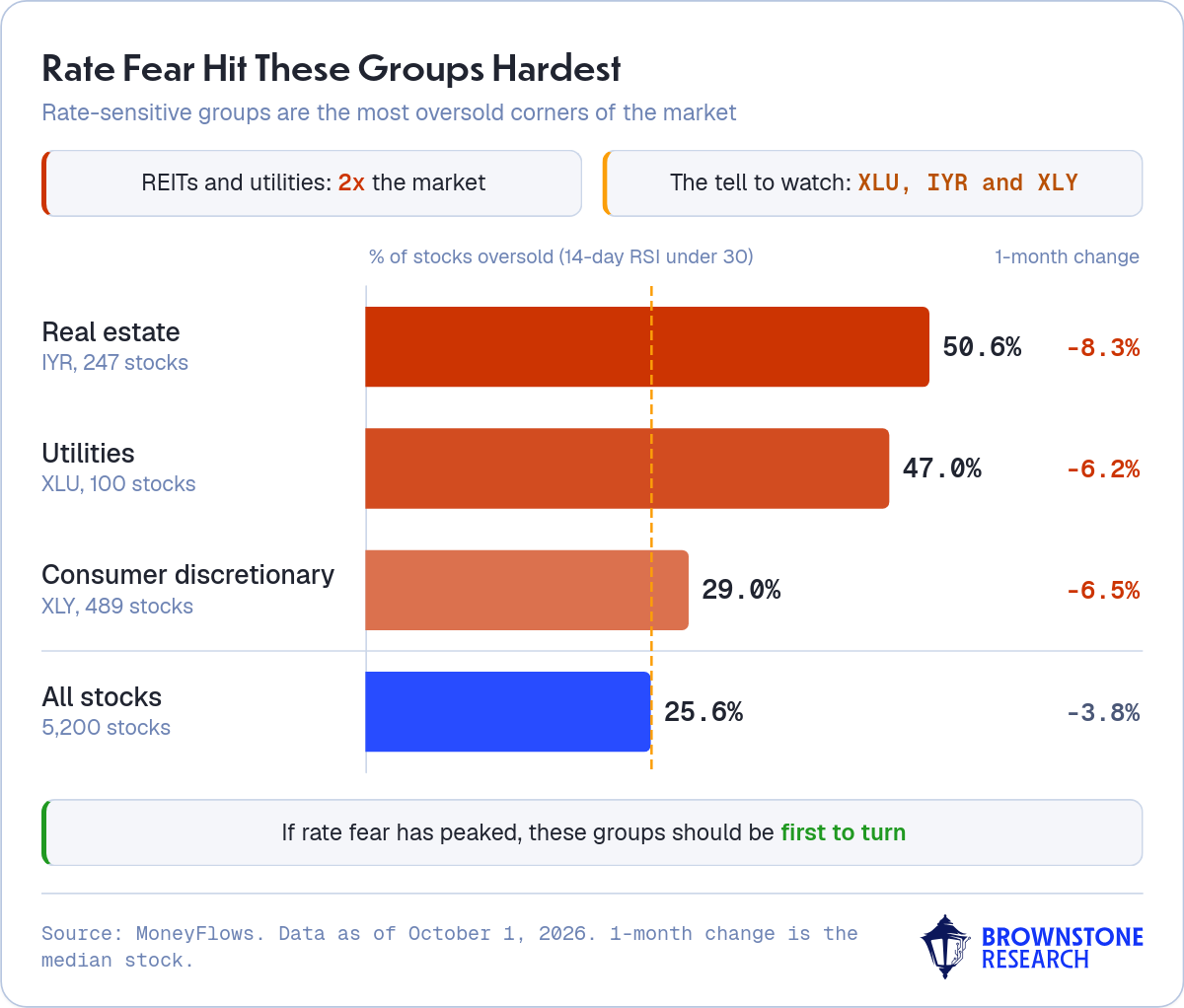
But when investors dump long bonds this broadly, rate fear is often close to peaking. Friday’s weak jobs report adds to that case. It’s hard for the Fed to hike into a soft job market. And if rate fear has peaked, we’ll see it first in the groups hurt most by high rates.
Utilities and real estate are both yielding sectors sensitive to rates, while consumer discretionary stocks are sensitive to consumer spending under restrictive rates. About half of all REIT and utility stocks are technically oversold, roughly double the rate for the overall market.
When the selling in these groups dries up and buying returns, that’s our tell.
The index never felt the cold. The market underneath took all of it. But the days are already getting longer, and the turn usually shows up before anyone sounds the all-clear.
As Hal Borland wrote, “No winter lasts forever; no spring skips its turn.”

The most expensive part of Nvidia’s chips isn’t made by Nvidia. It’s a tiny device that’s sold out through 2027. And is expected to command $2 trillion a year from the AI giants. Nvidia’s CEO calls it “a technology miracle.” Without it, Nvidia’s chips wouldn’t work. In this video, Jeff Brown gives away the name of a key stock in this space, for free.

While everyone's talking about the "AI slowdown," Trump just initiated his most extreme national security mandate ever. It could spark a $5.9 trillion bull market in a completely different tech sector. Click here to see Jeff Brown's urgent strategy session.

The timing of the next potential Fed move has become less certain…
One of the major catalysts was New York Fed President John Williams, who said last week that there was “no need for urgency” following September’s hike. Although Williams indicated that one more increase might be appropriate later this year, markets took his comments as favoring a December move rather than back-to-back hikes in September and October.
Last Tuesday, we also saw some softening in economic data. August job openings fell by 256,000 to around 7.08 million (the lowest since March), pointing to an easing in labor demand.
Oil has also pulled back as Middle Eastern exports improve. That has provided some relief from energy-related inflation concerns.
To be clear, the market isn’t ruling out further tightening ahead. Instead, traders have become less certain that it will happen in October. As I write, the CME FedWatch tool is indicating a 23% probability of a quarter-point hike when the Fed meets this month. The prevailing view is that the Fed will hold steady.
A few pieces of data have helped shape that view…
One of those key pieces of data is the Personal Consumption Expenditures (PCE) price index, which rose 3.4% from a year earlier in August, well below estimates.
On Friday, we saw the release of September’s nonfarm payrolls (NFP) report. The numbers showed only 29,000 jobs added in September, well below expectations of around 84,000.
Remember, the Fed’s dual mandate is for “price stability” and “maximum employment.” A more upbeat jobs report might have given the Fed cover to continue hiking rates. It’s harder to do that with new hiring below expectations.
Again, none of this necessarily means the Fed is done hiking. But it does reinforce expectations that the Fed will wait until December to raise rates – or even hold rates steady for the rest of the year.

Micron (MU) just delivered another record quarter. But its outlook may tell us more about the AI boom than its results.
Last Wednesday evening, the memory-chip maker reported fiscal fourth-quarter sales of $54.2 billion, up 379% from a year earlier. This is absolutely incredible growth for a company with a market cap larger than the GDP of Switzerland.
Earnings before interest, taxes, depreciation, and amortization (EBITDA) were $47.3 billion. That’s nearly 7x higher than the same quarter last year.
And growth isn’t done yet. Wall Street consensus has Micron’s revenue doubling again in fiscal 2027. We project it will beat that lofty target…
Yet even with sales growing this quickly, Micron still cannot satisfy the market’s appetite for memory.
CEO Sanjay Mehrotra said demand has strengthened since the company’s last earnings call. He expects memory and storage supply conditions to be “much tighter” in 2027 and 2028 than in 2026.
Micron has already reached agreements covering the vast majority of its 2027 high-bandwidth memory (HBM) supply. This is the specialized memory used alongside powerful AI processors.
Adding supply takes time. Chipmakers must build specialized manufacturing space, install equipment, and bring production up to speed. Micron plans roughly $25 billion in capital spending in the first half of fiscal 2027 as it works to expand capacity.
For investors, this reinforces an important point: the AI infrastructure buildout extends far beyond buying more Nvidia processors.
Those processors need memory to hold the information they are working on. Without enough memory, adding computing power alone cannot solve the bottleneck.
This was a more bullish forecast for memory demand than most investors anticipated. And it shows that the demand for AI infrastructure continues to accelerate far faster than Wall Street believes.
But this shouldn’t be a surprise to regular readers. We’ve been pounding the table for years saying this buildout would be far bigger and last far longer than most people believed.
And Near Future Report subscribers definitely aren’t surprised by this result. We’ve had Micron in the portfolio for two years, and the position is up 930%.
And based on everything we just learned from the earnings, that run seems far from over.
Add Brownstone Research as your preferred source on Google to see our latest stories in your feed.
 Add as a preferred source
Read the latest insights from the world of high technology.
The bond market quickly caught on that the PCE numbers could’ve been fudged...

That deadline still looms large, and if China says yes to those export controls, metals supply in America and...

Indexes look great, your brokerage statement may not.