



The D-Day for Critical Metals Gets an Extension
That deadline still looms large, and if China says yes to those export controls, metals supply in America and...



The bond market quickly caught on that the PCE numbers could’ve been fudged...

The Personal Consumption Expenditures (PCE) Price Index was released on Wednesday.
And investors took notice…
PCE is a measure of consumer inflation, one that’s closely followed by the Federal Reserve.
In the August update, headline PCE rose by 3.4% compared to last year versus estimates for a gain of 3.7%. The core measure that excludes the volatile food and energy categories rose by 3.0%, which was also below expectations for an increase of 3.3%. Both figures dropped from July’s rate of change.
Although PCE inflation sits well above the Fed’s 2% inflation target, it seems to be moving in the right direction.
Moderating inflation initially sparked a rally in stock indexes as odds for another rate hike at the Fed’s meeting later this month fell to 36%. That figure stood at nearly 70% heading into the PCE report.
But the bond market didn’t reflect the mood of stock investors.
Bond prices barely budged as yields remained steady after PCE was released. Then the sell-off in bonds picked back up as yields started jumping again.
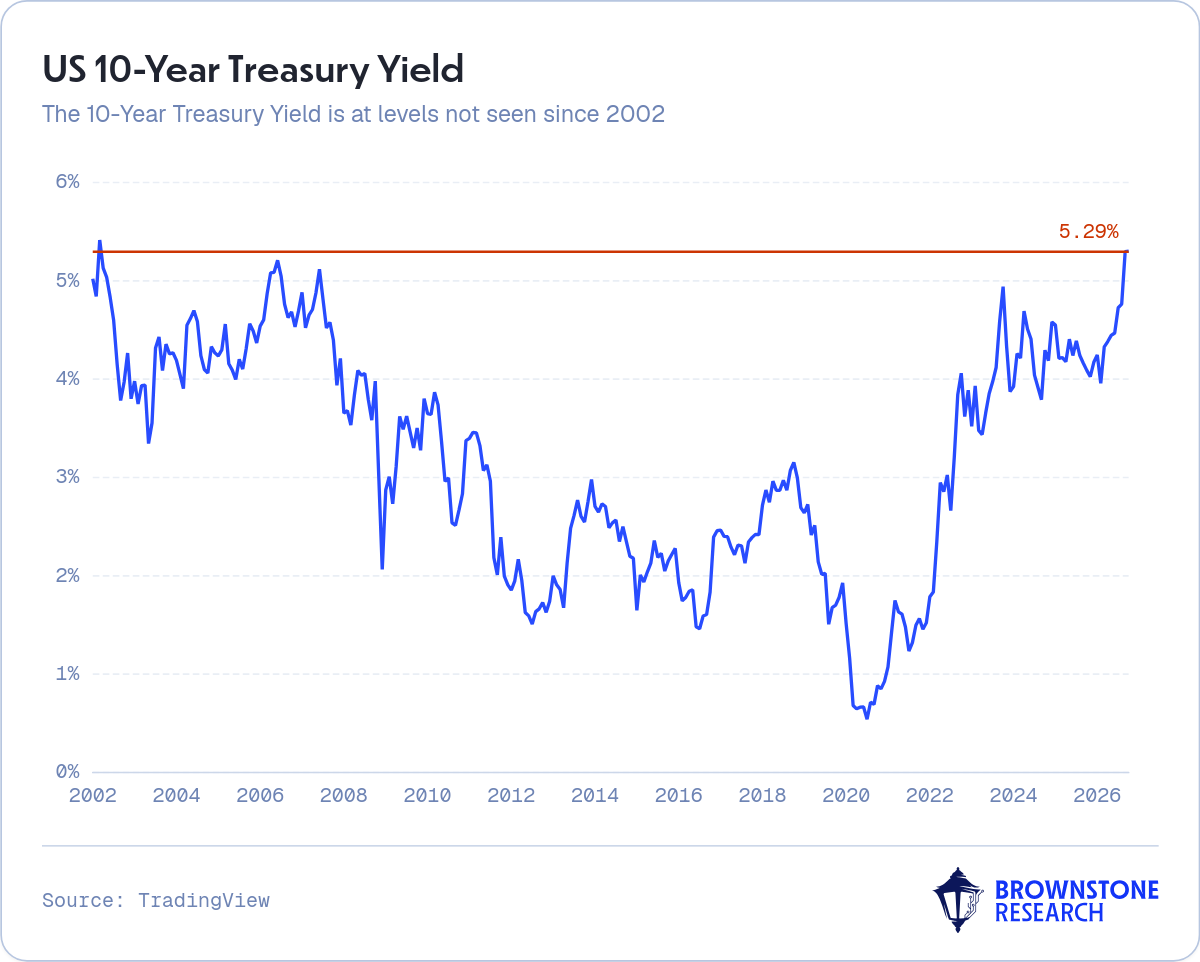
The 10-year Treasury yield jumped to 5.34%… the highest level since 2002.
All else equal, lower inflation should mean less upward pressure on rates. So, why did the exact opposite happen?
The bond market quickly caught on that the PCE numbers could’ve been fudged, while underlying inflation pressures remain extremely broad.
That sounds like a conspiracy. It’s not. The Bureau of Economic Analysis (BEA), which compiles the PCE report, recently announced that it was changing its methodology.
Specifically, the BEA adjusted calculations for things like portfolio management fees, legal services, and computer software. As a result, at least 0.2 percentage point was knocked off the core PCE figure. The prior month was revised lower as well.
This doesn’t mean anything nefarious is happening. But the BEA changing its methodology for arguably the most important inflation metric right now is odd. Treasury yields are breaking out to multidecade highs. Investors are trying to understand how to price these assets. And the BEA changes the formula for a key piece of data now?
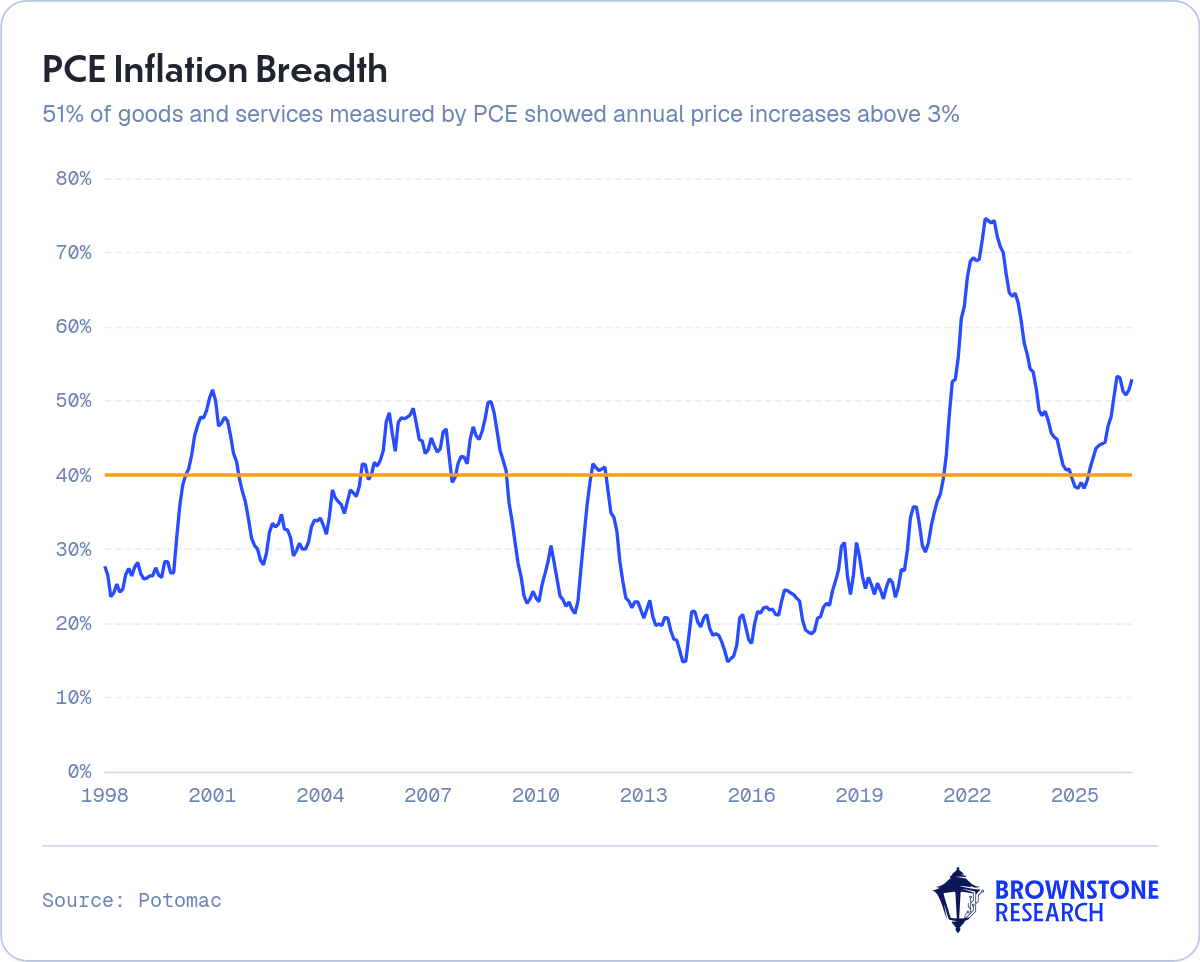
The second reason for newly higher rates is that the “breadth” of high inflation across PCE components isn’t getting much better. When you look at the components going into the report, 51% of the goods and services in the PCE basket showed price increases above 3%.
That’s well above the pre-pandemic average of 32%. The proportion of components above 3% also sits well above the level estimated to coincide with inflation at the Fed’s 2% target, which is around 40%. Inflation breadth has been worsening since the start of 2025 (chart below).
That means the inflation problem remains broad, while changes in the methodology contributed to the softer figures seen in August.
Overall, tighter monetary policy should be on the way, whether the Fed hikes at its next meeting or not.
Inflation and the impact on interest rates across the yield curve will also remain a source of volatility across the markets. The median stock in the S&P 500 is currently down more than 15% from the high. Longer-dated bond yields are jumping to the highest levels seen in decades.
It’s a bit of a cliché, but bond investors are often considered the “adults in the room.” Stock markets initially cheered the upbeat PCE numbers. The “adults” aren’t so sure.

Jeff Brown calls it the “AI Master Key” – a tiny chip loaded on top of Nvidia’s processors. It’s sold out through 2027. The AI giants are expected to spend $2 trillion a year on the AI Master Key. And the three American-controlled companies are set to take off on Dec. 30. Jeff shows you how to get in with as little as $500 – and names one stock free.Click here to see how.

One tiny corner of tech (not AI) could be about to get a $5.9 trillion cash injection thanks to Trump. Silicon Valley insider Jeff Brown just held an urgent strategy session and gave a free pick for this new bull market. Click to get the FREE pick now.

As Clint just covered, the 10-year Treasury yield touched 5.3% yesterday, its highest level since May 2002…
This had an interesting impact on alternative assets such as gold, silver, and Bitcoin.
The 10-year yield is the main benchmark for long-term borrowing costs across the economy. As such, mortgages, corporate bonds, and equity valuations, to a degree, are each affected by changes in this yield.
This is why the 10-year is considered the “risk-free rate” for long-term investments. Investors compare other investments to the rate of return they could generate by holding 10-year Treasury notes.
The conventional wisdom is that higher rates raise the opportunity cost of holding assets that do not provide a yield. Two assets that fall into that bucket are gold and silver, which makes their pullback this week unsurprising.
But Bitcoin’s price action might be…
Bitcoin is often described as “digital gold” because of its fixed supply and the slow, predetermined pace at which new coins are issued. And, like gold, Bitcoin doesn’t provide a yield.
As such, it would be reasonable to expect Bitcoin to pull back this week alongside gold and silver. But it didn’t.
Bitcoin has traded in a tight band between $83,000 and $85,000 for most of the week. And with Bitcoin trading around $83,700 as I write, it’s roughly flat compared to where it was last week. In other words, it’s hardly moved.
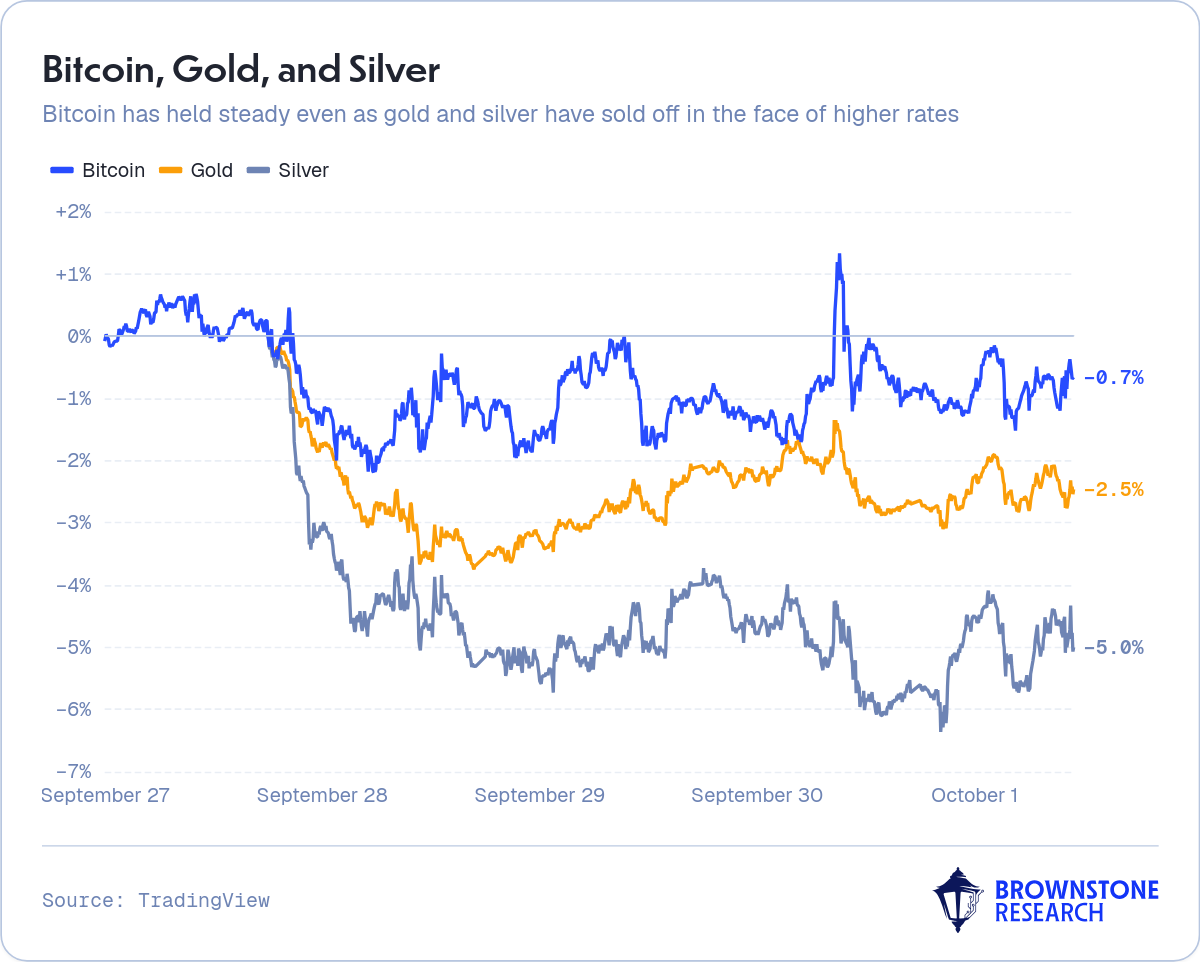
Bitcoin’s resilience suggests that the price action is being driven by something other than yields. And while nobody knows exactly why an asset trades the way it does, it has become clear that Bitcoin is responding at least in part to the same fiscal strain that’s driving interest rates higher in the first place.
The U.S. government’s debt burden just surpassed $40 trillion, and Uncle Sam is on the hook for around $1.3 trillion in interest on the federal debt this fiscal year.
That interest bill is the mechanism.
A larger debt stock, rolled over at yields near multidecade highs, means the U.S. Treasury must issue more debt just to cover the debt it’s already sold. Thus, the interest expense is only going to increase from here.
Bitcoin holders are seeing a government that must keep borrowing to service past borrowing, with no cap on the number of dollars it can create to do it. That’s the draw.
Bitcoin’s attractive in this climate because its supply is capped at 21 million bitcoins total. And with 20.09 million bitcoins already here, the remaining supply is minuscule.
In other words, there just aren’t that many bitcoins to go around. In a world where increasing debt must be paid with increased inflation, Bitcoin represents a sound store of value.
On top of that, there are other factors plausibly holding up Bitcoin’s price – seasonality, a convincing break above technical resistance, and new interest in public blockchains’ utility in AI-powered finance. My colleague Ben Lilly covered those topics on Wednesday.
Of course, one week of resilience in the face of rising interest rates doesn’t make for an entire investment thesis. But it sure supports Bitcoin’s value proposition today.

For many years, Western pharmaceutical companies mainly viewed China as a place to manufacture medicines at lower cost or as a large market where they could sell their products.
That view is changing quickly.
China is becoming an important source of new drug discoveries, and some of the world’s biggest pharmaceutical companies are now paying billions of dollars to gain access to medicines invented there. Two major deals announced in late September show just how fast this shift is happening.
Novo Nordisk, one of the world’s leaders in obesity and diabetes medicines, signed a deal worth as much as $2.6 billion with China’s Hengrui Pharma. The agreement centers on an experimental drug called HRS-1596, which targets both the GLP-1 and GIP hormone pathways.
These are the same general biological systems behind some of today’s most successful obesity drugs. What makes HRS-1596 especially interesting is that it is being developed as a pill that could potentially be taken only once a week. If it eventually proves safe and effective, that could offer patients a very convenient alternative to weekly injections.
Novo is paying Hengrui $300 million up front, with additional payments possible as the drug moves through development and commercialization.
Merck announced another major China-focused deal just one day earlier. The company agreed to pay SciBrunch Therapeutics $400 million up front for worldwide rights to an experimental cancer drug called SPR2015. The total value of the agreement could reach $2.13 billion if the medicine meets future development and sales milestones. SPR2015 targets KRAS G12D, a mutation found in several difficult-to-treat cancers, especially pancreatic and colorectal cancer.
What makes this deal particularly notable is that the drug has not yet entered human clinical trials. Merck is therefore paying hundreds of millions of dollars for a medicine that is still very early in development.
These transactions are part of a much larger trend.
Western drugmakers including AstraZeneca, Roche, GSK, and AbbVie have also been looking to China for promising medicines. Chinese biotech companies have become faster and more sophisticated at discovering drugs, running early clinical trials, and designing products that can compete globally.
In some cases, they can move promising medicines into development more quickly and at lower cost than traditional Western biotech companies.
The bigger story, therefore, is that the geography of pharmaceutical innovation is changing.
China is no longer simply copying Western medicines or manufacturing drugs designed elsewhere. It is increasingly creating molecules that some of the world’s largest pharmaceutical companies want badly. And they want them enough to pay billions of dollars for them.
Not every deal will succeed, most experimental medicines still fail during clinical development, and the multibillion-dollar headline values include future payments that companies receive only if their drugs succeed.
But the direction is becoming clear.
Chinese biotechnology has become an important part of the global pharmaceutical research ecosystem, and Big Pharma increasingly views China not just as a market or a factory, but as one of the places where the next generation of important medicines may be discovered.
Add Brownstone Research as your preferred source on Google to see our latest stories in your feed.
 Add as a preferred source
Read the latest insights from the world of high technology.
That deadline still looms large, and if China says yes to those export controls, metals supply in America and...

Indexes look great, your brokerage statement may not.

The Fed’s job is to turn down the fun before the market drives its car into a ditch...