



No More Punchbowl
The Fed’s job is to turn down the fun before the market drives its car into a ditch...



Indexes look great, your brokerage statement may not.

Managing Editor’s Note: The U.S. dollar could break as early as October 7… Not weaken. Not slip a few percent. Break.
That’s according to our colleague, Market Wizard Larry Benedict. Larry says something big is coming for the U.S. dollar, and if he’s right, that means your bonds, your cash savings, even the dollars in your pocket will all be put at risk.
Larry is holding an emergency briefing on Wednesday where he will cover exactly what’s happening and what you can do about it ahead of the “reckoning.”
Just go here to sign up with one click to join him on Wednesday, September 30, at 8 p.m. ET.

The S&P 500 closed Friday at 7,743. That’s less than 1% from its all-time high. The Nasdaq set back-to-back records on Monday and Tuesday.
But of the 5,220 stocks we track, 2,638 sit 20% or more below their 52-week highs. That’s 50.5% in bear market territory. In tech, it’s 69%.
There are indexes, and there are markets. The index is led by a handful of mega-caps. The market is thousands of stocks.
And it is under the surface where you can read flows data. That shows us which stories big institutional players are betting on and where they are moving their money.
Last week, bond yields surged. The 10-year Treasury hit 5.2%, its highest level since 2007. The 30-year topped 5.5%, last seen in 2004.
When safe bonds pay that much, anything that pays a yield has to compete. So investors sold whatever looked like a bond.
Bond ETFs saw 173 outflows and just two inflows. REITs saw 92 outflows and zero inflows. Utilities had 74 outflows and one inflow. Banks had 73 outflows. Insurers had 46.
One stat sums it up: The median stock bought last week paid no dividend. The median stock sold paid 2.2%.
So where did the money go?
Technology was the only sector with more buying than selling, 64 inflows to 31 outflows. The buying centered on AI chips and software as AMD crossed $1 trillion in market value on Monday.
But dig deeper … even within tech, we see a split market. “Only” 34% of mega-cap tech stocks are in a bear market, whereas for micro-cap tech it’s 88%. Big money is picking winners, not buying the whole sector.
Healthcare shows a similar split. Diagnostics and lab tools drew 43 inflows and zero outflows. Drug developers took 68 outflows against 9 inflows.
Financials are the strangest story. They have the healthiest breadth of any sector, with only 21% in a bear market. Yet they took 187 outflows, more than any other sector. The market’s safest shelter is being sold, which could indicate a broadening of outflows.
Hotels, restaurants, and leisure stocks had 67 outflows and no inflows. Gas near $4.50 and mortgage rates at 7.37% will do that.
Energy got zero inflows, even with oil near $100. Big money seems to be betting Hormuz reopens.
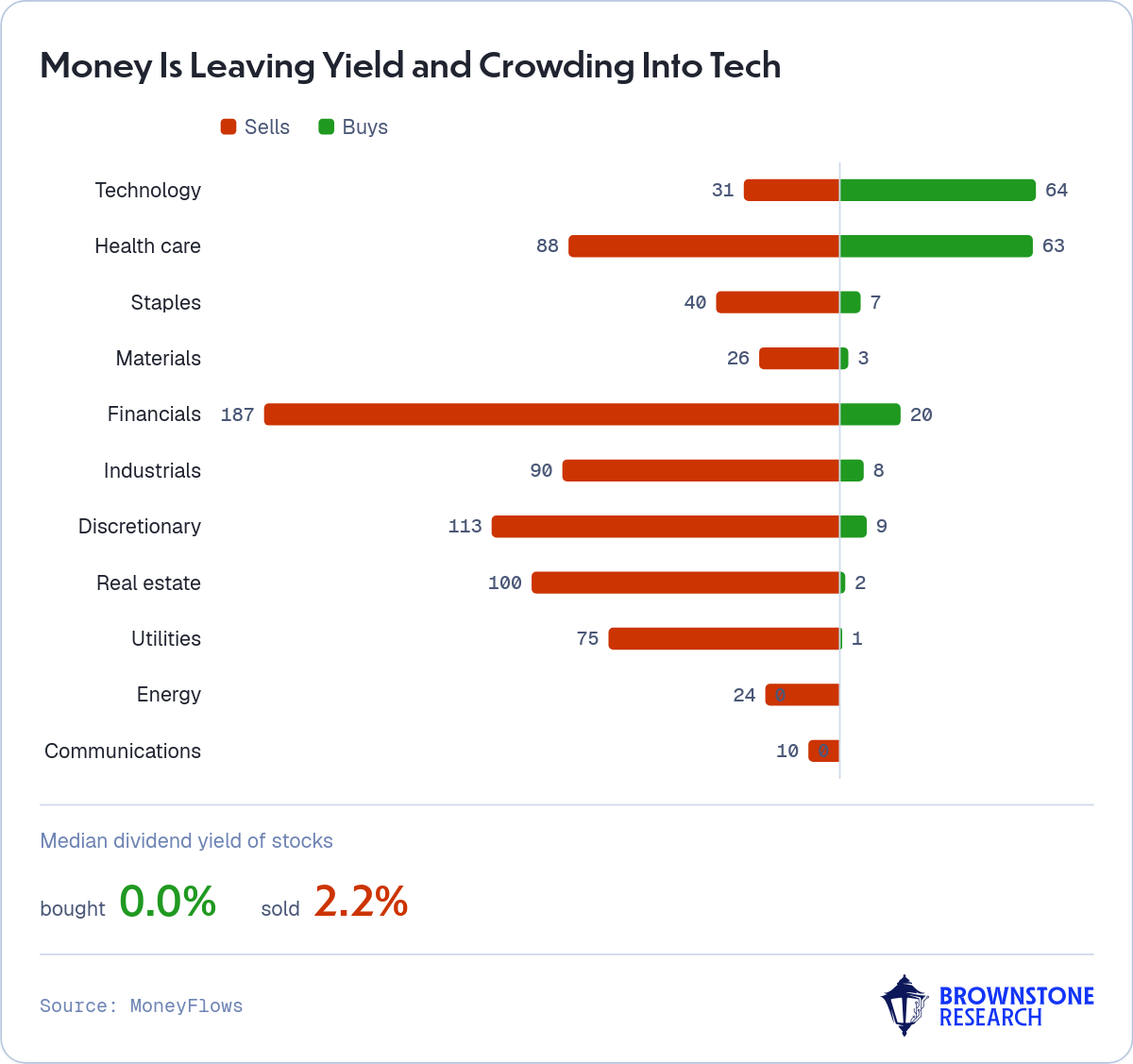
Indexes look great; your brokerage statement may not.
History says: Hang in there.
As the philosopher Lao Tzu said: “Who can make the muddy water clear? Let it be still, and it will gradually become clear.”

Brownstone Research founder Jeff Brown and hedge fund “Market Wizard” Larry Benedict are holding an emergency broadcast on Wednesday, September 30 at 8 p.m. ET. They believe an event scheduled by Washington could gut the biggest winners of the AI boom. They’re talking about potential losses of up to 40%… Yet for the prepared, it could be the opportunity of a lifetime. Click here to learn more.

Uber, AirBnb, SpaceX… every monster run happened behind a wall your 401(k) was never allowed to cross. Now that wall is coming down, and Larry Benedict is naming the one ticker positioned for the money that pours through – free. Click here.

The White House is weighing a program to actively spread U.S. dollar stablecoins around the world. That’s according to a Bloomberg report from last week.
The mechanics under discussion are joint ventures between the government and private-sector stablecoin firms.
This looks to involve multiple agencies, including the Treasury Department, the State Department, and the U.S. International Development Finance Corporation (DFC) – the agency that normally finances infrastructure projects abroad.
The general idea is that the DFC would help finance payment infrastructure in emerging markets. Meanwhile, the State Department smooths the diplomatic path, and private issuers provide the tokens.
The U.S. government effectively becomes a distribution partner for the dollar in digital form in areas where local banking is weak and dollar demand is already strong.
This is the most aggressive, coordinated stance we’ve seen yet toward promoting stablecoins abroad.
Why would the federal government do this?
Two reasons …
First, a global proliferation of dollar-backed stablecoins would help solidify the dollar’s position as the world’s reserve currency.
The second reason is what we wrote about in our Chain of Thought essay, “Don’t Fight Bessent”.
U.S. stablecoins are backed by short-term Treasurys. As a result, every stablecoin issued creates more demand for U.S. Treasurys. That’s good news for Treasury Secretary Scott Bessent, who has plenty of debt to sell and is motivated to issue shorter-term debt to help tamp down rates at the long end of the curve.
Put more simply, stablecoins seem to be going swimmingly at home. And now, the government wants to take the show on the road.
It seems only a matter of time before dollar stablecoins have a market capitalization measured in the trillions of dollars.
The major market indexes are masking a growing weakness … and the evidence is there for anybody willing to look under the hood.
While the S&P 500 and Nasdaq are both hovering within 2% of their prior record highs, the average stock has been pulling back.
Just look at the price action on Monday, Sept. 21. The S&P 500 shot higher by 1.5%. Optimism over Meta’s new AI agent – Muse – provided the spark, which sent the “Magnificent 7” soaring. In fact, an ETF tracking the Mag 7 jumped to a new record high.
But across the rest of the market, it was a different story.
The number of stocks making new 52-week lows outnumbered those making new 52-week highs by nearly 4 to 1 that day.
The reason so many individual stocks can fall while the major averages hang near highs is how the indexes are structured. Both the S&P 500 and the Nasdaq are market-cap weighted. That simply means larger companies get more weight in the index.
In fact, 40% of the S&P 500’s allocation is to the 10 biggest stocks … familiar names such as Apple (AAPL), Nvidia (NVDA), and Microsoft (MSFT).
While that’s just a single day of bad breadth, it continues a worrying trend since August.
Stock market breadth is how you track participation in a trend, with the premise that you want to see broad participation in a rally.
There are lots of ways to track breadth. That could be the number of stocks making new highs versus new lows, advancing issues compared to declining issues, or the percentage of stocks trading above a key moving average.
You can also compare the performance of the average stock to the capitalization-weighted indexes. I like to watch the Invesco S&P 500 Equal Weight ETF (RSP) against the S&P 500.
RSP treats each stock in the S&P 500 equally compared to the cap-weighted version that bases allocations on market values.
While the S&P 500 holds near its high, RSP has fallen by just over 5% since the middle of August.
But growing evidence suggests that the pullback in the average stock has gone too far and could set up a mean-reversion trading opportunity.
Just look at the percentage of stocks across the market trading above their 20-day moving average (MA). That’s a good way of tracking how many stocks are trading in short-term uptrends. Here’s the chart.
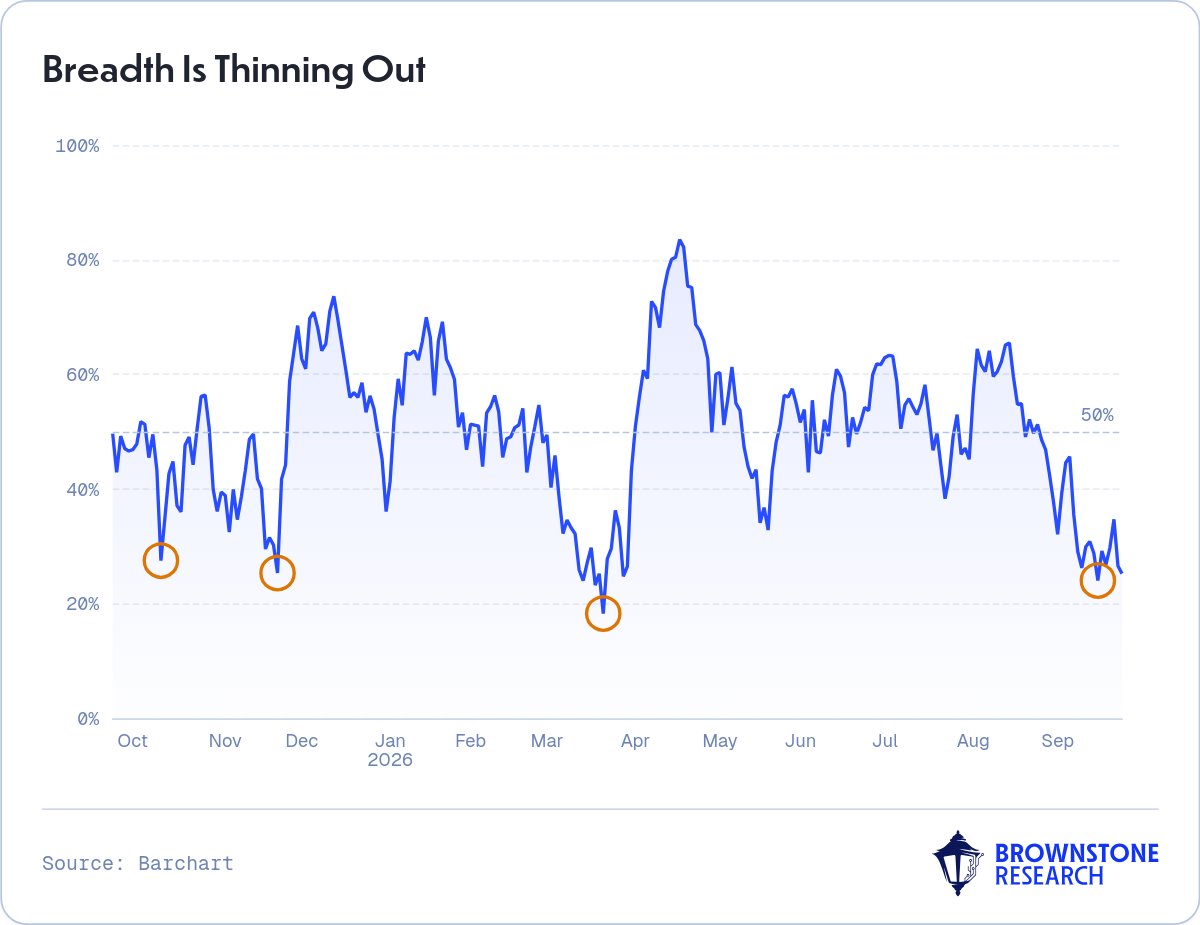
The percentage of stocks across major exchanges trading above their 20-day MA dropped to 25% recently. Extensions below 30% don’t happen often and have occurred only one other time this year, back in March. Over the past year, it has only happened in three other instances (circles in the chart above).
It marks an extremely oversold condition in the average stock and has often sparked at least a short-term rally in the market.
That’s why Larry Benedict and I are recommending trades to get our subscribers positioned for a rebound.
In The Opportunistic Trader, we’re also adding call options to leverage the rally potential in one sector that’s beaten up and ready for an oversold bounce.
The pullback in the average stock is hitting extremes across various metrics. We believe it’s time to get positioned for a short-term rally.
Add Brownstone Research as your preferred source on Google to see our latest stories in your feed.
 Add as a preferred source
Read the latest insights from the world of high technology.
The Fed’s job is to turn down the fun before the market drives its car into a ditch...

We should not confuse the AI opportunity with the technology sector alone...

Sometimes, what you see depends on how you’re looking, not just what is there.