



The Hidden Bear
Sometimes, what you see depends on how you’re looking, not just what is there.



We should not confuse the AI opportunity with the technology sector alone...

Editor’s Note: Something is coming for the U.S. dollar … and hardly anybody is prepared.
That’s the message from our colleague and “Market Wizard” Larry Benedict. According to Larry, the dollar could break as early as Oct. 7. Not weaken, not slip – break.
It’s a bold claim, but Larry’s ready to share his findings – including what it means for investors – on Sept. 30 at 8 p.m. ET. Readers can sign up for the event with one click right here.

America’s data centers are about to become the fifth-largest natural gas customer in the world. Only the entire United States, Russia, China, and Iran currently use more.
That’s the conclusion of a BloombergNEF report released last week.
Data center natural gas demand is now expected to increase by 15 billion cubic feet per day over the next decade. That forecast has more than doubled in just nine months … And it even assumes many of the proposed data centers don’t get built.
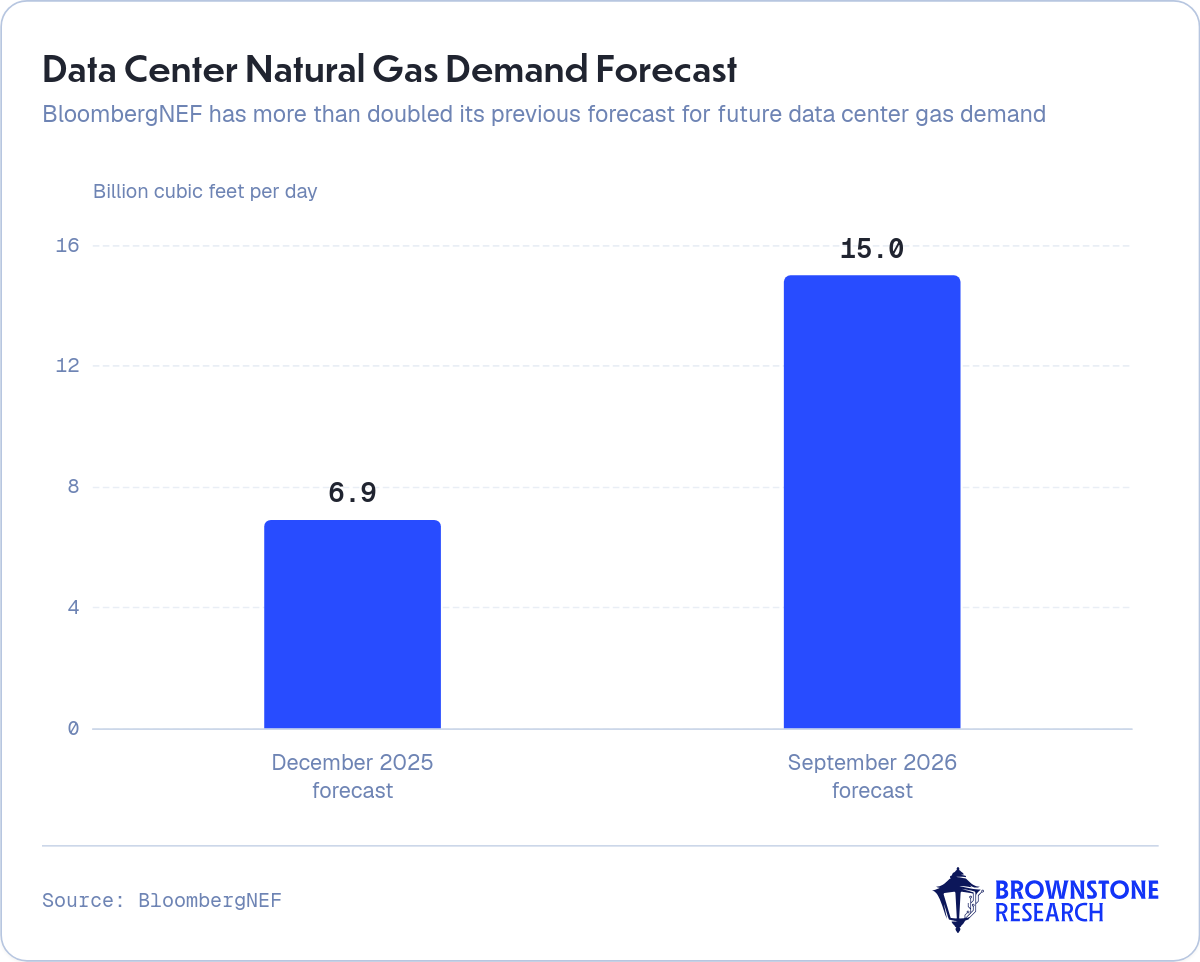
This tracks with other reports showing that U.S. data centers will consume about 20% of the nation’s electricity by 2035. That’s up from 5.9% right now.
This is a huge adjustment in projections – one a research firm is rarely willing to make because it clearly shows its earlier forecast was wrong.
But it goes to show that AI infrastructure is more than just chips, servers, and fiber-optic cables. All those systems need electricity. And natural gas is becoming a critical link between the digital economy and the physical infrastructure needed to power it.
Why gas?
It can fuel power plants that operate around the clock and adjust output as needed. BloombergNEF expects it to provide 69% of the electricity required by new grid-connected data centers.
For investors, that creates several ways to participate. One is to get positioned for higher natural gas prices. But that requires getting both demand and supply right. A producer can face disappointing prices even as customers consume more gas if production expands faster.
The steadier way to profit is to look at the infrastructure required to deliver the fuel.
Consider Energy Transfer (ET). The company is a giant in the “midstream” energy space. It specializes in moving and storing energy commodities such as natural gas.
In January, it began delivering natural gas to Oracle’s data center near Abilene, Texas. That was the first of several long-term agreements covering roughly 900 million cubic feet per day across three Oracle data centers.
Energy Transfer also says the majority of its contracts are fee-based. In other words, the price of the gas passing through its infrastructure doesn’t matter. So long as the gas flows, the company gets paid. This limits sensitivity to commodity prices.
And that makes its investment exposure different from a straight bet on the price of gas. The opportunity is to earn returns from connecting customers to reliable supply, not to hope that natural gas prices rise.
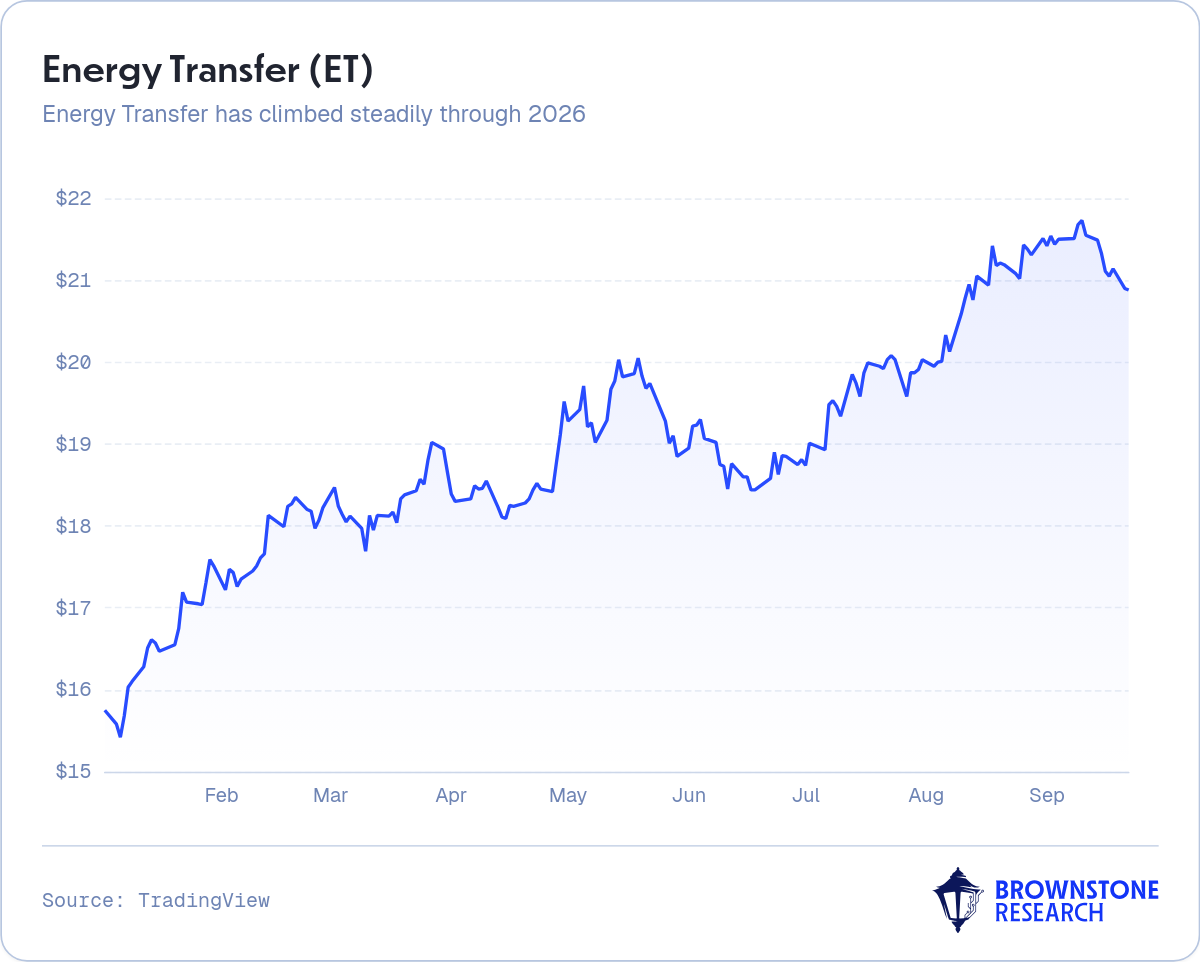
ET is up about 33% year to date, an eye-catching move for a midstreamer, a group typically owned for its generous dividends.
Pipelines are one part of the opportunity. BloombergNEF reports that strong demand is stretching gas-turbine manufacturing capacity and lengthening delivery times. The companies making the equipment that converts gas into electricity are another important part of this buildout.
Of course, a 2035 forecast is not a guarantee of revenue. Projects can slip, customers can change plans, and paying too much for a beneficiary can still produce a poor investment. The opportunity still has to be evaluated company by company.
But the broader lesson is clear.
We should not confuse the AI opportunity with the technology sector alone. Following the infrastructure behind the computing power leads us to a much wider set of businesses.
Some sell the chips. Others deliver the fuel that keeps those chips working. Both will be great investments.

Ask most Americans where their money is safe, and they'll name the same four things. According to Jeff Brown and Larry Benedict, all four are now in danger. Not from a stock market crash, but from what they expect to happen to the U.S. dollar at 1:00 p.m. ET on Wednesday, October 7, on a deadline set by the federal government. During their upcoming emergency briefing, they’ll say why – and where they say the money goes instead. Click here to reserve your free seat.

NASA is paying Elon Musk over $800 million to destroy the International Space Station. But according to Wall Street veteran Dylan Jovine, they’re paying a company one-one thousandth the size of SpaceX a billion dollars a year for the replacement. SpaceX gets a demolition job. The tiny company he's been researching gets a tenant. And NASA is far from the only one. Go here now for our newest space stock report >>> Because after Dylan recommended Rocket Lab to his readers at $3 and change, they saw the stock run up 3,874%. And he believes this one could do even better. Here’s the stock >>

The CLARITY Act failed to pass cloture in the Senate last week. The future of the comprehensive digital asset bill is now more uncertain. And the chances it gets passed this year are slim.
And yet, as I write, the price of Bitcoin is up 11% since then.
What gives?
Regulatory agencies such as the SEC and CFTC had been mostly on the sidelines as CLARITY worked its way through Congress over the past year. All else equal, they would have preferred to get CLARITY over the line.
But with the bill now once again in limbo, the new mindset is “Fine, I’ll do it myself.”
Immediately following the failed vote, the chairs of the SEC and CFTC, Paul Atkins and Michael Selig, respectively, both released statements doubling down on their pro-crypto stance. They also emphasized their intentions to give digital assets clear rules.
This was more than talk.
On Thursday, the SEC released its first innovation exemption. This was related to Tokenized Securities Venues, or TSVs. These use automated market makers (AMMs), the technology employed by most decentralized exchanges, such as Uniswap.
The exemption allows TSVs to trade tokenized versions of national market system (NMS) stocks. These are the equities most investors will find in their traditional brokerage accounts.
The stocks themselves will be trading on permissionless technology, but in a permissioned manner. Users will need to pass traditional know-your-customer (KYC) and anti-money laundering (AML) checks before trading onchain. It’s not the ideal solution, but a step in the right direction.
And this trend is picking up speed.
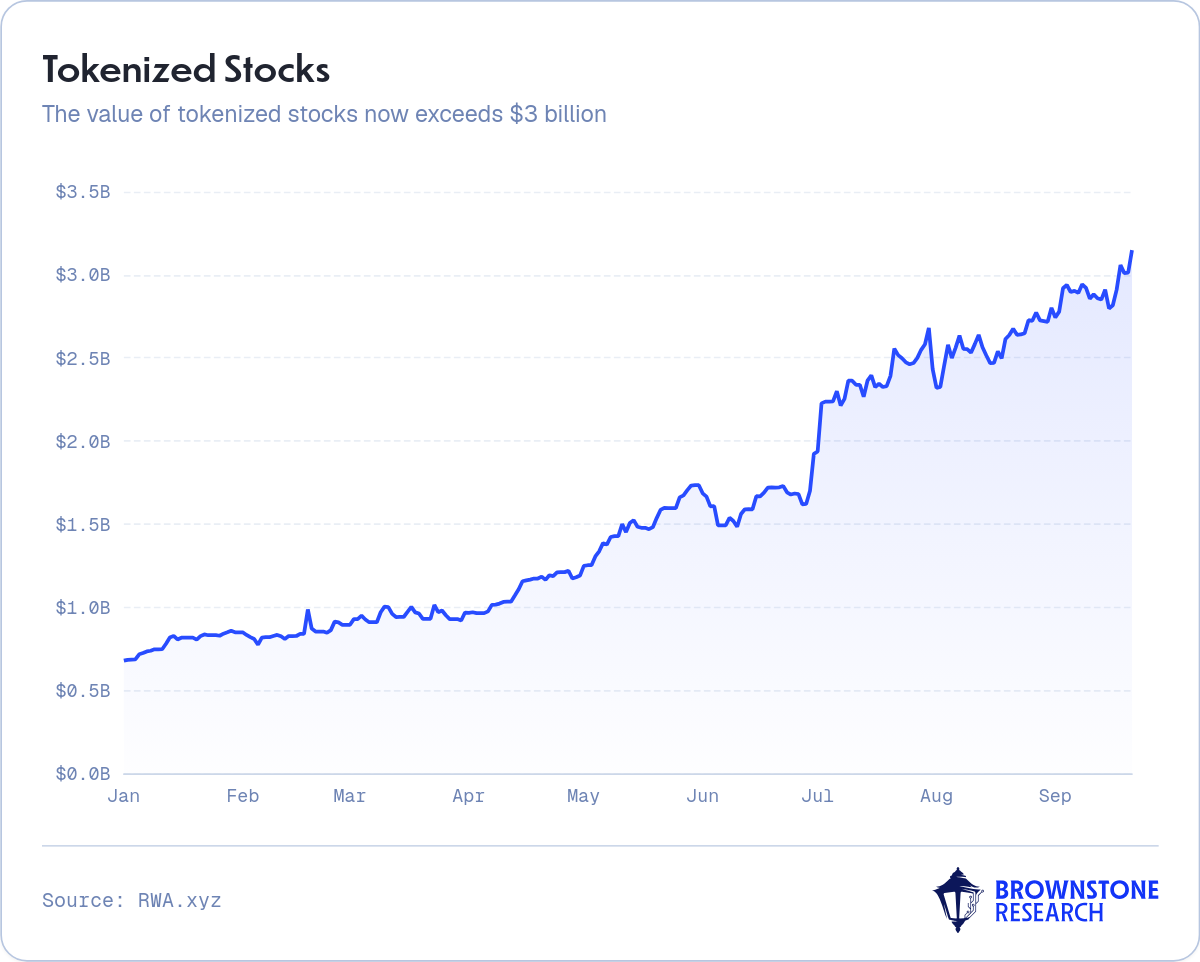
There are $3 billion worth of tokenized stocks trading onchain today.
That was just the SEC side of things.
The CFTC separately issued a no-action relief letter that enables software providers to connect users to regulated derivatives markets without having to register as brokers.
This means software such as your digital asset wallet, user interfaces, and front-end solutions that relay a user’s order to an exchange are not considered brokers. A key requirement is that they don’t take custody of the assets.
This is a big deal. Wallet providers such as MetaMask were being sued over this a couple of years ago.
Additionally, the CFTC filed “Regulation Crypto Asset Transactions and Regulation Crypto Asset Markets” with the Office of Information and Regulatory Affairs (OIRA).
This is a formal way of saying the CFTC has sent the White House a detailed framework for how it plans to regulate digital asset trading under its existing authority.
Once the review process is complete, we’ll learn more about the contents of what was sent.
Both agencies were well equipped with contingency plans ahead of the failed CLARITY vote. And now they’re executing.
And the speed at which these agencies have been moving has reinvigorated the entire crypto market.
As we’ll see below, BTC has finally broken out above the crucial 50-week moving average we’ve been tracking for readers here over the past month.
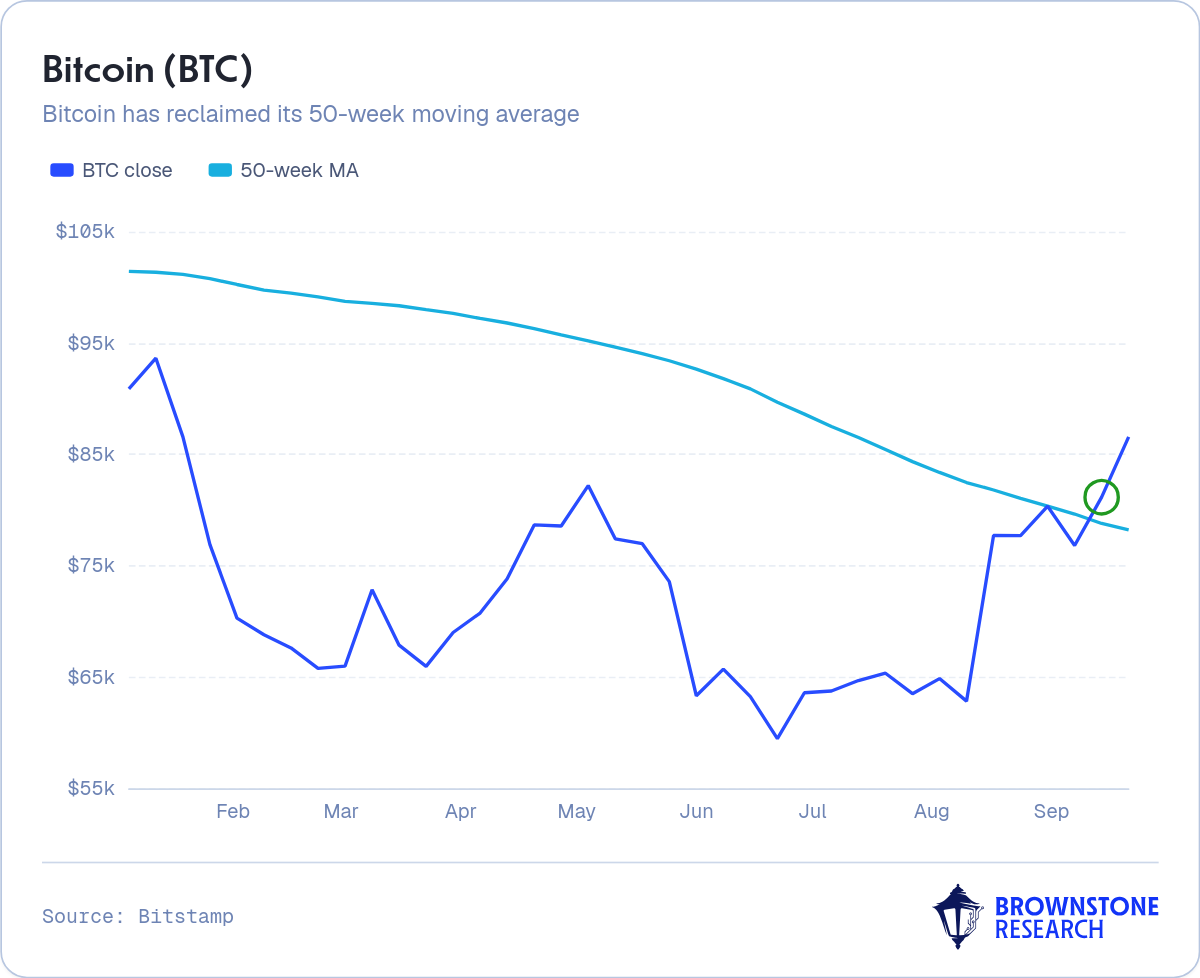
This represents its first close above the 50-week MA since last October and what could be the start of a new multiyear bull market.
Numerous altcoins, such as the ones we feature in our Permissionless Investor portfolio, responded to the recent news even more favorably than BTC.
For months, we’ve been saying investors did not need CLARITY to be bullish on digital assets.
And finally, the long-awaited regulatory catalyst looks to be here.

Rising rates are supposed to be bad for gold, but the metal seems to be breaking that rule.
When rates rise, they push the yield on assets such as bonds higher. Gold, which has no yield, becomes less attractive by comparison. Also, rising rates can boost the dollar. And since gold is predominantly priced in dollars, gold purchases become more expensive for international buyers. Again, gold typically falls.
And for the last three weeks, it looked like this inverse relationship would hold once again.
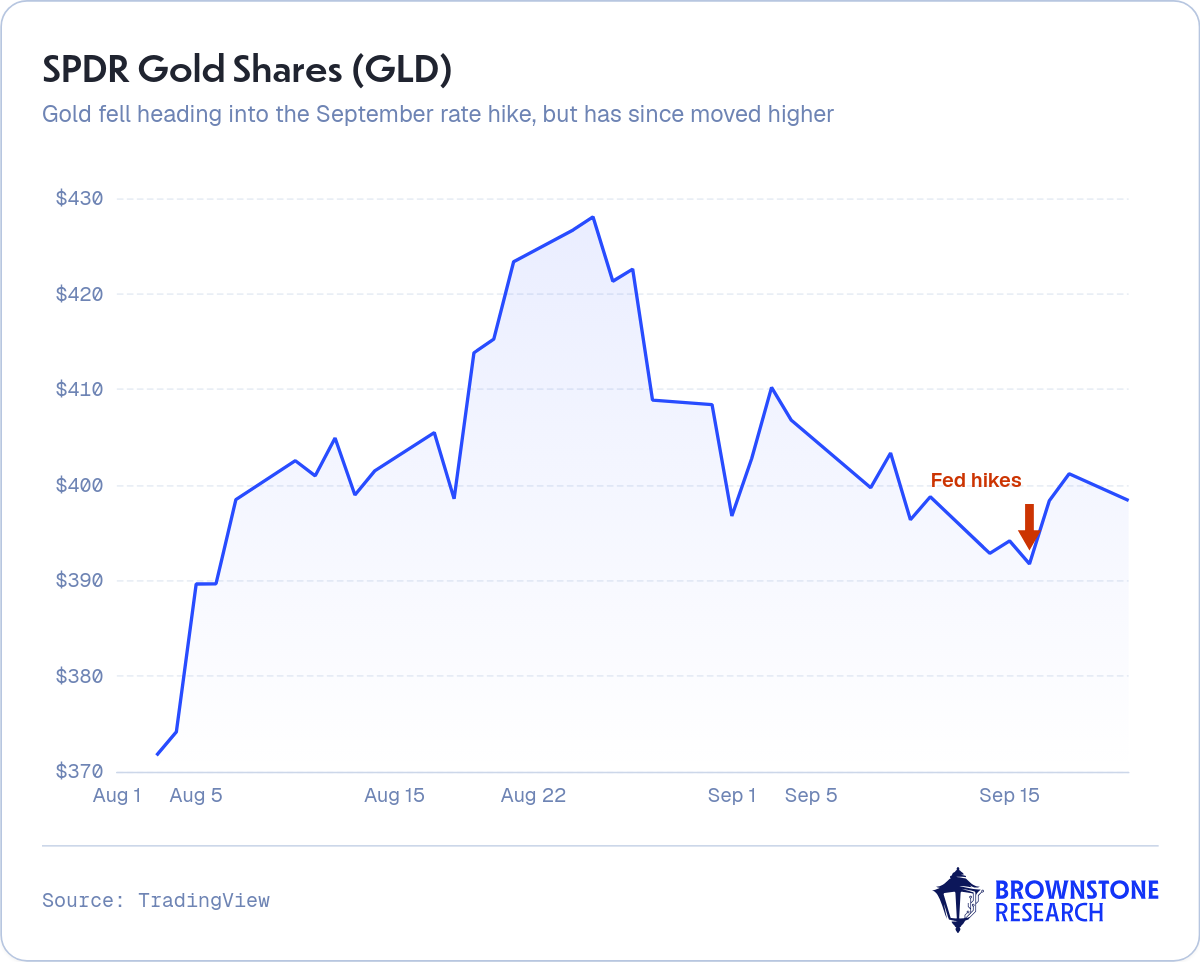
After hitting a recent high near $4,700 on Aug. 25, gold spent the next three weeks drifting lower. The yellow metal fell back to a low of $4,235 on Sept. 16.
This was the market accounting (correctly, it turns out) for the likelihood of a rate hike from the Federal Reserve (the Fed).
Last Wednesday, the Fed announced that it was raising the federal funds rate by 25 basis points (0.25%). Based on recent history, that news should have sent the gold price tumbling.
Interestingly, that pattern just broke. Instead of falling, gold surged nearly 4% in the two days following the Fed’s rate hike.
Here we can see that gold spent most of August on the decline, but began to rally following the Fed’s rate hike last week.
What to make of this?
Gold rallying after a confirmed hike suggests one of two things:
Point No. 2 is interesting. You’ve likely heard it called the “debasement trade.”
The debasement trade is the recognition that governments around the world aren’t even pretending to be good fiscal stewards anymore. In the U.S. alone, national debt recently topped $40 trillion. Multitrillion-dollar deficits stretch from here to the horizon. An aging population will exacerbate things as more retirees lean on programs such as Social Security in the years ahead.
Put more simply, investors aren’t abandoning the paper, but they don’t trust it quite like they once did. And so, they’re turning to the yellow rock.
But it’s not just investors.
Central banks bought a record 289 metric tons of gold in the second quarter alone. These are the institutions charged with managing their domestic monetary systems … and they are piling into gold right now. That should tell us something about confidence in fiat money today.
At the same time, we saw roughly $2 billion flow into gold exchange-traded funds (ETFs) in a single week earlier this month. That’s largely institutional money raising its gold allocation, and those institutions clearly aren’t buying based on rates and yields.
The takeaway here is that gold is coming to be seen as a key reserve asset once again.
Central banks and institutional investors are accumulating gold through price swings and without regard to interest rates … and that pattern suggests that they are treating it as a long-term holding, not a trade.
That being the case, it’s wise for self-directed investors to maintain an allocation to gold as well.
Add Brownstone Research as your preferred source on Google to see our latest stories in your feed.
 Add as a preferred source
Read the latest insights from the world of high technology.
Sometimes, what you see depends on how you’re looking, not just what is there.

If the Fed has gone back to raising rates, why was the post-hike bounce in stocks so strong?

To be completely fair, there is a non-zero chance that things go horribly wrong