



Kevin Warsh Shows His Feathers
If the Fed has gone back to raising rates, why was the post-hike bounce in stocks so strong?



Sometimes, what you see depends on how you’re looking, not just what is there.


Sometimes, what you see depends on how you’re looking, not just what is there.
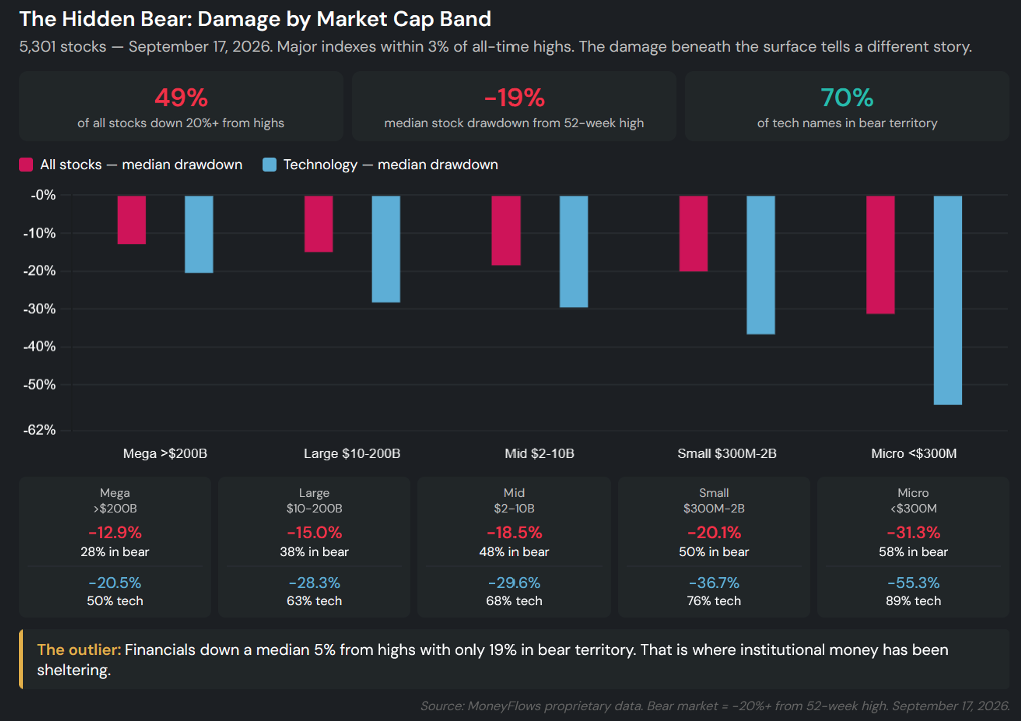
Look closely at stocks today, and you might see a hidden bear … at least in some corners of the market.
Of the publicly traded companies in my universe, 49% are down 20% or more from their 52-week highs. That is a bear market by definition.
Last Thursday’s relief rally barely moved the needle, shaving the number by roughly one and a half percentage points. The bear is awake; you just have to look to find it.
The median stock is 19% off its high. The cap-weighted index is up nearly 20% year to date while the median stock is up 5%.
The damage shows a clear staircase.
Bigger companies have fallen less. Smaller companies have been hit harder.
Mega-caps are down a median 13% from their highs, with 28% in bear market territory. Large caps are down 15%, with 38% down 20% or more. Mid-caps are down 18%, with nearly half in bear markets. Small caps are down 20%, half below the threshold. Micro-caps are down 31%, with 58% in bear territory.
Technology is worse at every level—70% of all tech names are in bear markets, with the median tech stock down 34%.
Two fundamentals predict damage. Profitability matters most: profitable micro-caps are down an average 11% from their highs. Unprofitable micro-caps are down 52%: a 40-point spread driven by whether the business makes money. Debt compounds it—small and micro-cap companies with high leverage are down a median 36%, with nearly three-quarters in bear territory.
Financials, down a median 5%, stand apart with only 19% in bear market territory. That sector, energy, and healthcare are where institutional money has been hiding.
Most other sectors have quietly been suffering …
With all that said, it’s not like we haven’t been here before.
In March, a similar bout ran 12 sessions before the March 20 low, which produced 337 outflows and marked the exact bottom.
The S&P 500 was 9% higher one month later.
Since 1990, there were 765 sessions with 100 or more institutional outflows—just 8.3% of all trading days in 36 years. Forward returns are positive at every horizon—one week, one month, three months, six months, one year, and two years. The two-year average return is 21.1% with a 79% win rate.
History also shows what comes back fastest.
Across nine midterm cycles since 1990, the Nasdaq 100 averaged 37.4% in the year following Election Day—more than double the Dow’s 12.4% and well ahead of the S&P 500’s 14.5%. Growth leads the recovery. Every time.
The stocks most beaten up today—mid-cap, rate-sensitive, and fundamentally sound—fit the profile that has snapped back hardest when midterm uncertainty clears.
For many, it’s painful right now. But history tells us the pain has always been temporary.
And recovery has always followed.

Elon Musk’s new patent protects a new invention that could rewrite the future of wealth forever. It’s a radical new form of AI Jeff Brown calls “M.A.G.I…” One so revolutionary that Elon called it an “infinite money glitch.” Click here to see the details because he believes this is a once-in-a-generation opportunity to potentially create wealth on a scale most people can’t even comprehend.

It will open a rare new investment vehicle that could have the biggest impact on your wealth since the dot-com era. In 2025 alone, it booked a 592% total gain in backtests. Soon, everyone will be using this type of financial AI to find stocks. So we urge you to try it now, BEFORE it spreads. Until Tuesday, September 22, claim free access here.

Going into last Wednesday’s Fed meeting, markets were pricing a near-certainty that the Fed would hike rates by 0.25%. When that move was confirmed, it came as little surprise.
But now that the decision has been made, attention has shifted to what happens next.
Was this simply a one-off move or the beginning of a tightening cycle?
Fed Chair Kevin Warsh didn’t offer a definitive answer. However, he made it clear that inflation remains too high and that data over the summer hasn’t shown a meaningful improvement in the underlying trend.
Warsh described the rate hike as removing “a dose of accommodation.” In other words, the Fed made borrowing money a little more expensive. And with the economy remaining relatively strong, the Fed clearly believes it has room to hike again if inflation remains uncontrolled.
That’s generated new questions. Will rising oil prices keep inflation elevated enough to justify another hike? Will the Fed increase rates again before the end of the year?
More broadly, how much pressure can the economy, housing market, and stocks absorb if Treasury yields continue to track higher?
In short, the market is no longer trading the Fed’s decision. It is beginning to price the potential rate path ahead.
If the dollar and Treasury yields continue to climb—and rate-sensitive parts of the market continue to weaken—that’s telling me the market is pricing in a more aggressive rate path from the Fed.
However, if yields stabilize or reverse, the dollar pulls back, and stocks regain lost ground, investors may believe the Fed’s increase will be a one-off move.
We have to recognize that the market may need time to establish a new direction after the news event passes.
Don’t assume the first reaction provides the final answer. Let the market digest the news, watch how the important levels behave, and patiently wait for the next genuine setup to unfold.

Money is pouring into private biotech companies at a pace we haven’t seen in years …
On Tuesday, Sept. 8, a company called BrainChild Bio raised $116 million to work on brain cancer in children, and Moonwalk Biosciences raised $70 million for an obesity drug.
Then, over the next two days, Solstice Oncology raised $225 million and Encoded Therapeutics raised $275 million. A smaller company, Tectora Therapeutics, added $55 million.
Then came the bigger money. An investment firm called Luma Group closed a new $410 million fund to back young life-science companies. And Frazier Life Sciences added more than $1.1 billion to a fund it uses to invest in small and mid-sized biotech companies, bringing that fund to about $2.8 billion.
That second part matters more than it sounds. Startups raising money is normal. Big investors handing more money to the people who pick the startups means the folks with deep pockets—pension funds, endowments, wealthy institutions, etc.—believe biotech is worth betting on again.
Two names dominate, and both tell you something.
RA Capital Management has been on a tear since late August, participating in 30 funding rounds this year. In September alone, it invested in four companies: Solstice, Tectora, Typewriter Therapeutics ($56 million for in vivo CAR-T), and Superluminal Medicines.
The other is Eli Lilly, and it’s the more structurally interesting one. Flush with cash from its obesity and diabetes drugs, Lilly has ramped venture investing hard: 12 deals so far this year. That compares to 15 in all of 2025, eight in 2024, five in 2023, and one in 2022.
That’s a 12-fold increase in four years. The company’s GLP-1 profits are now effectively functioning as a venture fund for the whole sector.
This is a sea change from a few years ago, when the entire industry was suffering through the “biotech winter,” as Jeff Brown calls that difficult period. Biotech stock prices were falling. And biotech IPOs and acquisitions had slowed to a trickle.
In that environment, it was tough for even the best young biotechs to attract venture capital. That’s because investors don’t get excited about good science. They get excited about good returns. And for years, money went into the private biotech ecosystem, but very little ever came out.
We can get an idea of the biotech VC slowdown in the chart below.
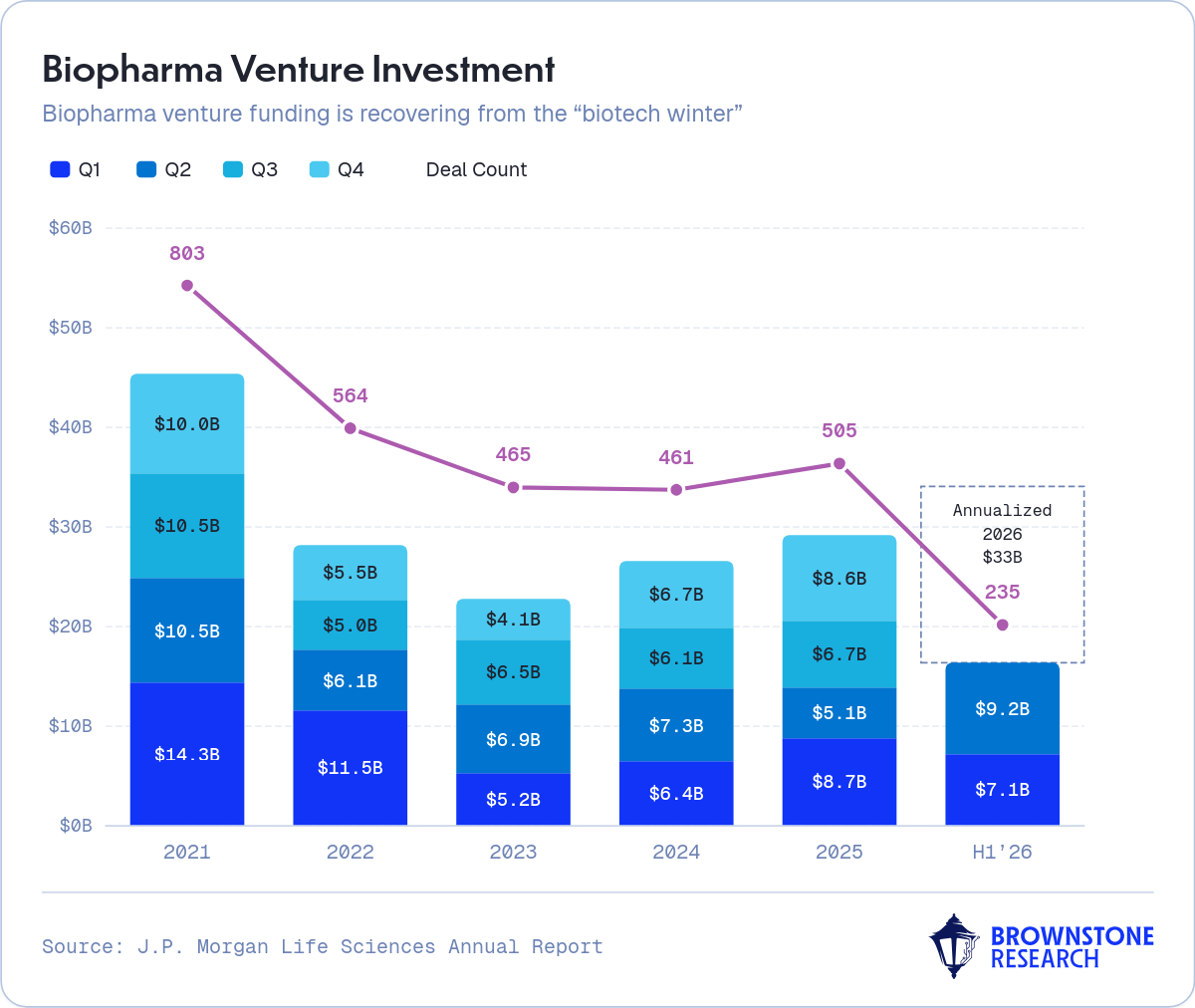
Notice the big drop in VC activity after 2021. That’s the biotech winter taking hold. But the data also shows something else—VC interest is coming back. On an annualized basis, 2026 surpasses any year since 2021.
We can thank this recent run of multibillion-dollar pharma acquisitions, which unclogged the pipe and increased the appetite for these riskier deals.
After all, when private investors who backed those companies finally get their payday, they put those proceeds back into the ecosystem.
That’s the engine restarting. And after years of sluggish activity, the biotech flywheel is now in full swing.
Add Brownstone Research as your preferred source on Google to see our latest stories in your feed.
 Add as a preferred source
Read the latest insights from the world of high technology.
If the Fed has gone back to raising rates, why was the post-hike bounce in stocks so strong?

To be completely fair, there is a non-zero chance that things go horribly wrong