



The AI Opportunity Buried Underground
We should not confuse the AI opportunity with the technology sector alone...



The Fed’s job is to turn down the fun before the market drives its car into a ditch...

Managing Editor’s Note: The U.S. dollar could break as early as October 7… Not weaken. Not slip a few percent. Break.
That’s according to our colleague, Market Wizard Larry Benedict. Larry says something big is coming for the U.S. dollar, and if he’s right, that means your bonds, your cash savings, even the dollars in your pocket will all be put at risk.
Larry is holding an emergency briefing next week where he will cover exactly what’s happening and what you can do about it ahead of the “reckoning.”
Just go here to sign up with one click to join him next Wednesday, September 30, at 8 p.m. ET.

It was Fed Chair William McChesney Martin who said it was the Fed’s job to take away the punchbowl just as the party was warming up.
In the metaphor, the party is a booming economy and stock market. The punchbowl is easy credit brought on by low interest rates. The Fed’s job is to turn down the fun before the market drives its car into a ditch.
That, in a nutshell, is what current Fed Chair Kevin Warsh says he’s doing …
Since 2024, central banks across developed nations have been lowering their key rates and introducing looser monetary policy. Low rates translate to cheap credit and plentiful liquidity.
That’s helped fuel the AI infrastructure spending boom that’s propping up the economy.
Cheap credit is also the perfect backdrop to fuel risky assets – everything from AI stocks to crypto and blockbuster IPOs.
But the liquidity and credit outlook is slowly starting to change. Last week, the Fed announced a quarter-point hike in the federal funds rate.
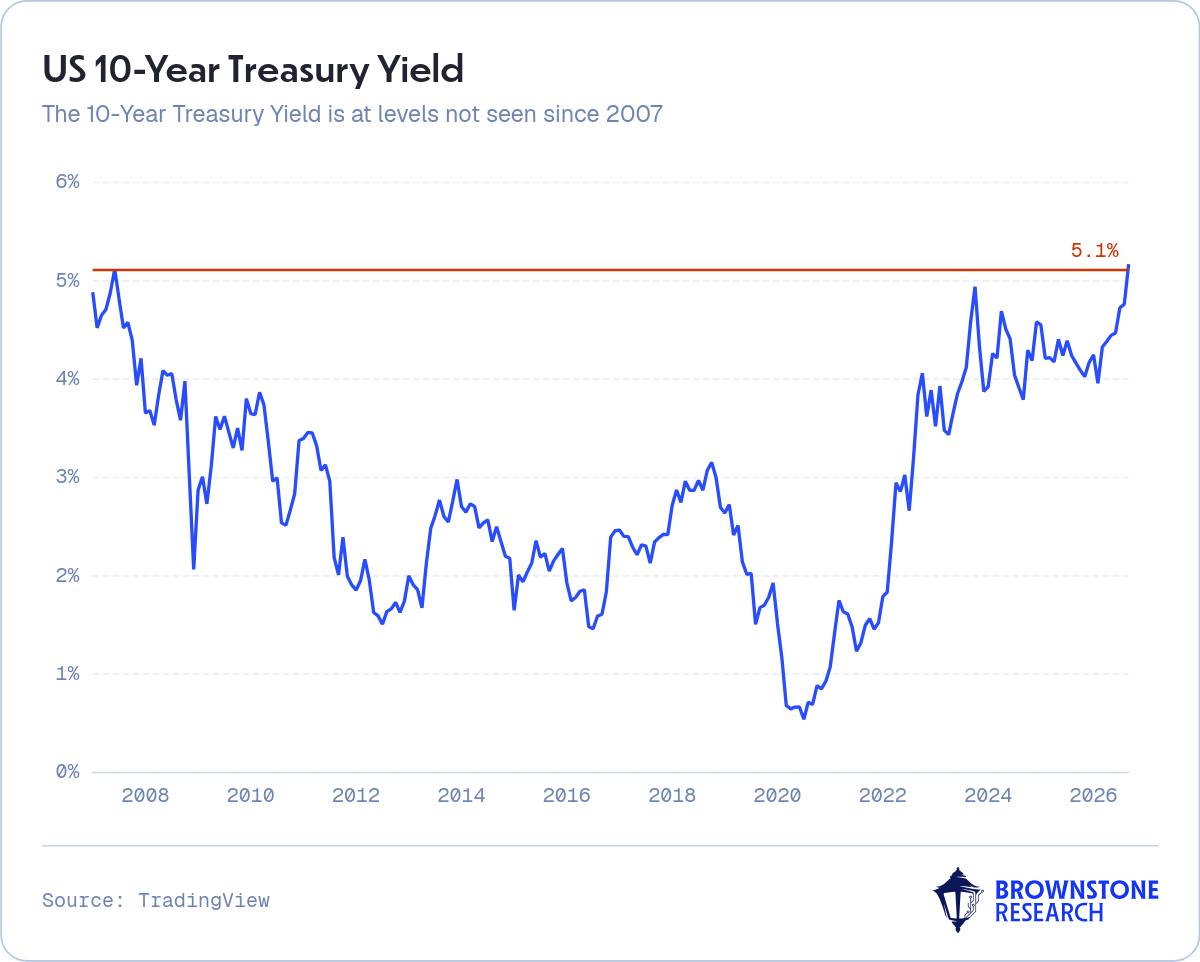
Interest rates on the long end of the yield curve have been rising rapidly. You might have noticed that the 10-year Treasury yield blew past 5.1% this week, a level not seen since 2007.
It’s not just the United States …
The European Central Bank and Bank of Japan raised rates at their September meetings as well. Others, such as the Bank of England and Bank of Canada, kept rates on hold but are sounding more hawkish because of inflation.
The percentage of central banks around the world hiking rates stood at just 15% a year ago. Now that figure stands at 33% and could rise further still.
The last time a similar proportion of central banks were hiking rates was in late 2021. That was just ahead of the peak in the S&P 500 heading into 2022’s bear market.
As the Fed and other central banks around the world move to increase interest rates, the punchbowl is going away again, and the effects could be felt across the market’s most popular trades.

Larry Benedict went 20 straight years on Wall Street without a losing year. Jeff Brown recommended Bitcoin at $240 and Nvidia in 2016. Now they’ve issued the biggest warning of their careers: The U.S. dollar will break on Wednesday, October 7, at 1:00 p.m. ET – on a deadline set by the federal government… It could lose up to a third of its value. Or even half… And the money doesn’t vanish. It moves into a market that could have potentially handed you over $410,000 the last time something like this happened. On Wednesday, September 30, at 8:00 p.m. ET, they share all the proof, free. Click here to reserve your seat for free.

An email announcing a new 401(k) investment option is coming to 70 million inboxes. Most will delete it – and miss what Larry Benedict calls the decade’s biggest opportunity. He’s naming the one ticker to own before it arrives – free. Watch here.

Five minutes versus 10 septillion years.
That was the comparison Google offered in 2024 when its Willow quantum chip completed a specialized benchmark in under five minutes. Google estimated that one of the world’s fastest supercomputers would need 10 septillion years to perform the same task.
Before you ask, a septillion is 10²⁴, or a 1 followed by 24 zeros. For a bit of context, the age of the universe is estimated to be 13.8 billion years. One septillion years would be about 72 trillion times longer. So, completing a task in 10 septillion years might as well be never.
This wasn’t an everyday business problem, but it illustrated quantum computing’s potential.
As impressive as that is, there are more than a few obstacles before this technology is ready for widespread commercial use.
One hurdle is the fact that a quantum computer could lose its speed advantage while waiting for an ordinary computer to catch up.
That sounds backward. But it’s an obstacle to building quantum machines that can perform useful work. And this week, IonQ (IONQ) announced progress toward overcoming it.
The challenge starts with quantum bits, or qubits. They are the building blocks these machines use to process information. Qubits are fragile. Small disturbances and imperfect operations introduce errors that can accumulate and ruin a calculation.
Researchers address this by spreading quantum information across multiple physical qubits to create a more reliable “logical qubit.” Repeated checks look for signs of errors without directly reading and destroying the information being protected.
But those checks generate data that an ordinary computer must interpret. Software called a decoder determines which errors likely occurred and how to account for them. If it falls behind, parts of the quantum calculation must wait.
In other words, the system protecting the calculation ends up slowing it down.
IonQ’s researchers tested a way to keep that decoder running fast enough using just one Apple M4 Max processor found in a MacBook Pro.
Their benchmarks modeled quantum workloads involving up to 408 logical qubits. Under the lower-error conditions studied, decoding added less than 0.3% to execution time. The ordinary processor could keep up with almost no additional waiting.
These were simulated quantum workloads, not a demonstration of a working 408-logical-qubit machine. The results depend on assumptions about hardware speed and error rates. But they show that one important supporting task could be handled with readily available computing hardware.
That matters because quantum computing’s commercial future depends on the economics of the entire system. A powerful quantum processor delivers little value if the equipment supporting it makes useful calculations too slow or expensive.
IonQ is also working on that broader integration.
On Wednesday, it announced plans to install its Superion 256 at Nvidia’s Accelerated Quantum Research Center in 2027. The system will connect directly with Nvidia’s computing infrastructure for research including materials science and drug discovery.
The announcements drew investors’ attention. Early Wednesday, IonQ rose roughly 11% before pulling back with the broad market.
The enthusiasm is understandable. Progress on a major engineering obstacle strengthens the case that commercially useful quantum systems can be built. But IonQ’s decoder was designed for its architecture. Its competitors still have to demonstrate their own solutions.
For investors, this is the progress to watch: reliable calculations, manageable costs, and systems that customers can easily put to work. Each obstacle overcome brings quantum companies closer to turning their scientific promise into a business.

The U.S. Food and Drug Administration (FDA) has launched a new initiative called Operation TrialBlazer, and its goal is to move promising experimental medicines into human trials quickly and efficiently.
Specifically, the FDA wants to remove delays, duplicated work, and unnecessary regulatory steps that can slow down development for months or even years.
The problem is especially important for modern biotechnology. New treatments such as gene therapies, cell therapies, RNA medicines, and complex antibodies are much harder to develop than traditional drugs.
Small biotech companies often conduct extra toxicology studies, manufacturing work, or laboratory testing simply because they are afraid that the FDA could put the trial on hold. Obviously, that costs time and resources.
The FDA also wants the United States to remain competitive with countries such as China and Australia, where early-stage clinical development has been expanding rapidly.
One important part of TrialBlazer is a new Expedited IND Pilot Program.
An IND, or Investigational New Drug application, is the package a company must submit before testing a new drug in humans. Traditionally, companies prepare most of the package first and then submit it to the FDA.
Under the new pilot program, certain parts of the IND may be reviewed earlier as they become ready.
For example, a company could prepare its animal safety studies first, then its manufacturing information, and later its clinical trial plan. The FDA could begin looking at some of these sections before the entire IND is complete. The normal 30-day FDA safety review still applies, but many scientific questions could be resolved earlier.
Another new idea is the use of a Qualified Research Institution, or QRI.
This could be an academic medical center or contract research organization (CRO). The QRI would help review the company’s toxicology, manufacturing, clinical design, and regulatory strategy before the information reaches the FDA. The goal is to find problems early instead of discovering them months later.
The initiative also encourages companies to prepare clinical trial sites while regulatory review is still happening. Activities such as ethics-board approval, site contracts, and pharmacy preparation could occur in parallel. This means a company might be ready to treat the first patient soon after the FDA gives permission to begin.
This might all seem like regulatory fine-tuning, but it will have a measurable impact on biotech, especially small biotech companies.
Smaller companies often rely on only a few employees and outside consultants. Earlier FDA feedback and better outside support could save them significant time and money, and possibly even reduce the need for additional financing.
Saving time and money is important when your company is burning through cash in the process of bringing a drug to market.
For now, TrialBlazer is still a small experiment. Applications opened in September 2026, and the FDA plans to select only eight to 10 sponsor-QRI partnerships for the first group.
The FDA appears to be moving toward a more flexible, stage-appropriate regulatory system.
If the program works, the long-term effect could be significant.
Saving even six months in early drug development could reduce biotech spending, require less shareholder dilution, produce clinical data sooner, and make the United States more attractive for biotechnology research.
For investors, the companies chosen for the first TrialBlazer group will therefore be worth watching closely.
Add Brownstone Research as your preferred source on Google to see our latest stories in your feed.
 Add as a preferred source
Read the latest insights from the world of high technology.
We should not confuse the AI opportunity with the technology sector alone...

Sometimes, what you see depends on how you’re looking, not just what is there.

If the Fed has gone back to raising rates, why was the post-hike bounce in stocks so strong?