




The ‘Death’ of a Robot
This is just a tinge of what we’ll be grappling with as the humanoids become more intelligent and more...



These factories will cost billions before even a single working chip is produced…

Managing Editor’s Note: Next week, Jeff Brown is holding an important strategy session…
He’s calling it the October Million-Dollar Cycle. It’s all to do with a strange market phenomenon that occurs every four years like clockwork.
It often passes unnoticed by those who don’t know to look for it… but for those who do, it presents an incredible opportunity in a very niche corner of the AI market.
Get all the details and reserve your seat with one click right here.

It will be “the largest and most valuable building on Earth by far.”
That’s how Elon Musk describes Terafab Texas, the semiconductor manufacturing complex planned for Grimes County. At 100 million square feet, the proposed building would have more floor space than 500 Walmart Supercenters.
Inside, Musk intends to bring advanced semiconductor manufacturing, memory production, and semiconductor packaging together under one roof.
The investment will be just as extraordinary. UBS estimates that spending on Terafab could reach $225 billion through 2031. That gives us a sense of the scale and the resources required to manufacture the chips needed to fulfill Musk’s ambitions at both Tesla (TSLA) and SpaceXAI (SPCX).

Terafab rendering | Source: SpaceXAI
Those ambitions include 1 billion Optimus humanoid robots, 2 million Cybercabs per year, and a constellation of 1 million AI data-center satellites.
This will require enormous quantities of semiconductors to process AI workloads, store data, and move data at a scale never envisioned before. This scale has profound implications for the entire semiconductor industry supply chain.
Reaching these goals will require years of engineering, construction, and manufacturing advances.
And while it might be hard to believe, preparations are already underway. In April, Tesla broke ground on a prototype semiconductor manufacturing facility on the North Campus of its Austin Gigafactory location. Here, engineers will refine processes before attempting them at Terafab’s proposed scale.
This facility in Austin is an advanced semiconductor manufacturing lab also known as the Terafab Research Fab. It is almost complete, and production is planned to begin this quarter.
Better yet, the ground has already been cleared in Grimes County, and concrete is being poured for the Terafab itself.
Terafab is an extraordinary example of the transformation and acceleration of an entire industry. But it’s not the only one.
Micron’s (MU) plans include $50 billion for two fabs in Idaho and up to $100 billion for its New York manufacturing complex. It plans to spend more than $250 billion in the U.S. through 2035 to expand production of the memory that computers and AI systems need to operate.
Taiwan Semiconductor’s (TSM) planned Arizona investment has reached $265 billion, covering chip factories, advanced packaging, and research capabilities.
And just last week, rumors surfaced that TSM was looking at Dallas as a second site. The total investment there may even exceed what it’s spending in Arizona.
In South Korea, Samsung and SK Hynix (SKHY) have announced approximately $520 billion for a future chipmaking hub. Intel’s (INTC) plans include more than $100 billion for new factories and modernization in the U.S. alone. GlobalFoundries (GFS) has outlined $16 billion for U.S. manufacturing and research. And Texas Instruments (TXN) plans to invest more than $60 billion across seven U.S. fabs.
These factories will cost billions before even a single working chip is produced.
I don’t believe most of Wall Street is taking into account the size and scale of this buildout. In fact, most don’t believe that the Terafab will be built anywhere near the scale that Musk has communicated.
When they realize they were wrong, it will serve as a catalyst to stocks attached to the buildout of the semiconductor supply chain.

This coming Wednesday, October 14 at 8 p.m. ET, Jeff Brown is going live with a HUGE AI update… To discuss a NEW AI trade that could mint millionaires… starting by the end of this month. Click here to automatically save your seat for The October Million-Dollar Cycle…

One ticker could give you the chance to make all the money you need before the end of 2026. Larry Benedict has already identified it and believes the first move could begin on December 9. Get his ticker free before December 9.

After a bruising summer, the semiconductor sector is showing signs of new life. See for yourself.
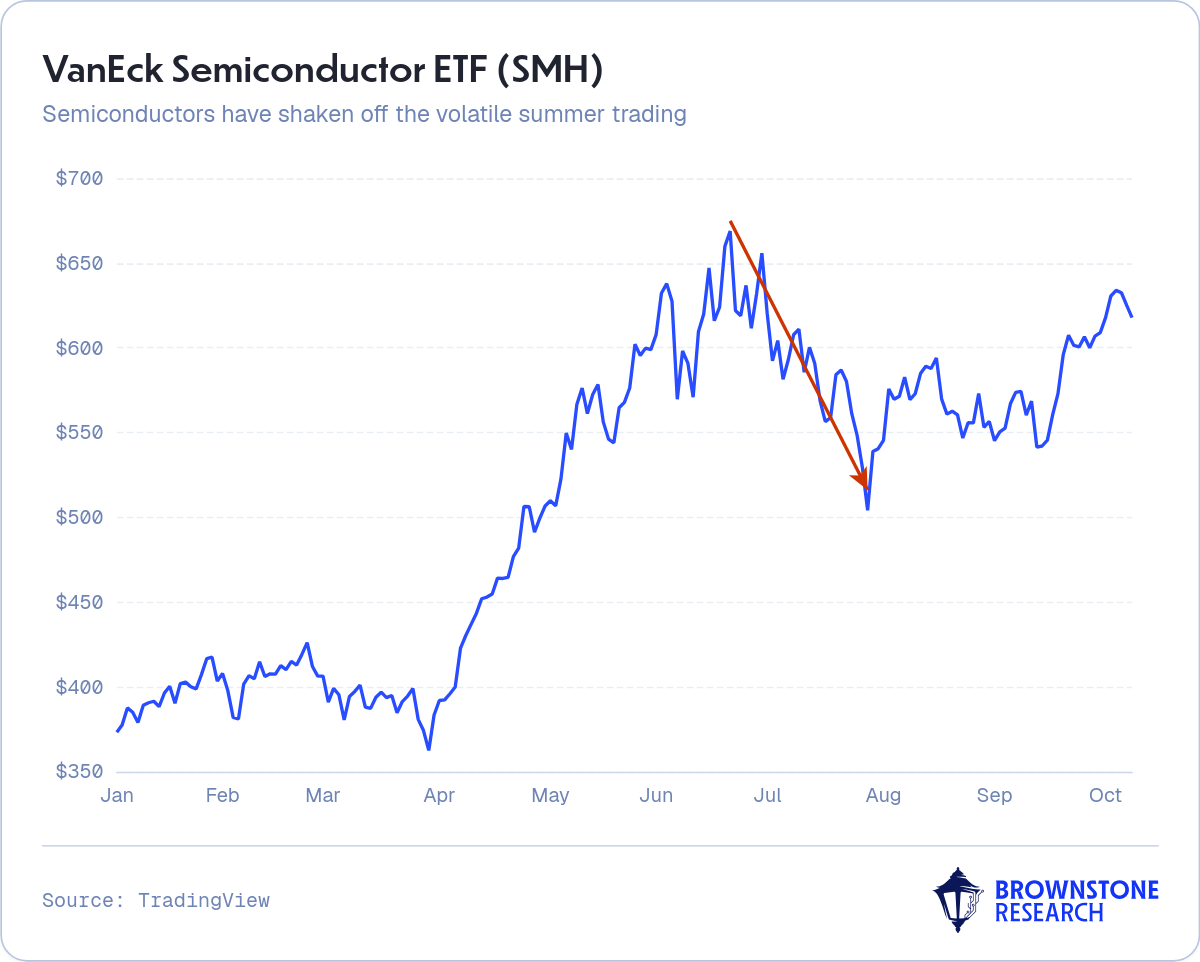
After peaking on June 22, semiconductor stocks – as measured by the VanEck Semiconductor ETF (SMH) – fell as much as 25% by July 29. But after several months of uneven trading, conditions are coming together for the next leg higher.
Last week, both AMD (AMD) and Nvidia (NVDA) broke out to new all-time highs. Meanwhile, Micron’s (MU) latest earnings were a reminder of the massive demand for more AI compute. Even with expectations already high, the company exceeded Wall Street’s forecasts and issued a stronger outlook. The need for more memory continues to grow as AI systems become more capable and more widely used.
Importantly, this is all happening at a time of rising rates, with the 10-year Treasury yield recently breaking out to 24-year highs.
Higher rates make borrowing more expensive and can put pressure on stock valuations. But the impact differs from one business to another. Companies that generate substantial free cash flow and have limited refinancing needs are better equipped to fund growth without relying on expensive new debt.
That’s why we saw investors turn to AI stocks. They’re looking for businesses with the demand, cash flow, and financial strength to keep investing through a tougher rate environment.
We’re also entering a historically favorable stretch of the calendar. October has been the strongest month in midterm election years. The S&P 500 has gained an average of 3%, finishing higher nearly 74% of the time. November follows with an average gain of 2.7% and positive returns nearly 80% of the time.
That gives us a constructive backdrop heading into year-end. That doesn’t mean we should expect gains during every midterm. In October 2018, ahead of the midterms in President Trump’s first term, stocks fell nearly 7%.
But once this year’s election results are settled, businesses will have a clearer picture of the political landscape.
Republican control of both chambers would give the administration more room to advance its agenda. If Democrats win either chamber, major legislative changes will become harder to pass.
For businesses, that’s not the worst outcome. A federal government with split control between the parties typically means deadlock. Deadlock can mean stability and fewer legislative surprises that require a quick pivot.
But staying bullish through year-end does not depend on any one outcome in Washington. The need for more computing capacity, advanced chips, and electricity will remain after the votes are counted regardless of the outcome.
Over the next two months, keep an eye on how that demand translates into business results. During earnings season, watch the largest technology companies’ spending plans and their suppliers’ order books. Look for signs that new factories and power projects are moving toward production.
As evidenced by the breakout in semiconductors, the AI trade may have stalled through the summer, but it’s far from over.

There are three new Nobel laureates, and you might be surprised at what they accomplished…
The 2026 Nobel Prize in Physiology or Medicine has been awarded to three scientists whose work gave researchers something that once sounded almost like science fiction: the ability to control selected brain cells using flashes of light.
Karl Deisseroth of Stanford University, Peter Hegemann of Humboldt University in Berlin, and Georg Nagel of the University of Würzburg received the prize for discoveries that helped create a technology called optogenetics.
Today, optogenetics is one of the most important tools used to understand how the brain works.
The story began with a surprisingly simple organism: algae. Some single-celled algae can sense light and swim toward it. Scientists discovered that they do this using special proteins called channelrhodopsins.
These proteins sit in the cell membrane and respond when light hits them, allowing electrically charged particles to move into the cell. Hegemann and Nagel helped uncover how these light-sensitive proteins work. Researchers then realized that if the gene for one of these proteins could be placed inside another kind of cell, that cell might also become sensitive to light.
That idea became especially powerful when scientists applied it to neurons, the electrical cells that make up the brain.
Deisseroth showed that channelrhodopsins could be placed into selected neurons and activated with extremely short pulses of light. Scientists could suddenly turn specific groups of brain cells on or off almost instantly.
Instead of simply watching which parts of the brain became active during a behavior, researchers could directly test what particular cells did.
This was a sea change for neuroscience.
Before optogenetics, it was often extremely difficult to determine which cells were responsible for a particular behavior. But now, researchers can activate or silence selected circuits and observe whether an animal’s movement, sleep, memory, fear, appetite, or other behavior changes.
This is more than just a science experiment. The technology is also becoming important for biotechnology and drug discovery.
MapLight Therapeutics (MPLT) uses optogenetics together with other technologies to identify brain circuits, cell types, and drug targets involved in psychiatric and neurological diseases.
Novartis also says it uses optogenetics in its neuroscience research, while Integrated Biosciences has developed an optogenetic screening platform to search for new small-molecule drugs.
In other words, a tool originally developed to understand basic brain biology is increasingly helping companies decide which biological targets may be worth turning into medicines.
In addition, researchers are exploring whether light-sensitive proteins could help restore vision when the eye’s natural light-sensing cells have been destroyed.
Companies including Nanoscope Therapeutics and GenSight Biologics have developed experimental optogenetic approaches for retinal diseases. These treatments remain experimental, and optogenetics is still primarily a research and drug-discovery tool rather than a routine medical therapy.
The Nobel Prize recognizes much more than one clever laboratory technique. This technology allows researchers to investigate some of the deepest questions about the human brain.
Optogenetics has not solved diseases such as Alzheimer’s, Parkinson’s, or schizophrenia, but it has given scientists a far better way to understand the cells and circuits involved.
Sometimes, before medicine can learn how to repair the brain, science first needs to understand how it works.
Add Brownstone Research as your preferred source on Google to see our latest stories in your feed.
 Add as a preferred source
Read the latest insights from the world of high technology.
This is just a tinge of what we’ll be grappling with as the humanoids become more intelligent and more...

The index never felt the cold. The market underneath took all of it.

The bond market quickly caught on that the PCE numbers could’ve been fudged...