




The Market’s Winter Solstice
The index never felt the cold. The market underneath took all of it.



This is just a tinge of what we’ll be grappling with as the humanoids become more intelligent and more central to our lives.

Managing Editor’s Note: Every four years, something strange happens in the market. Our colleague Jeff Brown calls it “the million-dollar cycle.”
You won’t hear about it on the evening news. Most financial advisors couldn’t explain it if you asked. And yet, like clockwork, it’s shown up again, and again, and again.
Most people don’t notice until it’s already played out. But a small group of investors knows exactly what to watch for. And each time this shift has taken hold, they have had the chance to turn a single $1,000 stake into six figures…
If you’d like to potentially be one of them, make sure to RSVP for Jeff’s upcoming event with one click here.

Figure AI, one of the leading intelligent humanoid robotics companies, had a problem to solve.
It couldn’t decide how to decommission its previous generation of Figure 02 robots. So, it asked the crowd.
Of all people, Arnold Schwarzenegger replied on X, suggesting that Figure AI melt them.
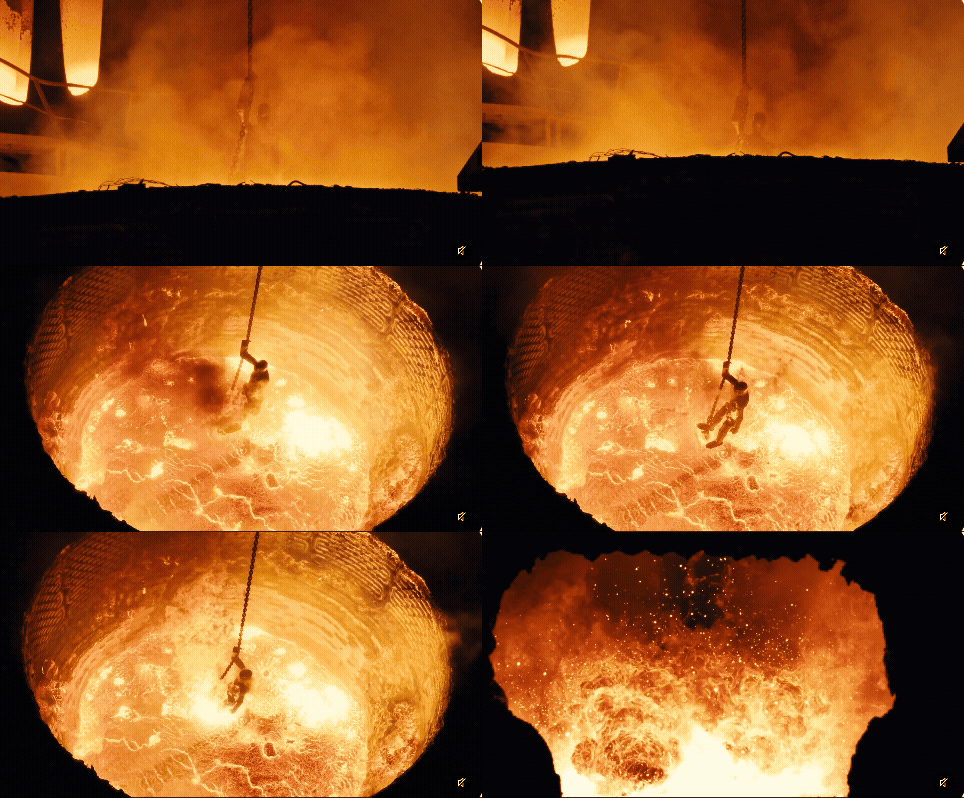
And that’s exactly what Figure AI did. It shipped them off in boxes to Finland, where a team and a 75-ton arc furnace were prepared to enable their demise.
There’s no way to describe it. You’ll have to see it for yourself…
Source: Figure AI
Figure AI went so far as to fly out Schwarzenegger to film him on site actually lowering Figure 02 into the molten steel. He even gave the robot a send-off with an expected “Hasta la vista, Figure 02.”
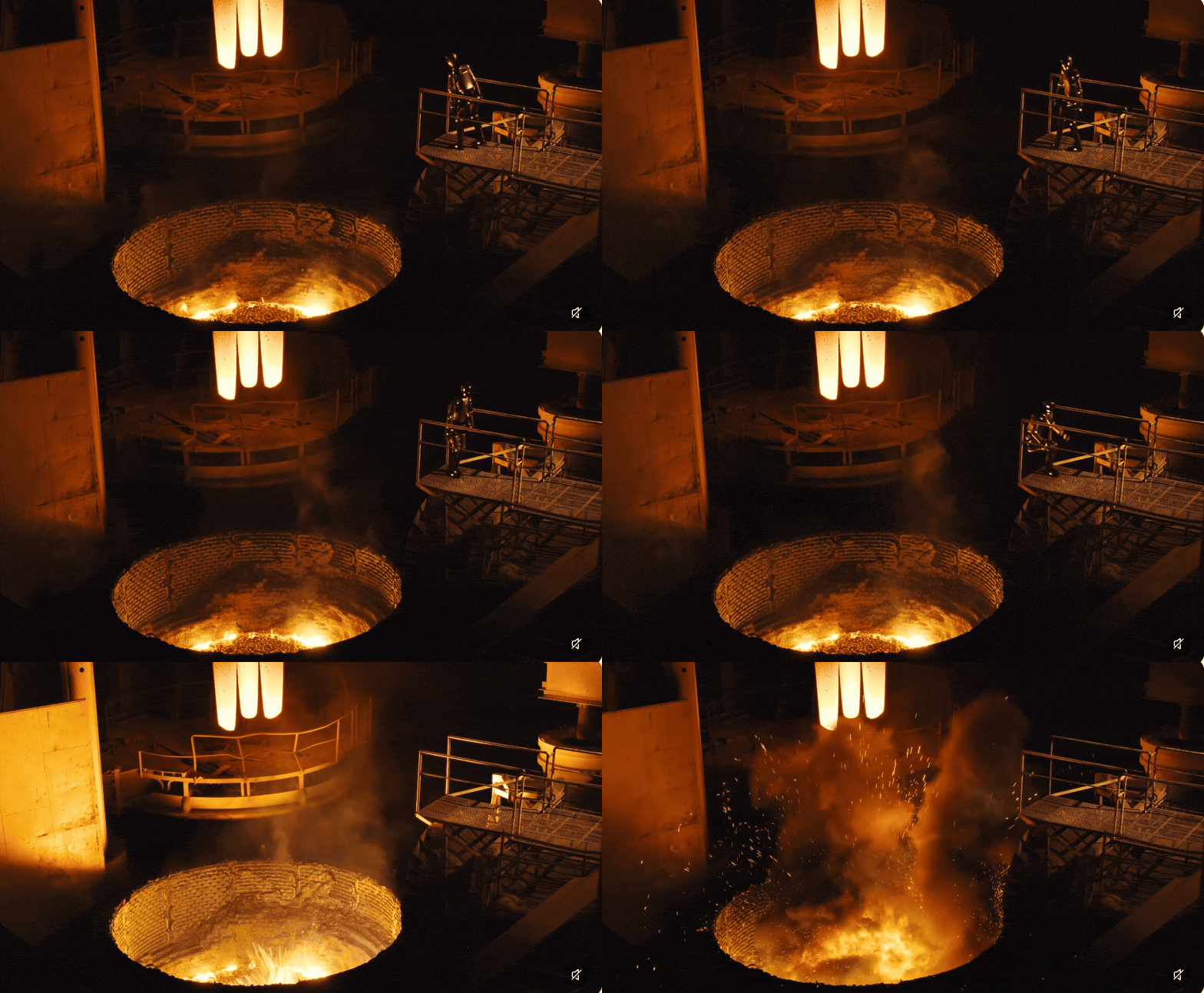
But the visuals became more difficult to watch after that. The next self-immolation was a Figure 02 standing on a precipice, peering over the edge into what was bubbling below. He then turned to leap back into the vat of molten steel.
Source: Figure AI
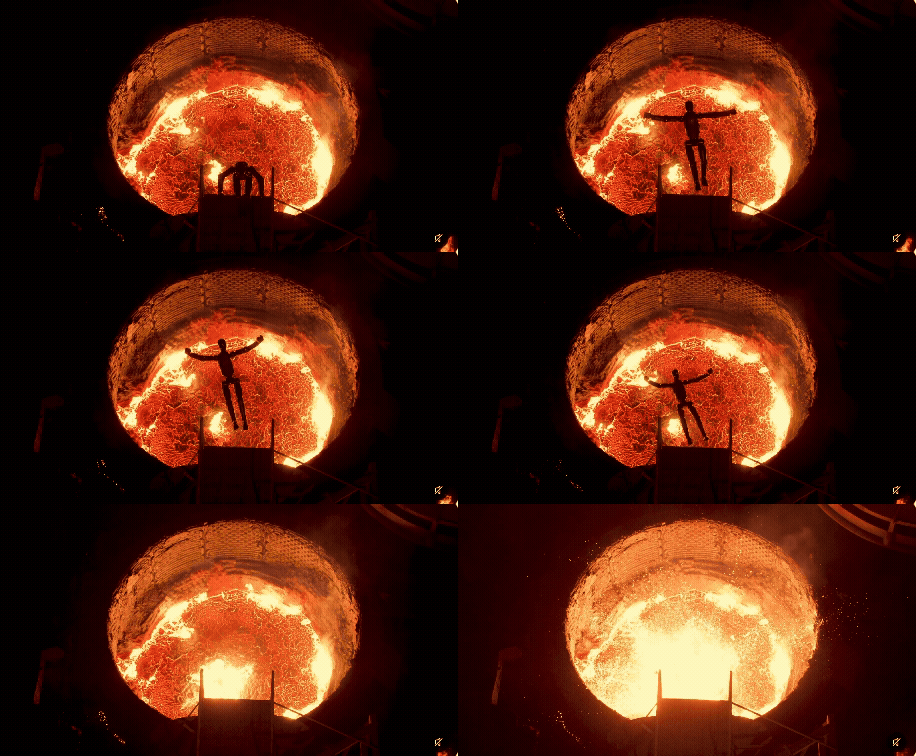
And then perhaps the most difficult to stomach, a Figure 02 backing up to the edge, leaning back, and ending it all in a fiery explosion upon impact.
Source: Figure AI
I don’t know about you, but I found watching this quite uncomfortable. These humanoids have humanlike movements now and are intelligent. It feels too close for comfort.
While we know that they are not sentient (yet), and they were in fact programmed to send themselves off to a fiery death, it still represents some form of end of life.
In product management, this is referred to as EOL. And for tech companies that make hardware, there is always a question of what to do with the prototypes when they are no longer useful.
Store them in a warehouse? Put a few in a museum (eventually)? Throw them in the trash?
In Figure AI’s case, it decided to melt them down… Terminator style.
But to what end?
Figure AI was actually making a pragmatic decision. The risk for Figure AI was for a bad actor to get ahold of a Figure 02 for industrial espionage.
It’s easy to forget about units that are hiding in a warehouse, which also means it is a lot easier for an agent to appropriate one – perhaps an agent of China – for the purpose of reverse engineering the hardware and software.
So, melting the Figure 02 population down to metal was the easiest way to destroy the intellectual property, avoid it falling into a competitor’s hands, and eliminate the labor cost associated with tearing them down.
And while we all know that Figure 02 wasn’t alive, at the pace of development that we are seeing right now, it won’t be long before we’re having discussions around consciousness and sentience, and whether or not we need to decommission robots that are not aligned or have gone rogue.
That feeling when watching a Figure 02 leap to its own “death” is just a tinge of what we’ll be grappling with as the humanoids become more intelligent and more central to our lives.

The last four times this secret market cycle played out, you could have turned $1,000 into $1.6 million during the first cycle in 2011… More than $1.8 million in the second cycle in 2015… More than $680,000 in the third cycle… And more than $1.7 million in the last cycle in late 2022. It’s happening again by the end of October, so click here to RSVP to Jeff Brown’s The October Million-Dollar Cycle special event.

That’s when billions of dollars could begin moving into one overlooked corner of the AI boom. As that money moves, Larry Benedict believes it could create your next chance to profit. Get the ticker he is watching before December 9.

Bitcoin is facing its toughest technical test yet: the price at which it opened the year.
Moving above this level would put Bitcoin in positive territory for the year.
And the asset might get help from a surprising place… perhaps as soon as tomorrow.
But first let’s look at the yearly open.
In recent weeks you’ve likely noticed the Bitcoin rally has cooled. And every time Bitcoin attempts to break out above $87,000, it has ended up quickly retreating.
This is no coincidence. The $87,000 level is where Bitcoin began trading to start the year. That makes it important, and stubborn, technical resistance.
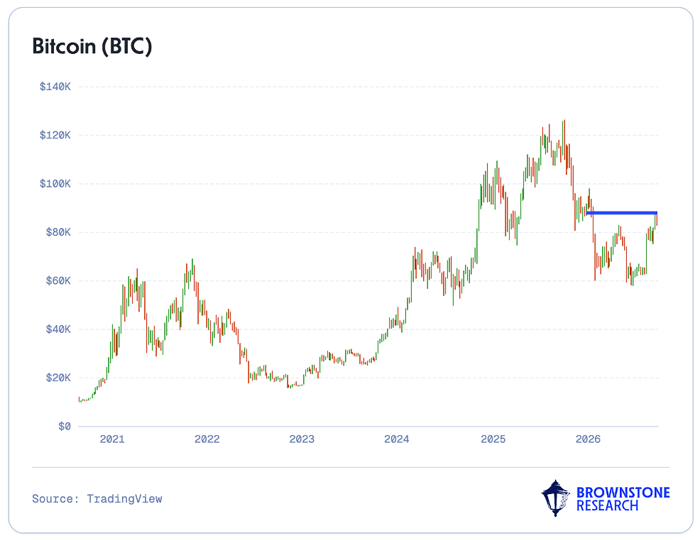
There have been positive catalysts in recent weeks…
The SEC and CFTC have been aggressively pursuing regulatory guidance over the last month. This came on the heels of the CLARITY Act failing to pass the Senate. Their guidance reinvigorated the market.
But the yearly open has continued to hold.
In the immediate term, we should expect to see continued consolidation below the yearly open until the market finds its next catalyst.
So, what could that catalyst be?
In yesterday’s Chain of Thought, I showed why the Fed’s balance sheet acts as a liquidity spigot, a multiplier for Bitcoin during bullish periods. It’s a simple enough argument. An expanding Fed balance sheet injects liquidity into the system. All else equal, that capital chases assets and pushes prices higher, Bitcoin included.
Now, a second spigot is opening at the U.S. Treasury.
The Treasury has been running buyback operations, stepping into the market to purchase its own longer-dated bonds at auction. We covered this in Don’t Fight Bessent.
Which is why tomorrow’s 30-year Treasury auction is worth keeping an eye on.
This is the sector of the bond market that forced Bessent to intervene back in August. Put simply, demand for long-dated U.S. debt was tepid. So, the Treasury Department had to buy the bonds itself.
September reversed this trend.
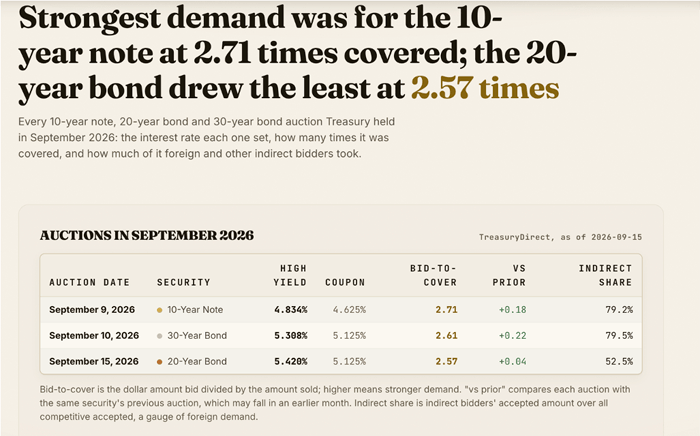
As we’ll see below, yields are trading at levels not seen since the early 2000s. That seems to have done the trick. Demand came in strong for long-dated bonds and drew the best bid-to-cover ratio in months.
Source: thevaultreport.com
The bid-to-cover ratio is the total amount of bids divided by the amount of debt sold. September’s 2.61 means buyers wanted $2.61 of bonds for every $1 available. If the bid-to-cover drops, that’s a possible sign that Bessent needs to intervene more.
Another metric worth watching is the indirect share. This is how we measure the strength of demand at auction. The lower the figure, the more that primary dealers need to step up and absorb the auction. Last month’s 79.5% is a strong showing.
The question will be whether that demand holds.
Bid-to-cover and indirect share are two of the metrics that we’ll have our eye on at Thursday’s auction.
And if any of those metrics suggest that demand is soft, then we’ll wait to see if the Treasury restarts its buyback machine. So far, those buyback operations have been small in the context of the overall Treasury market. But reports have indicated Bessent could tap the nearly $1 trillion Treasury General Account to fund more buybacks.
That’s a liquidity bazooka. It hasn’t been fired yet. But that doesn’t mean it’s not loaded.

A much cooler-than-expected consumer inflation report should’ve provided some relief… but bonds can’t seem to catch a break.
The Personal Consumption Expenditures (PCE) price index is closely watched since it’s the Federal Reserve’s preferred inflation gauge. PCE inflation for the month of August came in at 3.4% versus expectations for 3.7%.
That should’ve come as a relief to investors looking for any signs of slowing inflation. But bonds continued their sell-off anyway.
Following the report, the 10-year Treasury yield jumped as high as 5.29% – the highest level since 2002. The 30-year Treasury rate topped 5.64%, which is a level not seen since 2001.
But just when it looks like yields can do nothing but soar, signs are growing that the move is overdone.
High energy prices, rising inflation, large government budget deficits, rising corporate debt issuance…
The catalysts driving higher interest rates keep stacking up.
That’s pushing longer-dated bond yields out of a chart pattern that warned of higher interest rates.
Look at this chart of the 30-year Treasury yield…
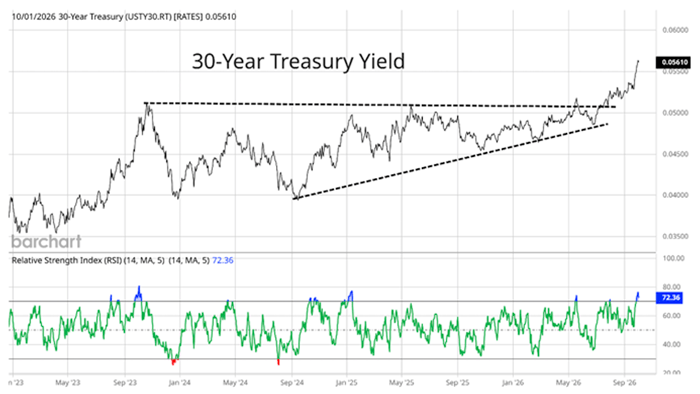
The 30-year formed an ascending triangle pattern over a period stretching back to 2023. The pattern is characterized by a resistance level that keeps being tested while higher lows are formed along the way.
Ascending triangles usually break out to the upside, which is exactly what happened when the 30-year yield pushed above 5%.
That breakout has sparked a big move in rates, with the 30-year yield rising as high as 5.64%.
Remember that bond prices move opposite to yields, so bond prices are selling off as rates move higher.
But the move in one ETF tracking longer-dated bond prices looks like it’s overdone, which could set up a mean-reversion trading opportunity.
Take a look at the chart below of the iShares 20+ Year Treasury Bond ETF (TLT) that tracks long-term bond prices.
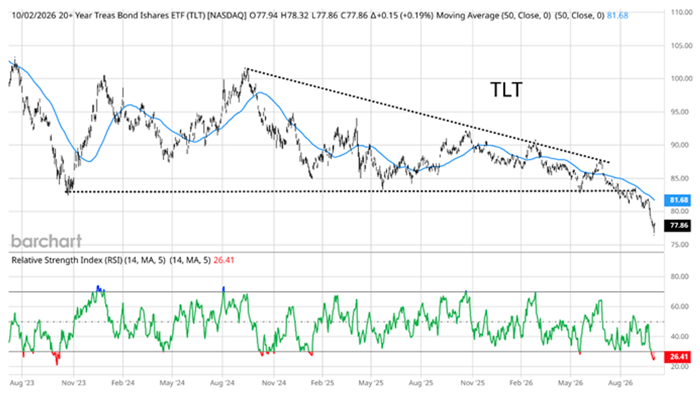
As the 30-year yield kept testing resistance near the 5% level noted above, TLT was testing support at the $83 level (lower dashed line).
Following the breakout in yields, TLT fell below that support level. But now TLT is showing signs of being extremely extended to the downside, which could set up a reversal higher.
Price is extended 5% below the 50-day moving average (MA – blue line). The Relative Strength Index (RSI) also fell to 24 – the most oversold level in three years.
The reasons driving a quick rise in interest rates aren’t going away anytime soon. But bond yields won’t keep rising in a straight line forever.
For now, the jump in yields and corresponding sell-off in bond prices look ready to reverse.
Add Brownstone Research as your preferred source on Google to see our latest stories in your feed.
 Add as a preferred source
Read the latest insights from the world of high technology.
The index never felt the cold. The market underneath took all of it.

The bond market quickly caught on that the PCE numbers could’ve been fudged...

That deadline still looms large, and if China says yes to those export controls, metals supply in America and...