




Market Lows Are Rarely Clean
Stocks were climbing out of bear territory, but then the bond market spoke up.



Fortunately for Bessent, there’s one group of buyers with a voracious appetite for short-term U.S. debt.
Editor’s Note: Tonight’s the night…
At 8 p.m. ET, Jeff Brown is going live with his October Million-Dollar Cycle strategy session…
He’ll get into all the details of this cycle that occurs every four years like clockwork… yet still manages to fly under the radar of most investors. But for those who know what to watch for – and how to prepare – it represents a rare setup.
You can go here to sign up automatically.

If the reports are to be believed, you can say goodbye to the 20-year U.S. Treasury…
The latest news is that analysts now expect Treasury Secretary Scott Bessent to stop the sale of 20-year U.S. debt. At the same time, he’s expected to reduce auction sizes for other longer-dated bonds.
This is becoming a theme…
At last week’s auction for 30-year bonds, the Treasury deployed the full $6 billion of what it allows itself to spend on buybacks.
What this means is that the Treasury Department is actively draining long-dated bonds from the market through buybacks and fewer issuances. Why would Bessent do that?
The answer: He’s trying to get the long end of the curve under control.
You’ve likely seen that the yields attached to long-dated Treasurys have risen to multidecade highs. As I write, the 10-year Treasury yields about 5.2%. That’s up from around 4% this time last year.
Rising rates are a burden for the federal government, which ran a $2 trillion deficit for its most recent fiscal year. Climbing yields will only make the total debt pile, and the interest paid on it, more perilous. Bessent needs to get long-dated yields under control. And he needs to do it quickly.
By removing long-dated Treasurys from the system through the buyback program and fewer new issuances, the same demand will chase fewer assets. That means these bonds get a bid. And since the price and yield of Treasurys move inversely, rates should fall… and the federal government gets some breathing room.
But if the Treasury is issuing less debt on the long end, it’ll have to make it up with short-term bills. And fortunately for Bessent, there’s one group of buyers with a voracious appetite for short-term U.S. debt. That would be the issuers of stablecoins.
U.S. dollar stablecoins are backed by these short-term Treasurys, which are considered “cash equivalents.” That makes stablecoin issuers price-agnostic. The issuers don’t care what that debt costs or what it yields because they have to buy it whenever they issue stablecoins.
This is a relatively new phenomenon…
In one year, the stablecoin market grew from $172 billion in late 2024 to more than $300 billion by late 2025.
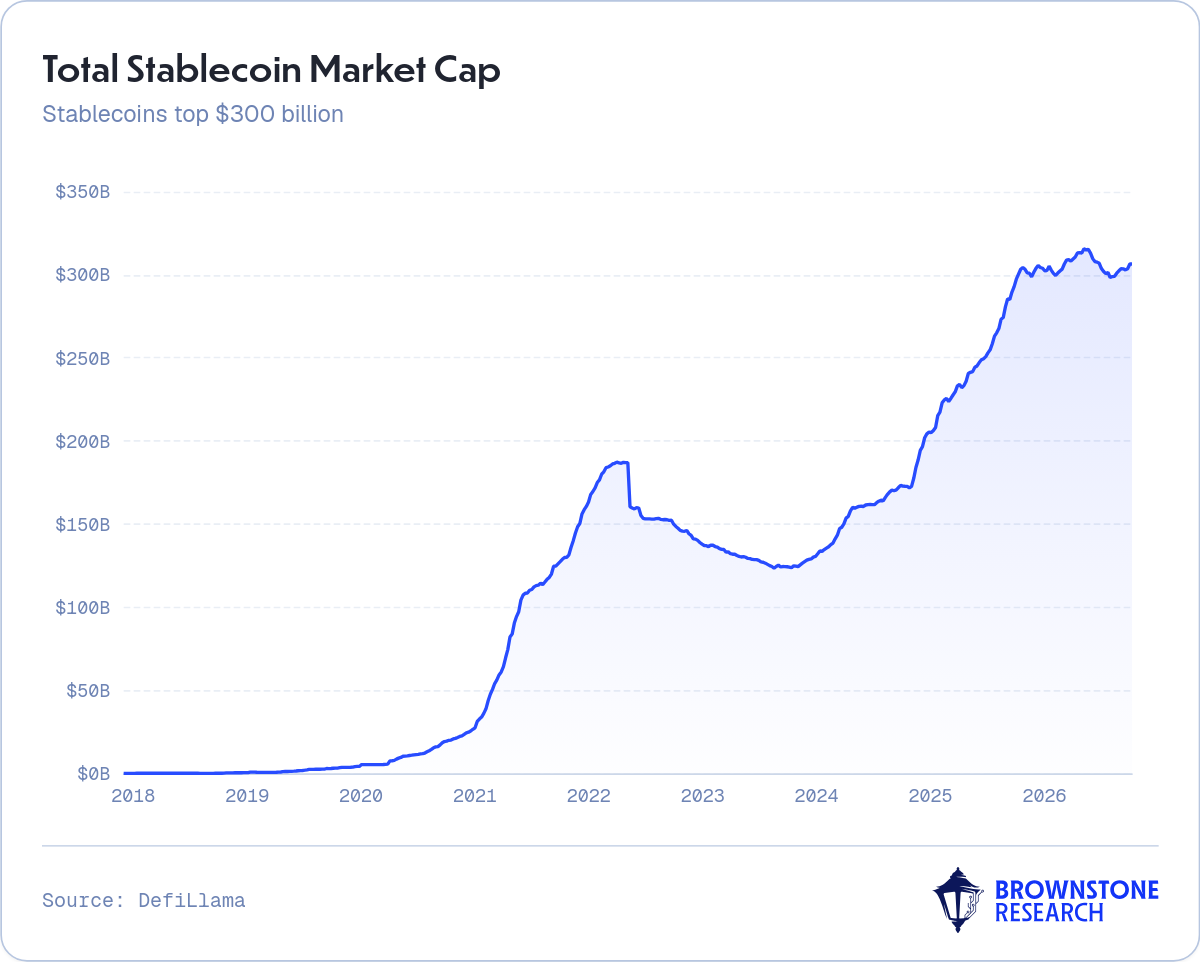
As a result, stablecoin issuers changed the market almost overnight.
The share of short-term Treasury auctions that primary dealers were forced to absorb ran at 25% to 35% from 2022 to mid-2024. Then from late 2024 into late 2025, it fell to 18% to 25%. That decline coincides precisely with the period when stablecoin growth went vertical on the heels of the GENIUS Act.
This is a big reason why the tokenization of assets will only accelerate. As these assets move onto public, permissionless blockchains, they will need liquidity to trade against. That means more stablecoins. And that means more demand for U.S. debt.
When it comes to tokenization, maybe the Trump administration believes in the benefits to investors. But the government definitely believes in the benefits to the Treasury market.
Onchain we go…

Record AI debt. Rising rates. Stalled data centers. Wall Street firms are backing away. Tomorrow, October 15, Marc Chaikin and Joe Austin will reveal why the AI boom now resembles the 2008 crisis – and the exact steps to take now during the "AI in Crisis" event. Sign up today

It happens about every four years (not elections)... and every single time, without exception… It has created some of the biggest millionaire making opportunities in history. It’s happening again by the end of this month. Which is why Jeff Brown will give you all the details TONIGHT, October 14, at 8 p.m. ET. Click here to save your seat for The October Million-Dollar Cycle.

This week has a packed economic calendar and several events that could easily swing the market.
The biggest focus will be on inflation, with September’s Consumer Price Index (CPI) later this morning, followed by the Producer Price Index (PPI) tomorrow.
After August’s 3.4% CPI reading, markets are expecting headline inflation to accelerate to 3.7%, with month-over-month inflation rising from 0.4% in August to 0.6%. The major factor driving those higher expectations is rising energy prices.
Any upward surprise could ignite concerns that the Federal Reserve will need to keep raising rates to bring inflation back under control.
Thursday’s PPI report will provide another important clue on the inflation front – in particular, whether businesses are facing higher costs. Because ultimately, if they can’t absorb those increases, they will pass them on to consumers.
Markets are currently pricing in about a 24% chance of a 25-basis-point rate hike later this month. That jumps to around 70% for a 25-basis-point hike in December.
That will have folks tuning in to hear Federal Reserve Chair Kevin Warsh when he participates in an International Monetary Fund discussion on Thursday evening. Although the odds will likely remain relatively slim for an October hike, any major surprises in the inflation data or Warsh’s comments have the potential to unsettle the market.
Another key area to watch is the Treasury market.
Last week, the U.S. 10-year Treasury yield pushed as high as 5.36% before pulling back to around 5.24% by week’s end. If inflation comes in hotter than expected, another jump in yields could put renewed pressure on stocks and the major indexes.
With so many potential catalysts packed into a handful of days, we could see some sharp moves as traders digest new information and reassess the outlook for interest rates and implications of corporate earnings.

If you’re trying to buy a house right now, good luck…
Freddie Mac’s weekly survey shows the average 30-year fixed mortgage rate at 7.4%, which is up from 6.3% at this time last year. That’s an increase of 110 basis points in 12 months… which is a big move for mortgage rates.
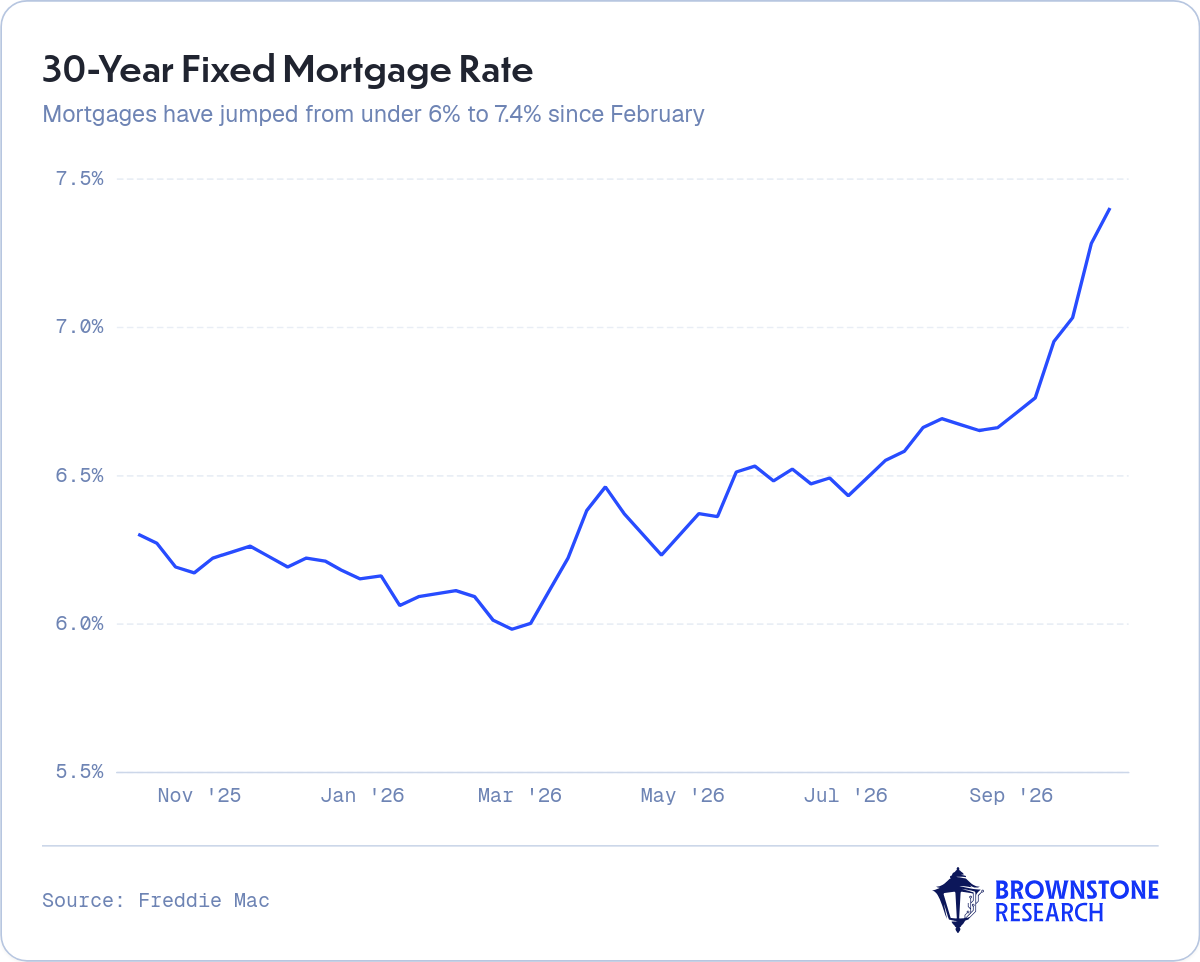
For context, Freddie Mac is formally the Federal Home Loan Mortgage Corporation. It is a government-sponsored enterprise that Congress created to keep money flowing into the housing market. The company buys mortgages from banks and other lenders, bundles them into securities for investors, and guarantees them.
When we see the weekly survey show an increase this strong, the usual instinct is to look for a housing-specific cause. Maybe it’s bank pricing, credit spreads, or a tightening at the government-backed mortgage agencies themselves. But any of these explanations would result in a widening spread between mortgages and long-dated Treasurys, which hasn’t happened.
That means the rising mortgage rates we see today are almost entirely caused by a rising 10-year Treasury yield. In fact, the 10-year Treasury rate has risen 109 basis points over the past 12 months.
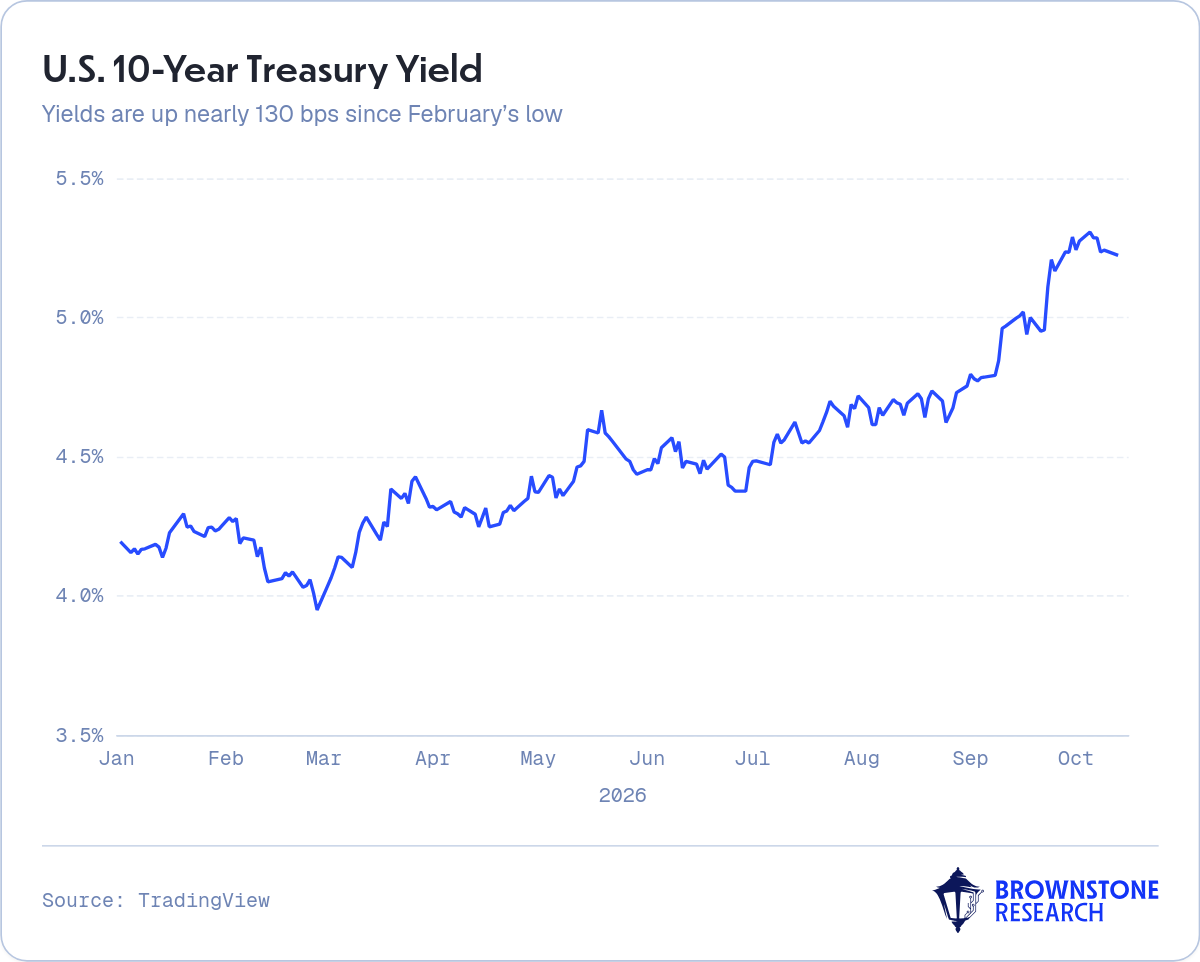
So, the spread between the 30-year fixed-rate mortgage and the 10-year Treasury rate has not materially changed. This tells us that rising mortgage rates are tied directly to what’s happening in the U.S. Treasury market. And that matters for policy.
If there were a housing-specific cause pushing mortgage rates higher, we might see the agencies adjusting their guarantee fees or engaging in outsized purchases of mortgage-backed securities (MBS).
And to be sure, the agencies have purchased tens of billions of dollars in MBS this year. But doing so did not push mortgage rates lower… because their current rise is directly tied to the 10-year Treasury.
We should also note that this isn’t the Federal Reserve’s (the Fed’s) fault… because the Fed controls only short-term interest rates. Case in point – when the Fed raised its target rate by 25 basis points last month, the 10-year Treasury rate actually fell by 7 basis points.
The takeaway is that housing affordability is now a function of the Treasury market’s appetite for long-duration debt. Any scenario for a housing revival has to start with a lower 10-year Treasury yield… and there are no policy gimmicks capable of creating a shortcut.
It’s a good reminder that these yields have a big impact beyond just the Treasury market. And right now, the future of the housing market is being determined by the bond traders.
Add Brownstone Research as your preferred source on Google to see our latest stories in your feed.
 Add as a preferred source
Read the latest insights from the world of high technology.
Stocks were climbing out of bear territory, but then the bond market spoke up.

These factories will cost billions before even a single working chip is produced…

This is just a tinge of what we’ll be grappling with as the humanoids become more intelligent and more...