



Bessent Finds His Buyer
Fortunately for Bessent, there’s one group of buyers with a voracious appetite for short-term U.S. debt.



Bessent appears to be picking up the quantitative easing baton from the Fed. And so far, it doesn’t seem to be working.

Editor’s Note: Next Wednesday, our colleague – Market Wizard Larry Benedict – is holding an emergency briefing…
He says money has started leaving the AI giants that dominate millions of retirement accounts… and folks whose retirement remains tied to those former leaders while the new winners rise elsewhere may be in for a retirement reset.
But he also has his eye on the one ticker that could stand to benefit as more than $1 trillion starts to move… And he believes it could become the first major opportunity of what he’s calling the “AI Retirement Reset.” He’s explaining everything next Wednesday, August 26, at 8 p.m. ET. You can go here to sign up.
Treasury Secretary Scott Bessent calls himself “America’s top bond salesman.” Increasingly, he’s also America’s top bond trader.
Bessent is no stranger to orchestrating massive macro trades. He worked for George Soros and helped orchestrate Soros’ famous bet against the British pound in 1992 that netted $1 billion in profits.
Bessent also has some experience trading the yen. Over a decade ago, he helped Soros structure a bet against the yen that generated another billion-dollar payday.
Bessent also ran his own hedge fund after leaving Soros, where he continued trading currencies and other assets sensitive to the macro landscape, such as U.S. Treasury securities.
In other words, Bessent is no stranger to playing in the biggest markets in the world…and he’s bringing that experience in the form of policy actions for the Trump administration.
We’ve already seen that unfolding in currency markets, where Bessent has led interventions to manipulate the value of the Argentine peso and, more recently, the Japanese yen.
But Bessent’s latest trade might be the most consequential of all…especially if it doesn’t work.
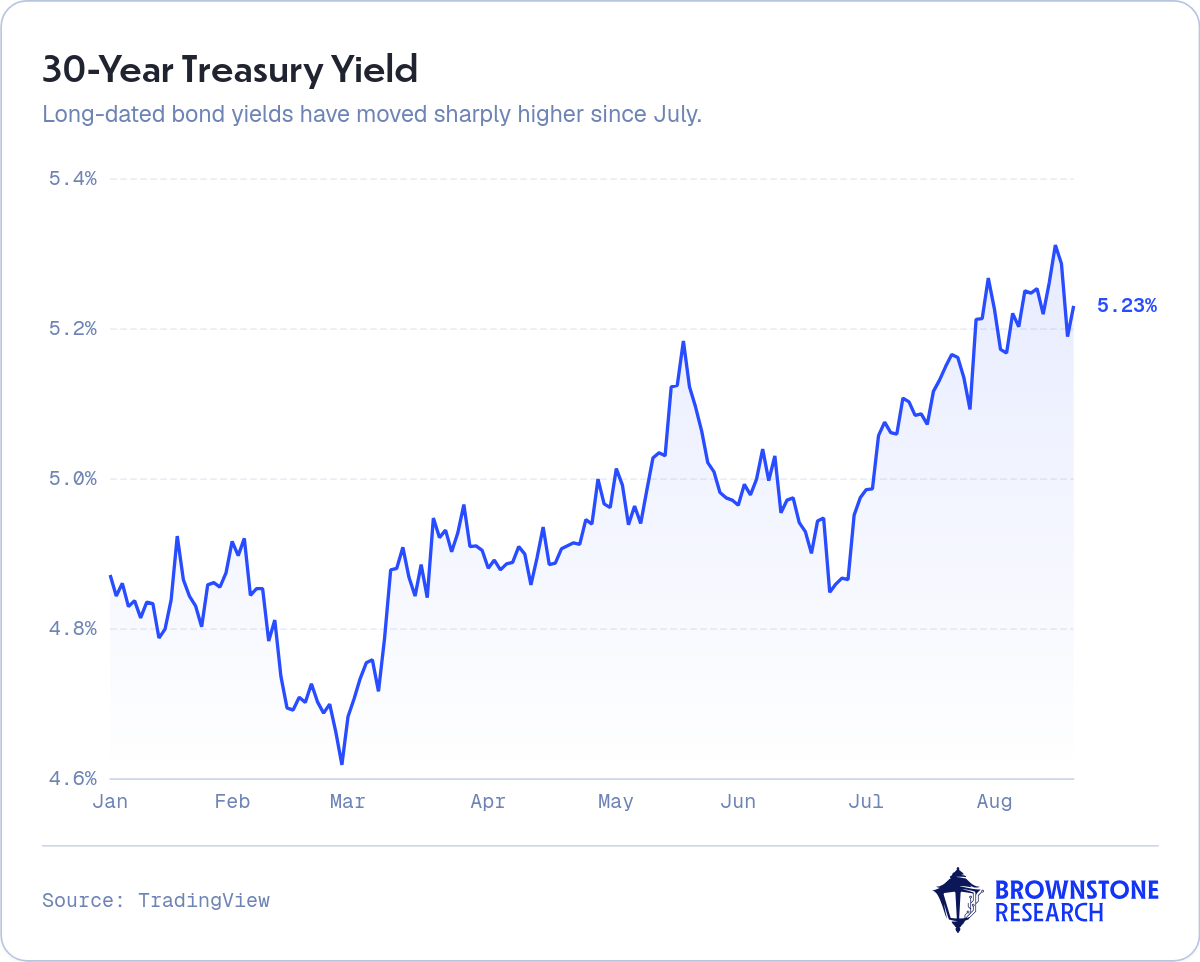
Just one day after the U.S. 30-year bond yield hit a 19-year high, the Treasury announced that it would double purchases of long-duration debt to at least $4 billion under an existing buyback program.
While the Treasury said the increase in the buyback was to provide greater liquidity in long-term debt, the real reason is to ward off the storm of higher rates.
Rising rates affect borrowing costs for everyone from the federal government to households and businesses. But for the federal government specifically, even small moves in interest rates can mean billions of dollars.
So far this fiscal year—which runs from Oct. 1 through Sept. 30—the federal deficit stands at $1.79 trillion. That’s money not covered by federal revenue…that had to be papered over with more debt.
Last month, the 30-year Treasury carried a yield of about 4.8%. Applied to that $1.79 trillion figure, it comes to about $85.9 billion in interest. But long-term bond yields have risen to about 5.2% as I write. Financed at that rate, the interest expense to the deficit is around $93 billion.
This example assumes the deficit is financed entirely with 30-year debt, which it isn’t. The deficit is financed with a mix of maturities, but the numbers are still staggering.
Net interest payments on the U.S. federal debt are projected to reach over $1 trillion annually for the first time ever. Rising interest rates aren’t going to help matters.
That, in a nutshell, is why Bessent is trying to tamp down on rates.
But the increase in the buyback is more symbolic than anything…$4 billion is nothing compared to the size of the U.S. public debt market. Like I said, the debt just crossed the $40 trillion threshold.
If this sounds familiar, that’s because the Federal Reserve has been pulling a similar maneuver—off and on—since 2008. It’s called “quantitative easing.”
Bessent’s moves aren’t technically quantitative easing. The proper term would be “yield curve control.” But it amounts to the same thing: An attempt to force down rates.
Traders sniffed this out, and it sparked big moves across the market, particularly in assets sensitive to the outlook for liquidity and the money supply. Gold prices jumped 4.3% following the announcement while Bitcoin surged nearly 7%. The U.S. dollar saw a sharp pullback against other currencies, including the euro and yen.
While big moves look to be underway, the intended target isn’t feeling the impact.
The 30-year rate went from 5.28% before the buyback announcement to 5.19%. A day later, the 30-year was already back to 5.25%.
Bessent appears to be picking up the quantitative easing baton from the Fed. And so far, it doesn’t seem to be working.
While the intervention is sending shockwaves across the capital markets, longer-dated Treasury yields are already shaking off the surprise.
That means jitters over the impact of high interest rates aren’t going anywhere, and the jump in volatility across asset classes is just beginning.

Not all tokens are created equal.
Anthropic just proved it.
Tokens are small pieces of information an artificial intelligence model reads and generates. Every question we ask is broken into input tokens. And every answer the model produces is returned as output tokens.
AI companies generally charge customers based on how many tokens they use.
This makes tokens sound like a commodity. Put another way, any given token is just as good as the next. And many people believe that. But that’s far from reality.
Last month, the Chinese AI company behind an open-source model called “Kimi” lowered the price of using its model. U.S. technology stocks sold off as investors assumed the major U.S. AI labs would be forced into a race to the bottom.
But even after lowering its prices, Anthropic still charges more per token than Kimi. And customers are willing to pay that premium.
Why?
Because 1 million tokens from Kimi and 1 million tokens from Anthropic’s Claude may be identical in quantity and compute. But they are not equal in economic value.
A more capable model can write better code, complete a complex research project faster, or even solve a problem the cheaper model can’t.
For a company paying an engineer $200,000 a year, saving several hours of work can be worth hundreds or even thousands of dollars. In that situation, paying a few extra bucks for higher-quality tokens is more than worth it.
After all, customers aren’t really buying tokens. What they are buying is completed work.
That is why Anthropic can charge more than lower-cost competitors.
But here is where the story gets even more interesting… Anthropic has also been lowering the price of its own tokens.
Earlier versions of its flagship Opus model cost $15 per million input tokens and $75 per million output tokens. Newer versions cost just $5 and $25, respectively. That’s 67% less.
These reductions have been happening consistently for nearly four years. AI labs lower the prices of their older models by 10x a year. Here’s a chart showing ChatGPT token prices for various models.
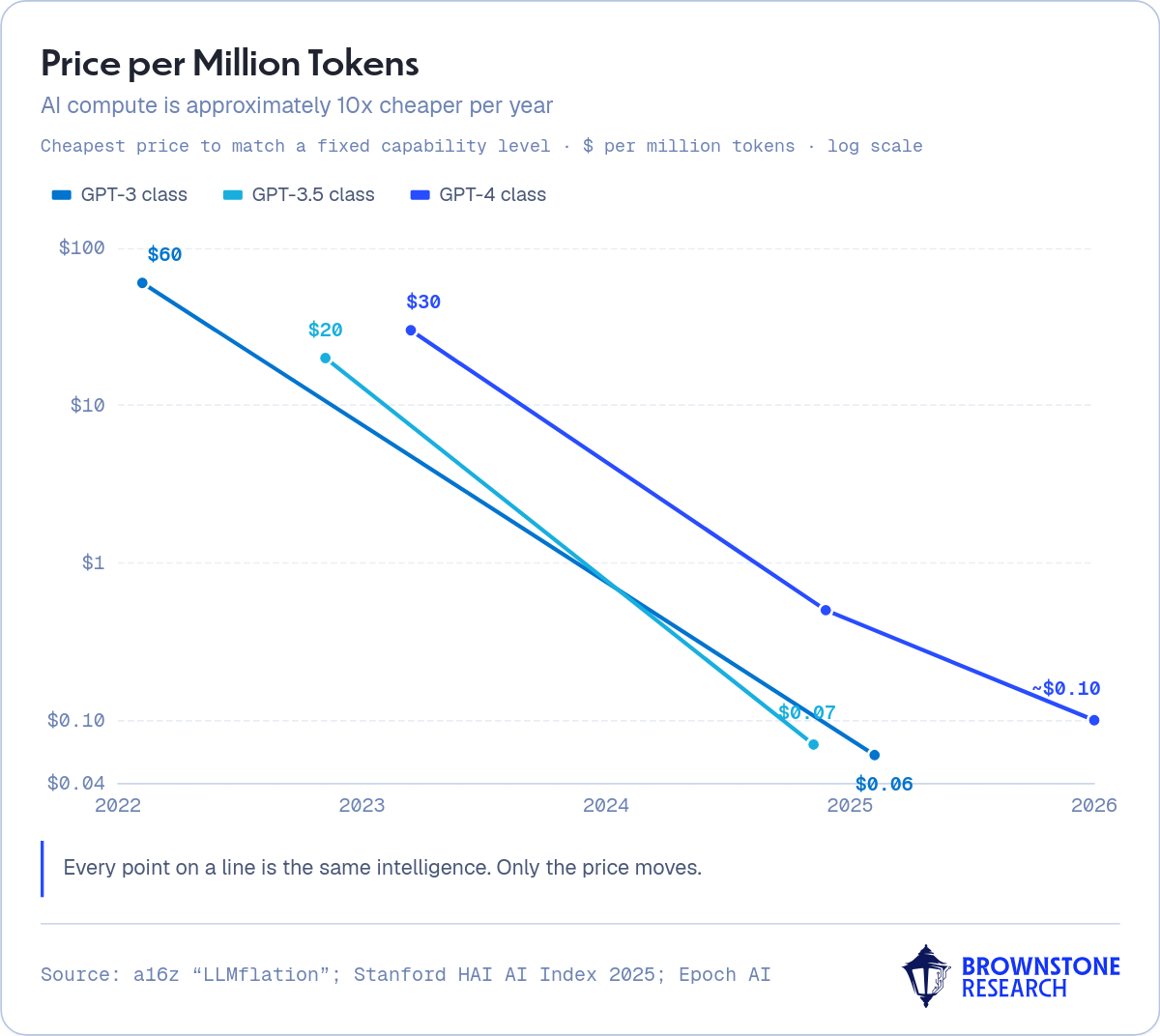
This is part of doing business for these labs. In fact, research firm SemiAnalysis projected that Anthropic’s margins increased as the cost per token declined even faster than pricing.
More efficient AI chips can produce far more tokens from the same amount of computing power. Better software keeps those chips operating at higher utilization. Techniques such as prompt caching also allow AI systems to reuse previous work rather than repeatedly calculating the same information.
It’s believed that Anthropic’s gross margin on inference—the money left after paying to generate its responses—rose from 38% to over 70%.
Preliminary figures show that Anthropic generated over $11.5 billion in revenue in its second quarter. That’s 14x more than the same quarter last year.
And its annualized recurring revenue—recent sales extrapolated over an entire year—surpassed $65 billion. And Anthropic backers expect that figure to breach $100 billion by the end of the year.
At 70% margin on $100 billion, that leaves it a lot of money to spend on additional compute.
And Anthropic was even able to raise its prices for tokens of its most capable model, Mythos. That’s just more evidence that not all tokens are created equal, and that customers are willing to pay up for access to more capable models.
We are beginning to see much of the value that AI creates accrue toward the AI labs. Being the largest, fastest-growing lab, Anthropic is capturing a large chunk of that economic value.
Precise numbers aren’t known at this moment, but they will be once Anthropic gets closer to its initial public offering (IPO). Part of that process requires detailed disclosures in an S-1 filing.
We are eagerly awaiting that filing. That will give us the clearest look at the economics of a frontier AI lab.

Last November, the U.S. Geological Survey (USGS) added a name to the Critical Minerals List, and I suspect most investors were surprised…
The Critical Minerals List was introduced as part of the Energy Act of 2020. As the name suggests, a critical mineral is any commodity that:
So, what metal does the USGS feel fits that definition?
It wasn’t a rare earth. It wasn’t copper.
It was silver.
We’re talking about the oldest monetary metal in the world, and the USGS classified it as strategically essential…
That’s for one reason: industry and electronics now rely on silver heavily.
Most people think of silver as just a monetary metal. But silver has been used in industrial applications as far back as the 19th century. However, that demand was historically marginal to the silver market…until recently.
Solar manufacturers are the largest industrial buyers of silver on the planet. The solar industry consumed 197.5 million ounces in 2024. That was roughly 30% of all industrial demand.
Naturally, this heavy demand makes the solar industry extremely sensitive to fluctuations in the silver price. So as silver soared from $31 an ounce in January 2025 to an all-time high north of $120 in January 2026, the solar industry began to adjust its engineering to require less silver.
And it worked.
Per the World Silver Survey 2026, photovoltaic silver demand is forecast at 151 million ounces this year. That’s down 23.5% from 2024 levels. And it’s 19% below 2025.
Thanks to the engineering adjustments, the solar industry eliminated nearly 36 million ounces of annual silver demand in just 12 months. That’s the largest single-year reduction in silver demand the industry has ever seen.
Given that the solar industry accounted for roughly 30% of annual industrial silver demand, and that solar demand fell by 19% this past year, one would expect total industrial demand to fall by nearly 6% annually. But it hasn’t.
The data shows that industrial silver demand has fallen only 3%—half of what the math suggests we should expect. And the reason for that is simple: silver demand related to the artificial intelligence (AI) infrastructure buildout is screaming higher.
Silver demand from AI data centers and all the associated hardware is now growing 15% to 25% annually, depending on which study we favor. And here’s the thing—the AI industry cannot engineer silver out of the equation as solar did.
In the AI buildout, silver sits in switchgear, power distribution, relay contacts, and chip packaging. It is the best electrical and thermal conductor of any metal, which is exactly why it cannot be replaced.
And from the industry’s perspective, the cost of silver pales in comparison to the cost of GPUs and all the advanced hardware that makes it all go. So, there is no incentive to thrift it.
Meanwhile, silver is set to run a supply deficit—meaning more silver is being consumed than produced—for the sixth consecutive year.
According to the Silver Institute, the market is projected to record a shortfall of roughly 46.3 million ounces in 2026. That’s slightly wider than the 40.3 million-ounce deficit recorded in 2025.
An investor still thinking of silver exclusively as a monetary metal has an outdated mindset. The industrial demand for the metal is becoming material thanks to the AI buildout. Combined with a long-running deficit, that could act as a tailwind for silver in the years ahead.
Add Brownstone Research as your preferred source on Google to see our latest stories in your feed.
 Add as a preferred source
Read the latest insights from the world of high technology.
Fortunately for Bessent, there’s one group of buyers with a voracious appetite for short-term U.S. debt.

Stocks were climbing out of bear territory, but then the bond market spoke up.

These factories will cost billions before even a single working chip is produced…