







Nvidia’s Not Done Yet
It was an amazing quarter from a company that has been defined by amazing quarters.
In this issue
01
Nvidia's Not Done Yet
Nick Rokke
02
The Dollar's Under Pressure. Here's Why
Larry Benedict
03
An Old-World Commodity Becomes Quietly Essential to AI Power
Dave Forest
Nvidia's Not Done Yet

Nick Rokke
Senior Analyst
On Wednesday, Nvidia (NVDA) reported earnings, and the company crushed it…
The world’s largest company beat expectations and raised its guidance. It was an amazing quarter from a company that has been defined by amazing quarters.
Revenue soared 106% from this quarter last year to $96.2 billion. This beat expectations by nearly $4 billion. And gross margins stayed at 75%, which allowed its earnings before interest, taxes, depreciation, and amortization (EBITDA) to grow to $65 billion.
Most of these results were thanks to data center revenue, which grew 117% to $89 billion. Nine out of every 10 dollars Nvidia generated came from the chips and infrastructure powering artificial intelligence.
Revenue from hyperscalers more than doubled. The growth rate from the smaller neoclouds, enterprises, industrial customers, and governments was even faster. That sector grew 138%.
This shows the customer base is broadening.
The reason for this is simple. AI is moving from experimentation into production. Chatbots were a great start that introduced AI to the masses. But the next generation of AI, agentic AI, will search databases, write software, manage workflows, and complete other complex tasks.
These jobs consume and generate far more tokens—the small pieces of data AI models process. And every token requires compute. As Nvidia CEO Jensen Huang said, “compute is revenue.”
And looking forward, Wall Street analysts expected Nvidia to grow revenue 45% next year. That would be an incredible feat for a company with a market capitalization of approximately $5 trillion. But Nvidia guided much higher. It said it expects to see revenue grow 70% next year.
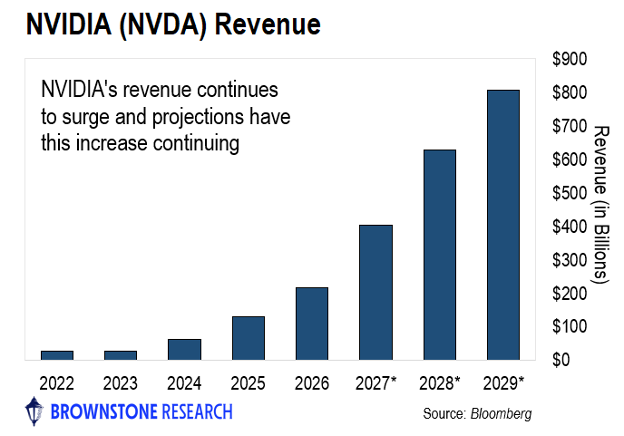
That means millions of GPUs and CPUs will get manufactured, installed, and powered up each year going forward.
And each of those chips going into data centers requires advanced memory, high-speed networking, semiconductor manufacturing equipment, power systems, cooling, and more.
Nvidia’s earnings show that demand remains strong across the entire AI infrastructure buildout. And demand is increasing even at these levels.
Many investors keep asking when the AI buildout will peak.
Nvidia says, “not yet.”
Recommended Links

IPO Insider Warns: “Avoid OpenAI and Anthropic’s IPOs! Until You See This”
IPO insider, Jason Bodner, reveals how ordinary investors could risk their retirement if they invest in OpenAI and Anthropic’s IPOs the wrong way. But if you make this one small change, you could potentially set up a six-figure nest egg. Click here to get all the details.

This Could Be Bigger than Robots and Self-Driving Cars
Forbes said that “investors who understand [this new AI application] stand to make a fortune.” It’s so powerful that it has been delivering gains big enough to turn $10,000 into up to $101,700… $151,600... and even a mind-blowing $650,000… All in a 24-hour period.
The Dollar's Under Pressure. Here's Why

Larry Benedict
Founder, The Opportunistic Trader
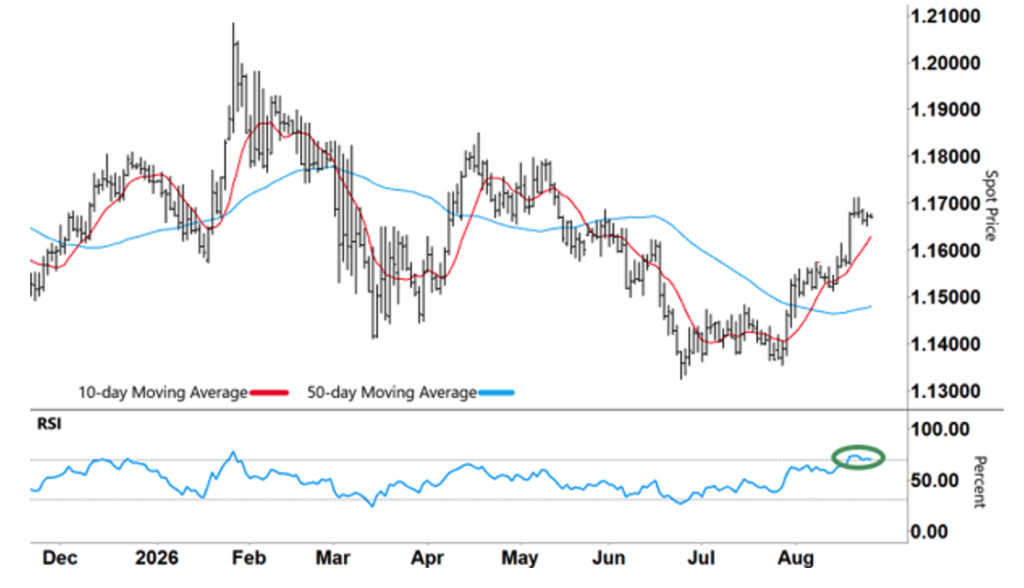
After breaking through the 1.16 level, EUR/USD pushed higher temporarily, trading above 1.17—its highest level since mid-May—before pulling back earlier this week. But it hasn’t been so much a story about a resurgent euro as it has been about weakness in the U.S. dollar (USD).
One of the major catalysts came on Wednesday last week. That’s when the U.S. Treasury announced that it would at least double the size of its buyback program for longer-dated bonds. That caught the market off guard and saw bond prices rise, causing Treasury yields to fall.
U.S. 30-year Treasury yields fell by around 10 basis points, hitting a 5.18% low on the day, with the 10-year dropping around seven basis points to back under 4.65%. Although they initially recovered much of that fall, they’ve since pulled back to around that same level.
That’s weighing on the USD. Lower yields reduce the relative attraction of U.S. assets to foreign investors, lowering demand for the USD. You can see how that played out in the chart of EUR/USD below:
Officially, the U.S. Treasury says that the buyback is designed to improve liquidity in the Treasury market—particularly by buying older and less-liquid securities. But there’s something else behind the move.
With the government facing refinancing requirements, higher long-term yields mean that maturing debt increasingly has to be replaced with more expensive new borrowings. Some investors interpreted the Treasury’s actions as an attempt to put downward pressure on yields and thus long-term borrowing costs.
That raised broader concerns around U.S. fiscal policy and added pressure on the USD.
At the same time, expectations around the Federal Reserve’s monetary policy have softened somewhat. Weaker employment numbers and relatively mild inflation readings have seen traders wind back expectations of a rate rise next month. But things remain very much up in the air.
Wednesday’s core Personal Consumption Expenditures (PCE) inflation print for July didn’t offer much clarity, either. Core prices rose 3.3% annually, in line with forecasts.
Of course, we can’t forget the other side of the currency equation.
Germany’s latest gross domestic product (GDP) print pointed to further economic recovery, while business confidence recently climbed to its highest level this year. Plus, persistent inflation pressures have kept the prospect of a European Central Bank rate rise on the table.
However, the pair’s rally this week has started to peter out. That comes with the Relative Strength Index (RSI) pushing into overbought territory (green circle). Any pullback in momentum or renewed strength in U.S. yields could see support quickly come back into the USD and push EUR/USD lower.
Plus, don’t forget that Fed Chair Kevin Warsh will deliver his first keynote address at the annual economic policy symposium at Jackson Hole today.
After the July Fed minutes revealed a hawkish debate inside the Fed—including concerns about inflation remaining well above target—currency markets will be searching every word from Warsh for clues about where rates could be headed next.
Surprises here could move expectations around rates. And that would directly flow into currencies.
An Old-World Commodity Becomes Quietly Essential to AI Power

Dave Forest
Senior Analyst
On February 25, 2021, Elon Musk created an entirely new tech metal.
This wasn’t some feat of alchemy. He didn’t come up with an entirely new substance out of thin air. Instead, he turned his attention to one of the world’s oldest industrial substances—phosphate rock.
When people think of phosphate rock (for those who ever bother to, anyway), they typically think of agriculture. As far back as the 1840s, American farmers used phosphorus won from phosphate rock to fertilize their crops. That led to large phosphate rock mining operations for fertilizer in states like Florida, Idaho, North Carolina, and Utah. Today, over 95% of phosphate mined in America goes to fertilizer and animal feed.
But, in 2021, Musk made boring old phosphate a key input into the batteries used in Tesla’s electric vehicles.
Up to that point, Tesla’s vehicle batteries used high-tech metals like nickel and cobalt. But that was a problem.
America has very little domestic mine production of either metal. Cobalt especially was a sore spot. The majority of global supply came from mines in Africa that were rife with accusations of poor working conditions, forced labor, and local exploitation.
Rather than staying reliant on sketchy suppliers, Musk made a bold move. He announced Tesla would phase out nickel and cobalt batteries—replacing them with a then little-known chemistry called LFP, or lithium-iron-phosphate (the F in LFP stands for “ferro,” derived from the Latin word for iron).
By 2022, the majority of Teslas rolling off the lines contained LFP batteries. Other EV makers followed suit, including Ford, Chevrolet, BYD, Kia, and Toyota.
The result is that, today, phosphate has gone from being the stodgy stuff used to grow corn to one of the most important components of the EV industry worldwide.
So far, so interesting. But what started as an input into EV batteries is now becoming quietly essential to powering AI data centers.
As I’m sure you’ve read, there are plenty of concerns around the power consumption of new data centers. In some locations, they can strain decades-old electric grids that simply weren’t built to handle this type of demand.
In June 2026, Tesla filed a trademark for a secretive new project called Megapod. The aim is to link proven LFP battery technology to an estimated 160,000 businesses across America that will potentially be looking for data center capacity in the next few years.
Megapod is a plug-and-play solution for companies looking to set up dedicated servers quickly and easily. It’s basically a premade data center that comes with ready-made computer servers, data processing hardware, network equipment, and power and cooling systems.
Think of it like a mobile home. Rather than pour concrete, erect framing, and slap up sheets of drywall, you simply get a premade unit delivered to the site. Hook it up, and you’re immediately ready to go.
One of the big advantages Tesla has in supplying premade data centers is batteries. Megapod will be powered by Tesla’s proven Megapack batteries, which the company already mass produces at its Lathrop, California, plant. These are batteries that all run on LFP technology.
Phosphate-driven LFP batteries went mainstream with Tesla vehicles. Now, with Megapod, phosphate could become one of the most sought-after tech fuels on the planet.
It’s just more evidence of AI-related demand showing up in unexpected corners of the resource markets.
More stories like this
Read the latest insights from the world of high technology.
-
-

Scientists Have Dreamed About This for Decades
This could mark an important turning point in the fight against cancer…
-
Quantitative Easing Is Back (Sorta)
Bessent appears to be picking up the quantitative easing baton from the Fed. And so far, it doesn’t seem...