




AI Is Hungry
The GPUs are being deployed in a timely manner. What isn’t arriving fast enough is the electricity to power...



The significance of what SpaceX is building cannot be overstated...


When you walk around SpaceX’s Starbase in Boca Chica, Texas, you get an immediate sense of the near future and the scale of what’s to come.
With two operational launch pads, the Gigabay—which can build up to 1,000 Starships a year—and the massive SpaceX (SPCX) offices, there is no question about how real the Gateway to Mars has become.
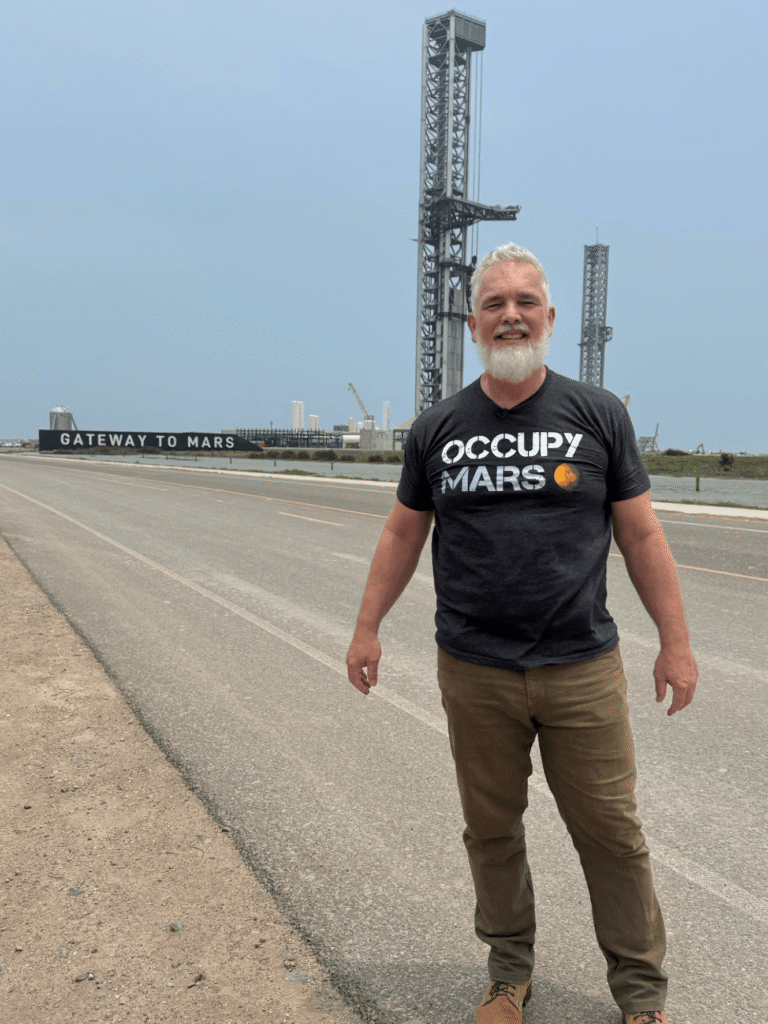
At the “Gateway to Mars,” SpaceX HQ | June 2026
But one other reality stuck out to me as I was standing just feet from one of the launch pads earlier this year…
There just isn’t enough space.
Starbase, Texas, is tucked into a tiny sliver of land with the “hard” border of Mexico directly south, the Gulf of America to the east, and the South Bay to the north. It’s currently about 1,000 acres.
And even though there is a little room for expansion, it would never be enough to support SpaceX’s operational plans to launch thousands of Starships a year by 2030.
That’s a mere four years away.
Expanding at Vandenberg Space Force Base in Santa Barbara County, California, or at Cape Canaveral, Florida, wasn’t possible either, which meant SpaceX would have to build a massive complex somewhere else.
Objectively, the options were limited.
SpaceX needed a location in the U.S. with enough acreage to support thousands of launches a year. It needed to be on the coast, as it is necessary to launch over water for safety purposes.
It had to be in a low-population area, and one that is geographically situated for southward trajectories that make launching payloads into orbit efficient. And ideally, the location must be near sources of energy, specifically natural gas.
Last week, we learned which location fit the bill.
SpaceX announced Starbase Louisiana—a breathtaking undertaking to build the world’s largest spaceport. It won’t even be close.

Rendering of Starbase Louisiana | Source: SpaceX
SpaceX announced that it will be investing $100 billion to build Starbase Louisiana in Vermilion Parish—specifically on Pecan Island—with southern exposure to the Gulf of America.
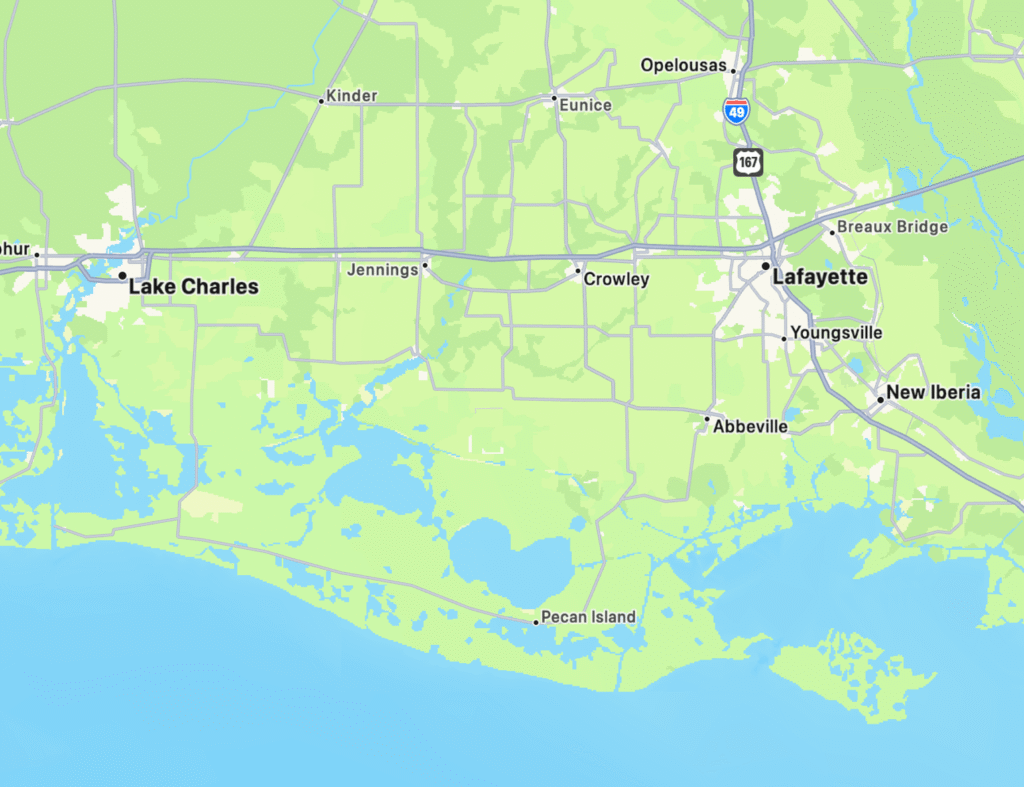
Pecan Island, Louisiana
This location is particularly interesting, given the strong natural gas infrastructure that Louisiana is well known for. Most don’t realize this, but SpaceX’s rockets are fueled by natural gas. More specifically, SpaceX processes natural gas through a liquefaction process to produce super-chilled liquid methane—the principal propellant for SpaceX rockets.
The combination of liquid methane and liquid oxygen in a high-pressure combustion chamber creates a chemical reaction, which produces the thrust to get the Starship into orbit.
The significance of what SpaceX is building cannot be overstated. The goal is a completely self-sustaining spaceport.
SpaceX will produce its own propellant on-site and generate its own power using natural gas. SpaceX will also have its own deep-water shipping port, as well as an even larger Starship manufacturing facility than its Gigabay at Starbase, Texas.
Perhaps they will call it a Terabay?
Either way, it will need to have the capability to manufacture more than 1,000 Starships a year to meet its launch cadence objectives.
Yes, SpaceX will be burning through cash making the absolutely massive capital investments needed to achieve more than 1,000 Starship launches a year.
But given SpaceX’s demonstrated ability to execute better than any other aerospace company in history—and the already impressive scale of SpaceX’s business with artificial intelligence, Starlink, and its launch services—Musk will have no trouble at all raising additional capital to enable his vision of making the human race a multi-planetary species.

One number stands between Bitcoin and a new bull market—approximately $80,300.
It’s not random. It’s the 50-week moving average.
What this moving average captures is BTC’s average price over the course of the preceding year. When BTC’s price is above it, the asset—and thus the crypto market—is trending bullish. When price breaks below it, as it did last November, sellers are in control.
As the chart below shows, the significance of this moving average is hard to overstate…
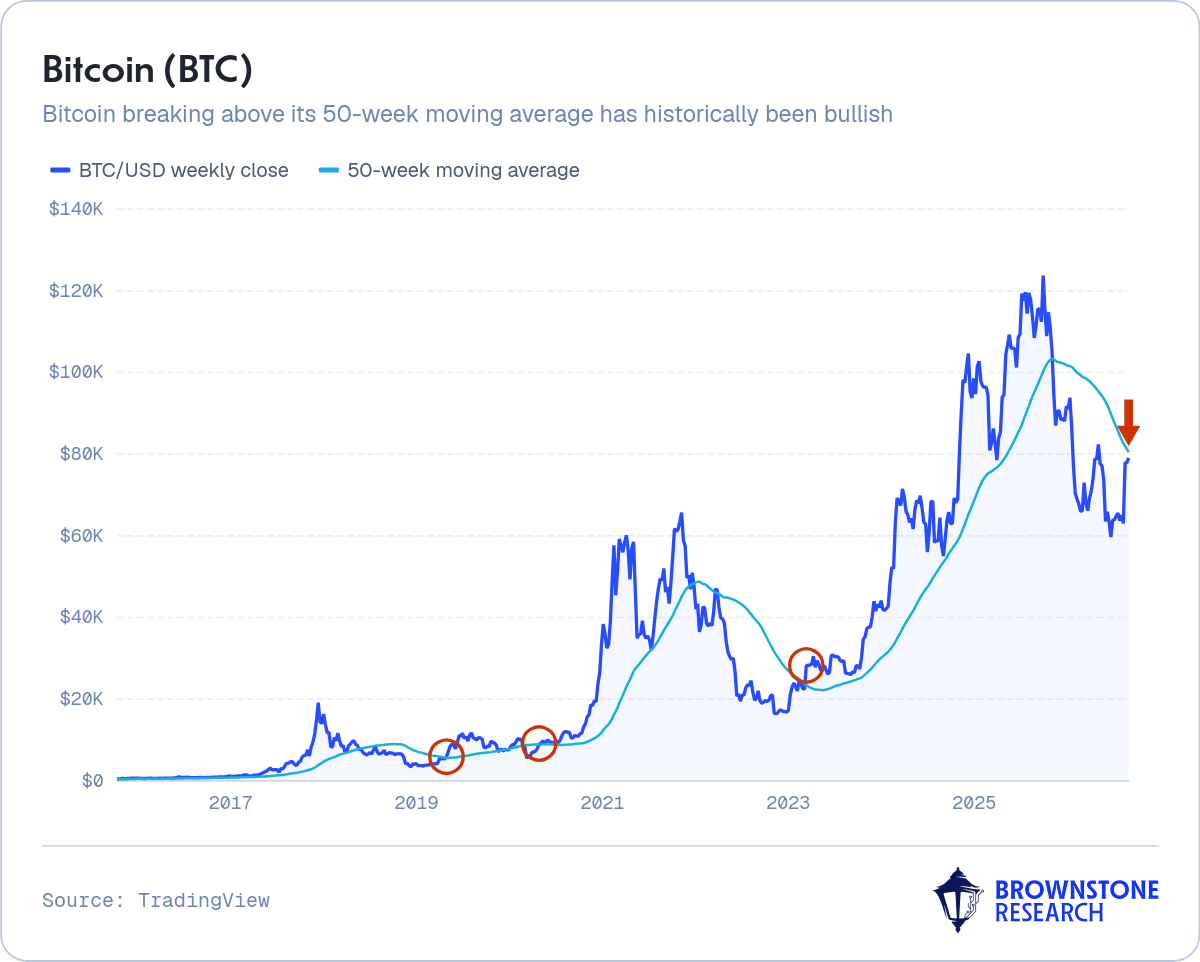
The 50-week moving average has historically been a perfect predictor of forward trends and parabolic rallies. Those circled areas show us the last three times BTC managed to break above it on a weekly basis.
The returns following those breakouts were as follows:
If we average out these three previous instances, we get an average return of 387% in about 11 months.
Should BTC break out above its moving average and follow that pattern, it would imply a high over $300,000 by the fourth quarter of 2027.
That may seem improbable and hyperbolic now. But history tells us that’s exactly the sort of price action we can expect to see if the breakout manifests.
There are other reasons to be bullish on Bitcoin right now.
From BTC’s power-law bottom, to the options market skew, to the lower-time-frame technical breakout we charted here a couple of weeks back, positive catalysts are building.
August’s move from $60,000 to $80,000 could be just the beginning.
It also tells us that if BTC begins registering consecutive weekly closes above $80,000 in September, the volatility compression we outlined last week won’t last much longer…
We’ll be watching closely.

For years, it was rough sailing for the biotechnology industry…
All equities are influenced by interest rates. But early-stage biotechnology companies can be hit especially hard. When interest rates rise, it makes these biotech companies—which typically won’t realize revenue or cash flow for years—less appealing to investors.
So, when rates started to rise dramatically in 2022, the entire industry suffered. As measured by the State Street SPDR S&P Biotech ETF (XBI), biotech stocks fell approximately 65% from the March 2021 peak to the 2022 lows.
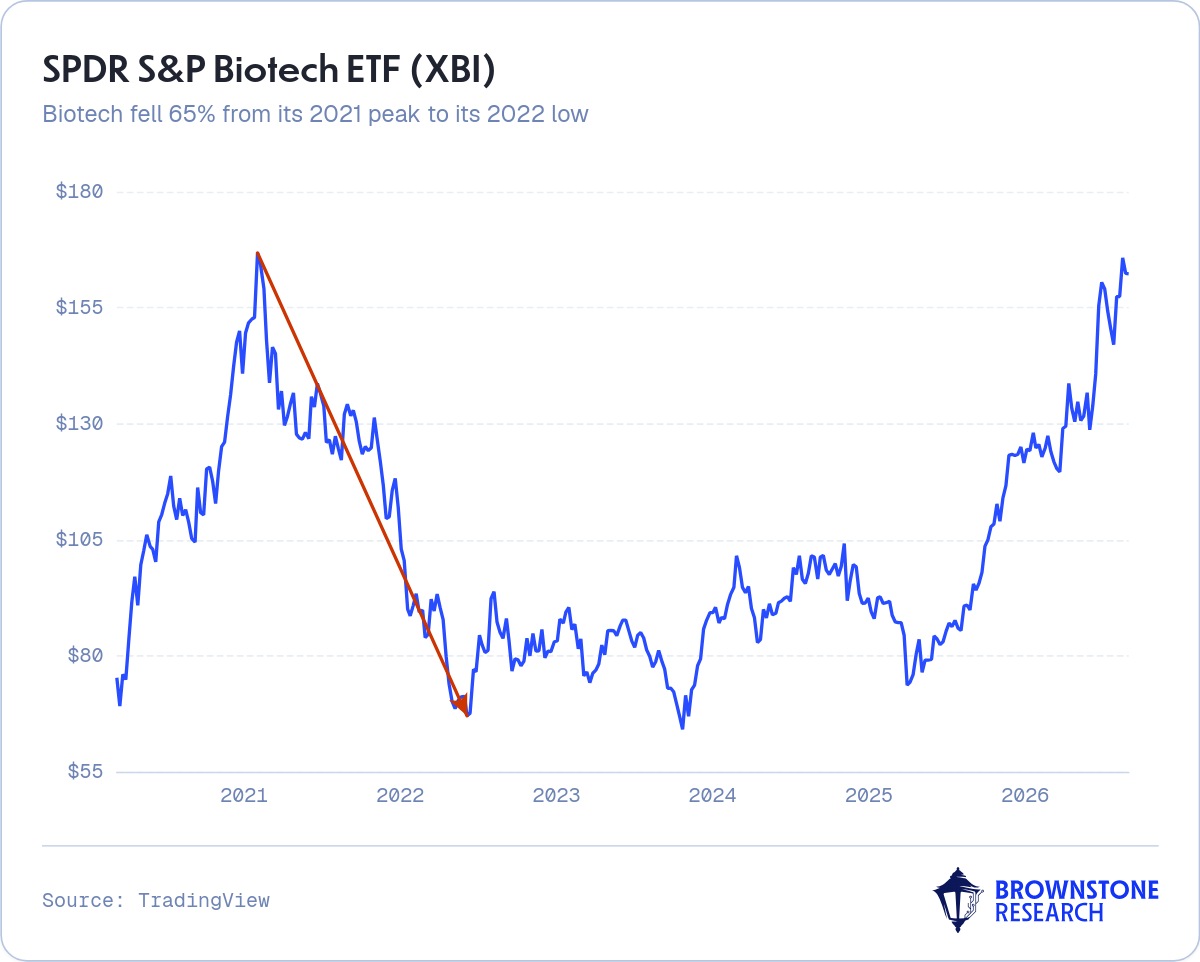
Obviously, biotech companies would prefer to not go public in that type of environment. So, biotech IPOs dried up.
But the chart above shows something else…
The biotech sector has come roaring back, with the XBI rallying approximately 78% over the last 12 months. And that newfound bullishness is leading to more biotech debuts.
Not only are more biotech companies going public, but they are also raising larger amounts of money. See for yourself:
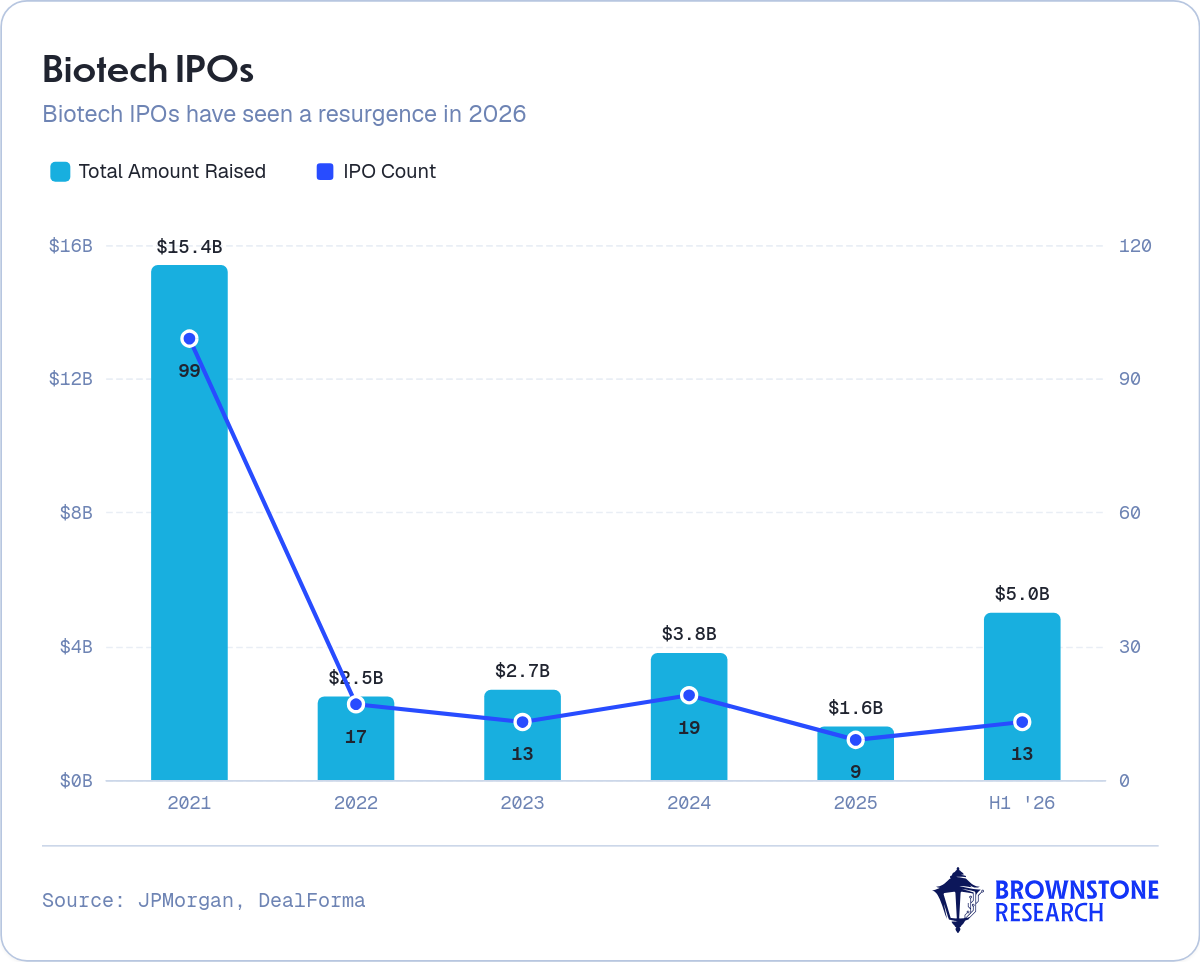
J.P. Morgan/DealForma analysis for the first half of the year counted 13 U.S. therapeutics and platform IPOs that raised approximately $5 billion. Under that definition, biotech companies raised more money in just six months than in any of the previous four years.
The size of individual offerings has also been impressive. Several companies have raised more than $300 million. Kailera Therapeutics raised approximately $625 million. Parabilis Medicines soon followed with an approximately $670 million offering.
These are very large amounts by biotech standards and demonstrate that institutional investors are once again willing to make substantial commitments to selected companies.
Demand has improved as well. Several recent offerings have been oversubscribed, meaning investors wanted to purchase more shares than companies were offering.
This is a big change from recent years when companies had to reduce their offering prices or even cancel their IPOs.
Perhaps even more important is what happens after these companies go public. More than half of the 2026 biotech IPO group now trade above their IPO prices.
That matters because investors who make money on one IPO become more willing to participate in the next one. It’s a virtuous cycle: Stronger investor returns lead to greater demand, which allows more companies to go public and raise larger amounts of capital.
Importantly, this is not the type of speculative fervor we saw in 2021. Companies are coming to market with stronger science, more advanced drug programs, and clearer clinical paths.
That selectivity could make the biotech recovery more sustainable.
One more positive implication: A functioning IPO market gives private biotech companies another realistic path to liquidity besides being acquired. All else equal, that means more venture capital activity in young biotech companies.
Jeff has referred to recent years as the “Biotech Winter.” And that was an apt description. But the latest IPO data shows us that winter has finally thawed.
Biotech IPOs are back, and investors should be paying attention.
Add Brownstone Research as your preferred source on Google to see our latest stories in your feed.
 Add as a preferred source
Read the latest insights from the world of high technology.
The GPUs are being deployed in a timely manner. What isn’t arriving fast enough is the electricity to power...


There’s one metal named in the procurement rules that hasn’t seen a major deal…yet.