




The AI Bears Are Wrong (Again)
On the surface, it makes some sort of sense. But this argument misses two things…



This chart is a tried-and-true gauge of crypto’s risk appetite…

By Feruz Kurbanov, Senior Analyst, Brownstone Research
Bristol Myers Squibb (BMS) recently announced a major partnership with NVIDIA to build what is expected to become one of the largest artificial intelligence (AI) supercomputing systems dedicated to pharmaceutical research and development.
While many drug companies have already begun using AI through partnerships with technology firms, this announcement stands out because BMS is making a significant investment in its own AI infrastructure.
Rather than simply using someone else’s software, the company is building a powerful computing platform that could support nearly every stage of discovery and development of new medicines.
Traditionally, developing a new drug has been a long and expensive process that often took 10 to 15 years. Scientists studied a disease, identified possible drug targets, and then tested thousands of chemical compounds in search of one that might become a successful treatment.
AI has the potential to dramatically improve this process. Instead of physically testing thousands of molecules in a laboratory, advanced AI systems can analyze millions or even billions of possible drug candidates on computers before researchers begin experiments. This could help scientists identify the most promising medicines much faster while reducing both costs and the number of failed projects.
Additionally, AI is becoming much more than a tool for speeding up existing work. Modern AI systems are increasingly able to discover hidden biological patterns that would be extremely difficult for humans to recognize on their own.
By analyzing enormous amounts of genetic, medical, and chemical data, AI can identify new disease pathways, predict possible side effects, and even suggest completely new types of medicines.
As AI models become larger and more sophisticated, they may uncover scientific discoveries that would have been impossible using traditional research methods alone.
The partnership also highlights NVIDIA’s growing importance within the healthcare industry. NVIDIA’s powerful graphics processing units (GPUs) have become the preferred technology for training large AI models and running complex scientific simulations.
Just as pharmaceutical companies once competed by building the best laboratories and manufacturing facilities, they are now beginning to compete by building the strongest AI computing infrastructure. In many ways, advanced supercomputers are becoming just as important to drug discovery as laboratories filled with scientific equipment.
BMS’s announcement could also influence the entire pharmaceutical industry. Companies such as Pfizer, Merck, Roche, Novartis, Eli Lilly, AstraZeneca, GSK, AbbVie, and others are unlikely to ignore this trend.
As AI proves its value in discovering new medicines more quickly, many large pharmaceutical companies will likely increase their own investments in supercomputing, AI platforms, robotics, and advanced data systems.
Competition may increasingly depend not only on who has the largest pipeline of drugs but also on who has the most powerful AI-driven research capabilities.
For biotechnology companies, this trend may actually create new opportunities. While AI can help design and improve medicines, it still needs innovative biological discoveries to work with.
Small biotechnology companies often specialize in uncovering new disease targets or developing breakthrough scientific ideas. These discoveries become even more valuable when combined with powerful AI systems that can quickly optimize and develop them.
As a result, strong biotech companies may become even more attractive partners or acquisition targets for large pharmaceutical companies.
Overall, the BMS-NVIDIA collaboration signals a broader transformation taking place across the healthcare industry. Pharmaceutical companies are no longer relying only on laboratories, manufacturing plants, and clinical expertise to stay competitive.
Increasingly, they are also becoming technology companies, investing heavily in artificial intelligence, supercomputing, and advanced data analysis. Just as cloud computing reshaped the software industry over the past two decades, AI now appears poised to reshape how new medicines are discovered.
This partnership may ultimately be remembered as another important milestone in the beginning of a new era of AI-driven drug development.
By Ben Lilly, Senior Analyst, Brownstone Research
There is one chart that starts moving before every crypto mania.
It never announces itself. Rather, it breaks out quietly after months of bearish price action.
We’ve seen it trigger in the months leading up to the 2017-2018 and 2020-2021 raging bull runs. Life-changing gains followed.
It flashed again last summer, just before Ethereum ran from $2,100 in June to nearly $5,000 by late August.
As you can imagine, it’s a signal worth watching.
The chart I’m referring to is the ETH/BTC ratio. It tells us how much Bitcoin one Ether can buy. The bigger the ratio, the more valuable Ether is relative to Bitcoin. The lower it goes, the more valuable Bitcoin is relative to Ether.
It is one of the most tried and true gauges of crypto’s risk appetite.
When the ratio rises, it means money is moving beyond Bitcoin and into the broader market, into smaller market cap tokens like Ether. Smaller altcoins are primed to run.
Ethereum sits second by market cap, right behind Bitcoin. Since it is the alpha of altcoins, it tends to be the first to pick up these new flows.
And as we’ll see on the charts below, the ratio is currently flirting with a key line in the sand… the 200-day moving average. Currently, the ratio sits at roughly 0.29. The 200-day moving average rests just above it at 0.296.
Previous breakouts that sustained an upward trend above the 200-day moving average have foreshadowed every major ETH move in history. This includes when it went from less than $60 in early 2017 to over $1,300 by January 2018… less than $300 in early 2020 to more than $4,600 by late 2021… and last summer’s sprint from the $2,100 range up to nearly $5,000 in just two short months. Take a look:
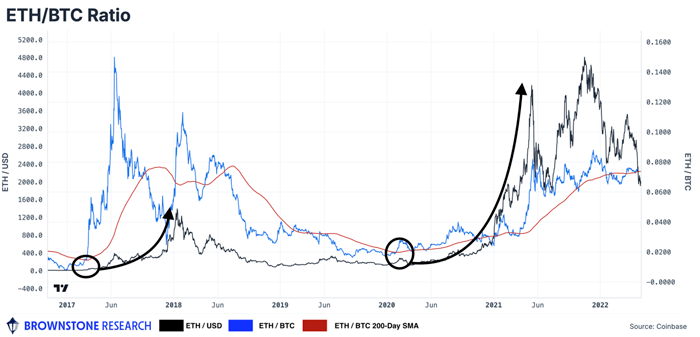
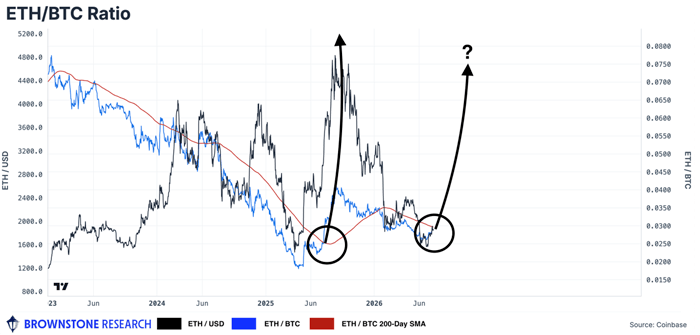
The chart suggests a breakout might soon be on the cards after finding a higher low. And the timing couldn’t be more perfect…
The CLARITY Act is once again at the goal line with regulators and the White House pushing hard to ensure its completion before the Senate breaks for August recess on August 7. As a reminder, CLARITY will establish a comprehensive regulatory framework for the cryptocurrency industry.
If the bill passes the Senate, we can expect the president to sign the bill into law, greenlighting a wave of capital into the market.
Ethereum stands to gain the most in a post-CLARITY world. Ethereum is where the vast majority of tokenized real-world assets (RWAs) are already stored. These are traditional financial assets like U.S. dollar-backed stablecoins, tokenized stocks, and tokenized bonds.
It is already far and away the leader in RWAs. Its 44.5% market share is nearly three times higher than its top competitor.
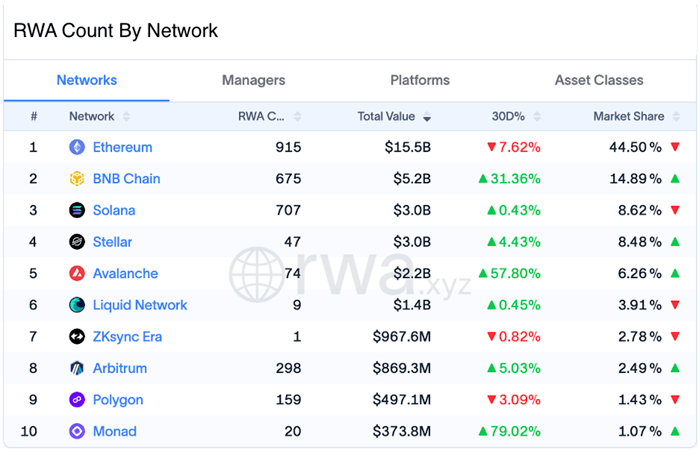
Source: rwa.xyz
This is because there is no chain capable of matching its liquidity, tooling, decentralization, and security.
If CLARITY is signed into law and the migration of Wall Street assets to crypto hits high gear, Ethereum will be far and away the winner.
That’s what makes the timing of this potential ETH/BTC ratio breakout all the more interesting. The next couple of weeks could represent the moment crypto goes full risk-on for the months to come.
Let’s watch how the Senate responds over the next couple of weeks as the CLARITY Act’s text is introduced to the public.
By Larry Benedict, Founder, The Opportunistic Trader
Friday’s sharp selloff caught many people off guard.
For months now, investors have been crowding into the same group of momentum-driven AI infrastructure and semiconductor companies. This narrow band of stocks was caught up in a feedback loop, as momentum-based algos bid them ever higher.
But just as buying momentum can distort the market on the way up, it can exacerbate selling too. Friday’s action showed a glimpse of how quickly and brutally markets can unwind when momentum turns.
The market can’t keep going up forever. At some point, markets reach a level where expectations become difficult to exceed, leaving them vulnerable to a sharp pullback. And that’s what we’re beginning to see.
What started as weakness in a handful of semiconductor stocks has spread through the broader technology sector, dragging both the Nasdaq and broader market lower.
And now earnings season is adding another challenge for the rally.
Market sentiment didn’t improve with streaming giant Netflix (NFLX) issuing a softer-than-expected outlook. This week, Alphabet (GOOGL), Tesla (TSLA), and Intel (INTC) are scheduled to report. Any negative reaction could set the tone for next week when juggernauts Microsoft (MSFT), Meta Platforms (META), Apple (AAPL), and Amazon (AMZN) all report.
Earnings are arriving as the market reaches a critical juncture. With valuations stretched and indexes already looking a bit skittish, investors will be less willing to overlook negative news.
Against that backdrop, there’s renewed fighting in the Middle East – though ceasefire negotiations continue. Lower energy prices drove a big part of last week’s lower-than-expected inflation prints. However, oil prices have risen sharply since hostilities broke out again. Clearly, the longer the conflict plays out, the more pressure higher oil prices will exert on inflation.
Although the probability of an interest rate hike at the Fed’s meeting next week has fallen to around 14%, the CME FedWatch Tool is putting a much higher chance (42.6%) of a rate increase by year’s end, with just an 18.5% chance of rates remaining unchanged.
Higher rates would put pressure on high-growth stocks, which have been the engine of much of the rally.
Put simply, buyers will have less incentive to buy. It reinforces the need to be cautious. The last thing you want is to be caught on the wrong side of the market when a risk-off move unfolds.
Right now, we’re seeing a market that’s becoming increasingly headline-driven. There’s potential earnings risk, growing geopolitical uncertainty, and shifting interest rate expectations.
If earnings disappoint or inflation concerns re-emerge, it could set off another round of sharp selling.
Add Brownstone Research as your preferred source on Google to see our latest stories in your feed.
 Add as a preferred source
Read the latest insights from the world of high technology.
On the surface, it makes some sort of sense. But this argument misses two things…

In South Korea, individual stock traders have an unusual nickname: gaemi, the Korean word for ants.

The GPUs are being deployed in a timely manner. What isn’t arriving fast enough is the electricity to power...