



Airborne Wind Energy
It’s hard to imagine that developments will continue to pick up at an even faster pace than what is...



Everyone is watching the silicon and the zoning fights. But how many investors are watching the steel?
There is a number moving through utility boardrooms and data center war rooms right now that very few in the technology world are watching.
That number is 128.
The average lead time to build and deliver a large power transformer in the United States is currently 128 weeks. Weeks, not days. That’s nearly two and a half years.
And that’s just for standard transformers. For the biggest generator step-up units – the ones that connect serious power to the grid, buyers are being quoted four to five years out.
We already know about the GPU and memory shortages inherent in the artificial intelligence (AI) data center buildout. And we know about the growing number of zoning fights over data center placement in certain states and counties. Those are real bottlenecks, and they are easy to see.
But there is another constraint sitting one layer beneath all of it. It’s quieter, it’s more physical, and it’s far harder to fix.
Even if a hyperscaler wins the data center permit, secures the necessary power allocation, and gets access to all the GPUs and memory technology that it needs, it still cannot bring the data center online until the transformer shows up – usually 128 weeks later.
Given the time-sensitive nature of the AI arms race, that’s a delay the hyperscalers cannot afford. But it stems from a problem that’s very difficult to solve.
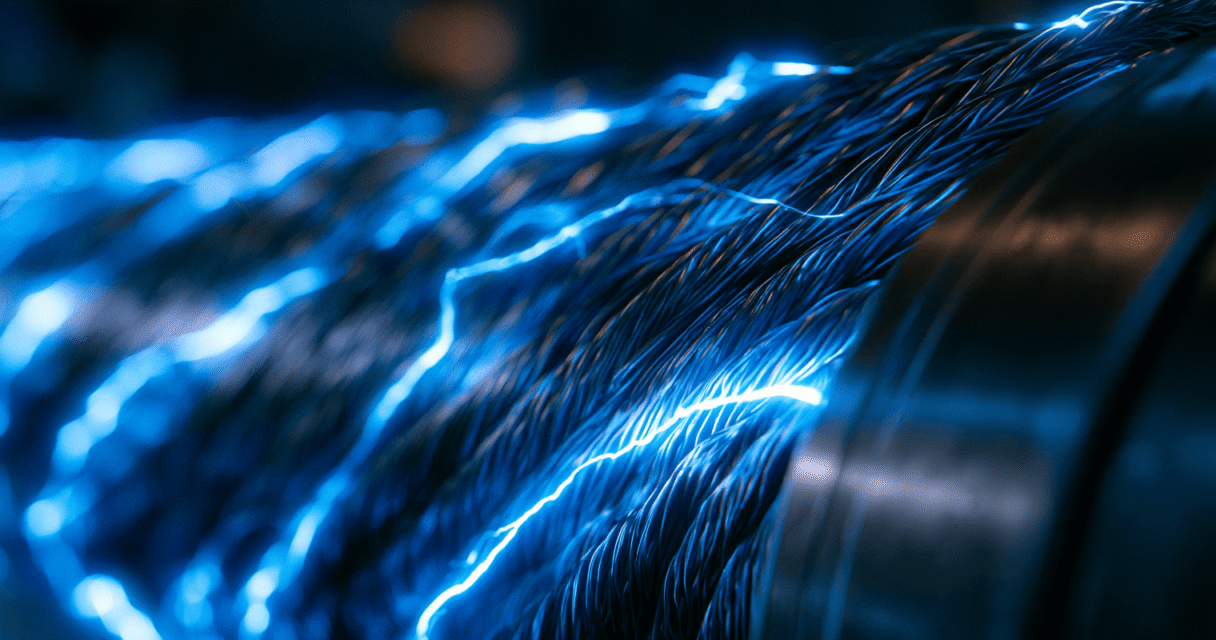
A transformer, stripped down to its essence, is a coil of copper wrapped around a core of steel. But not just any steel.
The core has to be built from grain-oriented electrical steel (GOES). It’s a material engineered at the atomic level so that its crystalline grain structure all points the same direction, thus letting magnetic fields pass through with minimal energy loss.
That engineering is critical.
Ordinary sheet steel wastes enormous amounts of energy as heat when you run alternating current through it. So it’s just not economical for transformers.
GOES is what makes an efficient transformer possible. And here is the part that matters for anyone trying to model the AI buildout: no one can improvise this material.
You cannot 3D print GOES. You cannot substitute a cheaper grade. You cannot spin up a new production line next quarter because demand spiked.
Producing high-grade GOES requires decades of proprietary metallurgical process control, specialized rolling equipment that costs hundreds of millions of dollars, and years of customer qualification testing – because a transformer manufacturer cannot afford a defective core inside a piece of grid infrastructure meant to run for 40 years.
So when demand for transformers suddenly triples, the supply of the one material they all depend on does not respond in months. It responds in years, if it responds at all.
That’s the hidden bottleneck. Everyone is watching the silicon and the zoning fights. But how many investors are watching the steel?
Given the nature of the steel bottleneck, it raises an important question. How did the most technologically ambitious country on Earth end up unable to make enough of a basic industrial input?
It’s not for lack of natural resources. The United States has plenty of iron ore. And it has the engineering talent to turn the raw materials into finished goods.
However, the United States offshored nearly its entire domestic steel industry over a period of roughly 40 years – from 1980 to 2020.
Throughout that period, one electrical steel plant closed, then another. And then the specialized knowledge walked out the door with the workers who retired.
By 2020, domestic production of grain-oriented electrical steel had consolidated down to a single company operating two legacy plants in Butler, Pennsylvania, and Zanesville, Ohio. For many critical grades, the country had become almost entirely dependent on imports.
To be sure, this looked like efficient markets at work for decades. American companies could buy steel on the cheap from low-cost producers in Asia.
But it turns out those efficiency gains were short-lived… and perhaps short-sighted. Because now American companies are at the mercy of foreign steel producers at a time when every day counts.
With the AI buildout accelerating, America is finding out, in real time and at industrial scale, the downside of treating manufacturing as an afterthought for decades. This is the part of the story that a purely technological lens may miss.
The AI infrastructure race is not just a contest of software algorithms and chips. It is running headlong into the physical and material consequences of a generation of economic choices (i.e., offshoring).
And the response now underway – tariffs on imported electrical steel, federal efficiency rules written to protect domestic core material, companies breaking ground on new plants – is simply an attempt to reshore the industrial capability that the United States deliberately let go.
This is a perfect example of how and why policy decisions are so critically important to economic growth.
The transformer shortage is not only a data center problem. Data centers are simply the loudest customer in a room that was already crowded.
The same scarce GOES supply and the same overstretched transformer factories are being pulled at simultaneously by the broad reindustrialization of America and the urgent need to harden the power grid and replace aging infrastructure that’s been neglected for decades.
In short, America needs more transformers. And that will require more steel. New domestic GOES and transformer capacity announcements are underway, but most will take three to five years to meaningfully impact supply.
So here is the takeaway, and it’s bigger than any one company or any one metal…
The AI story is fundamentally a story about the advanced technology – software, compute, memory – that made this revolution possible.
But the infrastructure that makes it all work is far more familiar to us – the materials and machinery we’ve used for decades to build and operate our power grid, such as transformers and steel. And scaling the hardware at the pace of growth of AI has proven to be very difficult.
As the buildout continues, we can expect the same pattern to repeat across a whole series of unglamorous industrial inputs that very few analysts are modeling – specialty castings, high-voltage switchgear, copper refining capacity, skilled electrical labor. These are the simple and critical inputs required to allow the AI boom to continue to grow.
The winners of the AI era will not only be the companies designing the advanced chips. They will also be, quietly, the ones who own or rebuild the physical capacity to actually deliver the power to the AI data centers.
Regards,
Joe Withrow
Senior Analyst, Brownstone Research
Read the latest insights from the world of high technology.
It’s hard to imagine that developments will continue to pick up at an even faster pace than what is...
An “insider” from Anthropic has quit his job – walked away from a ton of money, in fact –...

OpenAI announced that Astra is a “generational leap in capability.” AGI has most certainly arrived...