




Beware of Biased Billionaires
Over the last week, we have discovered that this is a massive, well-coordinated psyop carried out by some powerful...



We’re seeing AI-first companies working towards supplanting Google’s and Apple’s smartphone operating systems…And one of the most visible pushes to enter this space has been from none other than OpenAI.
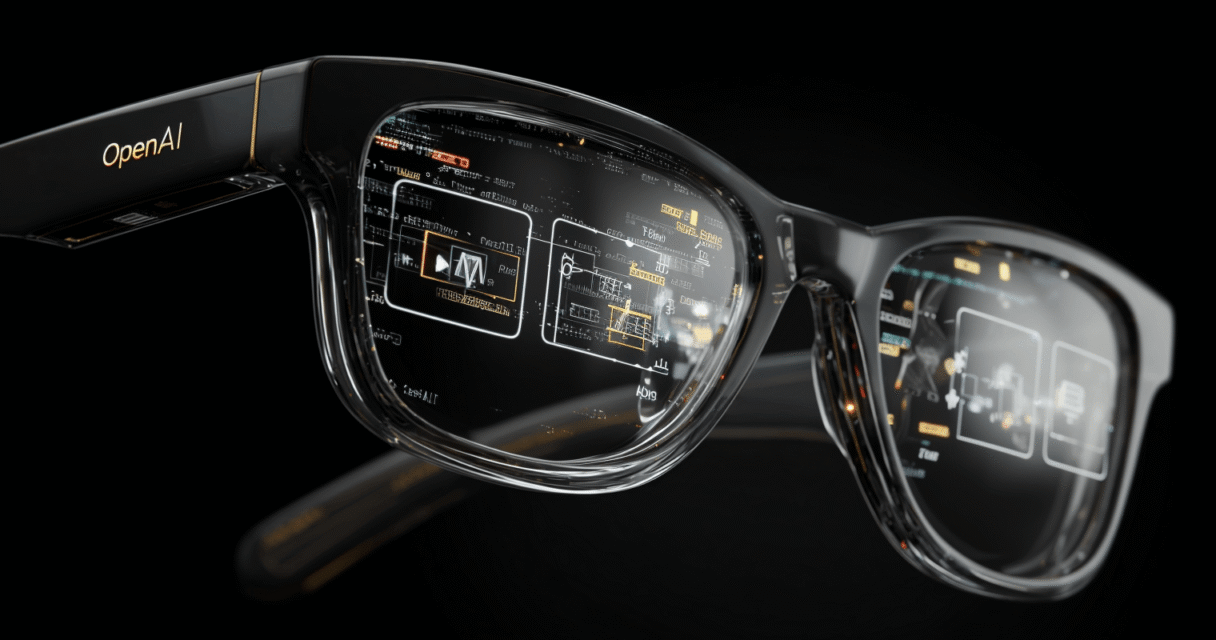
The next generation of electronics devices is up for debate.
Will it be a phone-like device?
Or a pair of smartglasses?
A wearable device like the AI Pin from failed Humane AI?
Or something as simple as a smartwatch or ear pods?
Whatever it is, it will be intelligent. And it will be powered by AI.
That’s why we’re seeing AI-first companies working towards supplanting Google’s and Apple’s smartphone operating systems…
And one of the most visible pushes to enter this space has been from none other than OpenAI.
In May 2025, OpenAI made a bold and expensive move to spend $6.5 billion to acquire IO, a hardware startup firm founded by former Apple executive Jony Ive in 2024.
It was one heck of an exit for Ive after just a year’s work.
It was clear that OpenAI’s CEO Sam Altman didn’t want just the “brand”… but the person behind it – the person who was integral in designing Apple’s iconic products like the iPhone, iPad, and Apple Watch, which have all been category-defining consumer electronics products.
The purpose of the acquisition was to create AI devices.
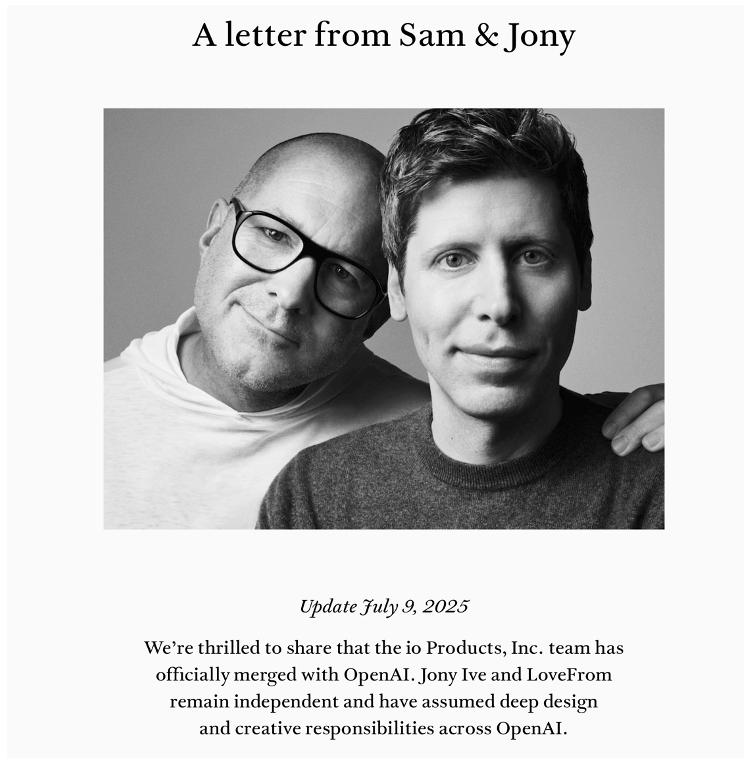
By July, “Sam & Jony” shared “a letter” about the deal, along with a “hard launch” photo of the partnership, shown below.
Not a whole lot else was published.
Source: OpenAI
With billions of dollars to spend on research and development, and one of the leading frontier AI models, the deal wasn’t and isn’t something to ignore.
And since this announcement, not much has been known about which direction OpenAI would lean into for development and design…
Until last weekend.
The product development efforts had been kept quiet, as OpenAI’s efforts appeared to be focused on accelerating new AI model development and signing $1 trillion-plus in AI data center deals in an effort to dominate the industry.
A Hong Kong-based analyst known for having accurate information on Apple over the years posted on X some very specific details on what OpenAI is building.
And it’s worth understanding.
The first point was that OpenAI had partnered with Qualcomm and MediaTek to develop new smartphone processors (semiconductors) to support OpenAI’s new product initiative.
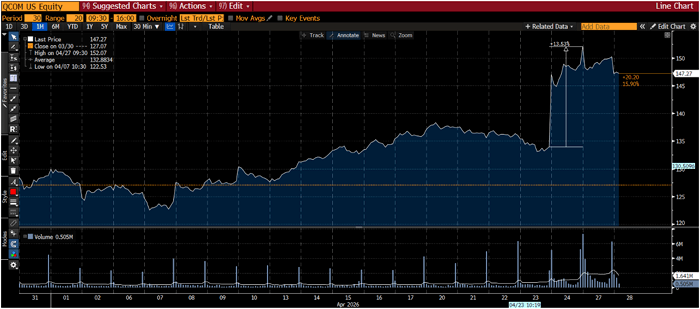
Despite the mass production being planned for 2028, the initial rumors of the news – which surfaced before the post – sent Qualcomm’s (QCOM) stock up 13.5%.
1-Month Chart of Qualcomm (QCOM)
The idea is for OpenAI to develop a full-stack product – from the semiconductors up to the application layer – and redefine the smartphone category entirely.
Part of that solution will be to develop a brand-new operating system (OS) that would replace Google’s Android OS and Apple’s iOS on smartphones.
If successful, Google (GOOGL) and Apple (AAPL) would be in trouble.
Not surprisingly, the new device will be grounded entirely with artificial intelligence (AI), specifically agentic AI.
The concept is: Rather than having a smartphone that supports software applications (apps) that we have to lean into and use throughout the day, OpenAI’s device will be designed to work for us.
The user will just have to manage the flow.
Don’t think, just flow.
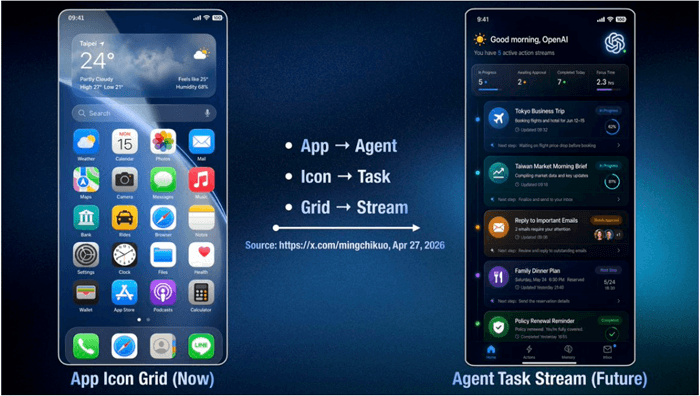
The Hong Kong-based analyst, Ming-Chi Kuo, provided his own visual based on what he knows for what this product will look like.
Source: Ming-Chi Kuo
As shown above, rather than a screen full of apps that we’re all used to today (on the left), the operating system will simply show a stream of tasks managed by agentic AI (on the right). The tasks are depicted with status and also action items that need the users’ review and/or approvals.
The vision is sound.
Future AI-centric devices will no longer require the user to hunt and peck and search for information or work through multiple steps to get anything done.
It’s time-consuming work that is not a very good use of our time. We only do it because we have to. It’s the only way to get things done.
But that’s the purpose of agentic AI: To abstract away the complexities of transacting in today’s world.
Whether that means transacting with information or for commerce. It can all be done in the background for us – using agentic AI.
The project is legitimate, and OpenAI is reportedly already chosen as a manufacturing partner.
China-based Luxshare is a direct competitor to Hon Hai Precision Industry (aka Foxconn), which is Apple’s contract manufacturer.
And the timing makes sense.
With a stated goal to be in mass production in 2028, now is the time to lock in semiconductor design and selection, product specifications, supply chains, and manufacturing.
This is clearly meant to be a high-volume product.
Given that OpenAI now has about 900 million weekly active users for ChatGPT, and about 50 million paying subscribers, it already has a well-established distribution for a new product like this.
And for those of us who actively use generative AI and agentic AI solutions, you’ll know that once you make it part of your daily workflow, there is no going back. The utility is just incredible.
The real question is whether this next-generation device will be a handheld screen akin to a smartphone… or not?
I can’t help but think that a new category-defining product will allow us to be hands-free and enable us to multitask more seamlessly without having to go back and forth with our device.
Going “hands-free” lends itself towards intelligent smart glasses (augmented reality glasses) with audio enabled in the eyewear.
Screens will have their time and place. They aren’t going away for work and entertainment. But we’ll be able to perform a lot more with a lot less… just go with the task flow generated by our personalized agentic AIs.
This latest product push by OpenAI, on top of all its other initiatives, does come at an odd time though…
Just yesterday, a nine-person jury was seated in the Elon Musk v. Sam Altman et. al. legal case, the outcome of which could literally turn OpenAI upside down and revert it to its original mission and structure as a non-profit entity.
Objectively, Musk’s case is strong. Altman’s is weak.
The stakes couldn’t be higher.
And Altman is pretending it’s just business as usual…
Additionally, OpenAI’s relationship with investor Microsoft has weakened significantly, as the two have loosened the structure of their business relationship just in the last few days. I don’t believe the timing is a coincidence.
If OpenAI loses the legal battle, it won’t slow down the development of AGI or ASI one bit.
It will simply restructure the competitive dynamics in the industry and where the institutional investment will flow.
One thing is for sure: It is time for the next big consumer electronics device.
It has been almost 20 years since the launch of the first iPhone. Two decades.
We’re living in a very different world right today than 20 years ago.
The electronics products that we use day in and day out will soon reflect that.
Add Brownstone Research as your preferred source on Google to see our latest stories in your feed.
 Add as a preferred source
Read the latest insights from the world of high technology.
Over the last week, we have discovered that this is a massive, well-coordinated psyop carried out by some powerful...
Last month I was excited to see an announcement made by a leading humanoid robotics firm, Figure AI, for...

When demand exceeds supply, something has to give…