




A Walk Through the AI Factory
Imagine millions, and eventually perhaps billions, of AI agents working continuously. Every one of them needs computing power. They...



An incredible development in both artificial intelligence and the space economy launched from the other side of the country at Vandenberg Space Force Base in California...
This has been an incredible week for the emerging space economy.
On Monday, we explored the significance of the first commercial flight of SpaceX’s Starship in The Bleeding Edge – Starlink’s Masterplan.
Today, the excitement continues.
Launched today from the Cape Canaveral Space Force Station was NASA/SpaceX’s 13th operational spaceflight mission, known as Crew-13.
The Falcon 9 rocket with the Dragon spacecraft carried four NASA astronauts to the International Space Station (ISS).
They will now begin a six-month mission.
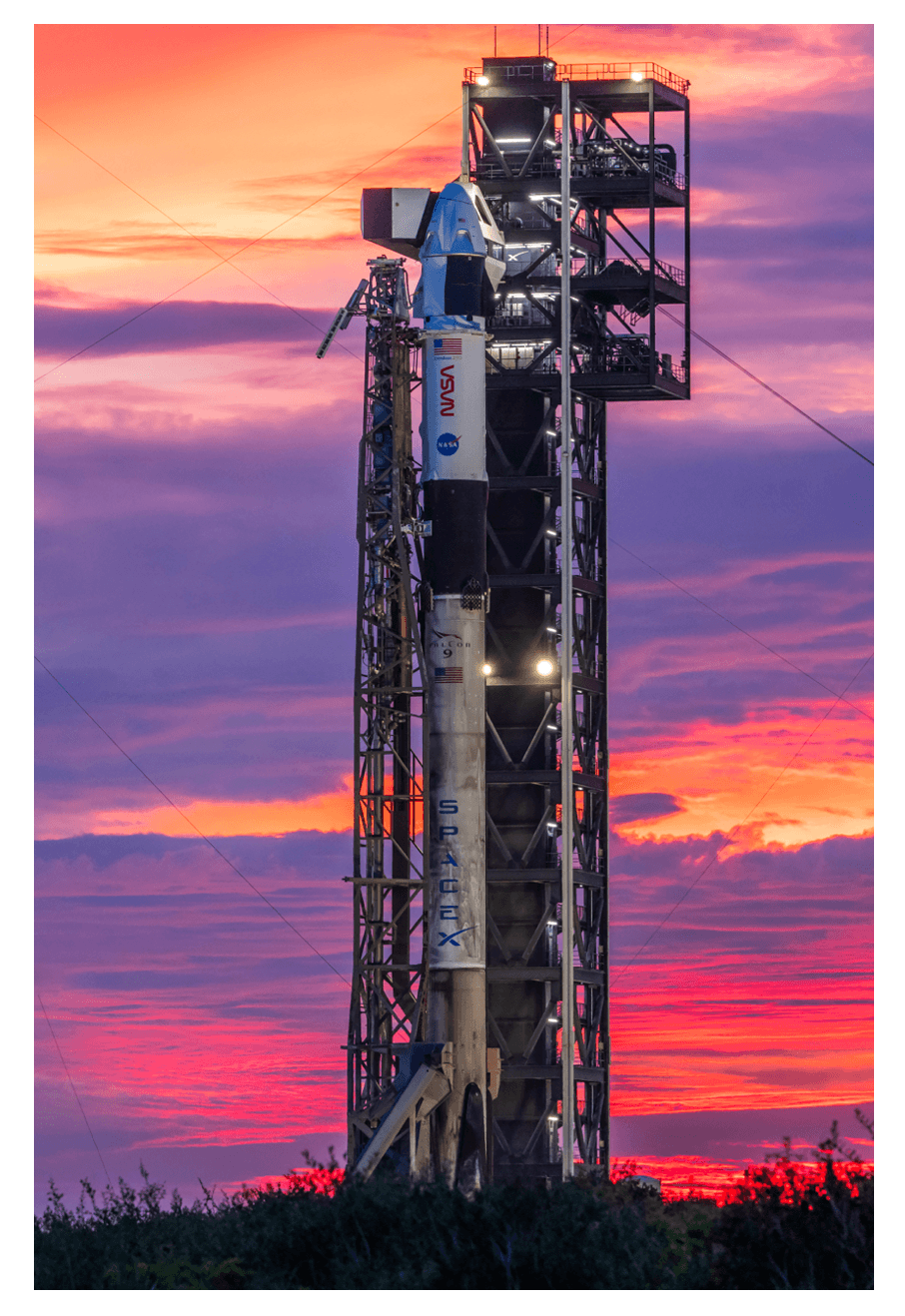
Crew-13 Mission, Cape Canaveral Space Force | Source: SpaceX
This is the second flight for this particular Dragon spacecraft and the third flight for this particular Falcon 9 booster. Below you can see the moment Dragon separated from Falcon 9…
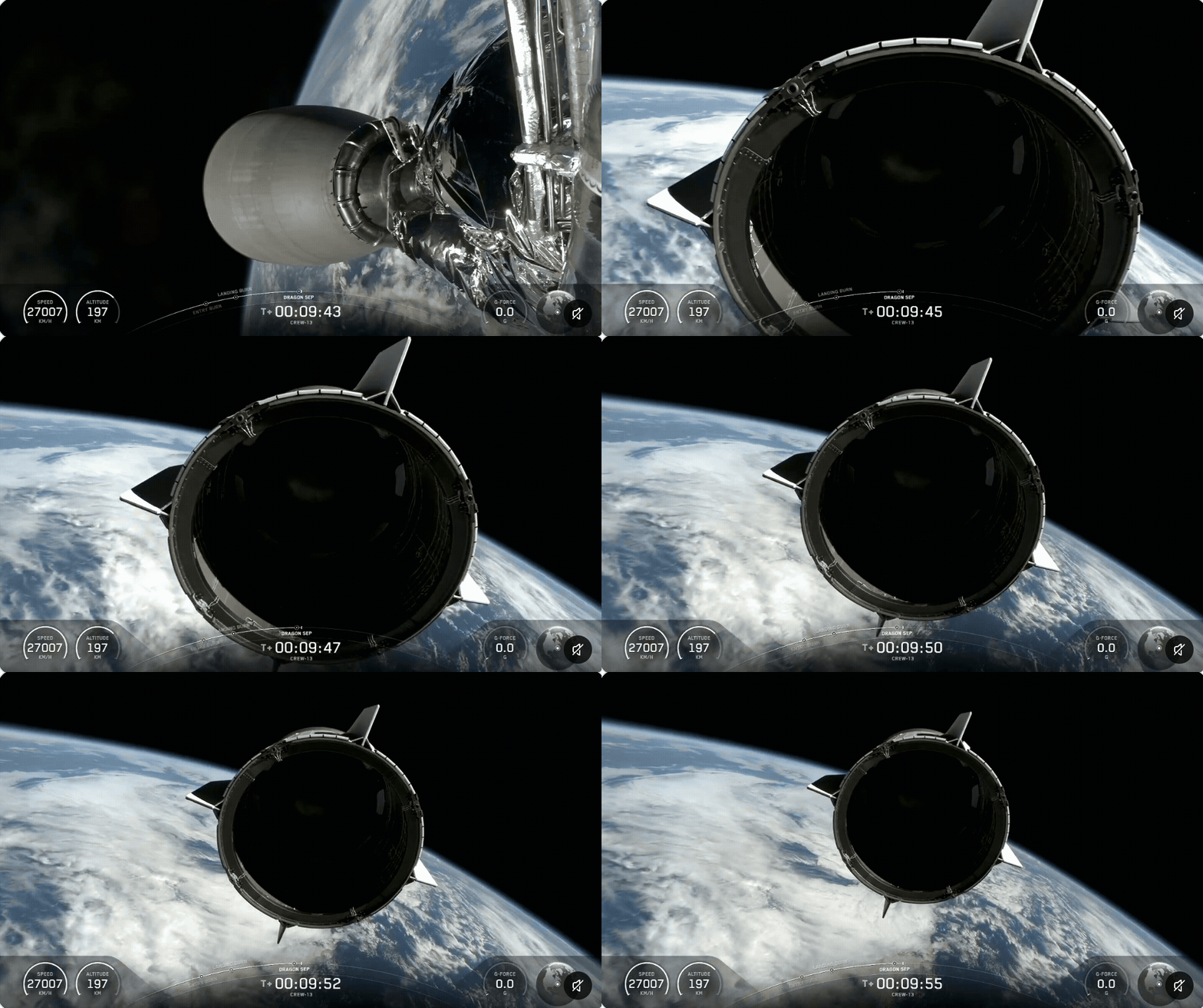
Dragon Spacecraft Separating from the Falcon 9 | Source: X @SpaceX
It’s a testament to the transformational value in reusable rockets and spacecraft. For comparison, launching astronauts to the ISS on NASA’s Space Launch System (SLS) costs about $4.2 billion per launch.
The cost to do the same using SpaceX technology is roughly $300 million.
That means that SpaceX is only about 7% the cost of NASA’s SLS – an incredible savings with far greater reliability and safety.
But that’s not the only exciting launch that happened today.
Another incredible development in both artificial intelligence and the space economy launched from the other side of the country at Vandenberg Space Force Base in California.
Sitting atop yet another Falcon 9 rocket was the Transporter-18 mission, which is a dedicated smallsat rideshare mission comprised of 130 different payloads.
Two of the spacecraft on the rideshare mission have re-entry vehicles, and 41 of the payloads are contained within four orbital transfer vehicles, which act as a kind of taxi service, eventually dropping off the satellites into their desired orbits after they reach low Earth orbit.
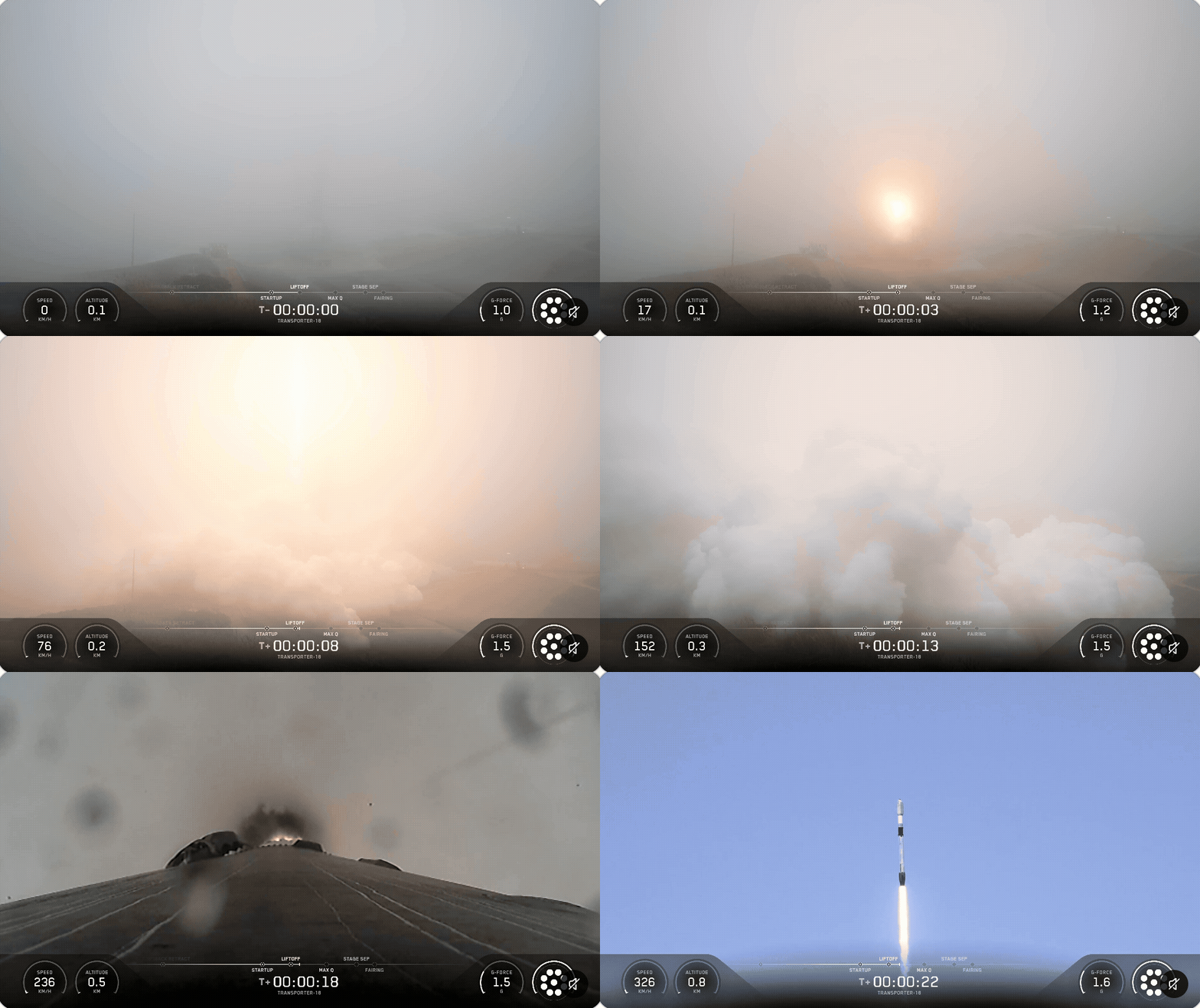
SpaceX Launch of Transporter-18, Vandenburg Space Force Base | Source: SpaceX
All of this might sound routine for those of us who follow the industry…
But there is one special payload on Transporter-18 that is worth highlighting.
The satellite is known as MVP, which is tech speak for minimum viable product. And it is part of Google’s (GOOGL) Project Suncatcher, which is Google’s moonshot project to build a constellation of AI satellites in sun-synchronous orbit.
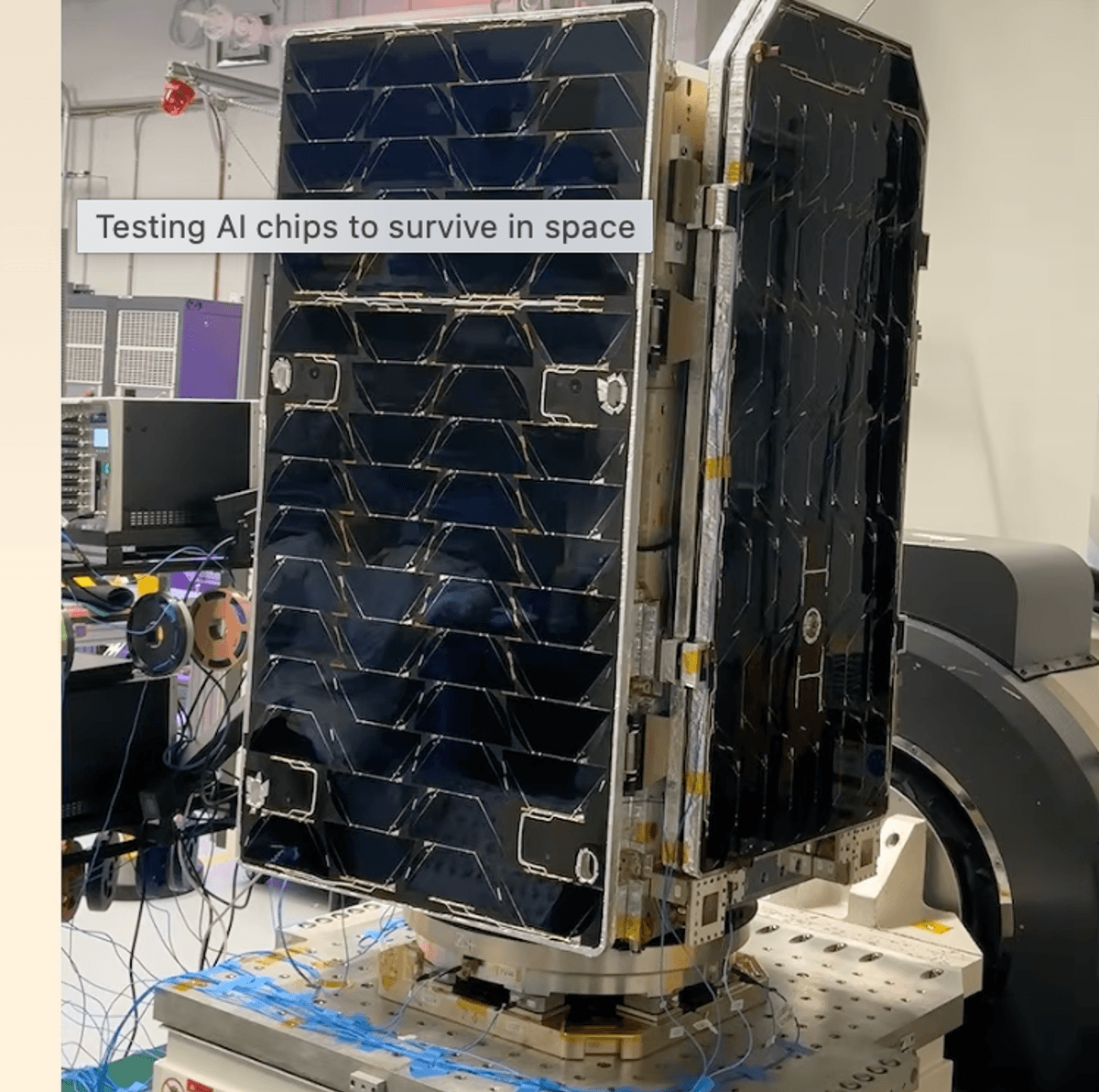
Google’s MVP Under Vibration Testing | Source: Google
Once thought to be a fringe idea or absolutely impossible, putting computational resources into Earth’s orbit to take advantage of the sun’s free energy and the natural cooling in space has become a very popular approach to solving for the new energy production constraints here on Earth.
The only major argument that exists today is whether or not this can be done economically.
My answer to that is a resounding yes – within the next 24 months.
This was again the importance of the Starship’s first commercial flight.
When SpaceX gets to the stage where it is launching hundreds of Starships a year, launch costs will drop to below $200 a kilogram to low Earth orbit, which will transform the economics of AI computation in space.
However, Google’s approach to AI computation in space is different than SpaceX’s plans to build a 1 million AI data center satellite constellation.

A former hedge fund manager whose firm Barron’s ranked in the top 1% worldwide says buying Bitcoin is the wrong move. His readers have had the chance to collect $4,898… $11,145… and even $17,350 from Bitcoin’s moves without owning a single coin. Now he’s revealing the whole strategy, free.

One tiny corner of tech (not AI) could be about to get a $5.9 trillion cash injection thanks to Trump. Silicon Valley insider Jeff Brown just held an urgent strategy session and gave a free pick for this new bull market. Click to get the FREE pick now.
Google is opting for much smaller clusters of satellites that fly in close sync with one another – with only 100-200 meters in distance from the next nearest AI satellite.
This is shown below in the short video animation, with the black arrow always pointing at the Earth as the satellite constellation orbits.
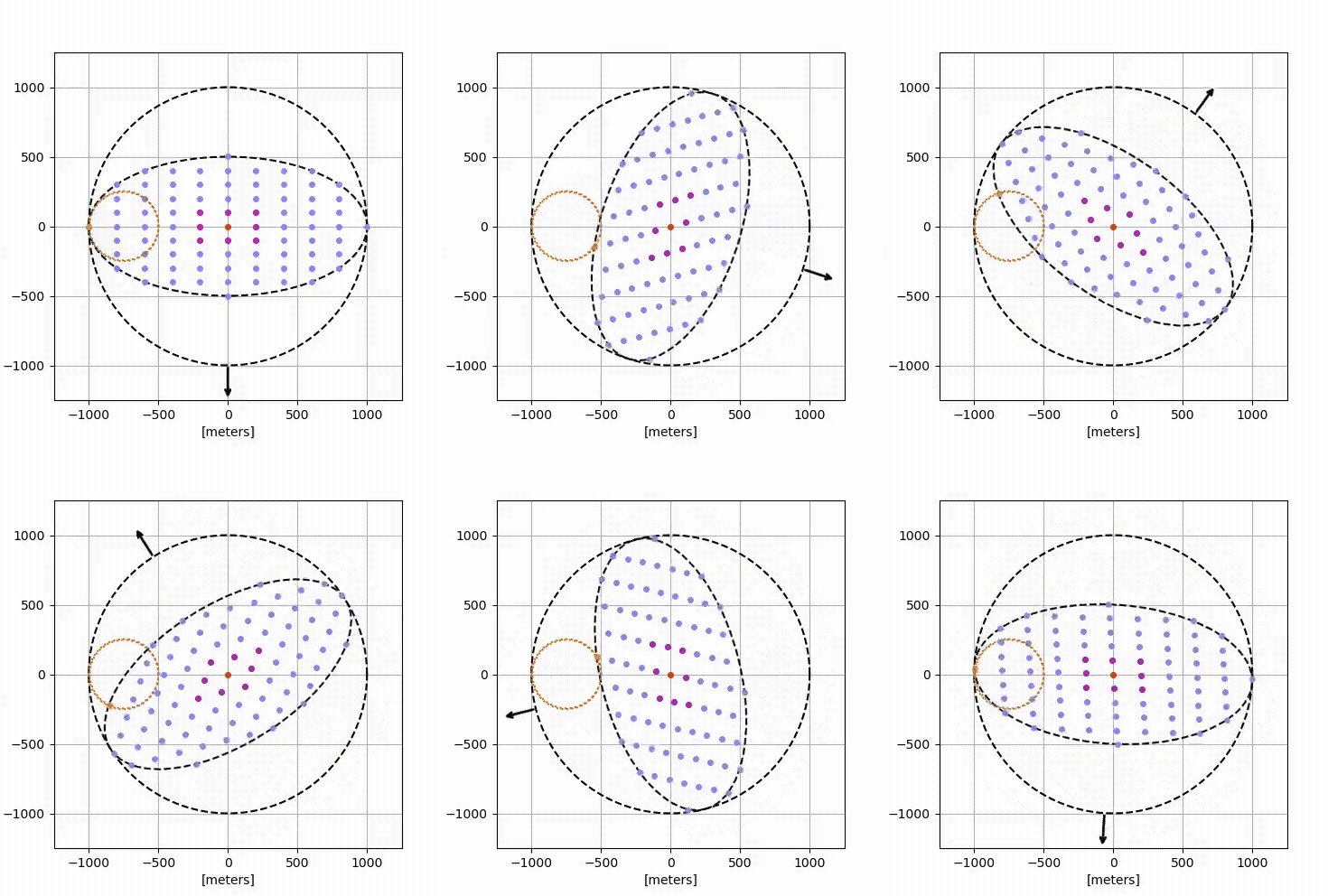
Google’s Vision for Space-Based Data Center Satellites | Source: Google
Google has chosen this architecture as it envisions multi-terabit bandwidth optical connections between the satellites to support distributed machine learning and artificial intelligence workloads. Hence their close proximity.
From what Google has disclosed about the project, its AI satellites will be much smaller than what SpaceX is planning with its AI1 satellites.
Google’s MVP contains just four of Google’s Tensor Processing Units (TPUs), basically the equivalent of a single server that would reside in a rack of servers.
Google’s TPUs are its own equivalent to GPUs, in that they are to be used for running machine learning and AI workloads.
The MVP’s solar panels will provide only about 1 kilowatt of power to support the TPUs. This compares to the 100 kilowatts plus of power that the SpaceX AI1 satellites will produce.
To be clear, Google’s MVP is just a prototype, but the intended designs are much smaller than what SpaceX will build with its AI1 satellites.
An oversimplification would be to say that Google will probably launch the equivalent of a server or two worth of computational resources per satellite, and SpaceX will launch a rack or two of computational power with each AI1.
Oddly, Google stated that it will only be able to run its TPUs for about 15 minutes before needing to be shut down to cool off before restarting again.
One would think that the near-absolute-zero temperature of space would be sufficient for continuous operations, which raises the question of the efficiency, or lack thereof, of Google’s cooling mechanism.
Google uses a thermal interface material, a sheet of heat-absorbent material that sits between the printed circuit board (PCB) where the TPUs reside and the aluminum and copper radiators, which help pull the heat away from the PCB.
As we all know, Google is – first and foremost – an advertising company.
Building and launching satellites is not in Google’s wheelhouse.
Even today, about 78% of all its revenues come from its services business, which is primarily advertising. And 21% comes from Google’s cloud services business.
That’s basically the entire company.
Which is why Google partnered with Planet Labs (PL) to assist with developing the MVP AI prototype satellite.
The relationship between Google and Planet Labs goes back several years, suggesting Google’s premeditated desire to have computational assets in space.
Alphabet (GOOGL), Google’s parent company, invested in Planet Labs’ Series D funding round in 2017, and again in 2021 as part of its reverse merger into a SPAC – in order to become a public company.
Today, Alphabet owns a bit more than 10% of Planet Labs’ outstanding shares.
Obviously, if Google were to expand its ambitions to manufacture and launch thousands of AI satellites, the business opportunity for Planet Labs could be enormous, with incredible investment implications.
But before we get too excited about Planet Labs, I was surprised at how seemingly apathetic Google has been regarding this project.
James Manyika, Google’s senior vice-president for research, commented…
We don’t expect, to be perfectly frank, that we’ll have anything usefully operational in the next few years.
He dug the hole deeper with…
Remember how Google was researching for like 15 years, before anything showed up? I think this is going to look like that.
What a wet blanket. I couldn’t disagree more.
The economics of launching mass to low Earth orbit are improving on an exponential curve.
Regular Starship flights will change everything.
SpaceX will launch the first prototypes of its AI1 satellites in Q4 2027 with “significant scale” in 2028.
What we’ll see from SpaceX in the first half of 2028, within 18 months from today, will be extraordinary.
While Google says it plans to launch a couple more prototype satellites next year, it simply isn’t moving with any sense of urgency.
We would think that it should be leaning in as aggressively as possible.
After all, SpaceX is already catching up to the size and scale of Google Cloud, with its own terrestrial cloud-based services under its xAI division, thanks to its record buildout of AI data centers.
This is a genuine competitive threat to 21% of Alphabet’s entire business.
Just imagine the scale of that competitive threat when SpaceX has hundreds of thousands of AI1 satellites in orbit, benefiting from the orbital worldwide communications infrastructure already in place with its Starlink constellation of satellites.
That’s why SpaceX’s AI1 satellites will be, on average, about 24 kilometers apart from one another as compared to Google’s 100-200 meter tight constellation.
SpaceX’s AI satellites will link directly with Starlink satellites for backhaul communications to manage AI workloads back and forth with Earth. As we explored on Monday, Starlink has already built a literal world wide web, an orbital internet infrastructure encompassing the entire planet.
What apathy from Google.
The lack of urgency on behalf of Google’s management team is a strategic mistake.
It will cost Alphabet dearly over the long run.
While the company will still be fine, it will have just missed out on an incredible growth opportunity, much in the same way that it got beat by Amazon (AMZN) in the cloud services industry.
Alphabet will still make out like a king, though, as it invested in SpaceX as a private company in December of 2015, May 2019, and April 2021 – well before the SpaceX (SPCX) IPO.
The value of Alphabet’s current equity holding in SpaceX is now about $82 billion.
After Elon Musk himself, Alphabet is the second largest shareholder of SpaceX, with about 6.8% of all outstanding shares.
So, it’s easy to understand why it has no problem partnering with SpaceX on launch services.
The more business it sends SpaceX’s way, the more valuable its equity becomes.
And impressively, just as with all of Musk’s companies, SpaceX doesn’t abuse its near-monopoly position on launch services.
It continues to drive down costs as quickly as it can, because it understands that the best way to create value and increase the size of the opportunity is to expand the overall market as quickly as possible, through more attractive economics to space.
In a sun-synchronous orbit,
Add Brownstone Research as your preferred source on Google to see our latest stories in your feed.
 Add as a preferred source
Read the latest insights from the world of high technology.
Imagine millions, and eventually perhaps billions, of AI agents working continuously. Every one of them needs computing power. They...

Anthropic’s gig could be up, and its value as a private company could collapse.
This morning, SpaceX launched the 14th flight of its Super Heavy booster and Starship from its Starbase, Texas facility,...