




The Largest Merger in History
Tesla and SpaceX have now formed special committees to evaluate a potential merger between these two Elon Musk-led powerhouses.



The AI profit gap is already opening. And the companies on the wrong side of that gap are running out of time.

I want to nip this one in the bud right now…
AI skeptics keep asking the same question: Where are the profits?
This is a fair question. Companies are spending enormous sums on AI software, semiconductors, data centers, electricity, and more. If those investments fail to increase revenue, improve margins, or raise productivity, they say the spending will slow.
And that is right. But they are talking only academic theory…
This is not what the data is showing.
The data shows the early companies rebuilding their operations around AI are beginning to grow faster. They produce more revenue from each employee. And they are converting AI investments into profits.
The AI profit gap is already opening. And the companies on the wrong side of that gap are running out of time.
Boston Consulting Group (BCG) recently analyzed AI usage at 107 large public technology companies.
BCG measured the number of AI tokens consumed through software-engineering tools. A token is the basic unit of information processed by an AI model. The more productive work a company delegates to AI, the more tokens it generally consumes.
BCG then divided the companies into five groups based on their monthly token usage.
The results were striking. As we can see in the following chart, the heaviest users of AI are showing the highest median revenue growth.
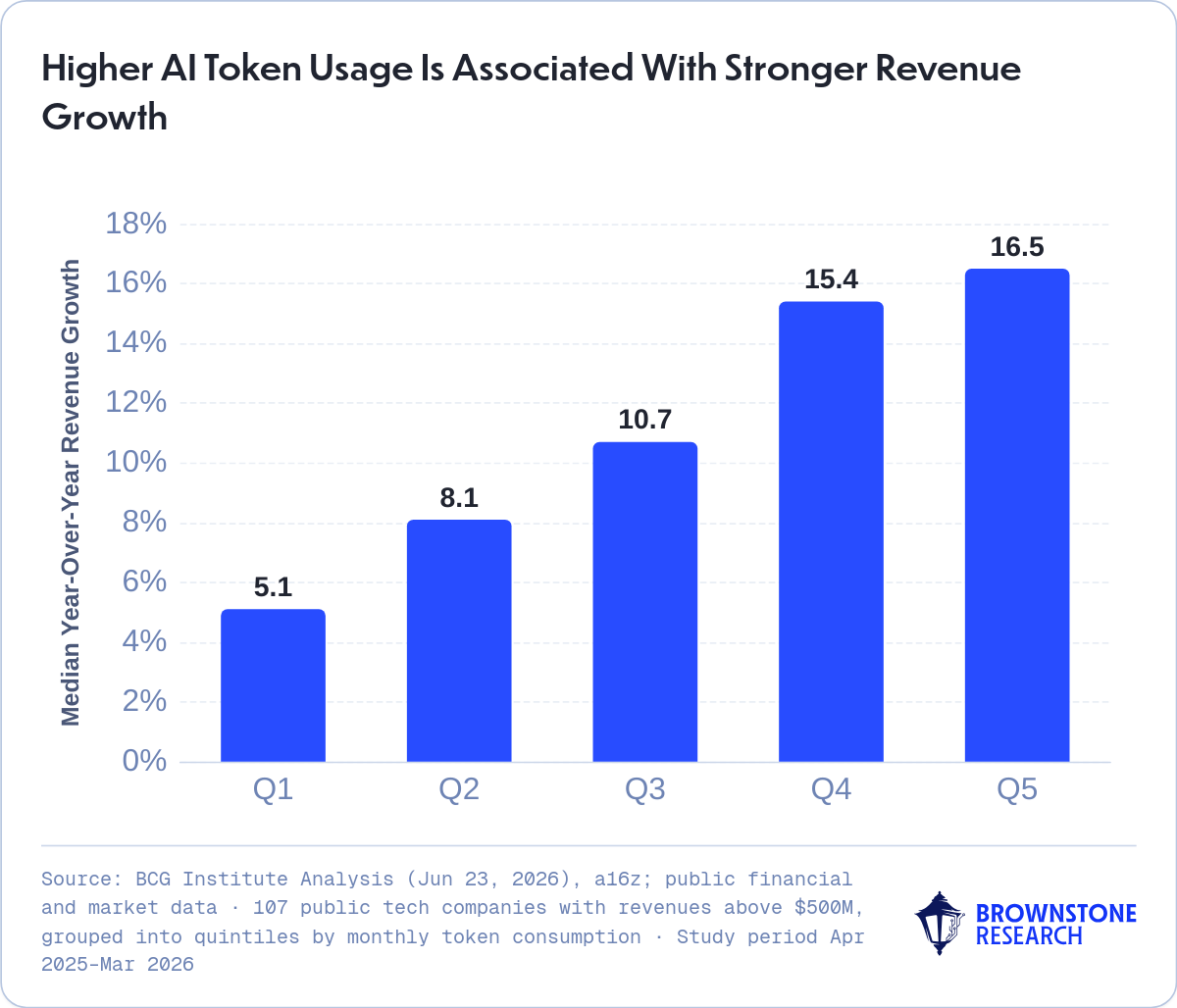
The quintile (Q) spending the most tokens grew revenue more than three times the rate of the companies using the fewest tokens. And the results improved across every single group.
Now correlation does not necessarily mean causation. Faster-growing companies may have more engineers, more digital workflows, and more money to invest in AI. The BCG study alone cannot tell us that AI caused every additional dollar of revenue.
But the same pattern is appearing across several independent data sets. PricewaterhouseCoopers (PwC) surveyed 1,217 senior executives across 25 industries. It found that just 20% of companies are capturing 74% of the economic value currently being generated by AI.
The leaders were not merely buying more AI subscriptions. They were twice as likely to redesign entire workflows around the technology. They were also 2.8 times more likely to increase the number of decisions made without direct human intervention.
Morgan Stanley has shown that adopters of AI are seeing both higher profit margins as well as increased future earnings projections.
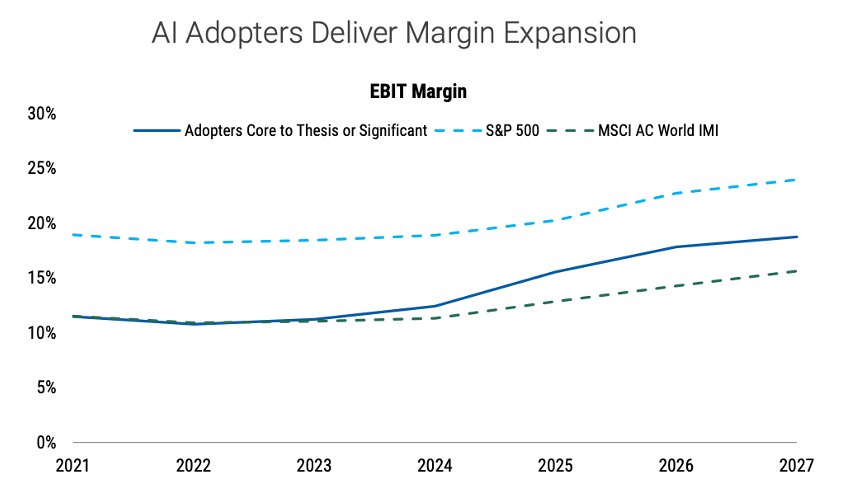
Source: FactSet, Morgan Stanley Research
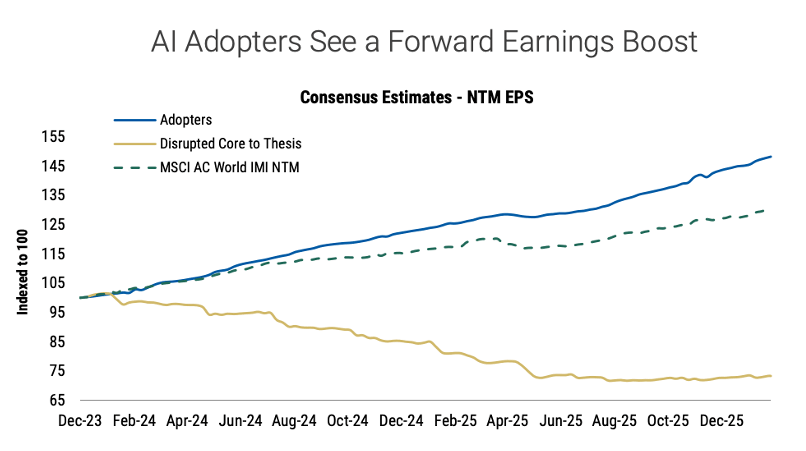
Source: FactSet, Morgan Stanley Research
We’ve long said that going forward, today’s companies will be broken into two cohorts: Companies that have adopted AI and companies that have gone bankrupt. There is no middle ground.
And companies are beginning to realize this…
Studies tell us that AI leaders are pulling away from the pack. And Palantir’s (PLTR) recent earnings results tell us that more companies are trying to join them.
Palantir builds the software layer that connects AI models to a company’s data and operating systems. This moves AI beyond a demonstration and into real business workflows.
On August 4, it reported earnings and smashed its expectations. Its overall revenue growth was 93% year-over-year to $1.9 billion.
But what really caught my attention was that its U.S. commercial revenue accelerated at an ‘otherworldly’ rate of 149% year-over-year.
And the company closed 220 contracts worth at least $1 million, including 73 contracts over $10 million.
This is a powerful demand signal. Businesses aren’t abandoning AI because the technology has failed to produce value…
They are spending aggressively to move it from pilot programs into production.
AI usage is still very unevenly distributed.
Fintech firm Ramp analyzed anonymized spending data from more than 70,000 U.S. businesses. The median company spent just $11.38 per employee each month on AI tools and services.
The top 1% of companies spent $7,449 per employee – more than 650 times the median.
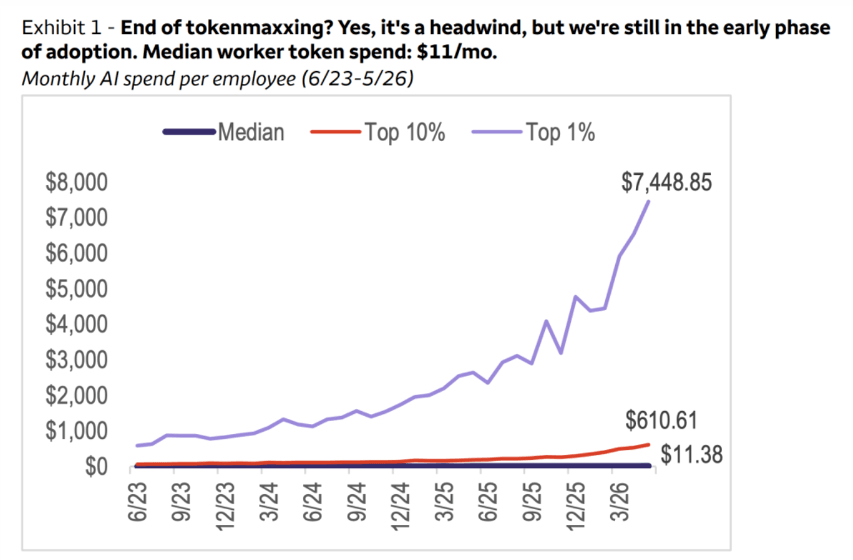
Source: Wells Fargo Securities, LLC, Ramp AI Index
The gap shows that businesses are moving along two different adoption curves.
The median company is still experimenting with a few software subscriptions. The leaders are treating machine intelligence as core infrastructure.
And once a company finds a workflow where AI generates measurable value, a powerful flywheel begins.
The flywheel begins inside the enterprise. A company uses AI to improve a valuable workflow. That produces more revenue, lower costs, faster product development, or better customer service.
The company then reinvests part of that economic gain into additional AI deployment.
Employees become more experienced. The systems gain access to more proprietary data. AI becomes integrated into additional workflows.
That produces more economic value. And the cycle repeats.
And these top companies are demanding more AI. And they’re adopting solutions to help them deploy the proper model, like Palantir’s Evolve model selection to help customers pick the best AI model.
And it’s looking like the best models for most companies come from Anthropic. Just last week, news broke that Anthropic’s quarterly revenue grew 14x year-over-year to $11.5 billion.
By my calculations, that puts them on pace to achieve $70-80 billion in annual recurring revenue (ARR).
This is the basis of why NVIDIA CEO Jensen Huang calls data centers AI factories. The hyperscale data centers are where the frontier large language models (LLMs) get trained or manufactured. And then the money comes when people pay to use them or run inference tasks.
As companies use more AI, they consume more compute. That creates demand for advanced semiconductors, high-bandwidth memory, networking equipment, data centers, and electricity.
The biggest winners of the AI cycle will not only be the companies selling chips, data centers, and foundation models.
They will be the businesses that turn cheap intelligence into better products, lower costs, and faster decisions.
And that advantage will compound. The leaders will reinvest the savings. They will collect more data. Their systems will improve. They will ship faster and serve more customers without adding costs at the same rate.
The companies that remain stuck in pilot mode will not necessarily disappear tomorrow. But they will be competing against businesses that move faster, learn faster, and operate with fundamentally better economics.
The gap between AI operators and AI tourists will widen. And investors will focus on who more efficiently turns compute into cash. We believe that most of the gains will go to the top companies. And those companies will see their share prices increase in multiples going forward.
Keep focused. Keep invested.
Regards,
Nick Rokke
Senior Analyst, Brownstone Research
Add Brownstone Research as your preferred source on Google to see our latest stories in your feed.
 Add as a preferred source
Read the latest insights from the world of high technology.
Tesla and SpaceX have now formed special committees to evaluate a potential merger between these two Elon Musk-led powerhouses.

This isn't about simply recreating the old system on new infrastructure…

As companies give digital workers more responsibility, protecting their systems becomes part of the cost of putting AI to...