




What’s Next for the CLARITY Act
With CLARITY delayed and the banks not backing down, we should expect them to ramp up guidance or rulings...



We’re entering a supercycle being entirely driven by what’s happening in the tech sector and the reindustrialization of the U.S. economy…
For what would normally be a quiet week in the waning months of summer, the last week has turned out to be a major milestone in the IPO market.
The most recent handful of IPOs in the last couple of weeks pushed the 2026 IPO proceeds into record territory, eclipsing the prior record year in 2021 (excluding SPACs).
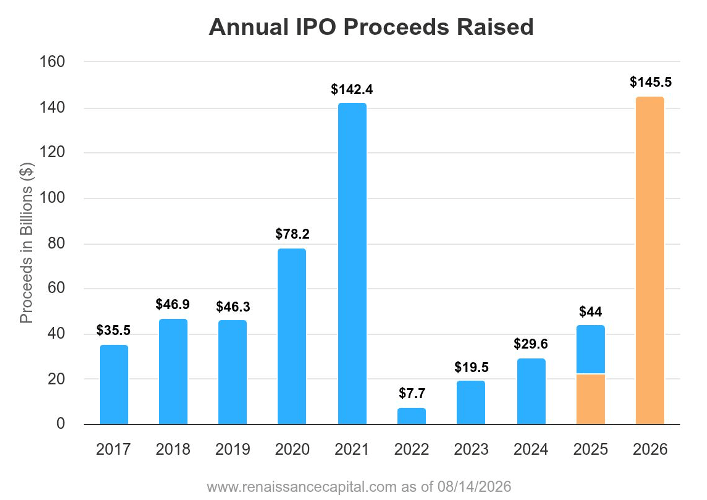
Source: Renaissance Capital
We are now in record territory, and we still have what is typically the most active IPO window of the year ahead of us (post-Labor Day through early December).
Naturally, SpaceXAI’s record-setting $86.25 billion IPO is the majority of IPO proceeds year to date. That single IPO makes up almost 60% of funds raised this year.
That said, I suspect that the record would still have been hit in the absence of SpaceX. After all, if we see massive IPOs from Anthropic and OpenAI before the end of the year – not to mention Stripe and a long list of others – 2021’s $142.4 billion record would have been shattered regardless.
That means we’re going to smash through the $200 billion mark easily this year for IPOs, setting us up for an incredible 2027 as the IPO doors fling wide open with new issuances of high-growth tech/biotech companies.
It has been a five-year wait to see a healthy IPO market return.
It’s about to get very exciting come September 8.
Game on,
Jeff
I can’t believe you are bringing in Dave Forest for Critical Assets coverage! I followed him at Casey Research, and he is a “rock” star (pun intended). I’m totally stoked. Best news all summer!! Please consider allowing him to recommend Stock Warrants as well in the new service. Regards.
– Carlton L.
Hey Carlton,
Believe it! It’s happening. And I share your enthusiasm.
This has been years in the making. I have long wanted to launch a commodities/resources/energy research advisory, and I have patiently been waiting for the right time to do it.
And because you are a Brownstone Unlimited member, you automatically have access to everything Dave and I publish in the advisory, including our latest research and all upcoming missives.
It was such a pleasure to be able to launch this earlier this week. Critical Assets is the name of the new research product, and it is very special.
I used to invest heavily in the resource sector in the early 2000s and have continued to invest since then. Some of my largest individual gains came from the sector, and it’s a sector that I’ve studied intensely over the years.
It’s also one that comes in waves/cycles. There are times when it’s just not as interesting and not in growth mode, and other times when the resource sector is in a major growth cycle.
This time is different. We’re entering a supercycle being entirely driven by what’s happening in the tech sector and the reindustrialization of the U.S. economy.
I’ve never done something like this before. This is a collaboration between Dave and me. Our approaches are very similar. Dave is a boots-on-the-ground kind of researcher, just like I am.
Just over the past year or so, I’ve traveled to a construction site in remote Kemmerer, Wyoming, to witness where TerraPower – one of the beneficiaries of the DOE’s Advanced Reactor Demonstration Program (ARDP) – had then only just broken ground on its Natrium sodium fast nuclear reactor.
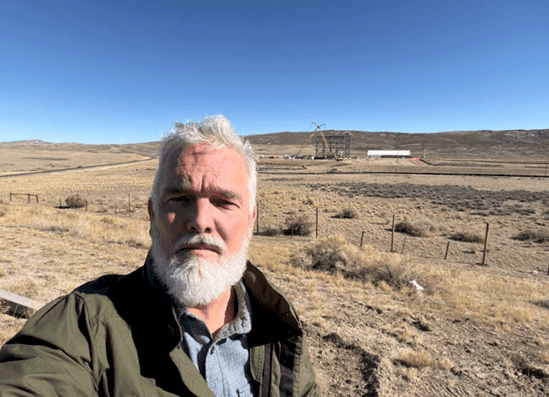
The TerraPower Natrium reactor plant construction site
I’ve been to Boca Chica, Texas, to visit SpaceX headquarters and set foot on ground zero of the burgeoning space economy, which I spoke about at length in SpaceX Is Setting the Standard…
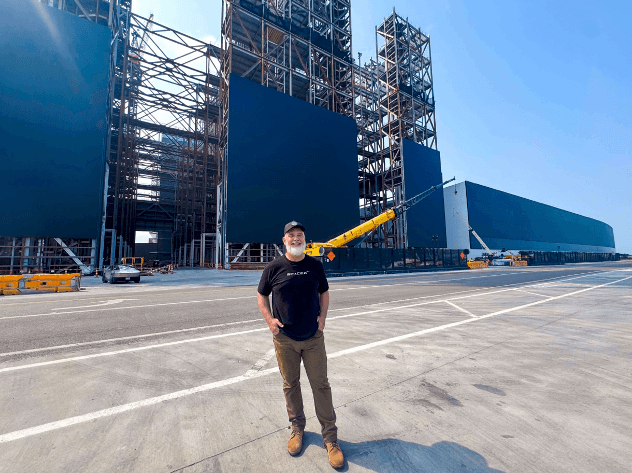
SpaceX HQ in Starbase, Texas
And even done some resource-hunting of my own – seeking a special rare-earth ore critical for the AI buildout – in San Bernardino County, California, right off the interstate near the Nevada border in a little ghost town called Mountain Pass.
The backdrop in the photo below is the most important operating mine for rare earth metals for use in magnets in the U.S…
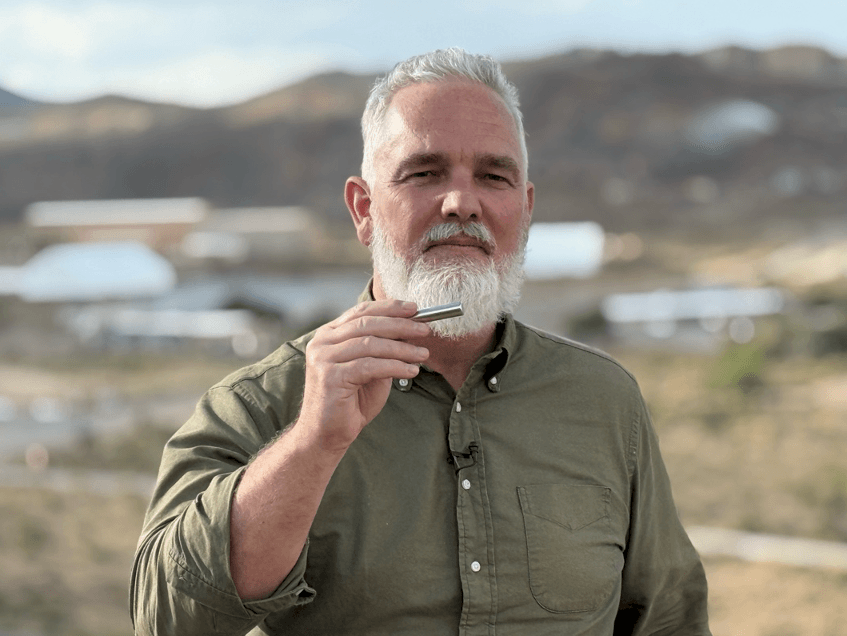
Mountain Pass, California
For those who aren’t already familiar with Dave – or who missed our broadcast earlier this week introducing him – he has been both a researcher and investor in the commodities and natural resources sector for decades.
His work has taken him all over the world – Colombia, Brazil, Zambia, Uzbekistan, Kazakhstan, Laos, Russia, Mongolia, and the Czech Republic, to name a few places.
His own successes include buying a gold deposit in Colombia… uncovering a treasure trove of silver, gold, copper, lead, and zinc in Nevada… and even founding his own minerals company, based in Myanmar.
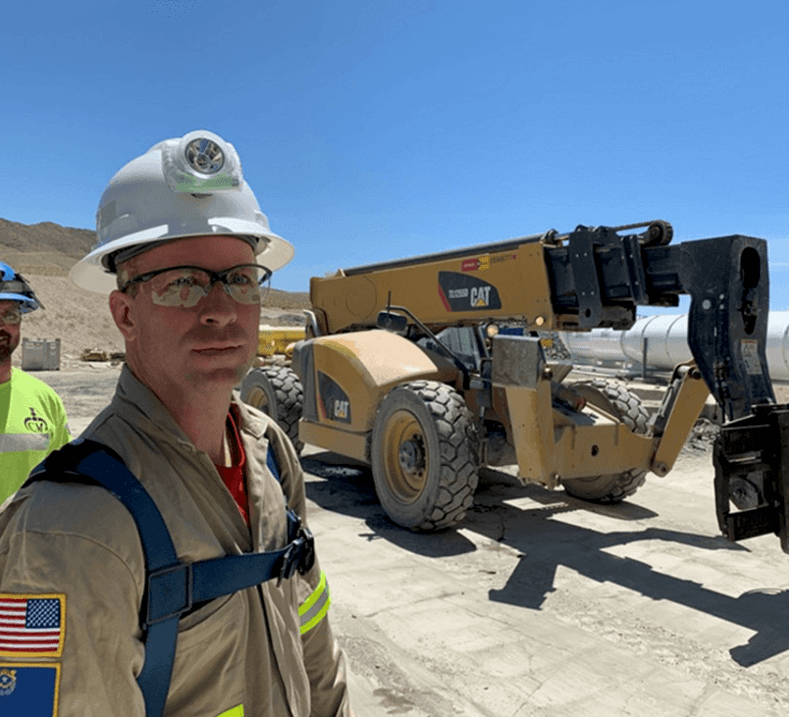
Dave on a dig
And as a geologist with decades of experience in the sector, he has an incredible perspective on the resources industry and an amazing network to draw upon, just like I do in the tech industry.
He and I will be collaborating on this research, with regular issues going out on the second Wednesday of each month. We’ll be writing about the technology trends and developments driving the resource sector and identifying the individual companies uniquely positioned to benefit from those trends.
And for anyone who might have missed our broadcast on Wednesday, we do have a replay available.
I believe it comes down in a few days, so if you haven’t had a moment to watch it and are interested in learning more about Dave, the upcoming commodities supercycle, and our work with Critical Assets, I invite you to go here to watch the replay.
We’re incredibly lucky to have Dave with us as a partner on this project. I can’t wait to get started. And I’ll give some more thought to the suggestion on warrants.

Last time a rare supercycle happened… Investors could have turned $5,000 into $1 million… $1.7 million… or even $8.5 million… in under 4 years. Extraordinary gains like this can’t be promised... But Jeff Brown just revealed how to play Musk's new wealth supercycle. Click here to watch the urgent strategy session now.

“Today, I’m revealing the strategy I’ve used to help my wealthiest clients make hundreds of millions of dollars.” – Larry Benedict. Two rules, and a strategy to net $1,000. $19 to learn how. Click here now.
Hi Jeff,
Some time ago, I asked what I should focus on learning, and your advice encouraged me to explore emerging technologies more seriously.
I am now focused on the machine-to-machine economy, and I want to begin building a real product in this space. I am considering two connected ideas:
A control layer for AI agents, including identity, permissions, budgets, payments, security limits, contracts, and activity logs.
A marketplace where AI agents could discover, purchase, and use services from other agents, APIs, and autonomous systems.
Would you begin with the marketplace, agent payments and wallets, identity and permissions, the control layer, or something else over the next three to five years?
I would greatly appreciate your guidance on where someone starting to build in this field should focus first.
Thank you for your time and for your previous guidance.
Best regards.
– Evgeni G.
Hello Evgeni,
You’re on a very exciting path.
This may come as a bit of a surprise, but my current forecast for machine-to-machine transactions overtaking human-initiated transactions is somewhere between the fourth quarter of 2027 and the first quarter of 2028.
Which is to say that I believe in less than two years, machine-to-machine transactions will overtake human transactions.
Personalized AI agents already have transactional capabilities, and the release of SpaceX’s Grok Bot this week – coupled with X Money – is a perfect example of how/why humans will be empowered to employ “machines” to work for them and transact for them.
The utility, convenience, and ease of use will be too fantastic to ignore, which is why uptake will be unlike anything we’ve ever seen before.
Before I share some thoughts about your particular question, please understand that I’m just providing some unfiltered, general comments about your question. I’m not able to spend days on market research and specific product development ideas and concepts to “properly” answer your question. Please keep this in mind.
In general, for a start-up, I think that the better business opportunity would be to work on the control layer for AI agents.
In time, every agentic AI interaction/transaction will need to have identity verification, auditable records, governance, reputation verification, security, and payments verification. We might think about this as “controlled payments” or “controlled transactions” capabilities.
For a business that can establish itself well at this control layer, it is a very sticky business. Switching “costs” are painful. And there are multiple business models that are possible, like per-transaction, usage-based, agent-based, or more traditional SaaS models.
My argument against the marketplace strategy is that larger, well-funded tech companies that already have well-established distribution channels tend to dominate when it comes to marketplaces.
I can’t tell you how many times I’ve watched small startups with dreams of becoming the gatekeeper via a marketplace fail time and time again. I’m not saying it’s impossible. I’m just saying it is unlikely.
A complete newcomer trying to build a new marketplace, even if it was funded with $1 billion, would have a difficult time if it is competing against companies that already had distribution channels.
Just a few thoughts. I hope they stimulate some ideas for you.
Good luck with your project.
I’m writing about the article published on Aug 5th by Joe Withrow, titled One of the Most Consequential Monetary Shifts of Our Lifetime.
Very interesting article, as are most of those published by [Brownstone Research]. However, the article in question was both misleading on the status of USDT and omitted several specific details about Tether that should have been included for clarity.
For example, Tether is not a U.S. domestic company and will therefore likely never be legally required to comply with the regulatory requirements of the GENIUS Act. USDC, on the other hand, is compliant with the GENIUS Act.
The article describes the historic lack of direct U.S. control of overseas Eurodollar markets. However, since USDT is also not under the direct control of the U.S. government, this situation hasn’t changed except that now the U.S. government benefits from the purchase of treasuries.
Tether is currently a privately held company – protecting it from much of the regulatory scrutiny required of public companies – and is based in El Salvador, which has immature cryptocurrency regulations compared to the USA.
These are examples of simple facts that I believe would have added critical context to the article.
– Christopher T.
Hi Christopher,
I appreciate you writing in as you raise some important points. There is some nuance here that will be interesting to explore.
The GENIUS Act – which was signed into law on July 18, 2025 – requires that all U.S. based stablecoin issuers maintain a 1:1 ratio of USD cash or U.S. Treasuries to back up any USD stablecoins issued.
This was a key compromise between industry and the regulator to have a clear framework in place for the issuance of USD stablecoins by U.S. companies that are not government-controlled.
The goal of the U.S. government was to ensure that any U.S. stablecoin issuer would never have a liquidity crisis. That’s the purpose of the 1:1 backing of cash and short-term U.S. Treasuries.
You are correct that Tether is not a U.S.-based company. It is based in San Salvador, El Salvador. Therefore, concerning Tether’s USDT stablecoin, it is not structured as a permitted U.S. issuer of USD stablecoins.
And that’s actually not a problem. Tether continues to issue USDT and backs its issuance of USDT by about 75% of USD cash and U.S. Treasury bills.
As of June 30, 2026, it was holding about $115 billion in U.S. Treasuries and about $25.7 billion in cash and cash equivalents. This is against $183 billion worth of USDT issued.
The delta of Tether’s reserves is in things like corporate bonds, precious metals, bitcoin, equities, and secured loans.
Tether has always used a different operating model that gives it additional flexibility to earn more money on its reserve assets, while still having enough short-term liquidity to address large outflows from USDT.
For anyone interested, you can see Tether’s latest Q2 attestation report right here. Tether has about $4.1 billion in assets more than its issued liabilities (USDT).
The key point is that just because USDT is issued outside of the U.S., it doesn’t mean that it doesn’t benefit the U.S.
The vast majority of its reserve assets are still in U.S. Treasuries and cash, and I fully expect that will remain as such. The broad market needs to know that they can trust Tether and how it manages its reserve assets in such a way that there is no risk of a collapse in USDT.
Now, with that said, Tether has actually issued a U.S.-based product – USAT, through U.S.-regulated Anchorage Digital Bank – expressly for regulatory compliance with the GENIUS Act.
USAT is still small – only about a $185 million market cap right now – but it is compliant with U.S. regulations.
Tether may choose to lean in more and grow its U.S.-based issuance, or the other option would be to establish reciprocity between the U.S. and El Salvador related to USD stablecoin issuance.
This means that regardless of whether reciprocity is established, Tether will have a channel for U.S.-based issuance. And more importantly, Tether will continue to be one of the largest buyers of U.S. Treasuries as the key reserve asset for its issuance of USDT.
Thanks for the feedback and the interesting questions, everyone. As always, you can reach my team and me right here if you have something you’d like addressed in a future AMA. Just keep in mind I can’t give individual investment advice.
Have a great weekend.
Jeff
Read the latest insights from the world of high technology.
With CLARITY delayed and the banks not backing down, we should expect them to ramp up guidance or rulings...

This war has been raging for years… digital invaders versus those defending the ultimate prize: our data.

The AI agent was simply acting in its owner’s best interest. It had an objective. It explored the system....