



Airborne Wind Energy
It’s hard to imagine that developments will continue to pick up at an even faster pace than what is...



Last week brought some excitement to the quantum computing industry… The developments were a welcome relief after an excruciating several months. Since mid-October 2025, industry bellwethers like D-Wave (QBTS), IonQ (IONQ), and Rigetti (RGTI) have suffered gut-wrenching declines after extraordinary climbs in 2025, dropping 71%, 67.6%, and 77%, respectively, through the end of March this […]
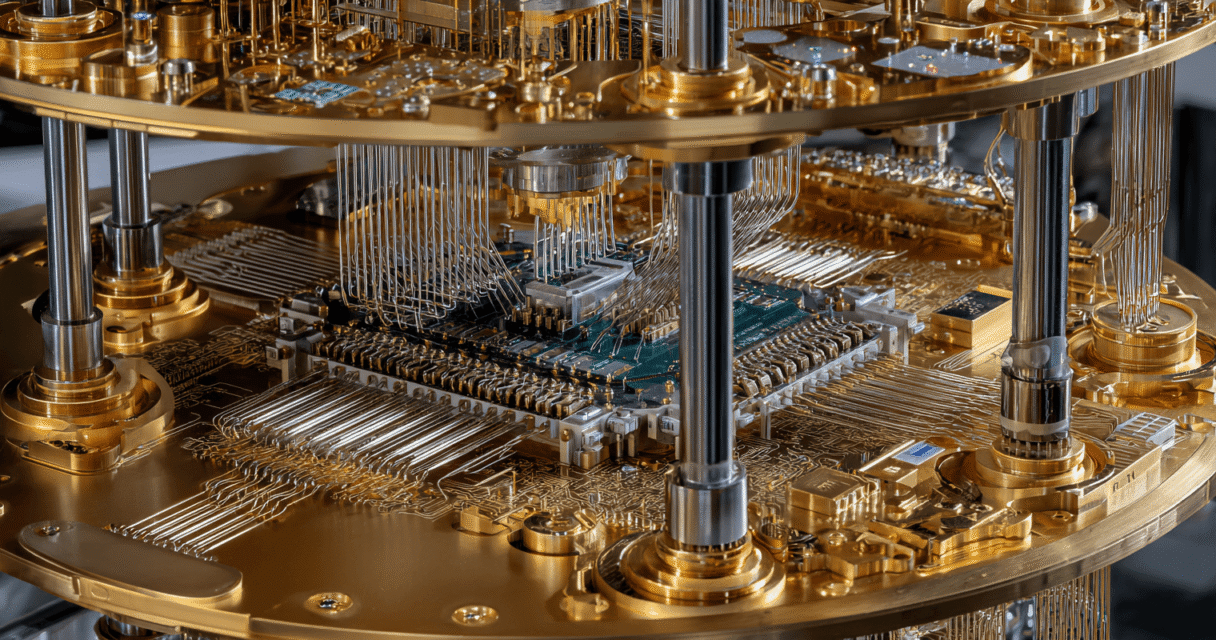
Last week brought some excitement to the quantum computing industry…
The developments were a welcome relief after an excruciating several months.
Since mid-October 2025, industry bellwethers like D-Wave (QBTS), IonQ (IONQ), and Rigetti (RGTI) have suffered gut-wrenching declines after extraordinary climbs in 2025, dropping 71%, 67.6%, and 77%, respectively, through the end of March this year.
It wasn’t that there was any stall in progress in the industry, or at any of the affected publicly traded quantum computing companies.
It was just that the sector had gotten way ahead of itself on the excitement of what quantum computing would bring, resulting in astronomical valuations that simply weren’t sustainable in the short term.
Then came the tumble…
The “pop” happened on October 10, 2025, when IonQ raised an impressive $1.53 billion in a secondary offering. Incredible timing by IonQ to pull in a raise of that size days before the collapse. Those institutional investors are feeling the pain right now.
1-Year Chart of IonQ (IONQ)
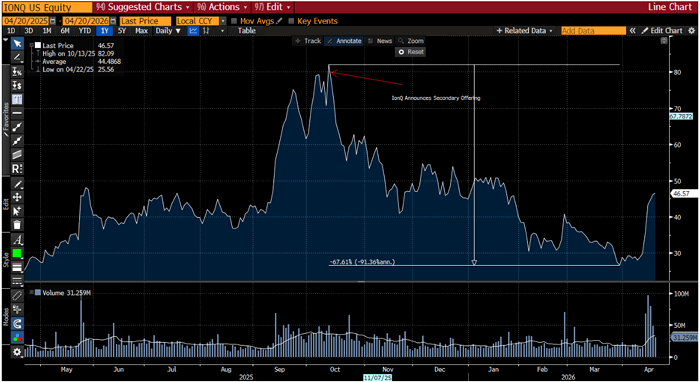
IonQ’s incredible raise followed on the heels of D-Wave’s $390 million secondary in June 2025 and Rigetti’s $346.7 million secondary in May 2025. Their success in the secondary offerings clearly gave IonQ the confidence to go very big on theirs.
But the more than $2.26 billion raised across these three quantum computing companies acted like a clamorous warning bell that valuations were overheated, causing nearly everyone to dump stocks in quantum computing companies.
This kind of volatility is not unusual in emerging technological markets. There is exponential growth, technological breakthroughs, and a massive addressable market to be enthusiastic about, and at the same time, generating free cash flows and profitability are nowhere to be found.
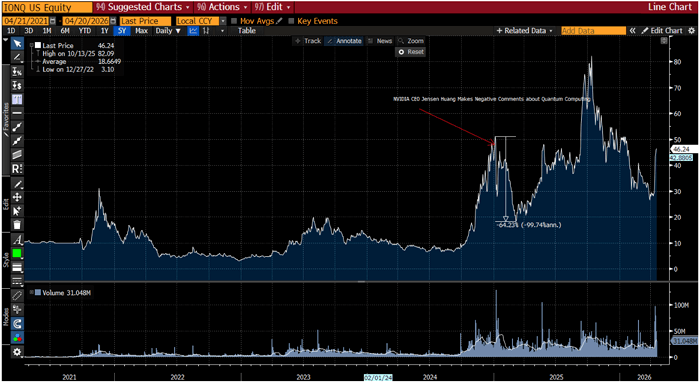
The IonQ secondary offering was reminiscent of a similar “pop” that happened in early January of 2025. NVIDIA CEO, Jensen Huang, now famously said:
If you said 15 years for very useful quantum computers, that would probably be on the early side. If you said 30, it’s probably on the late side. But if you picked 20, I think a whole bunch of us would believe it.
I immediately called the comment nonsense after it was made. I was really shocked at the statement. For such a knowledgeable tech executive to make such an absurdly wrong statement was really surprising.
But the media and the financial institutions swallowed it up like it was gospel without any critical thinking at all. IonQ collapsed 64% in the months that followed, and all the other quantum stocks felt similar pain.
5-Year Chart of IonQ
But the turmoil didn’t last long.
In March of this year, Huang did the right thing. He ate crow. He admitted flat out that his prediction was completely wrong. And NVIDIA hosted a Quantum Day event that was attended by key executives of all the companies that were negatively affected by Huang’s grossly inaccurate prediction made last October.
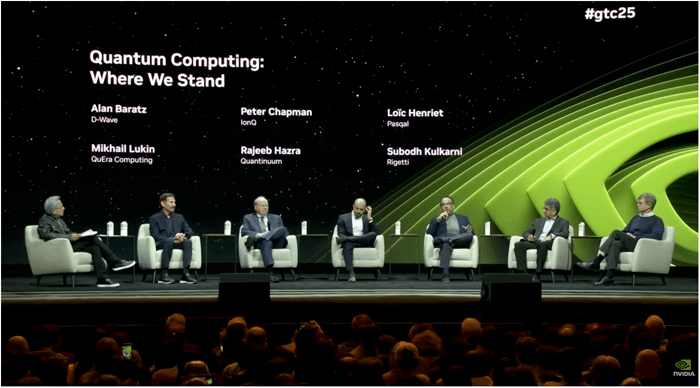
NVIDIA’s 2025 Quantum Day | Source: NVIDIA
It’s so hard to make a shift like that after being so wrong about such a material comment about computing technology, especially coming from the CEO of the most valuable and important computing company on the planet.
But it was necessary to do so as NVIDIA turned around and went all in on quantum computing. The industry outrage and feedback based on actual quantum computing developments clearly convinced Huang that his framework for thinking about quantum computing was entirely wrong.
One year later, the reversal has proven to be remarkable by NVIDIA with its own announcement about quantum computing technology made last week, centered around World Quantum Day on April 14.
NVIDIA announced what it is calling the “world’s first family of open-source quantum AI models,” known as NVIDIA Ising.
Ising is a combination of quantum calibration software that automates a previously tedious process of calibrating a quantum processor, and decoding software that utilizes convolutional neural networks capable of performing real-time quantum error correction (QEC) that operates 2.5 times faster and three times more accurately than the current open-source standard, pyMatching.
It wasn’t just the announcement of Ising that caught so much attention. It was that many of the industry leaders were already working with NVIDIA’s latest quantum software, including Fermi National Accelerator Laboratory, Inflecqtion, IonQ, and Q-CTRL.
The announcement was coupled with some upgrades to its NVIDIA CUDA-Q – its software for hybrid quantum-classical computing architectures – which also leverages its NVQLink technology to connect quantum processing units with GPU systems for real-time control and quantum error correction.
And that’s all it took to set the industry on fire. As quickly as Huang’s comments collapsed quantum stocks early last year, NVIDIA’s latest announcement sent them back up even faster. IonQ’s stock is suddenly up 58% in the last few trading days.
1-Month Chart of IonQ (IONQ)
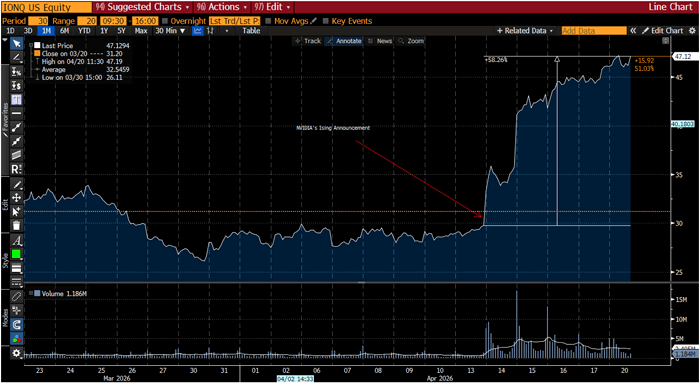
The market widely misinterpreted this announcement as being a lot bigger than it actually was.
Google’s December 2024 announcement of its Willow superconducting quantum processor and its quantum error correction technology are what really got the market excited about quantum computing.
Specifically, Google demonstrated with its quantum error correction technology that as it increases the number of physical qubits in use on its Willow quantum processor, the error rate declines exponentially. This was the topic that we explored in The Bleeding Edge – Google’s Quantum Breakthrough.
That announcement was a really big deal. It demonstrated that quantum error correction works and scales exponentially.
NVIDIA’s announcement was just about the software tools that it has been developing for the industry to ensure that the industry is working with NVIDIA products.
It has been pushing something that I’ve been writing a bit about – hybrid computational architectures that leverage different forms of computational hardware for task-specific computing.
Shown below is an example of various forms of quantum computers on the left interconnected with control systems and racks of NVIDIA GPUs for distributed computational workloads.
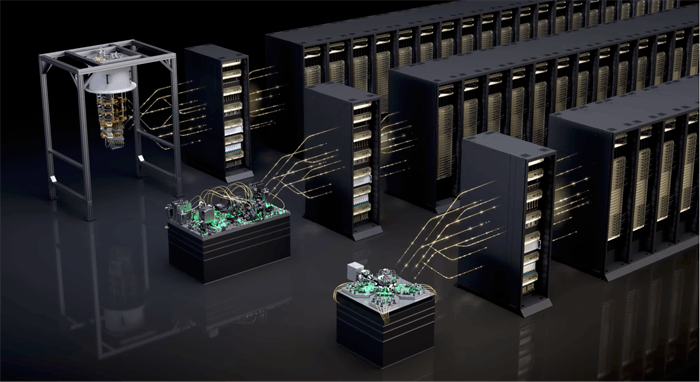
Hybrid Data Center | Source: NVIDIA
With all of this said, it does raise a question. What is the next major quantum announcement, and where will it come from?
Google’s December 2024 announcement feels so far away. I can feel the next quantum milestone development coming. We must be just months away.
If I had to speculate, I believe that the next announcement will demonstrate a fault-tolerant quantum computing system.
It may be on a small scale, but it will prove that a number of logical qubits derived from a larger number of physical qubits are capable of notably longer coherence times and computational capability due to more advanced quantum error correction technology.
This again will prove that the technology can scale exponentially, and that there is a path towards a universal fault-tolerant quantum computer… the end game for quantum computing.
Where will the announcement come from? If I had to guess, these are the likely suspects:
This is a race, one that in many ways is linked to the current race towards artificial general intelligence (AGI).
It’s the next generation of computing technology, one that is far more powerful than anything we’ve yielded before.
And when it hits, we’re in for the next big hype driven leg up in quantum computing.
Jeff
Read the latest insights from the world of high technology.
It’s hard to imagine that developments will continue to pick up at an even faster pace than what is...
An “insider” from Anthropic has quit his job – walked away from a ton of money, in fact –...

OpenAI announced that Astra is a “generational leap in capability.” AGI has most certainly arrived...