



Anthropic’s Risky IPO
Anthropic’s gig could be up, and its value as a private company could collapse.



We are now entering a world of permissioned AI use. And it’s fueling conversations around alternatives.

Managing Editor’s Note: Today, we turn to senior blockchain analyst Ben Lilly…
Over at his Chain of Thought e-letter, Ben explored the recent restrictions imposed on Anthropic’s latest Claude AI models – Fable 5 and Mythos 5… and how we are now entering a world of permissioned AI use.
It’s no doubt a familiar conflict for digital assets investors and enthusiasts. Pushback against open and permissionless ecosystems leading to advocacy for permissioned, government-controlled walled gardens.
And as you’ll hear from Ben today, as we begin to see companies capitulate to these demands for so-called guardrails, we’re seeing a corresponding push for better decentralized AI solutions. Read on for more from Ben…
The word just came down…
Anthropic – creator of the Claude LLM – is restricted from exporting the technology outside the U.S.
More specifically: On June 12, the Commerce Department issued a directive restricting all foreign nationals from gaining access to Anthropic’s latest models, Claude Fable 5 and Claude Mythos 5.
For some context, these are the models that Anthropic predicted would cause a cybersecurity “reckoning.”
Before the rollout, Anthropic took the time to give large American companies early access via Project Glasswing. The idea is that the companies could stress test their own code before the models were unleashed.
That, apparently, was not enough. The government now says Anthropic must obtain an export license for the models.
This presents a problem…
Anthropic cannot reliably filter its users by nationality. So, the company did something else. It temporarily pulled the plug on both models.
If you use Claude, you might have noticed:
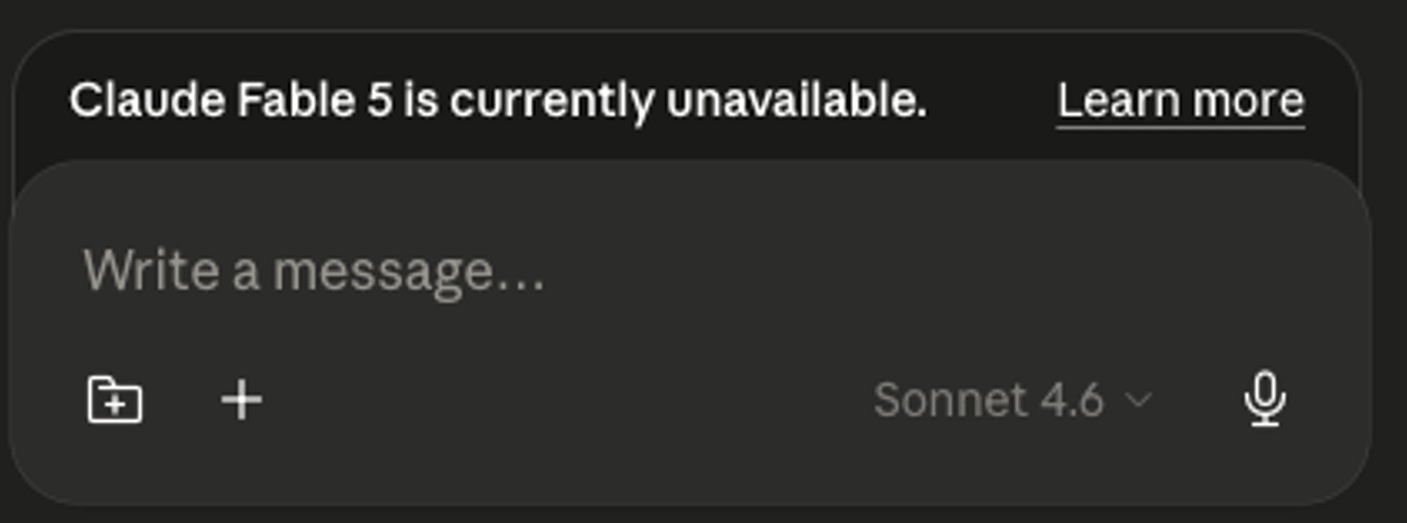
It’s an event that took many users of AI by surprise. Anthropic was seemingly rolling out this technology responsibly. But in the view of the U.S. government, it was not responsible enough.
And here we arrive once again at a debate that digital asset investors know very well: Permissioned, government-controlled walled gardens vs. open and permissionless ecosystems.
In the AI arena, this debate will only grow louder…
The only way a company like Anthropic could comply with this new directive is by gathering personal information and documents tying a user to a real-life individual.
This is no longer speculation.
Anthropic released new terms of service to its users yesterday afternoon.
It included this gem:

Source: Anthropic
We are now entering a world of permissioned AI use. And it’s fueling conversations around alternatives.
The leading frontier models from the likes of Anthropic, OpenAI, and Google are warehoused and controlled. The model, the data – all of it is behind lock and key. These AIs are, essentially, “closed.”
But there is another crop of competitors few have heard of. They operate with a permissionless, decentralized, and open-source ethos. The “open.” Some of the names in this arena are Llama, DeepSeek, and Kimi.
The reason you probably haven’t heard much about these models is that they’re not really considered a competitive threat to the closed systems.
But something is beginning to happen…
In terms of performance, open models only lag closed models by a few months.
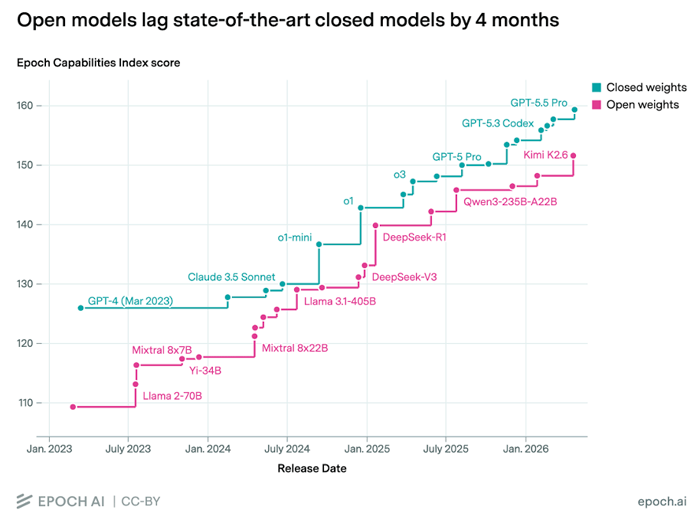
Source: Epoch.ai
This is significant considering the leading models are more than 40 times the price per input token than the leading open-weight model.

Source: Venice.ai
The gap is narrowing.
That means any small adjustment to how these models are trained, source data, or incentivizing contributors could close the gap entirely.
Very soon, AI users could face a choice: Onerous controls forced on them from the closed models… or an open-source alternative that is just as good.
Today, we’re talking decentralized AI, or DeAI for short.
Earlier this year, decentralized AI had an extraordinary breakthrough.
It came from a group operating on a decentralized and permissionless network referred to as Bittensor.
We can think of this layer-one network as an arena of competitors that try to earn the network’s native token called TAO. It’s not that dissimilar from Bitcoin.
The main difference is that the Bitcoin blockchain uses computer hash power to compete to solve a problem to win Bitcoin as a reward. For Bittensor, it’s about doing work that is valued by the network. Most of that work is around AI.
Earlier this year, a group ran a pre-training run over a fully decentralized and permissionless infrastructure. The LLM had 72.7 billion parameters.
It was a remarkable achievement as the hardware that was used for the pre-training was spread across more than 70 independent participants. The participants didn’t know each other, nor did they have to submit personal details of their identity.
It was permissionless.
And what the run proved was that this type of infrastructure was feasible for an LLM. For decentralized AI, it was a “zero-to-one” moment. And it suggests we’re about to witness a new era of model development using non-centralized setups, and the models will get better at an accelerated pace.
Earlier this month, another group in the Bittensor ecosystem called Macrocosmos.ai released a 100 billion parameter model called Orion-100B.
It was a model that went a step further than Covenant in terms of parameter size and its solution by proving that underutilized computing power can be harnessed across the globe to develop frontier-level training capacity.
The significance of this moment cannot be overstated.
And as the chart shows below, it represents an inflection point in the history of progress of decentralized LLM training.
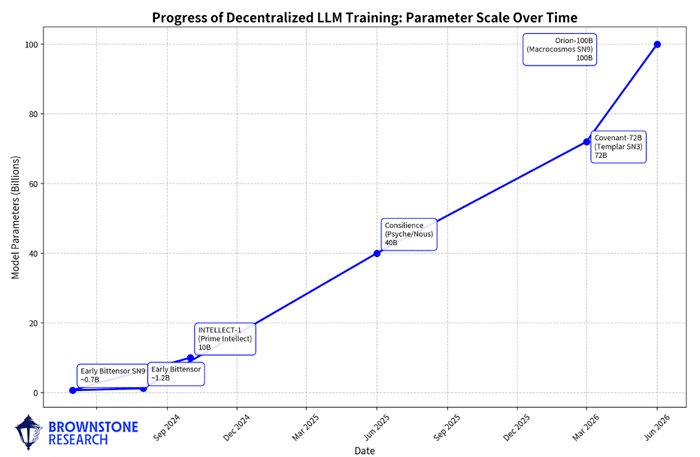
In the span of two years, this area of model development has gone from a sub-1-billion parameter size to 100 billion.
And while the leading frontier models are in the trillions, the gap is about to close at an accelerated pace. I wouldn’t be surprised to see the first trillion-parameter model trained in a decentralized manner in the first quarter of 2027.
GPU capacity for developers experimenting with this architecture is increasing by the day. And software is progressing in terms of running a decentralized training run to unlock this untapped compute.
It’s truly impressive when we begin to consider that these decentralized training runs can coordinate across compute with participants coming online and offline throughout the process…
That was the gap that was just closed.
In other words, the resources to build and experiment with these decentralized solutions are all there. And it’s only set to grow. And the decentralized AI solutions that spring from this experimentation will not be asking you for your driver’s license or Social Security number.
It’s the permissionless ethos… and it’s coming to artificial intelligence in a big way.
Subscribers to our premium crypto research service, Permissionless Investor, are already positioned for this exciting trend.
It’s reminiscent of Bitcoin bursting onto the scene just as world governments were implementing top-down policies on finance.
It showcased the need for a sovereign, decentralized, and permissionless money system outside of government control.
And here we are again…
There is, once again, the need for sovereign, decentralized, and permissionless solutions.
Only this time it’s involving the hottest technology of the day.
Your Pulse on Crypto,
Ben Lilly
Editor, Chain of Thought
Add Brownstone Research as your preferred source on Google to see our latest stories in your feed.
 Add as a preferred source
Read the latest insights from the world of high technology.
Anthropic’s gig could be up, and its value as a private company could collapse.

This morning, SpaceX launched the 14th flight of its Super Heavy booster and Starship from its Starbase, Texas facility,...

In today’s AMA, we explore the true utility of full self-driving vehicles… what to do when markets crash… and...