



Airborne Wind Energy
It’s hard to imagine that developments will continue to pick up at an even faster pace than what is...



The CEO of NVIDIA (NVDA) has stirred up a frenzy in the world of artificial intelligence…

Managing Editor’s Note: Don’t forget to secure your seat for Wall Street insider Jason Bodner’s upcoming event: The Nasdaq Glitch.
Jason discovered an obscure market anomaly during his 25 years on the trading floor. He calls it the Nasdaq “glitch.” And when his system spots one of these glitches, that stock tends to take off soon after – potentially hundreds or thousands of percent.
And now, this glitch has just flashed on another set of stocks… And Jason believes they could start climbing as soon as August 14.
The event is free to attend. You just need to make sure your name is on the guest list. You can click here to sign up automatically to join him on Wednesday, July 29, at 8 p.m. ET.
On Friday, the CEO of NVIDIA (NVDA) stirred up a frenzy in the world of artificial intelligence.
With a post on X, he came out in support of open AI models.
You might be thinking, so what? Seems normal… Not a big deal.
But the context and timing of Huang’s position are critically important to understand.
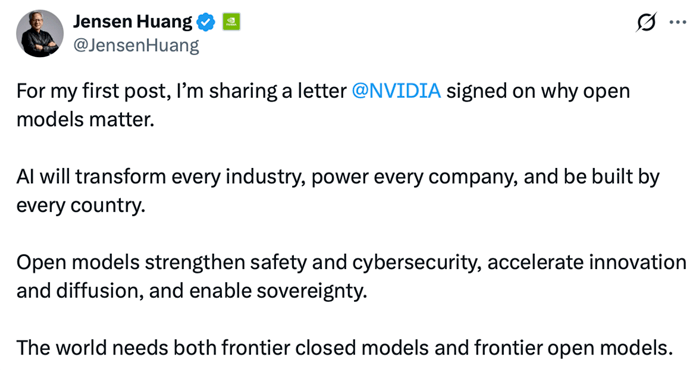
Source: X @JensenHuang
Notably, this marks the very first time Huang has posted anything on X.
And as the CEO of the world’s most valuable company, and one of the most important AI hardware companies in the world, everyone paid attention.
The post was a letter that he wrote to the industry about the importance of, and support for, open AI models in the U.S.
It’s titled Open Weights and American AI Leadership.
It’s short, and for those interested, you can find it right here.
For reference, “open weights” refers to an AI model whose parameters are made public. And an open-weight AI model can be downloaded by anyone, modified, and used for free. What remains closed is the dataset used for training and the training process.
For a quick summary of the key messages in Huang’s letter, below are a few pertinent lines from what Huang outlined:
Our AI leadership will be judged not by one frontier AI model, but by whether the United States builds a strong, open ecosystem that diffuses into every sector […]
Open weights expand access to the AI economy. Startups, established businesses, universities, and public institutions can build on advanced models without training one from scratch or paying frontier-model prices for every task […]
Open weights let every organization match the right model to the right job at the right cost, reserving frontier-scale capability for genuine frontier problems and running efficient, specialized models everywhere else […]
Reading the above, it is clear that this is just common sense.
The employment and support for open-source software and standards underpins the entire internet and enabled the resulting productivity boom.
It’s hard to argue against anything Huang presented to the industry. And so, the response was as expected…
It was a pile-on.
Elon Musk quickly supported with: “This has my full support. Jensen is right.”
Sam Altman, CEO of OpenAI, joined in.
Satya Nadella, CEO of Microsoft, did the same.
Sundar Pichai, CEO of Google, offered his support, noting the success of its own Gemma open-weight model.
The list is long, but in the outpouring of support, there was only one notable absentee…
Anthropic.
This is where the story gets really interesting, because it’s not about what was signaled and said… It’s all about what wasn’t said.
The catalyst was the release of an open-weight AI model by Beijing, China-based Moonshot AI, whose legal name – ironically – is Beijing Moon’s Dark Side Technology Company.
The released AI model is known as Kimi K3.
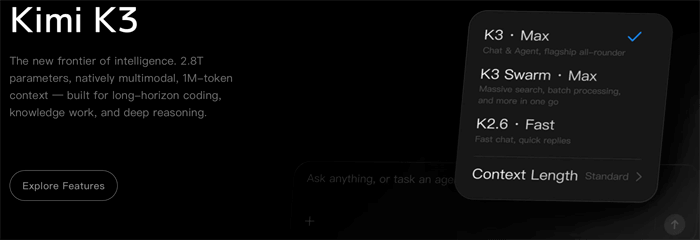
Kimi K3 | Source: Moonshot AI
Kimi K3 caught the attention of the entire industry, as it demonstrated near state-of-the-art (SOTA) performance on many benchmarks.
Below is just an example of performance for different software coding benchmarks.
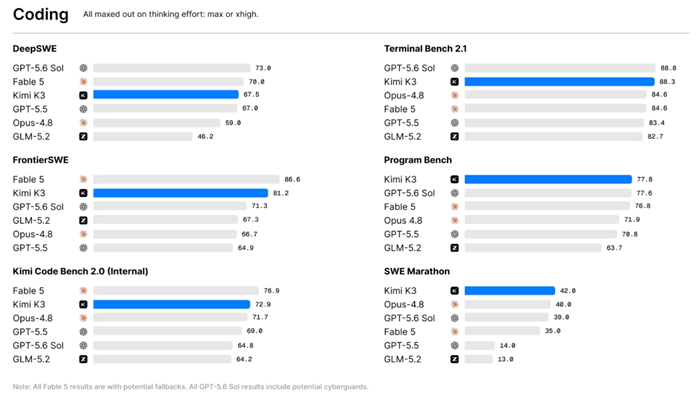
Source: Moonshot AI
It wasn’t the performance that shocked the industry.
It was that the company had only been formed in 2023…
And up until January of this year, it had only raised about $3 billion – a tiny fraction of the capital invested by the industry giants building frontier AI models, like OpenAI, Google (GOOGL), Anthropic, and xAI (now SpaceXAI).
Striking was Kimi K3’s dramatically low cost per task, compared to other leading frontier AI models as shown below.
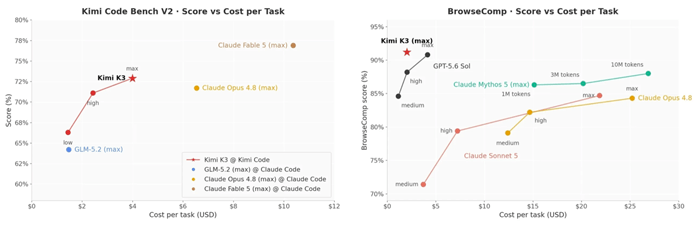
Source: Moonshot AI
The takeaway: Kimi K3 matches or beats the frontier Claude models from Anthropic on score while costing a small fraction per task.
On BrowseComp (a benchmark that tests how well an AI model can browse the live web to answer hard, fact-finding questions), it’s roughly one-tenth the cost of the Claude models for equal or better performance (~$2 vs. $22–27), and on the coding benchmark it’s about a third to half the cost of comparably scoring models.
And here within lies the issue.
As it turns out, Moonshot AI distilled Anthropic’s frontier AI model, Fable, for the accelerated development of its Kimi K3 model.
Moonshot AI carried out a highly sophisticated, large-scale campaign for industrial espionage and intellectual property theft. One so serious that it attracted the attention of the U.S. government.
This was done by creating tens of thousands of fraudulent accounts on Anthropic and millions of exchanges with Anthropic’s AI models.
Doing so is the process of distillation, which we can loosely think of as a student learning the capabilities of a teacher after millions of interactions and paying nothing for it.
It is, in a way, the reverse engineering of a frontier AI model.
Anthropic, OpenAI, Meta (META), and Google (GOOGL) have all called out the intellectual property theft by these distillation techniques in the past by companies based in China.
This is a massive issue for those companies that have now invested more than a trillion dollars building their frontier AI models.
They are very reasonably upset.
Sadly, this is not a new issue for many industries over the last several decades.
It was through the industrial theft of Cisco’s (CSCO) internet routing software decades ago that led to Huawei becoming the giant that it became in internet infrastructure.
Naturally, the U.S. government has raised the red flag about this latest development – something that has continually gotten worse over the last two years, as China has tried to catch up with U.S.-based companies and their frontier models.
Notably, MiniMax, DeepSeek, and Moonshot AI have all used distillation of U.S. frontier models to reverse-engineer their own.
This latest development of escalated industrial espionage elevated more calls for protectionism, and the potential to ban Chinese open-weight AI models in the U.S. market, as they were created through industrial theft and also have the risk of subversive data collection of any party that might use them.
Which brings us back to Jensen Huang’s letter to the industry.
Here’s what no one is saying…
This is especially true for high-value technology transfer that is considered of national strategic importance by the Chinese Communist Party.
Despite Google, OpenAI, Microsoft (through its equity stake in OpenAI), Meta, and SpaceXAI all having frontier AI models – as well as being harmed by what Moonshot AI and others have done – they all signed the letter.
Why?
The answer: They all have substantial businesses and revenue in mainland China, which they must protect.
If they take a firm stand against China and its industrial espionage, they will pay a high price that will damage their businesses.
And again, the points that Huang made in his letter are all accurate and important to push along technological advancement, regardless that it benefits NVIDIA…
Open-weight models, on the other hand, allow a broad community of researchers and developers to examine their behavior, identify vulnerabilities, develop safeguards, and improve them over time.
Policymakers should be careful not to conflate legitimate model-development techniques with misappropriation.
These are critically important points to make.
Frontier AI models, which are more expensive to use, aren’t necessary for most tasks.
Most frontier AI model companies also use distillation of their own models to deliver high-performance models that are significantly cheaper to use.
The key is to use the right model for the right tasks.
And to state the obvious, open-weight AI models aren’t only from China.
Google has its own open-weight Gemma family of AI models, and Meta has its Llama AI models that are all open-weight for the world to use.
Better yet, there are three very promising, private U.S.-based companies developing new open-weight AI models for the industry to use:
And they won’t be the last.
These latest developments from Moonshot AI and Anthropic contributed to the latest round of volatility in AI-related equities in the U.S.
It’s exactly what happened with the news of DeepSeek’s original model that was released in January 2025, which triggered a huge U.S. stock market sell-off. I first wrote about that in The Bleeding Edge – Did the Leaders in AI Get it All Wrong?
At that time, it was peak AI pessimism in the markets. The entire approach to developing the technology was being questioned. And I asserted that not only would AI investment not decline… it would increase, and the market would grow exponentially.
This latest bout of market volatility is a very short-sighted response to a far more nuanced issue.
The development of AGI (artificial general intelligence) and ultimately ASI (artificial superintelligence) isn’t a zero-sum game.
One company’s win doesn’t necessarily mean another’s loss.
The employment of artificial intelligence is the largest greenfield opportunity the world has ever seen.
It’s a technology that will ultimately underpin every industry.
It will become a foundational layer for the entire economy.
Anthropic is girding for regulatory capture in hopes of placing restrictions on how people can use and develop AI models for the purpose of “keeping everyone safe”… and improving its own competitive position.
It would have the opposite of the desired effect.
The best way is for the industry to unite to build bleeding-edge software and solutions, which can enable breakthroughs in any field we can imagine, and also defend against those who will try to use this incredible technology for malicious purposes.
The way forward is to lean in and be proactive, not to decelerate.
And that is the entire point made by Huang’s Open Weights and American AI Leadership letter.
This is the way,
Jeff
Read the latest insights from the world of high technology.
It’s hard to imagine that developments will continue to pick up at an even faster pace than what is...
An “insider” from Anthropic has quit his job – walked away from a ton of money, in fact –...

OpenAI announced that Astra is a “generational leap in capability.” AGI has most certainly arrived...