



The Agentic Bank Run
If Apollo is right, a bank run is coming. But it won’t be the panicked, lines-around-the-block variety...



these emerging relationships mean one thing—the plumbing for onchain finance is being built

25,000 stocks are about to make their way onchain.
I’m not saying these stocks will be represented through some derivative or synthetic instrument…
I’m saying these stocks will exist onchain in a tokenized form.
This was the latest news from Wall Street.
Longtime readers of Brownstone Research know this topic well. It’s tokenization. A trend that turns real-world assets like stocks, bonds, commodities, real estate, and more into digital tokens on public blockchains like Ethereum, Solana, and others.
This has several benefits…
It’s a trend that’s being pushed by the White House, SEC, and CFTC via their Project Crypto initiative. It’s a deliberate effort to bring finance onchain.
And this trend just keeps accelerating.
A quick recap:
The New York Stock Exchange (NYSE) is the largest exchange in the world. It facilitates the trading of more than $44 trillion in market capitalization.
The success of the NYSE is impressive. With more than 10 billion shares traded per day, the result is more than $350 billion in daily volume.
NYSE’s dominance would suggest that adopting public blockchain technology this early on would be unnecessary.
But in late March, the NYSE announced its intention to roll out a digital trading platform by late 2026.
And the exchange tapped Securitize to mint blockchain-native securities for corporate or ETF issuers on NYSE’s platform.
In short, stocks are moving onchain…
The relationship between NYSE and Securitize makes sense. Securitize already has nearly $4 billion in tokenized assets onchain. It works with names like BlackRock, Hamilton Lane, VanEck, Apollo Global Management, and BNY Mellon, among others.
Securitize is a destination for legacy financial players moving to public blockchain solutions.
And the NYSE is integrated into all the institutions that move capital throughout financial markets.
This is what makes the most recent news involving Securitize so impactful…
Computershare announced on April 29 that it’s supporting US-listed clients to issue equity securities in tokenized form thanks to an agreement with Securitize.
Computershare isn’t a name you hear every day. That’s because they operate in the background as an official record keeper of who owns shares in a corporation. They sit between the company and the shareholders.
And they aren’t small…
The firm serves as a transfer agent for over 25,000 companies globally and roughly 58% of the S&P 500. They are the clear leader. And Securitize just inked a deal with the biggest player in this opaque market.
Competitors will likely follow suit. Nasdaq’s relationship with crypto exchange Kraken’s xStock service still needs a transfer agent—expect an announcement from a Computershare rival like Broadridge or Equiniti in the coming weeks.
But already, these emerging relationships mean one thing—the plumbing for onchain finance is being built. And it won’t be a lateral move. It looks to be an upgrade.
Notably, Securitize’s Issuer-Sponsored Tokens (IST) model looks to sidestep a 50-year-old institution known as the Depository Trust & Clearing Corporation (DTCC).
The DTCC handles actual custody and record keeping that facilitates electronic trading. The company holds a near-monopoly on this service with about $100 trillion in assets.
The DTCC understands the shift happening and isn’t sitting still…
It has its own tokenization initiatives, but emerging inefficiencies suggest the DTCC is just trying to preserve its moat.
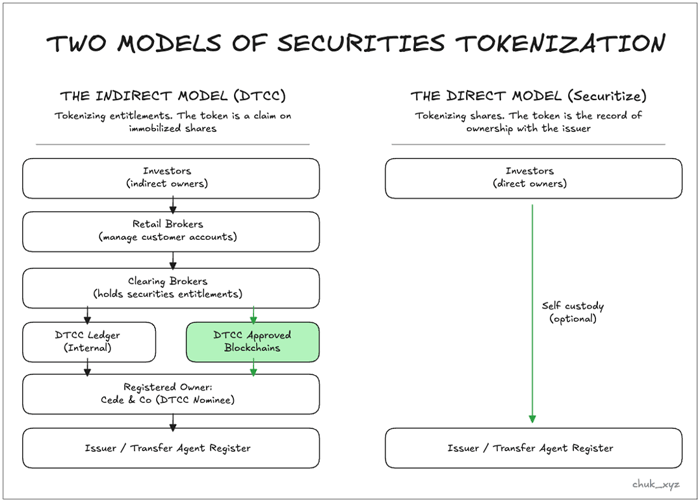
That’s because its tokenization solution doesn’t actually tokenize shares—it creates what’s called “security entitlements,” like a retail brokerage account. Those tickers on your screen aren’t actual shares; they’re legal claims on the stock.
What Computershare and Securitize are doing is issuing the equity as a token—no DTCC custody required.
To give you an idea, look at the graphic below. Notice the layers of friction on the left versus the Securitize model on the right.
Source: LinkedIn
Issuers can issue a token that is the record of ownership. And investors can self-custody those shares.
Here’s why that’s important to note…
In a letter written to the SEC, Securitize touched on a topic called composability.
Composability is a five-dollar word that blockchain professionals use to explain something simple— that two components can fit together like LEGO blocks. Meaning the token itself can operate throughout various protocols onchain without being altered.
It’s a word that means less friction.
And in the letter, Securitize CEO Carlos Domingo stated, “Natively tokenized securities can be used to facilitate de-fi use cases, such as on-chain trading, lend/borrow pools and other collateral use-cases within whitelisted ecosystems.” And here’s the important piece… “The notion that requiring a tokenized security to have a permissionless construct to effectively integrate within de-fi ecosystems is simply a misnomer.”
That last piece is the important one. It’s a theme we’ve been tracking in Permissionless Investor. These are projects that are permissionless while also enabling whitelisting solutions.
Translation: Onchain finance isn’t theoretical—it’s already in production.
In fact, our March recommendation was a protocol that allows for whitelisting solutions that just began working alongside some of Securitize’s partners…
But getting back to the SEC letter.
Domingo is tipping his hand with the ISTs—he intends for them to interact with the broader decentralized finance (DeFi) ecosystem.
He signals this further when discussing compliant trading via an “RFQ option.”
RFQ stands for request for quotation. It’s a system that’s in use for another asset that Securitize brought onchain, BlackRock’s onchain money market fund BUIDL.
BUIDL investors can use UniswapX’s RFQ framework to allow whitelisted participants to swap.
Securitize’s end goal is clear: move these assets onto public blockchains and into DeFi at large.
They have the infrastructure working and the clients to vouch that it works.
And now they just got the ability to bring 25,000 stocks onchain via the deal with Computershare.
The announcement offered no timeline. We anticipate the official green light is coming with the passage of the CLARITY Act.
The bill is set to lay the framework for digital assets to operate in a compliant manner in the United States. It’s currently in the Senate Banking Committee awaiting markup. And Senator Tillis has just stated he looks to move it to markup in May.
This means as early as the week of May 11 we could see CLARITY Act moving to the Senate floor for a final vote. And if CLARITY Act moves out of committee, we should anticipate the president signing the bill into law around the start of summer.
That’s how close we are to the tokenization trend accelerating beyond what we’re already seeing.
I’m sure we’re bound to hear a lot more news in the coming weeks.
Stay tuned…
Your Pulse on Crypto,
Ben Lilly
Editor, Chain of Thought
Add Brownstone Research as your preferred source on Google to see our latest stories in your feed.
 Add as a preferred source
Read the latest insights from the world of high technology.
If Apollo is right, a bank run is coming. But it won’t be the panicked, lines-around-the-block variety...

The old guard is competing to build the new gatekeeper that the market uses … and the result will...

Blockchains are infrastructure built for machines. And now the machines are here.