




Why the Fed Might Actually End
The dream of every central bank critic could be coming true – we might actually end the Fed.



While it may take several weeks to play out, make no mistake: sentiment is shifting

Regime changes are messy…
They conjure up images of foreign intervention, internal upheaval, and even violent protests.
It’s no different in the markets.
With enough time, market regimes (bullish or bearish) begin to feel permanent. Every previous crypto winter felt like it would never end. And every bull cycle felt as if it would go on forever.
And it was the pivot points—the regime changes—where a lot of money could be made…or lost.
And right now…Bitcoin is going through its own regime change.
It won’t be as dramatic as a political regime change. There will still be many vocally opposing the view. And the shift won’t be smooth.
But make no mistake. You should be bullish on Bitcoin right now.
And here’s why…
On April 13 in What The Market Is Waiting For, we touched on recent developments taking place in the market.
We suggested fundamentals for digital assets were strong even as token prices languished.
This included things like Ethereum daily transactions hitting all-time highs. The NYSE and Nasdaq moving closer to 24/7/365 markets. New asset classes coming onchain like stocks, ETFs, commodities, private credit funds, and more were hitting record highs.
At the end of the update, we said despite all the progress happening in the industry, prices remained depressed. But for that to change, we would need to see two things.
First, high-yielding credit in the traditional markets would need to calm down. They were starting to spike as geopolitical tensions rose.
They’ve since begun to normalize as seen in the green box below.
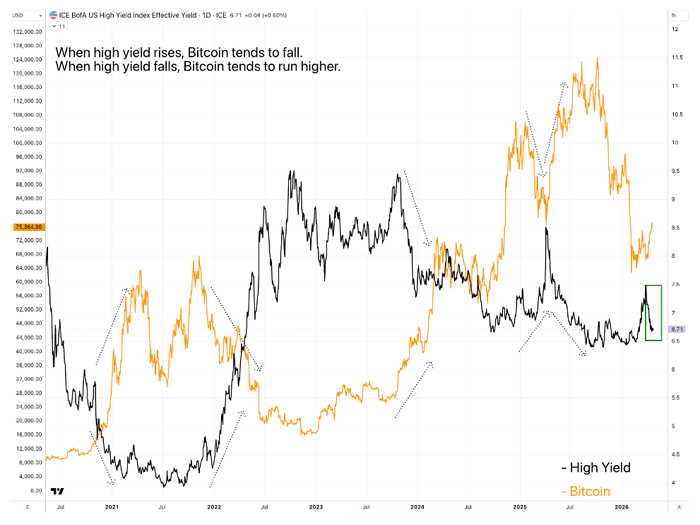
The price of Bitcoin has trended higher as this normalization plays out.
The second thing we were keeping an eye on is the 100-day moving average. We said if price can rise above this moving average, then any momentum would be easier to sustain.
Well, guess what just happened?
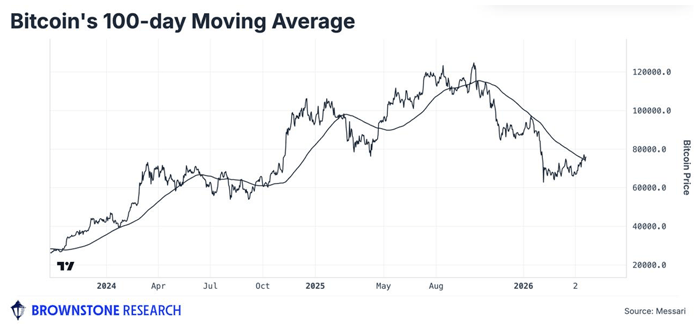
We find ourselves above that 100-day moving average for the first time since last summer.
This is all happening despite the ongoing geopolitical issues.
But let’s not forget, regime changes can be volatile.
We have various internal models we track to know whether a certain token is in a “bullish” or “bearish” regime.
Bitcoin is no exception.
A full explanation of the model is beyond the scope of this letter. But suffice it to say that it tracks traditional macro indicators alongside price action to determine if Bitcoin is in a “bullish” or “bearish” regime.
The last time a Bitcoin regime changed from bearish to bullish was 2024. But it wasn’t smooth sailing. We oscillated back and forth for a period before price, and the overall market, took off higher.
The bearish regime is shown in the red area with the bullish regime in green. We can see there were a few transitions before price went from sub-$60,000 to more than $100,000 in a span of a few weeks.
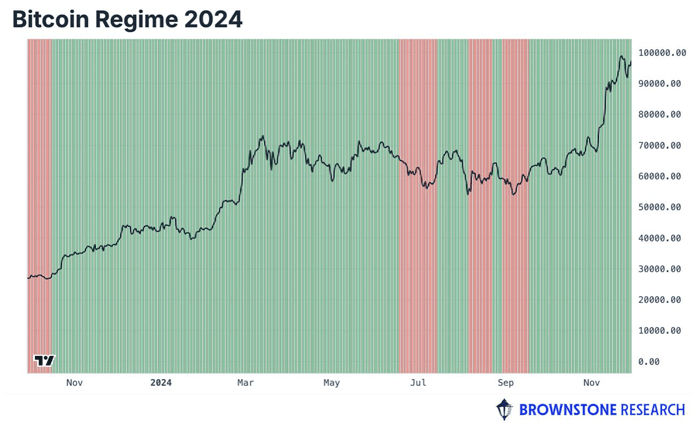
Today we’re witnessing another regime change.
The main difference now is we’re coming off a very lengthy bearish period—186 days to be exact.
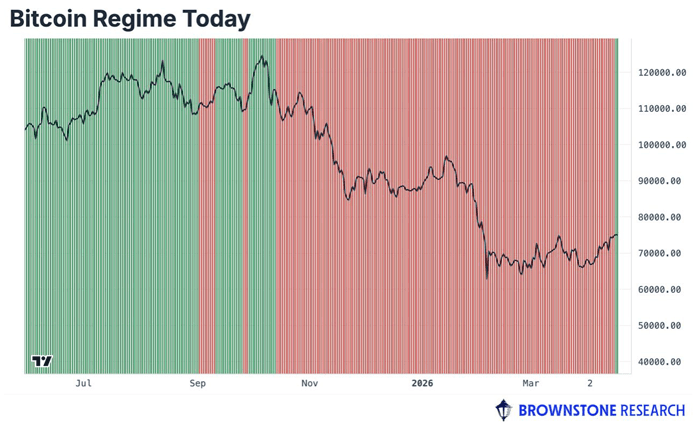
This is the longest bearish regime in history per our model. The next two longest periods were September 2018 to February 2019 — 163 days. Bitcoin rose more than 250% over the next four months.
The next bear was April 2022 to September 2022 — 150 days. Seven months later, price was up more than 40% to $30,000… before going on to climb above $100,000 the following year.
These two regime shifts looked different.
Once the 2018-2019 bearish regime ended, there were 177 days of bullishness ahead.
But for 2022, the regime flipped back and forth for four months.
Which is why, despite our model saying Bitcoin is now in a bullish regime, we need to be prepared for volatility.
The market might go back and forth a bit for the coming weeks until the new regime is firmly entrenched.
Geopolitical issues—which will affect investor sentiment— do not look to be subsiding anytime soon. This is not the time to go all-in.
But investors could consider gaining exposure if they haven’t already. If this bullish regime holds, we should also prepare for a surge in small-capitalization tokens. After all, as Bitcoin goes, so goes the market.
But there is another reason why a strong market surge—rather than a choppy few months—could be in the cards.
Onchain fundamentals are improving: transaction counts are rising, legacy finance is adopting public blockchain technology, and new assets are coming onchain daily.
These trends show no signs of slowing.
And what’s more…
The flow of dollars moving into BTC and ETH exchange-traded funds (ETFs) is on the rise.
The chart below shows the amount of dollars moving into Bitcoin ETFs (in blue). This is tracked against the price of the asset itself (in red). The daily flow values have been smoothed to allow us to see the overall trend. And that trend of late has been inflows.
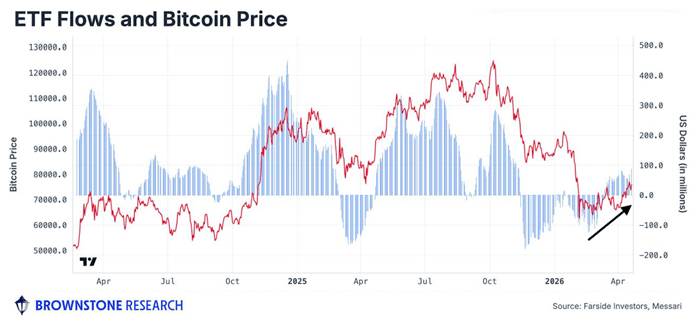
And as flows rise, price tends to follow. This acts as a tailwind to price as Bitcoin enters a bullish regime.
But here’s where things get more interesting…
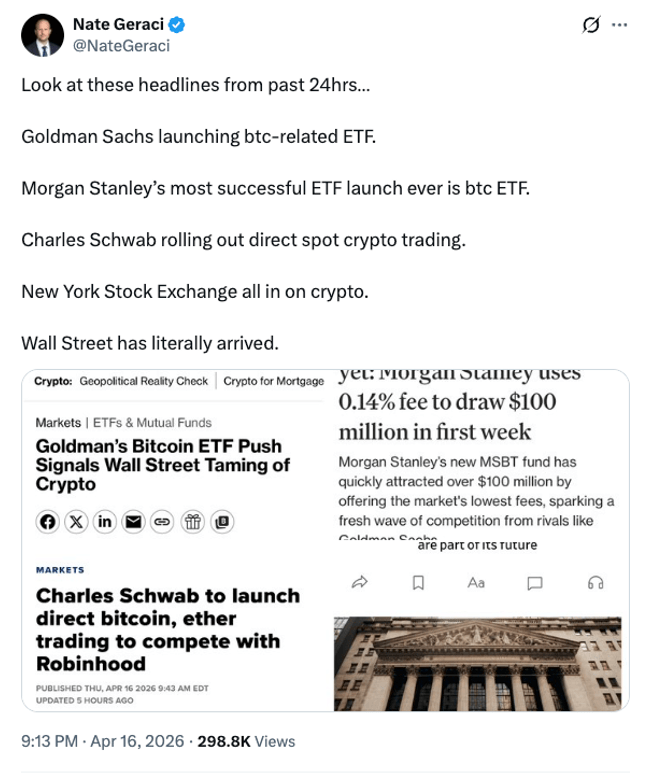
As Nate Geraci of NovaDius Wealth Management showcased on X.com last week, Wall Street and digital asset headlines within a 24-hour period were striking.
Goldman Sachs, Morgan Stanley, Charles Schwab, and the NYSE were all announcing a new ETF, direct spot crypto trading, or marking their future in digital assets.
Source: x.com/NateGeraci
It’s no coincidence.
For the first time in 186 days, the Bitcoin market has gotten bullish. Price has risen above its 100-day moving average. Institutions are seeing positive inflows. And Wall Street is making headlines with its newest offerings.
This is partly why the CLARITY Act—which intends to lay out a framework for digital assets—might not matter as much.
As Jeff and I laid out to subscribers of our crypto trading service, Neural Net Profits, over a week ago:
Negotiations around the CLARITY Act might not matter as much anymore.
The Securities and Exchange Commission (SEC) and Commodity Futures Trading Commission (CFTC) have been busy rolling out guidance for the industry.
In a collaborative effort, the two put together a token taxonomy. It breaks down five distinct categories of tokens, with only one of those categories pertaining to securities law.
The SEC has been issuing no-action letters and approvals in recent months for entities like the DTCC, Nasdaq, and New York Stock Exchange, which act as the plumbing to trade trillions of dollars of market value.
There was also a decision that granted certain decentralized front ends (a decentralized app — dApp) regulatory exemption, which has been a contested issue for many years. And part of the CLARITY Act language is pending.
Which is all to say, regulators have been making tangible progress on certain line items that sit in the CLARITY Act.
So even though the CLARITY Act waits for the Senate Banking Committee’s markup, we sense that the market is no longer waiting around for its passage as much as it was before. The industry is already receiving clarity on key issues and has much stronger confidence to move forward.
We’re witnessing a regime change.
And while it may take several weeks to play out, make no mistake: sentiment is shifting.
We’ll track the Bitcoin regime and the broader market in future updates.
Until then…
Your Pulse on Crypto,
Ben Lilly
Editor, Chain of Thought
Add Brownstone Research as your preferred source on Google to see our latest stories in your feed.
 Add as a preferred source
Read the latest insights from the world of high technology.
The dream of every central bank critic could be coming true – we might actually end the Fed.

JPMorgan can keep both pieces of infrastructure as long as it likes. But customers will decide where to do...

The bank realizes it needs to compete in the future of finance, and it’s one where agents roam freely...