


Crypto’s Point of No Return
Get these assets so entrenched, so dug in, that no future administration can rip them out without creating systemic...



It’s enough to get investors excited…with a few caveats.

A token just ran 286% in 20 hours earlier this week.
It’s a project you’ve likely never heard of… OSMO.
It’s the native token of the decentralized exchange (DEX) Osmosis, a popular project and exchange when it first came out in 2021.
Osmosis was popular because it did something most DEXs couldn’t (and many still can’t) accomplish. It allowed users to swap assets cross-chain.
The solution lets users move an asset sitting on one chain and swap it for an asset from another chain. And it does so seamlessly.
It would be like taking a token minted on Solana and trading it for a token minted on Ethereum. This is done without a derivative, without a “wrapped” version, and without a centralized exchange.
This seamless, elegant trading solution is what makes Osmosis an incredible project even to this day. But you probably wouldn’t know that by looking at a long-term chart of OSMO.
From a high of around $10.70 per token in January 2022, OSMO cratered. As recently as last week, one token could be had for about $0.03. But as mentioned above, the token recently caught a bit, climbing nearly 300% in less than a day.
And after doing a deep dive into the project, it looks like something big could be shaping up.
It’s enough to get investors excited…with a few caveats.
Back in March, there was a heated discussion in the governance forum of a blockchain network called Cosmos.
The topic: Cosmos was considering acquiring Osmosis.
For those unfamiliar, Cosmos is arguably one of the most innovative public blockchain ecosystems.
The promise of Cosmos was simple. It gives any application or project the ability to spin up its own blockchain and not be subject to whatever the chain you are residing upon prioritizes. This would be like a smartphone app not being subject to changes in Apple’s UI designs. It can simply exist on its own.
This gave each project and chain its own sovereignty.
But the real breakthrough for Cosmos was something called IBC or the “Inter-Blockchain Communication Protocol”. It was a solution that allowed any chain in the Cosmos ecosystem to easily communicate with one another.
The project came about in 2019. At the time, moving assets from one chain to another was not possible. There were no bridges, cross-chain swaps, or anything of the sort. Blockchains back then were like silos, operating independently.
Cosmos was focused on changing that and allowing assets to move freely across the ecosystem.
But Cosmos lacked something that still hinders its progress to this day…
If various applications and projects can spin up their own chain independent of the main Cosmos chain, called Cosmos Hub—how does the Hub accrue value?
It’s a critical question — the entire ecosystem’s success depends on the Hub’s success. That’s what makes Osmosis noteworthy. It is a chain in the Cosmos ecosystem, but it never suffered the same existential issue.
That’s because the exchange saw more than $100 million of volume per day back in early 2022. It rose to more than $3 billion in market capitalization at the time. And its value proposition was straightforward…
If you are a Cosmos chain, your assets can swap with all the other assets using Osmosis. It’s almost as if Osmosis was doing what the Cosmos Hub should have been doing all along. And Osmosis is still doing several million dollars’ worth of volume each day. This translates to seven figures in fees collected each year.
Said differently…
The protocol still has users. It’s functioning as intended. And it still has capital flowing through its system. It’s not a worthless project.
The project would also give Cosmos something it sorely lacks: fees.
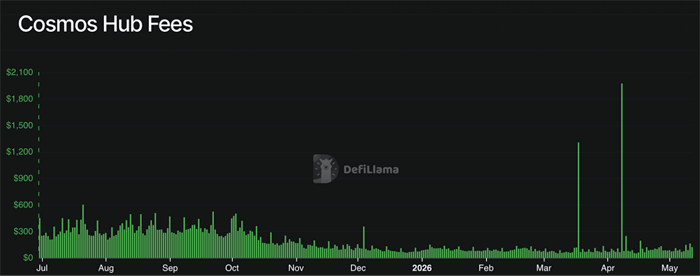
Lately, Cosmos is seeing about $100 in fees daily. Meanwhile, Osmosis is doing about $4,000 to $15,000 in fees per day in 2026.
That’s a 40 to 150x jump in fee capture.
Acquiring Osmosis could solve the Cosmos chain’s value accrual problem that’s plagued it since day one.
That’s why the community brought the acquisition plan to a vote. They called it COSMOSIS.
The original plan was brought to the public on March 11 of this year.
After more than a month of discussion, 50.37% of the community voted “no.”
The result surprised many.
After all, Osmosis generates far more value than the Cosmos chain. Acquiring the project would have been possible just based upon the tokens held by a community pool, plus some fees for a short period post-acquisition.
On the surface, it felt like a no-brainer.
But voters of “no” seemed to disagree. Issues with conversion rate fairness, philosophical objections, and technical execution risk were some of the factors that kept some parties on the sidelines.
But then…
In the following days, some “no” voters changed their minds. Based on recent comments, a revised integration path may be in the works.
That’s likely why OSMO is rallying right now. The acquisition could be back on track.
If that’s the case, then the main Hub of the Cosmos ecosystem could finally get what it’s been after for years—sustainable value accrual.
With such depressed prices across the cryptocurrency market, a deal like this could be a shot in the arm for digital asset prices in the Cosmos ecosystem.
That’s the optimistic view.
But a word of caution…
M&A may be commonplace in traditional markets. But crypto markets have had a difficult run with these types of deals.
The biggest one was the Artificial Superintelligence Alliance. It merged multiple tokens (FET, AGIX, OCEAN) into one—ASI.
The short-term impact was strong. All three tokens were up double-digit percentages on the news. But just over a year later, ASI’s market cap was around $2 billion, down about 78% from the peak.
Mergers and acquisitions require substantial coordination, technical integrations, and sound communication to work successfully. That hasn’t always been this industry’s strong suit. And it’s a big reason why the COSMOSIS deal should be approached cautiously.
Based on the Hub’s history, value accrual has not been a main priority since it first launched in 2019. Maybe that can change, but it’s not a small pivot. It’s a major change of mindset.
Stronger opportunities exist elsewhere. I’m particularly excited about decentralized finance projects bringing real-world assets on-chain and those sitting at the nexus of AI and crypto.
So, we’ll hope for the best with COSMOSIS. But for investors looking for upside, I’d recommend steering clear.
More on that next time…
Your Pulse on Crypto,
Ben Lilly
Editor, Chain of Thought
Add Brownstone Research as your preferred source on Google to see our latest stories in your feed.
 Add as a preferred source
Read the latest insights from the world of high technology.
Get these assets so entrenched, so dug in, that no future administration can rip them out without creating systemic...

There’s plenty of blame to go around, and I’m more than happy to name names.